A Catholic website refutes the two-rock argument against the primacy of the Roman Catholic church (derived from the primacy of the apostle Peter), the subject of my previous post.
Let’s call this the “little rock, big rock” theory. It claims that Peter is a little rock and his declaration (Jesus is the Christ) is the foundation of the Church. The Greek text of the passage says “You are Peter (Petros) and upon this rock (petra) I will build my Church.”(Mat 16:18-20). In modern Greek, the name Peter Petros means “small stone” and Petra means “stone.” The theory proposes that Peter was only a little pebble and unimportant, while the big rock was the “declaration” of several verses earlier, that Jesus was the Christ.
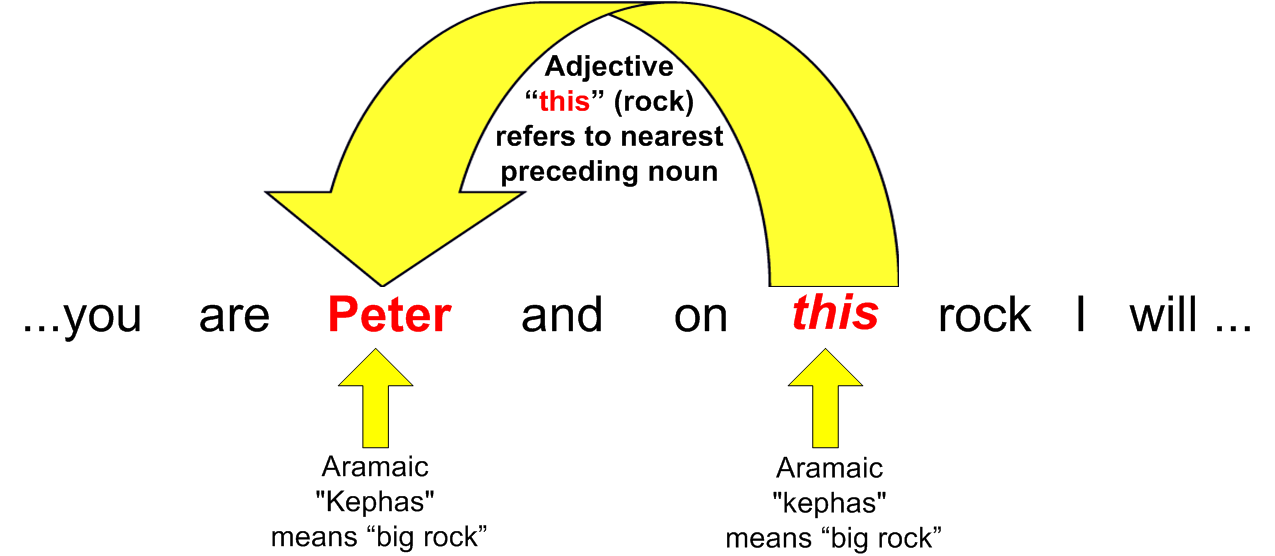
OK, I’m going to get a little “heady” here by talking about Aramaic, and ancient Greek. The Greek text is a translation of Jesus’ words, which were actually spoken in Aramaic. Aramaic only had one word for rock, kephas (which is why Peter is often called Cephas in the Bible). The word Kephas in Aramaic means “huge rock.” The Aramaic word for “little stone” is “evna,” and Peter was not called “Evna” or “Envas” or anything like that. In Aramaic, Jesus said “You are Peter (Kephas) and upon this rock (kephas) I will build my Church.” The metaphor worked well in Aramaic where nouns are neither feminine or masculine, but in Greek, the noun “rock” was feminine, and therefore unsuitable as a name for Peter. So the Aramaic word Kephas was translated to the masculine name Petros when it referred to Peter, and to the feminine noun petra when it referred to the rock. In ancient Koine Greek, petra and petros were total synonyms, unlike modern Attic Greek and unlike Ionic Greek which was about 400 year before Christ.
In Evangelical circles, the “little rock, big rock” theory is fairly recent. Nearly every Protestant commentary written in the last 50 years interprets Peter as the rock upon which the Church was built. (However, they didn’t believe that Peter had a successor, more about that here ). The scholarly Evangelical work, Carson’s “Expositors Bible Commentary” explains this well. It is in the section on Matthew 16. These Evangelical scholars looked closely at the Greek word for rock “Petra” and determined that it refers to Peter. The early Christians also referred to Peter as the Rock. Some Quotes are here.
I recently spoke with a grammar specialist who is not Catholic. She explained to me that the adjective “this” grammatically must refer to the nearest preceding noun, which was Peter, not his declaration which occurs two verses earlier.
When Jesus says “whatever you bind” to Peter in Mat 16:18, the Greek text used for “you” is singular. In Mat 18:18 the Greek text, the word for “you” in “whatever you bind” is plural. Catholics think these two juxtaposed but similar phrases lay out the early structure of the Church with Peter as the Pope and the other apostles as priests.
Some of the Church fathers do speak of Christ or of Peter’s confession as “the Rock” of Matt 16:18, ALL of these SAME Church fathers ALSO speak of Peter himself as the Rock. In other words, the confession of Peter is in relation to Peter. It says something about him, and his faith. In this respect, it was not an either-or proposition for our ancient Christian forefathers, but a “both-and” proposition. Here are what the fathers (and some other scholars of the ancient Church) have to say.
The fathers –including ALL the Greek fathers –say that Peter himself is the Rock of Matt 16. They make no distinction between Peter himself and Peter’s confession; for any father who speaks of it as Peter’s confession is ALSO on record calling Peter himself the Rock. ……
….If we compare Matt 16:18-19 with Isaiah 22:20-24, which describes the appointment of the Prime Minister of the old Davidic Kingdom of Israel –the minister who could act with the King’s own authority in the King’s physical absence –we can see quite clearly that Peter himself is being made the Rock in Matt 16:18. And, again, this is what all of the Church fathers consistently say (even when they also speak of other things as the Rock). Catholics believe that Jesus had a very specific purpose in saying that Peter was the Rock upon which he would build his Church. He was evoking Isaiah 22:22.
Isaiah 22:15-24 Mat 16:18-19 22:15 (Shebna) you have cut out a tomb here for yourself … in the rock? …I will thrust you from your office….22:20 On that day I will call my servant Eliakim son of Hilkiah, 21 and will clothe him with your robe and bind your sash on him. I will commit your authority to his hand, and he shall be a father to the inhabitants of Jerusalem and to the house of Judah. 22 I will place on his shoulder the key of the house of David; he shall open, and no one shall shut; he shall shut, and no one shall open. 23 I will fasten him like a peg in a secure place, and he will become a throne of honor to his ancestral house. 24 And they will hang on him the whole weight of his ancestral house, the offspring and issue, every small vessel, from the cups to all the flagons. …you are Peter and upon this rock I will build my Church; and the gates of hell shall not prevail against it. And I will give you the keys of the kingdom of Heaven, and whatever you bind on earth will be bound in Heaven and whatever you loose on earth will be loosed in heaven. In the Isaiah passage, Shebna was the Chancellor (like a Prime Minister) under King Hezekiah. This Prime Minister had a special role above the cabinet. He got the keys to the kingdom. Shabna messed up and was unfaithful so God appointed Eliakim to Prime Minister and gave him the keys. In Mat 16:18, Peter got the keys just the way Eliakim got them in Isaiah 22:15-24.
When Jesus says “whatever you bind” to Peter in Mat 16:18, the Greek text used for “you” is singular. In Mat 18:18 the Greek text, the word for “you” in “whatever you bind” is plural. Catholics think these two juxtaposed but similar phrases lay out the early structure of the Church with Peter as the Pope and the other apostles as priests.”
My Comment:
Even if Peter is being referred to as a rock in Matthew 16 (which is highly contestable), it is still a long journey from there to the primacy (in juridical terms) of the Roman church; and from there, to the primacy of the Pope,;and from there, to the infallibility of the pope and the impossibility of salvation outside the Roman Catholic church.
Thus, in “The Specific Functions of the Church in the World,” (Wisconsin Lutheran Seminary) Harold Eckert writes:
Rome’s rule for explaining the Scriptures and determining doctrine is the Creed of Pius IV. This Creed binds Rome to explain the Scriptures only according to the unanimous consent of the Fathers. In the year 1870 when the Fathers gathered and the pope declared his infallibility, the cardinals were not in agreement on Matthew 16, 18. They had five different interpretations. Seventeen insisted, Peter is the rock. Sixteen held that Christ is the rock. Eight were emphatic that the whole apostolic college is the rock. Forty-four said, Peter’s faith is the rock, The remainder looked upon the whole body of believers as the rock. — And yet Rome taught and still teaches that Peter is the rock.”
Eckert then attacks what he calls the “anti-Christ” principle which animates such claims to pre-eminence and authority:
And if we ever bear in mind what the Church is, that it is the body of believers in in Christ Jesus, known only to God, we shall not confuse the Church Invisible with visible church organizations. We shall not be drawn into the circle of those who today aim at world prominence and world dominion, holding world conventions for world movements, not on the basis of sound doctrine but by compromising doctrine, all in the name of the Church, and think that we actually are building the Church on earth thereby, and are the Church at work.
The Church is not built by such conventions, such unions. Anti-Christ movements are the result of such action. And such who attempt to make it a matter of conscience unto us for not participating in such movements will fail in their efforts, if we remain clear on the Church. Neither will anyone be able to do to us what Grabau did with the consciences of the Lutherans in Perry Co., Mo., and the pope did to Luther for a time, if we but cling to the truth of what the Church is. The last chain that fettered the papacy was the pope’s false teaching that Rome is the Church. Luther for a time thought that his salvation was dependent upon the Roman Catholic Church to this degree, that it was the Church, and to be saved he, therefore, had to remain in it or attached to it. Once he, however, learned that the Church is not Rome, but a spiritual house, the body of believers, the chain was broken and he was free, completely free from Rome in the eternal truth: “Therefore, we conclude that a man is justified by faith without the deeds of the law.” And Grabau had the Lutherans in Perry. Co., Mo., all upset with his false teaching of the Church, namely, that the Church is a “visible aggregate composed of ministers, whose function was to instruct their parishioners and direct all church affairs, and laymen, whose duty it was to hear and obey.” Once the Lord through His servant Walther taught these people, the believers in Christ Jesus, the Son of the living God, are the Church, and that the Church is not only in a Grabau organization, but also in congregations organi zed individually, because believers are there, were they in doubt
any longer about their status as Church.—Yes, let us remain clear on the matter of the Church.Next to the doctrine of justification, the doctrine of the Churchis of utmost importance. The confusion in Lutheran Church circles today and the wild union efforts on the part of some in many instances without a doubt is to be attributed to a wrong conception of the Church. ALutheran ecclesiastical empire is no more the Church than the Roman See. To build a Lutheran ecclesiastical empire, and at the expense of sound doctrine, is not building the Church. We Lutherans, who by God’s grace still have the Word in its truth and purity, and know the Bible only as that which it is (The Bible is the Word of God), are not here to compromise the Word and build an ecclesiastical empire, but to remain steadfast and true to the Word, and to bring it to< others in its truth and purity. If doing that great and glorious work has lost its greatness and glamour for us, and ecclesiastical empires mean more to us than every last word of Holy Writ then we as organizations are fast moving into the circle of anti-christian organizations, and should take particular note of what true discipleship of Christ consists. “If ye continue in my word, then are ye my disciples indeed, and ye shall know the truth, and the truth shall make you free.”
Intersting thread. I was going to copy and paste a quote and comment upon it… but some do-hicky pop-up thingie stops me.
It’s a spell-check killer too, but,… IP away.
Hi-Ho. Hi-ho.