The Axis of Neocolonialism
By Prakash Dhomal 10/02/2003 At 16:08
This essay argues that intellectual svaraj (self-rule) is as fundamental to the long term success of a civilization as is svaraj in the political and financial areas. Therefore, it is important to ask: whose way of representing knowledge will be in control? It is the representation system that defines the metaphors and terminology, interprets what they mean in various situations, influences what issues are selected to focus on, and, most importantly, grants privileges by determining who is to control this marketplace of ideas.
As an implicit body of standards, a representation system disguises a meta-ideology – the substratum of contexts on which specific ideologies emerge and interact. It includes the language used and the unstated frames of reference, and acts as the subliminal filter through which positions are constructed and their fate negotiated.
A people without their own representation system, in a worst case scenario, get reduced to being intellectual consumers looking up to the dominant culture. In the best case scenario, they could become intellectual producers, but only within the representation system as defined and controlled by the dominant culture, such as has happened recently with many Indian writers in English.
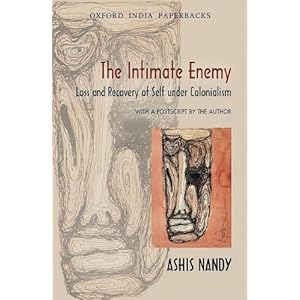
Ashis Nandy summarizes how this mental colonialism was brought about:
“This colonialism colonises minds in addition to bodies and it releases forces within colonized societies to alter their cultural priorities once and for all…. Particularly, once the British rulers and the exposed sections of Indians internalized the colonial role definitions….the battle for the minds of men was to a great extent won by the Raj.”[ii]
The repetitious use of a given representation system eventually leads to a widely accepted set of “essences,” as stated by Friedrich Nietzsche:
“The reputation, name, and appearance, the usual measure and weight of a thing, what it counts for — originally almost always wrong and arbitrary — grows from generation unto generation, merely because people believe in it, until it gradually grows to be a part of the thing and turns into its very body. What at first was appearance becomes in the end, almost invariably, the essence and is effective as such.”
Therefore, control over the representation of knowledge is analogous to control over the operating system of computers: representation systems are to competing ideas what operating systems are to computer applications. Control over this platform, especially its invisible standards and rules, is of strategic consequence.
The structure of the essay is as follows:
(1) Explaining the origins of neocolonialism.
(2) Showing that many Indians are themselves perpetuating neocolonialism today.
(3) Linking this with Western control from above the glass ceiling.
PART 1: The Origins of Neocolonialism
Part 1 explains the origins and causes of neocolonialism in India today, resulting from the abandonment of its rich classical tradition, and replacement by knowledge representation systems imposed by the colonizers. Let us understand how the West got to control today’s knowledge representation systems.

The hallmark of a good education in an American liberal arts college is based on what is called the “Western Classics.” A study of Western Civilization starts with the study of ancient Greek and Semitic thought, before moving on to Classical Roman, modern European, and finally, American thought. Such an intellectual foundation is deemed important for one to be considered a well educated person in the humanities, regardless of one’s religious beliefs (or lack thereof), and regardless of one’s specific academic major……
….I find similar deep respect and dignity for the Western Classics at Princeton, Harvard, Columbia, University of Chicago, Yale, Oxford, Paris, and virtually every top Western university. The benefit is not only intended for those specializing in the Western Classics. The Western Classics are in the core curriculum of many colleges, regardless of specialization…….
Marginalization of Indian Classics in India’s Higher Education:
….Compare this to the tragic state of Indian Classics in India’s own higher education. The equivalent to the Greek Classics would be India’s Vedas, Puranas and other Sanskrit, Pali and Tamil texts. In a comparable education system, students would learn about Panini, Patanjali, Buddha, Nagarjuna, Dharmakirti, Bharthrhari, Shankara, Abhinavgupta, Bharata Muni, Gangesh, Kalidasa, Aryabhata and dozens of other great classical thinkers produced by India.
Unfortunately, in the name of progress, modernity, and political correctness, Indian Classics have been virtually banished from India’s higher education – a continuation of the policy on Indian education started by the famous Lord Macaulay over 150 years ago.. While India supplies information technology, biotechnology, corporate management, medical and other professionals to the most prestigious organizations of the world[iv], it is unable to supply world-class scholars in the disciplines of its own traditions.
The reason is that the nexus of Indology studies remains in Western universities, almost as though decolonization had never happened. The top rated academic journals and conferences on Indology and India related fields are in the West, run largely by Western scholars, and funded by Western private, church and governmental interests. The best research libraries in the Indian Classics are in the West. Religious Studies is the hottest academic field in the humanities in the US, and is growing at a very fast rate, but is non-existent as a discipline in Indian universities.
Therefore, to get an internationally competitive PhD in Sanskrit, Indian Classics, Hinduism, Buddhism, or Jainism Studies, with the highest rigor in methods and theory, such that one may get an academic job in this specialty in a leading international university, a student is forced to go to a US, UK or German university.
Hence, one cannot find qualified experts of Indian religions in India, in order to debate Western scholars. The few Indian scholars within the Western academy who are educated in the Indian Classics, are either below the glass ceiling, or else are politically cautious given the risks to their career ambitions.
Furthermore, the marginalization of India’s heritage in its education system, particularly in the English medium system that produces most of the leaders of modern Indian society, has resulted in the leaders of industry, civil service, media and education becoming a culturally lost generation. The result is today’s self-alienated, cynical youth prevalent in many places, especially in elite positions.[v]
The justification given for the study of Greek Classics in the West is not that they are considered 100% “true” today (whatever that might mean), or that better thought has not superceded them. Rather, the purpose is to understand the history of the Western mind, so that students may lay a sound and strong foundation for their thinking in order to move this civilization further into the future. The Western Classics provide the Western intellectual with the resources to be a serious thinker for today.
It is also about the identity of Westerners and their culture. Great emphasis is placed on the integrity of an old “Western Civilization” traced back to Greece (although the massive inputs received from non-Western sources are carefully suppressed – see Part 3). This (re)construction of Western Civilization is an ongoing project, and is considered very critical for the survival and prosperity of what is known as the “West”.
One should apply this logic to Classical Indian thought and see parallel benefits for India’s renaissance. Unfortunately, a great disservice has been done to Indian Classics by equating them with religion. Arguably, the most comprehensive and challenging knowledge representation systems available outside the West are contained in the Indian Classics. The sheer magnitude of India’s Classics is over one hundred times as large as that of the Greek Classics. For a brief glimpse into some of the potentials based on the recovery of Indian Classics, see the web site for an academic Colloquium on this very subject.[vi]
Yet, whatever little is taught about Indian Classics tends to suffer from its ghetto like positioning as “South Asian,” whereas Greek thought is positioned as being “universal.” The dominant (European) culture, into which Greek thought became assimilated, claims to own the logos (the rational principle that governs and develops the universe), while non-Western peoples’ indigenous ideas are mythos and exotica. Greek Classics are taught in mainstream academia and are not relegated to a particular ethnicity or “area” of the world. Indian Classics, on the other hand, are considered relevant mainly as a way to understand what is unique (i.e. peculiar) about Indian ethnicity.
Furthermore, Greek thought is referenced as being of Greek origin, whereas, when Indian ideas are appropriated, their Indian origin is erased over time: real knowledge is implied to come only from Western sources; all others must wait till they get legitimized by being claimed as Western. This is because the knowledge representation system is under Western control, and hence they are the final arbiters of “what” belongs “where.” Only when something falls under Western control does it become legitimate.
Indic Traditions in the Western Academia:
Interestingly, Western academia hires many Indian scholars in the departments of English Literature, History, Philosophy, Sociology, and Political Science, amongst other humanities. However, while the Western audiences think of them as spokespersons for Indic Traditions, the vast majority of them are unwilling and unqualified to explain Indian Classics seriously. But their Western hosts and colleagues are usually unaware of this shortcoming in most Indian scholars. For this deficiency to become public about an Indian scholar is tantamount to a minor scandal, because they derive much of their clout based on the false perception that they are representatives of Indic thought.
To cover up their ignorance, many elitist Indians resort to a combination of Eurocentric and Marxist rhetoric about Indian civilization – the caste, cows and curry theory of India. They quote Orientalist accounts of India and even base their own scholarship as extensions and derivatives of colonial writings superimposed with Marxism. On the one hand, postcolonial studies are at the very heart of their specialization and career paths. But on the other hand, they are only trained in using Eurocentric hermeneutics and methods. Hence, they can deconstruct Eurocentrism with Western methods, but are completely inept at applying Indic categories and perspectives. They cannot replace the Eurocentric representation model with anything indigenous from India. Postcolonial studies often end up as Orientalism by the neocolonized.
Contrast this with Arab scholars, such as Edward Said and Abu-Lughod, who have led the deconstruction of Eurocentrism, not only generically but also specifically on behalf of Islamic and Arab civilizations.

Consequently, it is now becoming fashionable to replace Eurocentric history textbooks with accounts centered around the Middle East, going back to the Middle Ages. Likewise, Nell Painter is amongst the leading critics of Eurocentrism on behalf of Africans. Enrique Dussel is amongst many prominent Latin Americans attacking Eurocentric models.
However, in the case of a specifically Indic deconstruction of Eurocentrism, some of the finest academic challenge is often being delivered by Westerners, such has Ronald Inden and Nicholas Dirks. Many Indian scholars who are entrenched in the Western academe of humanities seem reluctant to risk their loyalty ratings, and in many cases, are simply too ignorant of their own heritage and invested in attacking this heritage.
While pockets of such Indic challenges to Eurocentrism do exist, they are not empowered to revolutionize the fields of religion, history, sociology, anthropology, women’s studies, Asian Studies, literature and art. They occasionally get their symbolic ‘day in court,’ but it is usually not the center court, where it really matters.[vii]
Indian Secularism Vs. American Secularism:
One serious misunderstanding amongst this milieu of elitist Indians has been their confused interpretation of secularism. The USA is a good nation with which to compare India in matters of secularism. It does not define secularism as alienation from its traditions. Even though tracing back American civilization to the Greeks is a big stretch, this link and continuity is emphasized. Certainly, the Judeo-Christian foundation of Americanism is made loud and clear. Recently, there is a new movement to rediscover the Native American heritage as being part of the New Americanism. On the other hand, secularism in India has come to mean anti Indic Traditions, especially anti-Hinduism.
To get certified that they are secular, many Indians line up to prove how they hate Hinduism, or at least how distant they are from what they perceive as a denigrated identity. The historian, Ronald Inden explains the root cause of this dis-ease:
“Nehru’s India was supposed to be committed to ‘secularism’. The idea here in its weaker publicly reiterated form was that the government would not interfere in ‘personal’ religious matters and would create circumstances in which people of all religions could live in harmony. The idea in its stronger, unofficiallv stated form was that in order to modernize, India would have to set aside centuries of traditional religious ignorance and superstition and eventually eliminate Hinduism and Islam from people’s lives altogether. After Independence, governments implemented secularism mostly by refusing to recognize the religious pasts of Indian nationalism, whether Hindu or Muslim, and at the same time (inconsistently) by retaining Muslim ‘personal law’.”[viii]
This agenda, built on a false definition of secularism, has been taken to such extremes that Sanskrit has been demonized, because it is seen as part of the Evil Brahmin Conspiracy to oppress all the victims of contemporary Indian society. Jawaharlal Nehru University, one of India’s elite institutions in the liberal arts, and the seminary that produces many of these maladjusted intellectuals, has fought hard to resist the establishment of a Sanskrit and Indian Classics department, whereas it is proud of its faculty and curriculum in a wide variety of European languages and civilizations.[ix]
This is the result of sheer ignorance about the scope and value of Sanskrit literature. Indologists believe that there are over 30 million distinct manuscripts in Sanskrit, mostly not cataloged, with less than one percent ever translated into a non Indian language. The vast majority of Sanskrit texts is not about “religion,” and covers a diverse territory of subjects – medicine, botany, aesthetics, fiction, jokes, sex, political thought, logic, mathematics, and so forth.

Sanskrit was the language of scholarship for a period of several millennia, in the same manner as English has become over the past century. To demonize and suppress this language and its vast literature, in the name of political correctness, is a tragedy against all humanity. Yet this is precisely what has been done for 50 years after India’s independence.[x]
The Hegemony of Language:
One result of all this has been that the colonial mistranslations of Sanskrit words have now become accepted by the majority of Indians educated in the English language, not only the scholars but also the leaders of India’s media, higher education, industry and administrative services.
Indic Traditions now have the added burden to legitimize themselves in terms defined by its former colonizers’ culture, i.e., using a Eurocentric frame of reference. Nietzsche’s prophecy quoted in the opening section of this essay has come true. By controlling their language, one can subjugate a people.
The richness of the meaning of a word is often very deeply embedded in the cultural context, in the history of how that word evolved over time, and in the wide contextual bandwidth of nuances and implied meanings that accompany its usage. To understand all the nuances of a word, then, is to understand the host culture. And to understand a complex culture is to live it and be it. This is why great harm is done when a foreign culture, especially a colonial one, imposes its own simplistic translations of Sanskrit.
Even greater is the harm when the natives of a colonized culture adopt these foreign translations – a process that is often gradual and subtle, and achieved with rewards of upward mobility offered by the dominant culture.
When a word with contextually determined meanings is reduced to merely one of its many meanings, it is like assigning a specific constant value to an algebraic variable, and thereby eliminating its usefulness as a variable. If someone translates “cuisine = McDonalds,” or “x = 5” when x is defined to be any real number between 0 and 10, then the reduction is a violence to the thing being represented.
Following are some examples of common reductions of Indic culture, where the contextual meaning is lost, and a simple and fixed meaning is imposed, so as to map it to the Eurocentric framework.
For openers, Ishwar is not God. Of course, both Hindus and Christians believe in one Supreme Reality, but the conception of each one is rather different. While Hindus celebrate the multiplicity of conceptions (as internal pluralism), the Abrahamic religions demand mono-conception (which they equate with monotheism). Ishvara has countless forms in which he is manifested inside the cosmos affording an individual access via his/her personal choice of form. But God is said to get very pissed off at “graven images” of Him, according to Abrahamic religions.
The Abrahamic Supreme Being is a male, angry and jealous God, with pathological notions such as Eternal Damnation that drive people into terrible obsessions in order to get “saved.” The Abrahamic God intervenes in history very rarely, and hence ends up privileging some tribe or community exclusively over all others.
If “Ishvara = God” were to be valid, then it would have to be an equality in both directions. Lets take the mapping “God à Ishvara.” This would mean that Jesus would be son of Ishvara. But Ishvara does not have such a son, and in order to preserve the integrity of the Indic narrative about Ishvara, we would have to say that Jesus is an Avatara of Ishvara. However, this is unacceptable to the Church, as it would mean the relativization of Jesus as one of many Avataras, and hence, would remove the need for a Hindu to convert to Christianity. Hindus would simply be able to say, “No, thank you. We already have Jesus as an Avatar in our current system.”
Furthermore, where would Mary, as Jesus’ mother, and the Virgin Birth be accommodated in the Indic narratives about Ishvara? Also, God has an enemy (i.e. the Devil), requiring the mobilization of humanity against him. Where would God’s “other” be accommodated in the Indic system? While God has an enemy on whom all evil gets blamed, Ishvara includes both good and evil internally, and hence, there is nobody external comparable to the Devil.
When Christians talk about these “equalities,” they assume that their Christian myth is sustained intact with the Indic narratives being distorted to fit into the Christian frame of reference. But this would do great violence to the worldview and integrity of Indic Traditions, reducing them to an Indianized Christianity.
My point is not that a merger of Hindu and Christian worldviews and myths is impossible.[xi] In fact, I find such possibilities very interesting and promising to pursue. However, I emphasize that this cannot be a simplistic equation in the name of political correctness, as is often the case. It has major ramifications to the relative positioning of the faiths involved. This would have to be a large project, with scholars from both sides working as peers – a friendly merger negotiation, and not a hostile takeover.
Similarly, devas are not gods, and devis are not goddesses. Also, Agni deva is not fire, but is symbolized by it. Murtis are not idols.
Shiva is not destroyer, but more like transformer, moving beings upwards in the evolution of consciousness. This is why Shiva is conceptualized as the lord of dance, yoga, enlightenment, and mysticism. This upward evolution entails “dissolution” of the falsely constructed mental frame of reference (maya), and this dissolution is quite different from everyday “destruction.” Shiva’s transformation is a set of deconstruction processes similar to, but going further than, postmodern deconstructions.
Atman is not soul, because of reincarnation and because of atman’s identity with Brahman (whereas soul does not reincarnate, and “soul = God” is blasphemy in most Abrahamic religions’ interpretations). Moksha and nirvana are not Salvation, because the latter is an escape from Eternal Damnation into Heaven, concepts that are very Abrahamic.
Shakti is not energy, as energy is but one form of shakti. Akash is not the same as space or sky. Rasa is another term with no Western equivalent, and hence untranslatable except via a thick description.[xii]
Lingam is not the same as phallus, and has a complex spectrum of meanings. Tantra is not sex.
Prana is not breath. There are many levels of prana, including in the unmanifest levels. Physical breath is a correlate of prana, and hence a way to influence and regulate prana.
There is no Sanskrit word “Aryan” – a noun referring to a race or ethnicity. The Sanskrit word is “arya,” which is an adjective referring to a quality of nobility. What are popularly known as Buddhism’s Four Noble Truths are, in the Sanskrit version, called the four arya truths. But this term does not refer to any race, as was misinterpreted by 19th century German Indologists in order to construct an ancient “Aryan” heritage for themselves. Surely there is no race called “tennis champion” or “good singer” – but if Wimbledon were to become controlled by an ethnic group (to stretch the imagination), then in the 30th century they might define themselves as the Tennischamps race.…you have a picture of what happened in 19th century German Indology.
Kshatriya and brahmin are job descriptions, representing duties that roughly correspond to leadership in matters of state and religion, respectively – and hence serve as a built-in balance between socio-political affairs and spiritual quest. The British mistranslations of Sanskrit texts over-emphasized the other worldly aspects, to glorify the world negation amongst the Hindus, and to make it easy for Hindus to accept British rule. Therefore, Orientalist constructions did not focus on the kshatriya dharma, as that is very world engaging and affirming. The British construction of “Brahminism” was to position themselves as masters in charge of India’s progress.
“Brahminism” is a pejorative name for Hinduism, similar to using “Pope-ism” or “Bishopism” to refer to Christianity. It implies that Hinduism is simply a belief made up by brahmins, with no legitimacy of its own.
Brahman as the ultimate reality is often confused with a different but similarly sounding word, brahmin, which is a job description for a spiritual leader.
Varna is not caste, and in fact, the European term “caste” and its modern Indian manifestation are not the same as the varna system.
People fail to differentiate between srutis (which are eternal truths), and smritis (which are manmade constructions, such as the Manusmriti that is often used to prosecute Hinduism). Smritis are, therefore, entirely amendable. Srutis are not frozen canons either, as there is no unique or final revelation, in contrast with the Abrahamic revelations – Sri Aurobindo claimed to bring us new srutis in recent times, and so have many others. Therefore, neither category of Indic scripture is frozen, contrary to common misperception.
Karma is not fatalism. On the contrary, it is the only metaphysical system that gives an explanation of each individual’s unique predicaments at birth based entirely on the individual’s own free choices previously made. It extols free will and individual responsibility.
Hinduism is not Hindutva, because the latter is a modern political construction. Likewise, Indic Traditions are a superset of Hinduism.
Itihasa is neither history nor myth in the Western sense. As explained by Ranajit Guha, Puranetihasa is its own unique genre of text with no western equivalent.[xiii]
This reduction of Indic concepts is consistent with Western tendencies to homogenize: Christianity asserts one path, one church, one book, and one conception of the divine. Marxism struggles to bring about a homogenous society as its Utopia. White Feminists impose their idea of womanhood upon all other women.[xiv] Multinationals, in the long run, collapse commerce into fewer brands and choices. Indic culture, on the other hand, did not view life as a zero-sum game.
Besides individual words that are mistranslated, entire Eurocentric ways of thinking are superimposed in the study of Indic culture, without critical inquiry as to whether they are applicable. For example:
Monotheism Vs. polytheism as lens: Monotheism and polytheism are assumed to be mutually exclusive and exhaustive categories, through which all religions are made to pass. Furthermore, monotheism is falsely assumed to have started in Judaism, when, in fact, Upanishads, much earlier than Judaism, already included monotheism along with other ways to conceptualize the nature of ultimate reality. Also, Abrahamic religions have strains of polytheism as well, but this is downplayed.
Only one religion allowed per person: A census of religious beliefs in Japan showed that over 70% of the population believed in more than one religion at the same time. However, given the exclusivist nature of the three Abrahamic religions, it is simply assumed by them that a person may have only one religion at a given time. This exclusivism mentality with rigid boundaries was imposed via the British censuses of India, and has remained a standard in classifying Indians’ spiritual beliefs. However, Indic Traditions have a history of internal pluralism, similar to the Japanese experience mentioned, and it is only recently that external threats have created “boundaries” around India’s religions. For nearly two thousand years, for instance, Christians lived in the pluralist milieu in India, because at that time, there was no hegemony or expansionism from Church headquarters in the West to control spiritual thought in India. This point illustrates that strictly speaking, dharma is not religion.
Linear theories of history:
The arbitrary theory that all human history has to fit the sequence: archaic à magical à mythical à rational à …., is one of the pillars of mainstream Eurocentrism.[xv] Events in Europe were seen to fit into this linear “progress.” Hence, this pattern got universalized into a “law of history,” and imposed upon all humanity. Eurocentric accounts of world history are forced to fit into this grid, by hook or by crook, and whatever does not fit is simply omitted or excused away. One could equally and legitimately claim that this theory is the result of backward projection by expansionist and conquering people, who went about appropriating the physical, intellectual and spiritual assets of others. The view from the colonized peoples would not regard conquest as progress or as a measure of superiority.
“West = progressive/superior,” and “non-West = backward/inferior”: In the secular fields such as anthropology, sociology, women’s studies, etc. this view is sustained by carefully selecting the issues to be studied, and by filtering the evidence (a.k.a. fudging the facts), resulting in misrepresenting India’s social problems as being entirely indigenous and as the very essence of Indic Traditions.
Erasure of the positive aspects, while appropriating them at the same time: It is almost sacrilegious in academe to include classical India’s positive contributions to world science, technology, agriculture, medicine, linguistics, mathematics, city building, social theory; to many aspects of Christianity[xvi], the Industrial Revolution of Europe, modern psychology, new-age movements, eco-feminism, and so forth. For, acknowledging these would collapse the Eurocentric theories of the “miracle of European Modernity.”
This hegemony is sustained by asserting power over academics. For instance, the overwhelming majority of academic scholars of Hinduism are Judeo-Christians, whereas in the case of all other major world religions (Judaism, Christianity, Islam, and Buddhism) the majority of the scholars are from within the given religion. No civilization can afford to give a facilities management contract to someone else to manage its knowledge representation systems.
Meanwhile, the Hindutva movement, while claiming to lead the revival of Hinduism, has been obsessed with the politics of building one particular temple, while abandoning all the intellectual temples to neocolonial forces. Its scholars tend to be mainly from the Hindu orthodox scholastic traditions, with little capability to engage this global age. Its few “modern” scholars have been too narrow, and interested mainly in refuting the “Aryan” theories. Consequently, the Hindutva’s overall perspective is very limited and intellectually shallow. It misfired in its attempt to bring Indian Classics into higher education, because of its silly choice of astrology as door opener. Blaming Muslims and Christians for all sorts of problems has often diverted from pressing internal issues facing Hinduism. A complete deconstruction of the ineptness of the “Hindu response” is going to be the subject of a separate essay.
PART 2: The Brown (Mem)sahibs[xvii]
This part illustrates that many Indian anti-colonial thinkers are themselves neocolonialists, for it is they who are propagating a Eurocentric representation system of knowledge and discourse. In particular, I discuss five categories of contemporary brown (mem)sahibs: (1) historians; (2) writers of English Literature; (3) South Asianized Indian American professors and journalists; (4) NGOs[xviii]; and (5) India’s post-independence rulers.
Eurocentrism and Indian History:
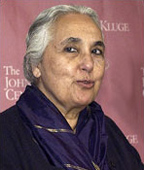
My first category of neocolonial brown (mem)sahibs is Romila Thapar and her dozens of former history students, who often guard the India and/or Hindu bashing fortresses at many American university departments, but who lack an education in Sanskrit and Indian Classics. They compensate for this deficiency with an overdose of Marxist and/or Eurocentric historiographies, often camouflaged as Subaltern studies. Ronald Inden explains how postcolonial Indian scholars have fallen into this trap:
“With the rise of identity politics, ‘postcolonial’ historians have shifted away from imagining class and national unities in India’s past and have started pointing to diversities, but many of these studies have a tendency to recuperate the older colonialist imaginings of India. Representations of the systematic mistreatment of women (patriarchy), the exploitation of the young (child labour), domination by a parasitic Brahman caste of Aryan descent, discrimination by castes (untouchability), and the triumphalism of an atavistic Hinduism reiterate the earlier images of India as an inherently and uniquely divided and oppressive place.”[xix]
These scholars hate being characterized as Eurocentrics, because that would run counter to their status as anti-colonialists and pro-Subaltern. Yet, they denigrate the sacred traditions of the very subaltern people for whom they claim to speak.
Inden explains the colonial origins of the presuppositions of India that are now commonly accepted by Indian scholars. His very important book, from which the following passages are excerpted, should be required reading for every student of India, in order to understand the origins of today’s neocolonialism:
“I wish to make possible studies of ‘ancient’ India that would restore the agency that those [Eurocentric] histories have stripped from its people and institutions.
Scholars did this by imagining an India kept eternally ancient by various Essences attributed to it, most notably that of caste.”[xx]
“I will argue that Euro-American Selves and Indian Others have not simply interacted as entities that remain fundamentally the same. They have dialectically constituted one another. Once one realizes the truth of this, he or she will begin to see that India has played a part in the making of nineteenth and twentieth century Europe (and America) much greater than the ‘we’ of scholarship, journalism, and officialdom would normally wish to allow. The subcontinent was not simply a source of colonial riches or a stage-setting in which Western hunters could stalk tigers, the sons of British merchants and aristocrats could make a financial killing, or the spiritualist find his or her innermost soul (or its Buddhist absence). More than that, India was (and to some extent still is) the object of thoughts and acts with which this ‘we’ has constituted itself. European discourses appear to separate their Self from the Indian Other – the essence of Western thought is practical reason, that of India a dreamy imagination, or the essence of Western society is the free (but selfish) individual, that of India an imprisoning (but all-providing) caste system. But is this really so? To be sure, these discourses create a strange, lop-sided complementarity between the Western Self and its Indian Other. Yet the consequence of this process has been to redefine ourselves. We have externalized exaggerated parts of ourselves so that the equally exaggerated parts we retain can act out the triumph of the one over the other in the Indian subcontinent. We will be unhampered by an otherworldly imagination and unhindered by a traditional, rural social structure because we have magically translated them to India.”[xxi]
“The effect of these wild fabrications of the nineteenth-century European imagination was to give pre-eminence to caste, the type of society epitomizing at once both constraint and excess, as opposed to the freedom and moderation of Western civil society, and to the lone renouncer rather than the individual-in-society. The result was not, as scholars often claimed, to depict India ‘as it was’. Indologists’ desires to elevate their West by denigrating this Indian Other were not, however, fulfilled simply by turning it into the land of Hindu castes and fakirs. Theirs was an imperial project that entailed the wholesale intellectual deconstitution of Indian economic and political institutions,….”[xxii]
“My main argument, then, is that the agency of Indians, the capacity of Indians to make their world, has been displaced in those knowledges on to other agents. The makers of these knowledges have, in the first instance, displaced the agency of the Indians on to one or more ‘essences’, and in the second instance on to themselves. The essences that they have imagined have been caste, the Indian mind, divine kingship, and the like. Although several generations of scholars have characterized and valued these essences in a variety of ways, they have for the most part considered them as somehow inferior, at least in the sense of explaining why India ‘lost out’ to the West. Since the civilization of India has been governed, they assume, by these dubious essences from the moment of its origin, that civilization’s place in the world has been, so to speak, predetermined from the beginning. Lacking the essences taken to be characteristic of the West – the individual, political freedom, and science – Indians did not even have the capacity on their own to know these essences. They did not, so one would have to conclude, have the capacity to act in the world with rationality. The European scholars and their doubles, the colonial administrators and traders, assumed for themselves the power to know these hidden essences of the Other and to act upon them. They would act both for themselves and for the Indians. Lest we think these practices affected only India, we should consider that the West’s image of itself as the epitome of the modern has depended, for two hundred years, on these changing portrayals of India as the embodiment of the ancient.”[xxiii]
While Black American scholars and Native American scholars have made considerable progress in rewriting the portrayal of their people for American textbooks[xxiv], Indian historians remain too invested in Marxist and Subalternist grand narratives of “Hindu oppression.” In this narrative, the Evil Brahmin plays the role of the elite bourgeoisie, and the Dalits and women are mobilized to play as the Oppressed Proletariat. Indian postcolonial thought has dislocated itself from Indian Classics. Therefore, even when criticizing Western hegemony, they are stuck with the use of Western theories.
Since the colonists plays the Bad Guy, these scholars locate pre-colonial “real India” in Mughal India. The 10th to 15th century period of pre-Mughal Islamic plunder is quickly glossed over. Anything prior to 10th century Islam is superficially treated, except for what is assumed to have been brought into India by other generous foreigners – the so-called Aryans, the Greeks, and many others. The self-serving meta-theory in which these historians are invested, simply forbids the possibility of positive indigenous developments.[xxv]
Furthermore, for political correctness, and to keep their “secular” ratings high, the well-documented genocides of Hindus are suppressed. This is in sharp contrast with the way Black slavery, Jewish holocaust and Native American genocide are mainstream topics and emphasized in American school textbooks.[xxvi]
Instead of being suppressed as politically incorrect, a dispassionate treatment of past atrocities would enable today’s Indians of all religions to distance themselves from historical genocides, and to forge a common identity as Indians. After all, it was the invading Muslims who plundered the native Indians, and the Indian Muslims today are mainly descendents of the natives and not of the invaders. For Indian Muslims, it would be far better to get rooted in Indian civilization, which is eclectic and flexible enough to include Islamic thought very hospitably, rather than identifying themselves as part of a pan-Persian and/or pan-Arab diaspora. (In a recent discussion with an Iranian scholar, I learnt that one of the key reasons why Iran is Shiite Muslim rather than Sunni Muslim is that Iranians refuse to Arabize their culture and identity. Recently, many Iranian Islamic scholars have renewed their interest in Zoroastrianism and pre-Islamic Iranian civilizations, which have a family resemblance with Vedic civilization. While the Arabs erased pre-Islamic knowledge systems as best as they could, the Iranians have tried to preserve their pre-Islamic language and culture, and have incorporated it into their reinterpretations of Islam. Indian Muslims could revive a similar trend, started by Akbar and Dara Shikoh, to fuse Islam with Indian Classics.[xxvii])
While the focus by many scholars has been on the negative stereotypes of Indic Traditions, they have failed to adequately treat their many positive contributions, especially those that have been appropriated by the West.[xxviii]
Another serious gap in Indian historiography is the lack of a thorough history of Hinduism. This work would show that Hinduism was developed and constructed over a considerable period of time, and has not been frozen (as some “essences”) in a lofty past. The importance of this to present day Hinduism would be to challenge many Hindus today who locate its perfection in some past era. This backward revival, as opposed to forward construction, is the result of not appreciating that Hinduism has had a long history of change, progress, and development in response to circumstances. A philosophy that has historically progressed can also have future progression, whereas one that has remained fixed is locked in orthodoxy.
Since religion, especially Hinduism, has been explained away as an obsolete need, not only do many historians fail to respect it and to understand its basic tenets, but they rely on socio-political theories according to which modernization would put an end to this scourge of humanity. Therefore, most scholars have failed to interpret the recent events in India and elsewhere in the world concerning the enormous popularity of religions.
For instance, it is commonly said by them that: (a) the BJP came to power; (b) this led to the TV Ramayana serial; (c) which, in turn, led to the uprising of popular Hindu sentiments; and (d) this culminated in the Ram Temple controversy at Ayodhya.

However, this chronology is false, made up to fit the theories. The TV Ramayana actually occurred before the BJP came to power. This TV serial’s massive success was caused not by the BJP but by the sentiments of Hindus, who had been suppressed for decades by a false notion of secularism. This revival of Hinduism at the grass roots is what led to the rise of the BJP.
For its part, the BJP took political advantage of the opportunity created by this oppression of popular religion. (They frittered it away on misguided causes, in my opinion, but that is another story.) The BJP’s rise to power was not the cause of the revival of Hindu sentiments, but the result of it. I witnessed similar religious revivals in Eastern Europe and ex-USSR, after the collapse of communism.
Ranajit Guha’s recent call to take the Indian Puranas seriously as a way to excavate an indigenous sense of history, is courageous and loud, and especially important since it comes from the very founder of the Subaltern Movement.[xxix] Guha is a living legend amongst “secular progressives,” the description under which the former Marxist thinkers of India now operate. He writes (and also says in his talks) that India’s itihas needs to be taken very seriously to excavate its sense of indigenous history.
Guha explains how itihas is a unique genre of literature, that cannot be called either Western style “history” or “myth.” Rather than being a history of mainly kings and armies, it is a repository of culture at the grass roots. Nor is itihas a fixed set of archetypal myths, because the audience participates in its unfolding in the present context, interpreting and adapting it over time. One hopes, given the bandwagon effect so important amongst Indian historians, that Guha’s U-Turn will also encourage a rethinking by other Indian historians

.
Historiography and Nation (Un)building:
History writing has been used both to build nations and to dismantle them.
China’s government has championed and funded major programs worldwide to promote a history of China that is constructed as being self-contained and insular, with minimum outside influences discussed. This account starts with Confucianism and Taoism as original pillars of Chinese thought.[xxx] Even contemporary communist ideology is depicted as a continuation of Confucianism and not entirely as a recent foreign transplant into China.
Modern Germany and Japan are also prominent examples of nation building based on constructing an integrated account of their own civilization, history and identity. The European Union is a major new project in the same direction. All these are examples of backward projection by a contemporary sense of positive cohesiveness.
History has never been an objective reporting of a set of empirical facts. It’s a present day (re)conception and filtering of data pertaining to the past, to build a narrative that is consistent with the myths of the dominant culture.
The Saudis invest petrodollars heavily to promote a grand positive narrative of the Arab people and their central place in the destiny of humanity. In fact, the export of Wahhabi Islam is largely a cultural export of Arabism, using religion as a means.
Scholarship is also used in the opposite manner. Imagine a hypothetical scenario, just by way of analogy, in which the USA is colonized by an alien civilization for several centuries. After successfully draining out the massive material and intellectual property, the colonizers finally leave, but a neocolonialism is installed as their control device. Having become immensely wealthier than their former colony, these aliens control the study of Americanology, with a focus on deconstructing the nation’s sense of unity. They sponsor chairs, museums and textbook portrayals that separate out various parts of American culture into conflicting entities: Blacks are encouraged to fight Americanism in the same manner as Dalits in India are being encouraged; women are encouraged to follow the footsteps of their alien women; Mormonism is encouraged as anti-Christian; American Muslims (who by them comprise a significant portion of the US population) are not treated as being Americans; and so forth.
This analogy is relevant because the Metropolitan Museum of Art in New York removed Indian art of the Mughal period and placed it in a separate section called, “Islamic Art.”[xxxi]
Museums in many American cities have separated out Sikhism from the rest of India into its own section for display, and have many cultural programs focusing on it. It is quite fashionable in Asian Studies, Women’s Studies, and especially in South Asian Studies, to have separate “Dalitism” scholarship. All this has become wrapped around serious works on India as being mainly about caste, with all other items of civilization being brought in from elsewhere.
The reality of India is that it is both these: an integration of indigenous and assimilations from elsewhere. This process continues till today. It is the same as with any other civilization. The problem is that in the case of India the imported aspects are exaggerated and the indigenous aspects are largely erased.
While each rich and powerful civilization emphasizes its indigenous cohesiveness and continuity, and with scholarship under control of those loyal to it, the reverse is the trend among the economically weak civilizations such as India. In the case of Indian civilization, the scholars’ emphasis has been on how there might not even be such a historical entity as India or Hinduism, and how its civilization was entirely brought by foreigners into India.
This intellectual breakup of Indic Traditions into historical layers of cultural imports, each with a nexus in some other part of the world, is the intellectual equivalent of the political breakup of India. That so many Indian have sold out to this project is certainly noteworthy, and is a major untold story of our times. In the long run, it is tempting for the West to assimilate this last remaining non-Western knowledge system, and breaking it into digestible modules facilitates this. However, the havoc that such a potential breakup would unleash would also be of catastrophic global proportions.[xxxii] Furthermore, the future positive harvests that this civilization is capable of giving to the world would end.
By falsely portraying Indic traditions as anti-modern, the West and its Indian sepoys[xxxiii] have forced many Indians into the false dichotomy of tradition vs. progress. While the historical, revelation-based Abrahamic religions demand belief in a canonized dogma (placing religion and science in direct conflict), no such dichotomy between Indian dharmas and science occurred. This is because Indic Traditions accept an endless series of discoveries, and not just one unique event, and because the classical Indian role models are very often those of skeptics, free-spirited thinkers, and intense debaters arguing against established ideologies. Given its methodologies of discovering new knowledge, known as pramanas, dharma is progressive, and requires change and reformation as part of its on going process. It has become artificially frozen only in recent centuries, and this needs to be unfrozen so that the indigenous engine of progress and renaissance may resume.
For removal of doubt, I am against homogenized religion or homogenized ideas of nation, because that would run counter to the spirit and reality of dharma. Furthermore, I am against any marginalization of minorities, including Dalits, Indian Muslims and Christians. My contention is that just as Greek thought was appropriated to construct diverse and progressive thinking in Europe, and thereby bring about the Renaissance of Europe, it seems to be a promising project to use Indian Classics as the foundation for a universally applicable Indic worldview and renaissance.
The issues discussed in this essay have caused inner conflicts and schisms in Thapar’s Children, that are often written on their faces. This is why their preprogrammed defense mechanisms instinctively flare up – shouting “fundamentalist,” “nationalist,” and so forth – when they are merely questioned on the legitimacy of their qualifications as scholars of India. Inadvertently, and often with good intentions, they continue to feed what might be called Gentooism Studies.[xxxiv]
The influence of Thapar’s Children in the Western world is considerable. Almost every year, they fly their icon around the world for speaking tours at prestigious campuses, where her cult-like former students are well fed gatekeepers. They make sure that no opposing voice is included on the panels – hardly an academically sound approach. At one of her talks last year, someone from the audience had the courage to ask her whether she knew Sanskrit and whether she had read the original texts, or whether she relied mainly on European sources for her scholarship. Very angry at this “rudeness,” she dismissed the question by saying that she “only answers questions from academically qualified persons.” Clearly, since she did not know the woman in the audience, Thapar had no way of assuming that this person was not an academician, except for the fact that only an outsider to the cult and its sphere of control would dare ask such a question.
The American academe considers her and her former students as the authorities on India. Any challenge to this hegemony of the brown (mem)sahibs is met with fierce personal attacks.
‘Brown Shame’ in English Literature:
Arundhati Roy, Rohinton Mistry (of Oprah fame), Bharati Mukerji, and others of this new genre of English language Indian writers, are my second category of neocolonial brown (mem)sahibs.
They rake in their money and awards spinning a reinforcement of the caste, cows and curry meta-narratives of India. This is to be contrasted with recent Bollywood blockbusters, such as Lagaan, that have depicted the cross-cultural relationship from the Indian perspective, and hence, catered to popular Indian audiences. These writers, on the other hand, are not read by India’s masses, whom they pretend to represent. It is the Western reader, seeking to fortify his/her Eurocentric myth of superiority, who endorses such work. These authors serve as brown-skinned suppliers for the kind of Orientalism previously done by whites such as Kipling. Their work is widely prescribed in American colleges, as insightful approaches into the complexity of exotic India, in a friendly fictionalized manner. It is taken more seriously than it deserves to be, because the publishers are falsely marketing these authors as the real voices of India.
The triumphant myth of the West expands, and these authors get amply rewarded for their contribution to the progressive march of Western civilization. In effect, these are the intellectual equivalents of the sepoys who policed the British Empire with great loyalty and pride, and, in exchange, got rewarded by being upgraded to a tier above the rest of the Indians whom they helped to subjugate.
Noy Thrupkaew, an American feminist reviewer, takes Indian women authors to task for supplying the stereotype of the “hard-bitten, angst-ridden Asian-American protagonists who had ostentatious sex by page 30.” She continues: “But if Asian women weren’t screwing, the publishing world wanted them suffering (and maybe bravely triumphing after they got themselves to the United States). The Asian historical memoirs were based on a simple formula: Asia was hell; the United States is a hell of a lot better. ….the Asian-hell-to-Western-heaven motif leaves a U.S. reader in a nicely complacent spot: reclining in a La-Z-Boy and thinking, ‘Well, thank god for America!’”[xxxv]
This has become a bandwagon on which many Indian women authors want to hitch a ride to instant success. What used to be the White Woman’s Burden has, in many instances, been taken over as the Brown Woman’s Burden. But Thrupkaew is suspicious:
“Is this author exoticizing her ethnicity? Is she just feeding the public more stereotypes of lotus-blossom ladies and guacamole-hipped mamas? If she’s inaccurate or exceptionally critical or dewy-eyed in depicting the culture of her forebears, is it done in a way that suits the general public’s fixed ideas? If the answer to any of these questions is ‘yes,’ then there’s a problem.”
While a few manage to climb to the top, the ultimate fate of most of these authors is to remain below the glass ceiling, while their white sisters smile from above. Thrupkaew points to the faddish nature of the American reader, as she writes: “At its worst, South Asian and South Asian-American writing is just like tasty Indian food – to be chewed, digested, and excreted without a lot of thought.” Yet this craving for legitimacy and honorary white status is too attractive and irresistible for many. (“Western” is often a politically correct equivalent of what was previously called “white.”)
Richard Crasta, originally from Goa, explains how the neocolonial process is working here: “In its choice of the Eastern writers it will patronize – or not patronize – Western publishing is only following the traditional strategy of conquerors towards a conquered race: unsex the men, ‘liberate’ the women, reward and honor the eunuchs or race-traitors, thus letting them keep their untamed brothers in check. If the conquered women and men don’t get along as a result, so much the better….”[xxxvi]
Many Indians have learnt to play the game, explains Crasta: “[M]ilking the West has become a major Third World industry, art, or con game – one that we must master merely to survive. We are practiced milkers, and we’ll do almost anything, say almost anything, act any degrading role that’s called for – all for a drop of the gleaming, life-giving, white stuff.”[xxxvii]
But Crasta warns his fellow Indian writers of the dangers of trying to cross the glass ceiling: “This Western carrot of acceptance and riches is accompanied by a stick: Do not cross the boundaries. Always remember your place.…[T]he carrot and stick are so discreetly transferred by Third World writers onto their internal censor that they are often unconscious of their own self-censorship.”[xxxviii]
The harm this is causing is very serious, says Crasta:
“Ethnic shame is the opposite of ethnic pride … and it is a sublime example of the success of colonialism in co-opting us in our own subversion, and in our alienation from our culture and our earth, and ultimately the extinction of our own culture…. Educated Indians feel that they must apologize for every Indian who spits or shits by the roadside, for India’s official corruption, for the poor quality of Indian manufactured goods, for our repeated defeats by foreign conquerors, for our dirt and disease and poverty, now and forever. Faced with such a burden, it is no wonder that some Indians succumb to the temptation of simply denying their Indian origins….Why is ethnic shame such a serious matter, and not just some personal oddity? Because it contributes to our collusion with the forces that tend to make us invisible in a foreign society…. But there are other, more serious reasons for our shame, no doubt: the Western media’s and the American people’s association of India with highly negative images…. The India Haters Club is growing larger and larger, and its largest contingent is probably the millions of Indians for whom a few bitter experiences of betrayal have pushed them over the edge into self-hatred: Yes, my skin is brown, but my soul is white.”[xxxix]
Most eminent Indian postcolonial and literary theorists, such as Homi Bhabha, Gaytri Spivak and Dipesh Chakrabarty, lack formal education in Indian Classics to help their work, even though considerable classical Indian thought anticipated postmodernism and takes those notions even deeper. Gerald Larson correctly assesses:
“The problem with subaltern theorizing is that it is intellectually derivative from post-modernist and post-structuralist western ‘critical theory’ and thereby runs the risk of being little more than a kind of Neo-Orientalist theorizing.”[xl]
This growing genre of uniquely Indian Eurocentrism is simultaneously stupid and gifted, living paradoxically on an ivory tower. These young English language writers are of a new breed, often with revulsion to anything even remotely connected with Hinduism. As typical Macaulayites, they see nothing in Hinduism except for inequality between castes and burning of women. The paradox is that they are also sharp and acute critics of the dominance of the whites, colonialism, neocolonialism, corporate greed of America, etc. In other words, they have memorized well the rhetoric of Marxism, nowadays reinvented as “the leftist progressive circle.” But they are dislocated individuals from their souls and, like all loose canons, present dangerous implications.
While masters at deconstructing everything pertaining to British colonialism, what can these scholars replace it with? Answer: nothing that is prior to the Muslim invasion of India. Since the British period was cruel, and pre-Mughal India is dismissed as primitive (except for Buddhism which got intellectually moved from India over to East Asian Studies), what is seen as positive Indian culture is Mughal centric! In these minds, India’s worthwhile culture starts only when the Muslims colonized it.
The reason is simple: they lack knowledge of Indian Classics, and find it very embarrassing when this is pointed out to their white cohorts, because American liberal education includes a solid foundation in the Western Classics. Imagine telling an American liberal arts college to get rid of the Greek Classics, because the Greeks were primitive, pagan, and slave-owners.
This is the lie that these scholars live behind: the pretence that they are authentic ambassadors and representatives of Indian culture, when, in fact, they represent the West’s successful mental colonization of India. Hence, their neurosis and anger, when this contradiction gets exposed.
Their fierce public fight against the dominant culture is a reaction to their shadow side that is unable to become the dominant culture. Hypothetically, if there were a FDA[xli] approved gene therapy to change phenotypes into “white,” it is precisely this lot who would make a beeline for this ethnicity-changing procedure.
The frustration from being denied white status often gets an outlet via postcolonial studies. This is the syndrome that Richard Crasta has called “impressing the whites.” It is what Enrique Dussel, Frantz Fanon, Edward Said, and many others explain as the process by which the dominant culture appropriates a tier of intellectuals from the colonized culture, to serve as proxies in intellectually ruling over the masses. In exchange for this loyalty to the dominant culture, these Uncle Toms receive a considerably enhanced position, various rewards, and a sort of neo-white status.
It is to be remembered that 99% of all bullets fired and all police atrocities committed during the British Empire were done by Indian Sepoys under British command. Interestingly, the Chinese did not make good sepoys, because they refused to sell out. The Blacks had to be physically chained to enslave them. But Indians volunteered with great pride.
Today, the Indian Sepoy archetype, found in the Western academe and journalism, often does the dirty intellectual work. Their role on behalf of the dominant culture is to supply the myth of the “other” in a way that fits into the dominant culture’s grand narrative of itself. Rather than glorifying their success, the sooner their readers start to publicly call their lie, the better.
(As an interesting side remark, Lalit Mansingh, India’s Ambassador to USA, gave his speech at a major Hindu event in English. He can only give speeches in English.[xlii])
The “South Asian” Syndrome:
SAJA (South Asian Journalists Association) has influenced the movement to “South Asianize” young Indian Americans when they leave home and enter American colleges. SAJA runs on a clever marketing scheme: journalists from prestigious American media firms are brought on to the advisory board to give SAJA legitimacy, in exchange for enhancing their personal resumes as being “India experts.” Annual SAJA Awards, sponsored by corporations seeking to impress the Indian diaspora, are given to create role models of young journalists, who have often accomplished little other than championing the ideals of SAJA – Somini Sengupta is one recent example. This mechanism feeds itself. The SAJA internet discussion lists are carefully censored to filter out opposing views, even disallowing responses to direct personal attacks.
Many Indian journalist (mem)sahibs also serve as chowkidars (gatekeepers) for the West, as Crasta explains:
“Indeed, many of these immigrants are so terrified of voices that may offend the Masters that they will themselves act as filtering devices, as local policemen or toughs. Organizations like the Asia Society, South Asian Journalists Association (SAJA), and many ethnic newspapers regularly act as cheerleaders for those Indians who have impressed the whites, and as bouncers to keep their scruffy and impolite brethren from disrupting the harmony: on one occasion even trying to drop a ‘trouble-making’ Indian author from the program at the Asia Society.”[xliii]
SAJA is but a small node of a vast South Asian movement on American campuses. The South Asian movement carefully hides the fact that this term was invented by Henry Kissinger as part of the Cold War foreign policy to contain the non-NATO world. The South Asian Studies departments across the US have been funded ever since by “Title VI Grants” from the US State Department, intended to promulgate and promote a theory of that “area” in order to support US foreign policy. Edward Said analyzed this and wrote that besides the military, the Western powers also have “armies of scholars at work politically, militarily, ideologically.”
The following quote from a governmental report describes why the US Department of Defense invests in the social sciences to understand and reengineer the “others”: “The Armed Forces are no longer engaged solely in warfare…. For many countries throughout the world, we need more knowledge about their beliefs, values, and motivations; their political, religious, and economic organizations; and the impact of various changes or innovations upon their socio-cultural patterns. …” [xliv]
The same report recommends specific kinds of social research and reengineering, and one can find in this list many projects that are being carried out in the US academe and via NGOs in India. Never has the Indian media done an investigative report on why the US Defense Department is to be served by Indian scholars in this manner:
“The following items are elements that merit consideration as factors in research strategy for military agencies. Priority Research Undertakings: (1) methods, theories and training in the social and behavioral sciences in foreign countries. …(2) programs that train foreign social scientists. …(3) social science research to be conducted by independent indigenous scientists. … (4) social science tasks to be conducted by major U.S. graduate studies in centers in foreign areas. …(7) studies based in the U.S. that exploit data collected by overseas investigators supported by non-defense agencies. The development of data, resources and analytical methods should be pressed so that data collected for special purposes can be utilized for many additional purposes. … (8) collaborate with other programs in the U.S. and abroad that will provide continuing access of Department of Defense personnel to academic and intellectual resources of the ‘free world.’”
Over 90% of the students who get sucked into the South Asian movement on US campuses are Indians. On the other hand, most Pakistanis are unabashed about their identity, and join Islamic organizations. Even in the UK, where the Indian community is far older than in the US, there is no South Asian movement on campuses. Finally, nobody in India identifies himself/herself as being “South Asian.”
An American academic scholar, who publicly identifies himself as a Hindu, complains about many of his cohorts in South Asian Studies:
“It is very sad that those who once supported free thinking and spirituality now support political correctness and Marxism. I find that the South Asianists on this campus, both westerners as well as the Indians (who are almost exclusively from high caste, urban elite families) and Pakistanis (also ALL from wealthy families) have, for the most part, a real hatred of Hinduism specifically, and religion in general. Because I am not ANTI-Hindu, which ‘good’ scholars here are supposed to be these days, I was long ago labeled a fundamentalist and relegated to the fringe. Whenever there is a conference on South Asia, I am not invited. [But] it is okay because I have a tenured position.”[xlv]
Finally, Dinesh D’Souza, who recently wrote in praise of colonialism, as being a great gift to the colonized people[xlvi], is a product of the South Asian movement.
NGOs as Foreign Proxies:
Susantha Goonatilake, a Sri Lankan scholar, has completed a comprehensive study of his country’s NGOs and plans to publish his findings in a major book soon. His conclusions stated to me may be paraphrased as follows. Sri Lanka has been destroyed largely by the foreign funded NGOs operating there. Local scholars do what the sponsors demand, and hence serve as foreign proxies. This is remote-controlled neocolonialism of sorts. Goonatilake says that the same phenomenon has also happened to a fair extent in Bangladesh. But India, he says, is simply too large and resilient to be taken over, and has managed to survive despite all such activities.
It is this kind of NGO mentality that sends speakers to International conferences and to foreign media, so as to sensationalize and “expose” the internal social problems of India. While many NGO staff members and scholars are immersed into the Hindu and India phobia movement, there are also a large number who are simply sucked into this out of sheer ignorance, or out of the temptation for foreign travel and various grants as rewards. Many NGOs are the fifth column of Stealth Eurocentrism.
While the agenda of neocolonialism is rarely visible in the grant agreements, everyone experienced in this cottage industry knows what reports are “correct” to produce, in order to keep the foreign funds flowing. Those who resist “selling out” are weeded out by the sponsors in a Darwinian game in which fitness is defined in terms of anti Indic Traditions.
This explains why so many internal social problems of India get internationalized with the help of Indians, even though the international forums have no capability or track record in actually resolving these issues. Where domestic mechanisms already exist to resolve these matters, they are simply bypassed and their existence is simply ignored. It is a pitiable sight to see these nouveau and neo Westerners sign up as enthusiastic carriers of exotic gobar (bullshit) on their stupid little heads, from one event to another. Many of the problems mentioned in this essay would not be possible without Indian NGOs aiding and abetting neocolonialism.
The “Sixth International Conference on Dowry, Bride-Burning and Son-Preference” to be held in 2003, is one such example. Its intellectual leadership comes from Western feminists.[xlvii] The group’s first conference on the subject was held at Harvard University in 1995, where a “Six Point Program to Eradicate Dowry and Bride-Burning in India” was adopted. This Program was further revised at their subsequent conferences held at Harvard University and University of London. While the sponsors and scholars gained publicity for themselves, and continue to seek to “change mindset” on this issue, they admit that they have made no impact on the ground reality of this problem.
In sharp contrast with this are the many successful social reform movements from within the Indic Traditions. Madhu Kishwar describes in her talks how Western funded NGO feminists failed to make any dent in reforming rural property ownership biases against women, but that different movements run entirely using Indic principles and metaphors were very successful. The Swadhyaya movement is another great example of large scale reform, from within the culture, that is strengthening the indigenous knowledge systems rather than strengthening neocolonialism. There are also numerous successful examples of the practical use of traditional knowledge systems in areas such as water harvesting.
Colonial Style of Governance in India Today:
Hinduism and Christianity each comprise over 80% of the populations of India and USA, respectively. Therefore, it is appropriate to compare the status of each of these in its respective country, in relation to other minority religions. Following are some comparisons that are seldom mentioned by scholars and journalists who analyze India’s religions:
Continuing the British colonial practice, Hindu temples in India today are under the trusteeship of civil servants appointed by the Government of India, many of whom are not even Hindus.[xlviii] Therefore, when I give a donation at Tirupati, one of the largest Hindu temples in India, the money goes to the control of civil servants of the government, who then decide how it gets spent. However, the places of worship of all minority religions, such as Islam and Christianity, are entirely run by the management appointed by their respective members, with no governmental interference. By way of comparison, American Christians would never accept comparable discrimination against them. It is unthinkable that Churches in USA could come under the control and supervision of Federally appointed trustees, especially if non Christian religions would be exempted from this, simply as a way to prove the leaders’ “secularism.”
There is only one civil law in USA for all its citizens, regardless of religion. There is no such thing as a separate Jewish Law, or Catholic Law, or Mormon Law, or Protestant Law, or Muslim Law, and so forth, to govern the public life of Americans. The very thought of this is reprehensible to Americans. Yet, there is a separate and distinct Muslim Personal Law in India. This has been used by past politicians to grant religious minorities specific provisions. For instance, Indian Muslims may have four wives under Indian law, even in this 21st century – and yet it is fashionable for many intellectuals to defend this minority pampering law, rather than condemning it on grounds of human rights.
Imagine if the American affirmative action programs consisted of a list of hundreds of minority groups – including each named Native American tribe, Blacks, Hispanics, Italians, Polish, Japanese, Chinese, Arabs, Indian Americans, Russians, etc. – with a percentage of college admissions, jobs, etc. as quotas reserved for each group. Imagine if these “groups” were categorized under British colonial rule, when the colonialists conducted censuses using sociological categories as per their biased understanding. Furthermore, imagine that these federally enforced social divisions were to become the basis for hundreds of political parties, each seeking votes from its ethnic group, and promising to lobby on its behalf to improve its “deal” with the State. Few Americans with whom I have discussed this are willing to believe that India’s affirmative action program is so ridiculous as this scenario suggests, and yet it is precisely this way. Rather than removing historical distinctions over a few generations, by making affirmative action on individual need and circumstances, this Indian “secular” approach has become the cause for divisiveness in India. Caste is the result of political structure, and, conversely, caste persists to fuel the political opportunities it has created.
“Faith Based Initiatives” is a recent US government program by the Bush administration, under which Federal grants are given to religious organizations in order to do social work. This has created a major stir, on two accounts: whether the government should be funding religious organizations at all; and to what extent it should fund minority religions. However, a very similar program has functioned in India very successfully ever since independence. Its characteristics are newsworthy: (a) The majority of funds given under this program in India go to Christian and Muslim organizations, even though they comprise a minority. (b) This quantity given to minority religions has not declined, despite recent religious politics. (c) Nobody has complained about this state of affairs, as it is considered quite normal.
Tens of billions of dollars worth of land in India is owned by the Church, and in Mumbai, the Church is the second largest land owner, the largest being the Indian military. Most of this land was given under land grants by the British to the Church, and by subsequent Indian governments. Such generosity to a minority religion followed by only 2.5% of the Indian population has gone unreported. Given the foreign controlled nexus of the various Churches, this is tantamount to giving billions of dollars to subsidiaries of foreign entities that are engaged in social re-engineering of Indian society. The US government has never contemplated such generosity towards minority religions, especially those controlled from overseas.
Millions of India’s laborers and entrepreneurs who use Indian traditional knowledge systems are often deemed to be engaged in criminal activities by the government. Many British laws, enacted to de-industrialize India and to transfer manufacturing to Britain, persist today. Madhu Kishwar has started to raise awareness about this, by mediating and renegotiating the “ruler-ruled relations” in specific sectors of India’s economy. For instance, she has pointed out in an educational video, that metallurgical process pioneered in India centuries before the British learnt to make steel, and that had made India the world’s leading exporter of steel, remain criminalized today. Similarly, traditional civil engineering, once the basis for building India’s massive city complexes, is now outlawed in India. Government authorities constantly prosecute activities that are not compliant with Western norms, and treat India’s traditional style workers as common criminals.
Each of the above is a colonial legacy that the government has deepened even further. Indians have replaced British as the rulers of the masses, as colonizers of their own people.
Sitharam, a journalist in a major local vernacular publication in Bangalore, reflects on the ridiculous positions taken by many Indian “intellectuals” in the name of secularism and political correctness:
“It is a great tragedy in this country that words like Secularism, Sanatana Dharma, Social justice, uplifting of Dalits and so on, which are to be the considered greatest goals and ideals in any civil society,…. have become the playthings in the hands of petty politicians and anti-nationals who want to divide people to achieve self-gains even by throwing the society into unrest, and to warm themselves by lighting the pyres. The irony is that those mostly responsible for this state of affairs are the armchair intellectuals… Because of the irrational behavior of these intellectuals, it has now come to pass that anyone who wants to be recognized as secular, should be a professed leftist, and interpret society on a Minority-Majority basis or on Brahmin-Non Brahmin basis or Forward-Dalit basis. He, therefore, has to interpret, without using his critical faculties, any incident that occurs in the country so as to demonstrate that he is a leftist, an anti-Brahmin and a pro-Dalit. If not, he is at risk of being segregated and kept out of the coveted community of ‘Progressive intellectuals’. Now-a-days, to be considered as a member of the progressive intellectual community, it is not necessary as of yester years to be a scholar in Tarka, Vedanta or Mimamsa, or even geography, history or science,… It would suffice if he were committed to the above-mentioned policy…”[xlix]
This armchair intellectualism is often an exercise in juxtaposing ill-defined or inapplicable words. One such word worth deconstructing is “fundamentalist.” I have tried to get a definition of fundamentalism from armchair intellectuals, on the condition that we must then apply it equally to all parties, to ascertain as to whether a given party is fundamentalist or not. I have provided the following background to help this exercise:
1. If a literalist interpretation of ancient texts makes one a fundamentalist, as is the charge against those interpreting the Hindu Puranas in this manner, then the majority of American Christians and virtually all Muslims of the world, would have to declared as fundamentalists, because they do consider the Bible and Koran, respectively, in the literal sense.
2. If fundamentalism means believing that one’s own faith is the only true one, to the exclusion of all others, then, by definition, faiths based on unique historical revelations – the three Abrahamic religions – would be fundamentalist.
3. If “fundamentalism” is to mean an unwillingness to change, based on open-minded inquiry, then it is the same as “orthodoxy” (as contrasted with “liberalism”). In this case, most of the “Left” today is fundamentalist, because they are not liberal in the pursuit of new inquiry, and seem to thrive on repeating the liberal thoughts of icons of bygone eras.
4. If imposing one’s faith upon society at large is being discussed, then I would consider a better term to be “religious nationalism.” Every Islamic State, which means virtually every Muslim majority nation in the world, would qualify.
I have yet to receive a definition. It seems the term “fundamentalist” is being used for anyone who challenges the syndicated ideology of the incumbent group. Having said this, surely, there are intolerant Hindus, literalist Hindus, chauvinist Hindus, and so forth, as there are for any other ideology. But they cannot all be lumped under one umbrella.
PART 3: The Glass Ceiling
My previous Sulekha column, titled, “The Asymmetric Dialog of Civilizations,” based on a talk presented at the American Academy of Religion (2001) gives an overview of the role of the dominant culture, from above the glass ceiling. in creating and sustaining neocolonialism.[l] Therefore, I shall not replicate that information here.
Inden is quoted in Part 2 above explaining that the West used the “other,” and especially India, to define and construct itself. This happened both at physical and intellectual planes. The intellectual appropriation continues to this day.
The U-Turn process is my model for describing this appropriation, by which the West has been intellectually constructing itself, and it consists of the following stages:
Student/disciple: In this stage, the Westerner is very loyal to the Indic Traditions, and writes with the deepest respect. In many instances, India has helped the person to “find” himself/herself.
Neutral/new age/perennial territory: In this stage, Indic appropriations are repackaged as “original” claims by the scholar, and/or assumed as generic thoughts found in all cultures. In many instances, this is done in order to expand the market for the books, tapes and seminars, by separating from the negative image of “caste, cows and curry” traditions.
Hero’s return to the original tradition: The scholar brings the knowledge into Judaism or Christianity, so as enrich his/her own tradition, once the ego takes over and this identity asserts itself. Alternatively, the scholar repackages the material in secular vernacular, such as “Western psychology” or “phenomenology” or “scientific” framework. Now the sales mushroom, as the Western audiences rub their hands in glee, congratulating themselves for their culture’s sophistication.
Denigrating the source: At this stage are those scholars who specialize in trashing the source Indic Traditions.
Mobilizing the sepoys and becharis: I already defined sepoys as Indians who become proxies for Western sponsors. Becharis are women who overdo the “I have been abused” roles, so as to dramatize #4. Part 2 of this essay focused on them.
European colonial writers saw India as the theater where their European history was playing out, rather than viewing it from the Indians’ perspective. Likewise, may Judeo-Christian scholars use Hinduism Studies for their personal spiritual journey to enrich their native religion.[li]
Not all stages take place in every case, and these stages might not happen in this exact sequence every time. Often, one scholar ends his/her career at a certain stage of this U-Turn process, and the successors continue further along this process.[lii] It is important to note that Eurocentrism is most often unintentional and unconscious, because the person is so immersed in the myths of Westernism, that it is simply assumed to be the right thing to do.[liii]
This U-Turn has served as a way to plunder with one hand and denigrate the victim with the other. In earlier times, the Greeks appropriated much of “their” civilization from Egyptians. Christianity was built on Greek pagan ideas, but the pagans got condemned.
Therefore, subverting India’s Classics, while appropriating from them via a series of U-Turning scholars, is an important process for the sustenance of the myth of the West.
Some academic organizations, such as RISA (Religions In South Asia), remain as bastions of blatant Eurocentrism. See my “Asymmetric Dialog…” essay referenced above for details. Also, see my essay, “Who Speaks for Hinduism?”[liv] These scholars control classrooms as forums, in which the students are often naïve and are not given viewpoints that challenge the scholars.
For instance, HCS (Hindu Christian Studies) was set up by academic scholars specifically to have a dialog between these two religions. But the discussions were centered mainly on Christian perspectives of Hinduism, along the lines of the “caste, cows and curry” themes. However, once a few Hindus tried to discuss information on caste in Indian Christianity, social abuses in Christian majority countries, etc., they were severely reprimanded by Lance Nelson, the scholar in charge of HCS. When this did not succeed, they threw out the Hindus, except for those who work under the Christians’ control, and even blocked public access to the discussion archive.[lv]
Likewise, RISA membership is closed to practicing Hindus, to Hindu pandits, gurus and swamis, even though it is the official scholarly body about religions of South Asia.[lvi]
Both HCS and RISA give various excuses for behaving like the proverbial brahmins and treating the Hindus like shudras. For instance, they claim: (1) Practicing Hindus are not qualified to know about their own traditions.[lvii] (2) Most Hindus lack the critical thinking and/or the right “style” of presentation skills to merit entry amidst such lofty audiences. (3) It is for the Hindus’ own “good” to leave the controls with the Christians, so as to protect the Hindus from the Marxists. And so forth.
These “restricted” (and sometimes “secret”) societies use abusive language against those Hindus who try to bypassing the hegemony. The archive of these Hindu-bashing discussions is in the process of being researched for a series of future articles. Since their intended audience is not the well informed and self confident Hindu, they often get very embarrassed, afraid and/or angry when such Hindus discover their writings and start to read them publicly in front of large Hindu audiences.
Hindus’ loss of control over their own scholarship for centuries led to the “freezing” of a very vibrant tradition. While Christianity has progressed with constructive theologies (for instance, liberation theology), Hinduism scholarship has been under the trusteeship mainly of non-Hindus. Today, when Hindus re-interpret their texts to make them current with the times, they are dismissed as quacks, when all other major religions enjoy this privilege.
While literal Biblical interpretations are well respected, and this literalism is the belief of roughly half of all American Christians[lviii], when Hindus base their scholarship on literal interpretations of Puranas, they are condemned as “fascists”, “fundamentalists”, and so forth.
The academy does not encourage the use of Hindu categories to deconstruct and criticize Christianity, in the same manner as Christian hermeneutics are routinely used to deconstruct Hinduism.
It is simply expected of Hindus in the Western academic world to acknowledge acceptance of their servile place and be thankful for it. They are not entitled to the same rights to protest; nor is routine respect accorded – facts at variance with the rights and respect extended to Muslims and other minority religions in USA on their perseverance and demand. It is not surprising, therefore, that most Indian American Hindus confine their religious expression inside the walls of the 800 Hindu temples in North America, and “white Hindus” often prefer to hide their practice behind the new-age cover.
REFERENCES:
[i] “India and Europe,” by Wilhelm Halbfass. First edition, Delhi: MLBD, 1990, p. 44.
[ii] “The Intimate Enemy,” by Ashis Nandy. Delhi: Oxford University Press, 1983, 1994, pp.6-7.
[iii] This entire section is quoted from Colby College’s brochure about their curriculum.
[iv] Ironically, these fields are in the Western representation system, and therefore, many modern Indians assume, by association, that the Western Classics must therefore be superior and somehow more relevant as compared to India’s Classics. In reality, Indian Classics are very science and postmodernism compatible, and in fact, many interpretations of quantum mechanics, cognitive sciences and contemporary other disciplines have drawn considerably from them.
[v] Including at Sulekha and other discussion boards.
[vi] See: http://www.infinityfoundation.com/indic_colloq/colloq_home.htm
[vii] Writings by prominent scholars who expose Eurocentrism, such as Blaut, Dussel, Inden, Dirks, and Nandy, are often excluded from undergraduate Religious Studies reading lists, where the Christian, Marxist and/or Western chauvinistic lenses takes prominence.
[viii] “Imagining India,” by Ronald Inden. Indiana University Press. 2000. p.xii.
[ix] A Department of Sanskrit has finally been established after decades of vehement opposition, but it is barely staffed and is of minor impact as compared to the well entrenched Eurocentric and Marxist oriented faculty.
[x] See “Eleven Objections to Sanskrit Literary Theory: A Rejoinder,” by Kapil Kapoor. Posted at: http://www.infinityfoundation.com/mandala/s_es/st_es_kapoo_eleven_frameset.htm Also see “Decolonizing English Studies: Attaining Swaraj,” by Makarand Paranjape. Posted at: http://www.infinityfoundation.com/mandala/s_es/s_es_paran_swaraj_frameset.htm
[xi] This week’s article in The Washington Post illustrates the strong Christian movement that considers “joining with other pagan clerics in an interfaith service” to be “an extremely serious offense against the God of the Bible.” See: http://www.washingtonpost.com/wp-dyn/articles/A30501-2002Jul5.html
[xii] Clifford Geertz, “Thick Description: Toward an Interpretive Theory of Culture,” in The Interpretation of Cultures, (New York: Basic Books, 1973), pp. 3-30.
[xiii] “History: At the Limit of World-History,” by Ranajit Guha. Columbia University Press. 2002.
[xiv] This has been called The White Woman’s Burden.
[xv] Gebser is the most influential thinker on this.
[xvi] For instance, Buddhism brought into Christianity the following: church bells, monasticism, rosaries, chanting, etc.
[xvii] The British men were referred to by their Indian servants as sahibs, and their women as ‘mem’-sahibs. The word ‘mem’ was Indianized for ‘madam.’ Now, elitist Indians have stepped into this role, as the brown sahibs and mem-sahibs.
[xviii] Non Governmental Organizations, the equivalent of non-profit organizations in the Third World, are heavily infiltrated by Western funding sources, and often serve as proxies for their interests.
[xix] “Imagining India,” by Ronald Inden. 2000. p.xii.
[xx] Inden.p.1.
[xxi] Inden.p.3.
[xxii] Inden.pp.3-4.
[xxiii] Inden.pp.5-6.
[xxiv] The major revision from the Native American perspective came when they successfully changed Christopher Columbus’ depiction in history from hero to plunderer of the natives. This caused the 1992 celebrations of the 500th anniversary of Columbus to be marginalized, and textbooks to be rewritten. Recently, they have won a major landmark in convincing California to ban the appropriation of their symbols for frivolous use. See “Calif. may force schools to drop Indian mascots,” May 16, 2002. Posted at: http://edition.cnn.com/2002/fyi/teachers.ednews/05/16/indian.mascots.ap/index.html
[xxv] For a critique of this, see “On the Misportrayal of India: Toward a New Look at Indian History,” by Dr. David B. Gray, posted at:
http://www.infinityfoundation.com/mandala/h_es/h_es_gray-d_mispor_frameset.htm
[xxvi] See, for instance, “Resources for the study of the Muslim Period of India,” http://www.infinityfoundation.com/mandala/h_es/h_es_indian_hist_frameset.htm
[xxvii] For instance, there could be a “Mohammed Purana.” Sufis have already Islamicized Indic mysticism. Such a fusion would be far better than the alienation now resulting from an overdose of misunderstood secularism.
[xxviii] For a summary of these contributions, see the following two articles: (i)“Global Renaissance and the roots of Western wisdom”: http://www.noetic.org/Ions/publications/r56Malhotra.htm
(ii) “India’s place in global consciousness”: http://www.infinityfoundation.com/mandala/h_es/h_es_malho_global_frameset.htm
[xxix] “The Limit of History,” by Ranajit Guha. Columbia U.P. 2002.
[xxx] In fact, many Western scholars have told me that there is overwhelming evidence to prove that both Confucianism and Taoism were heavily influenced by Buddhism, and that Chinese archives from that era show this very clearly. However, it is the policy of the Chinese government, in which most Western China scholars are partners, that China’s civilization is to be depicted as internally constructed.
[xxxi] Note, there is no special Hindu-Buddhist Art section. There is a South Asian Art section. This is a contradiction in classification: geography in one instance and religion in the other.
[xxxii] See my previous Sulekha essay, titled, “America’s Last Chance,” on what a break-up of India might trigger in the global order.
[xxxiii] Sepoys were Indians working as the police under the British to oppress the Indian people.
[xxxiv] I wish to acknowledge Arvind Sharma as the person who proposed this term to me, as a way of describing the popular genre of scholarship against Hinduism. In the late 1790s, the British sponsored a distorted translation of the dharmasastras, in order to legitimize their social and legal policies in ruling India. This mistranslation, that continues to be the foundation of much social theorizing about India, was first published in the 1790s under the title, “The Laws of the Gentoos.” The term “gentoo” was a pejorative based on “gentile,” analogous to the term “nigger” used to refer to Africans. See Madhu Kishwar’s essay on this distortion at: http://www.infinityfoundation.com/mandala/s_es/s_es_kishw_mythic_frameset.htm Similar distorted scholarship continues to dominate today’s academic disciplines such as Indology, Religious Studies, and Anthropology.
[xxxv] “The God of Literary Trends,” by Noy Thrupkaew, AlterNet. June 24, 2002: http://www.alternet.org/story.html?StoryID=13448
[xxxvi] “Impressing the Whites: The New International Slavery,” by Richard Crasta. Invisible Man Books.pp.80-81
[xxxvii] Crasta.p.24.
[xxxviii] Crasta.p.15.
[xxxix] Crasta.pp.102-107.
[xl] “India’s Agony over Religion,” by Gerald James Larson. State University of New York Press, Albany 1995. pp.41-42.
[xli] US Food and Drug Administration, the agency that approves new pharmaceutical drugs and treatments.
[xlii] This was mentioned by Mr. Mahesh Naithani while introducing the ambassador as keynote speaker at a cultural event in New Jersey, commemorating the 50th anniversary of the Chinmaya Mission in 2001, in the presence of 10,000 persons.
[xliii] Crasta.p.112.
[xliv] Defense Science Board. Report of the Panel on Defense: Social and Behavioral Sciences (Williamstown, Mass., 1967). As quoted in “Representing the Colonized: Anthropology’s Interlocutors,” by Edward Said. Critical Inquiry, Volume15 Winter 1989. P.214.
[xlv] Anonymous academic scholar of Religious Studies. This person is a white American who claims Hindu identity publicly.
[xlvi] “Two Cheers for Colonialism,” by Dinesh D’Souza. The Chronicle Review, Page: B7. May 10th 2002. Available at: http://chronicle.com/free/v48/i35/35b00701.htm
[xlvii] The nexus of this is at the Gender and Religions Research (GRR) Centre in the Department of the Study of Religions, School of Oriental & African Studies (SOAS), University of London, UK. The money comes from a well intending NFI businessman’s International Society Against Dowry & Bride-Burning in India, Inc. (ISADABBI), USA.
[xlviii] This is true in practice of most large Hindu temples and institutions, and it is at the government’s discretion to apply such controls on Hindu organizations.
[xlix] “Our Post Independence Intellectuals,” by C. Sitharam. Published in ‘Samyukta Karnataka,’ a daily from Bangalore. 12.6.2002. English translation by Dr. Upendra Shenoy.
[l] See: http://www.sulekha.com/column.asp?cid=156155
[li] Once they make this U-Turn back, they often explain their appropriations using theories of archetypes, namely, that all ideas were always present within all cultures, anyway. However, the “uniqueness” claims of Western superiority of rationality, science, morality, etc., are never explained away in this manner.
[lii] For instance, Jung went to stage 2 and 3. But he was open about his debt to India. After his, his successors, i.e. present Jungians, erased these Indic sources and have sometimes denigrated the Indic sources as inferior in various ways. T. S. Eliot was very Hindu for a period when he composed his most famous poems, including The Wasteland. But today, this Indic influence is never mentioned in literature courses on Eliot.
[liii] This is why the term “stealth Eurocentrism” might be appropriate in some instances.
[liv] See: http://www.infinityfoundation.com/mandala/s_es/s_es_malho_critiq_frameset.htm
[lv] As an unprecedented sign of paranoia, the HCS leaders decided to even remove the old archive from public access, as it contained considerable hate speech against Hinduism. However, many of the abusive posts were saved by some persons in their private archive.
[lvi] It is open only to those Hindus who are deemed qualified as per the standards and definition of those in charge. The control of the group is with Westerners and their Indian sepoys.
[lvii] They have organized sessions titled, “Coming out as a Hindu or Buddhist in the academy,” where the few who are brave to face insults have come out to prove that their objectivity of Hinduism scholarship is not compromised by their being a Hindu or Buddhist. Note, my suggestion that they should have sessions on “Coming out as a Christian Proselytizer of Hindus” has not been well received so far.
[lviii] Per George Gallup’s book of surveys of Americans’ religious beliefs.