Rajiv Malhotra: Coconut Imperialism


Rajiv Malhotra on Postmodern Imperialism

The postmodern insistence on denying such identities as “Indian” and “Western” leaves non-Western cultures vulnerable to even further exploitation because they are denied the security of possessing a difference which is real and defensible. Postmodernism, then, tends to undermine the particular reality of the non-Western culture that might be in need of being affirmed, protected and developed.

The London-based Indian Muslim cultural critic Ziauddin Sardar points out that the postmodern criticism of nation-states and their related identities actually empowers imperialism insofar as it “softens the prey” on behalf of the predator empires by advocating the abandonment of distinctiveness in a one-sided manner. This is so because the West does not practice what it exports. The call to abandon distinctiveness is propagated and promoted through a network of intellectuals in the Third World nurtured and sustained by the First World.[ii]

[Lila: I’ll call this coconut imperialism, coconut being urban slang for “brown on the outside, white inside,” that is, Indians who have no connection to or knowledge of their own cultural heritage and simply ape/adopt Western culture wholesale]

Malhotra:

Postmodern philosophers have made many attempts to deconstruct the West’s “meta-narratives,” as they are often called, rightly pointing out that such claims of universalism are in fact parochial and arrogant views of what is merely one cultural tradition among many others. It is perhaps a paradox that the West is simultaneously protecting itself by rewriting its story in a new and renewed chauvinistic mode in which deconstruction itself is seen as the culmination and fruit of its long, singular and ineffably superior philosophical trajectory.

Without an outside perspective on the Western mentalities, the postmodern critiques assume an unfolding consciousness in which Westerners are the leaders and agents. They tend to project their latest theories back into Western intellectual history, thereby enhancing the Western collective identity rather than dissolving it. Although it decries identity, postmodernism is itself the product of a history that has been shaped by particular attitudes to difference and that cannot be assumed to be the template for world history. Postmodernism is highly critical of imperialism and colonialism, yet it has a grand narrative of its own which remains largely outside the bounds of the deconstruction process. Indian traditions are marginalized by the postmodernists.

[Lila: Thus, you have the meeting of minds between Slavoj Zizek, post-modern radical, and Julian Assange,  the publisher of Wikileaks, the two who are now the de facto spokesmen for millions, if not billions, of non-whites affected by empire.  Beneath the libertarian language, Assange is known to be deeply controlling. Zizek is the European icon of the new Uncle Comms – leftist or communist ideologues from the third-world doing the work of  our new remote imperialism ]

The two are now uncritically embraced by anarchists and peace-lovers, under the misleading assumption that they are simply public intellectuals, whereas, all signs so far point to Assange at least being a hybrid creation of the corporate-intelligence complex.]

Malhotra:

The power of the U.S.A. and the European Union remains unaffected by the fringe activities of its own liberal postmodern scholars. Ironically, many of the “leftist radicals” of the counterculture in France and the U.S. later became neo-conservatives — because of the temptations of the marketplace and because the sacrifices required by the left proved unsustainable. Only a few years after participating in strikes and anti-war and civil liberties marches, these “radicals” found themselves calling for the defense of “Judeo-Christian civilization” and advocating aggressive but selective “humanitarian” intervention into other countries. The U.S. military has used liberal social scientists to foment conflict in countries such as Chile and, more recently, Iraq. In fact, much of the research into foreign “area studies” is done by liberal scholars and ends up serving the interests of the state and/or church.[iii] At the same time, the West is secure in its sense of history and identity, and that’s because postmodernist discourse in the West is limited to academic cocoons and applied mainly to pop culture – it is not allowed to change the education system of policymaking, for instance.

India’s postmodernist scholars who brag about their Western training and connections are encouraged to deconstruct Indian civilization, showing it to be a scourge against the oppressed. The deconstruction of India by Indian thinkers has a destabilizing effect which invites a new kind of colonialism. The most fashionable kind of difference being championed by Indian postmodernists is on behalf of the subalterns, i.e. “from below,” seen as the oppressed underclass. But many of these “oppressed minorities” have been taken over by global nexuses (Western churches, Chinese Maoists and Islamists, to name only the major ones) with the result that they are not truly autonomous and independent but satellites serving a new kind of remote-controlled colonialism. Thus the postmodern posture on difference has had the overall effect of causing native cultural identities to become vulnerable to imperialism – which is exactly the opposite of what the postmodernists claim they want to achieve. This is a serious topic of inquiry outside the scope of this book and which I cover in my previous book, Breaking India.[iv]

Rajat Gupta: US Kicks Indians; Indians Bail Out Eurozone

Indians are rather evidently being scape-goated on Wall Street (“we stole their jobs, remember?”), although it was the Indian middle-class and Indian businesses on whose backs American investors and the middle-class saved what could be saved of their ruined portfolios.

It was also India where American corporations squeezed profits they could from their firms.

You’d think some one would for once remember that….

Meanwhile, India’s PM Manmohan Singh is only too happy to help even more – this time,  the oppressed of the earth, in Europe.

Firstpost:

“At the G20 meet on Wednesday, Prime Minister Manmohan Singh pledged $10 billion for bailing out crisis-hit eurozone.

…..At around the time that Manmohan made the announcement in Mexico, his number two in the cabinet, Pranab Mukherjee, was holding perhaps his last EGoM (empowered group of ministers) to decide on another kind of excess: too much food grains.

He gave away $ 10 billion, that is Rs 56,000 crore, in the blink of an eye. PTI

Not for the first time in this decade, India’s food production and food procurement have broken records. As a result there is nearly 82 million tonnes (MT) of food grain with the Food Corporation of India (FCI) which does not know where to keep it……..

The government buys wheat at about Rs 12.85 from farmers. Storage, transportation and other costs add another Rs 5.35, taking it to about Rs 18.20 per kg. But at the PDS outlets, it sells wheat at an average of Rs 5 per kg. Hence for every kilogram of wheat sold, the government loses about Rs 13 (very rough, back of envelope calculations). This is what is referred to as subsidy. Similarly for rice and other food grains which would take the total subsidy for releasing 13 MT to about Rs 17,000 crore.

It is cheaper for the government and better for the Indian economy to let the food grains waste than feed the hungry. Excess food grain is not as easy to give away as spare cash.

The Pranab Mukherjee EGoM was meeting to take a final call on this excess headache. It decided to pare down Rangarajan’s recommendation for release of 13 MT to just 8 MT to bring the subsidy burden down from Rs 17,000 crore to Rs 10,000 crore only, a saving of Rs 7,000 crore.

Back to Manmohan and his Mexico munificence. He gave away $ 10 billion, that is Rs 56,000 crore, in the blink of an eye. That is, he wrote off eight times more money to save the world than his finance minister saved by snatching away 5 MT of food from the plates of hungry Indians.

This place at the world’s high table sure costs a lot, a few million empty stomachs here in India. Suddenly, I’m not feeling so good about this superpower act. Are you?

Tehelka: Rajat Gupta Beneficiary Of Indian Government Largesse

Tehelka, a muck-raking journal in India, has a critical account of the public-private wheeling and dealing that made Rajat Gupta enemies in India. It doesn’t have links or other evidence, so take it with some skepticism.

Now, no sympathies for Public-Private deals from me.

But, here’s my point, this is an INDIAN ISSUE, not an American one.

The fact that Gupta invested with a Pakistani minister in the Indian telecom sector, or that the he got land at cheap rates from the government, should be addressed in the Indian legal system.

It seems mind-boggling that charges in one country (which I don’t know for sure are true, either) should somehow justify conviction somewhere else on unrelated and insubstantial evidence.

If there is a civil/ criminal issue in India, that is a matter for the courts there.

Moreover, some of the charges against Gupta in his dealings in India through New Silk Route, first arose in Wikileaks, if I recall right…..

But, here’s my point. Will Goldman Sachs or other foreign investors in India, who came in the door that Gupta opened, pull out, because Gupta is tossed out?

I doubt it…

Point Two.

Tehelka itself has been severely criticized for its tactics (including conducting private stings, invasions of privacy and extortion). And some of its journalists are accused of financial improprieties, as well.

And, even more intriguingly, and very much like it is here in the US, some of these journalistic exposes of business deals are written by people with skin in the game themselves, i.e., they profit by the negative stories.

So my guess is that the Gupta story is better explained as a bankster take-down of a convenient patsy, even if the patsy himself was once a prominent part of the globalist agenda.


Tehelka.com:

“According to sources, Gupta was provided land at throwaway or rather no price for his projects across India–be it in Andhra Pradesh, Gujarat, Orissa or Punjab due to patronage received from the highest levels. The Cabinet Committee on Economic Affairs (CCEA) in July 2006 sanctioned a one-time grant of Rs 65 crore to him to launch the Public Health Foundation of India (PHFI). Gupta was later sanctioned another Rs 36.15 crore in the 2007-08 budget without any explanation.

….Then PM’s Principal Secretary T Kutty Aiyappan Nair, who is now his adviser, is among four senior bureaucrats appointed on the governing board of PHFI at the time of sanction of the first grant while Planning Commission Deputy Chairman Montek Singh Ahluwalia is on its advisory board. Gupta, former director of Goldman Sachs and Procter and Gamble, is chairman of the foundation.

Another organisation of Gupta promoted by the PM is the Indian School of Business (ISB). The Centre didn’t object to hefty sums of money Gupta has been collecting as fees while claiming it to be one of his philanthropic activities. The PM persuaded the Punjab government to acquire 70 acres of prime land worth Rs 105 crore from farmers in Mohali for leasing it to the school for 99 years at a token rate of Rs 1 per acre. The ISB website says it plans to enroll 280 students at the Mohali branch in 2012.

The $1.4 billion New Silk Route, a firm started by Gupta with Galleon Group chief Raj Rajaratnam–who has been sentenced to 11 years’ jail for inside trading—to focus on investments in India, secured a licence for broadband wireless services in Madhya Pradesh in June last year through its subsidiary Augere Mauritius. One of the founding partners of the firm is Pakistan Finance Minister Abdul.

The power Gupta wields in the corridors of power in New Delhi is such that nobody in the Home Ministry raised any questions on the deal despite Augere Mauritius providing broadband Internet services in Islamabad, Rawalpindi, Lahore and Karachi.

It was because of Gupta’s proximity to the PM that Sberbank, Russia’s largest state-run bank, appointed him to its board as the first and only foreigner at five times the salary of its Russian directors to use his good offices for entering the Indian banking sector. It got the Reserve Bank of India’s clearance to open a full service branch in New Delhi in August 2009. Since then, Gupta has been retained as a strategic adviser just, in case, his influence is needed again.”

Mitt Romney: Private Equity Shark

Barry Dyke in Pirates of Manhattan II

“Much of Americans’ wealth resides in retirement plans managed by the asset management industrial complex (mutual funds, private equity, hedge funds, banks, etc)—which the author estimates to be a minimum $18 trillion. However, management fees eat up investor returns—creating headwinds virtually impossible to overcome. The author, citing Morningstar data, estimates that mutual fund shareholders—where most 401(k) funds resides—pay a minimum of 0.90 percent for every $10 thousand invested (and much higher when trading costs and other costs are factored in). Private equity and hedge fund managers—extract  a much higher fee schedule, commanding 2 to 3% manager fee, plus 20 to 30% incentive compensation fee known as “carried interest.” [Private equity is where Presidential Candidate Mitt Romney made his fortune].

The author comments, “On a whole, investment performance from highly paid investment managers has been horrible over extended periods of time. According to Morningstar, over 61 percent of stock mutual funds have lagged the S&P 500 index over the past five years.  In 2011, only 20 percent of funds beat the Standard & Poor’s 500-stock index, the worst showing for active fund manages in over a decade.  Returns for private equity and hedge funds [both get much of their money from state pension funds] have been inconsistent, opaque, self-serving and hard to measure.”

However, asset managers saw their compensation soar. According to reports filed with the SEC in 2012, in reporting to go public,  the private equity firm The Carlyle Group [which gets a great of  investment money from state  pension giant CalPERS] reported that three billionaire founders David Rubinstein, William Conway and Daniel D’Aniello reported a combined payday of $402 million in 2011.  Most of this compensation was in cash dividends, where financiers enjoy a highly favorable 15% capital gains taxation rate on income.

Dyke notes while 401 (k) mutual fund investors were hammered, fund managers compensation soared. “

Forbes: Gupta Must Pay For Wall Street, Because…

Well… you decide, after reading this,  just why Rajat Gupta ought to pay for Wall Street excesses….

And why he should be equated with Ivan Boesky.

Mind you, this writer wants him to get much, much more than the three years Boesky got.

Richard Levick, who takes his role as a pundit super seriously:

“Rajat Gupta an unwitting dupe? That seems a gross underestimation of a man who’s circumnavigated the financial markets as ably as anyone in recent history.

Here the jurors may have missed the compelling tie that bound Gupta to Rajaratnam but, if so, it’s not the jurors’ fault. They just don’t happen to live and work in a world like Wall Street where favors are done and relationships cultivated at any cost; where informal conversations slip into illegality with amazing nonchalance; where secrets are traded like marbles; where insider trading is, as Gupta’s prosecutor, U.S. Attorney Preet Bahara put it, a “performance-enhancing drug.”

It’s called “intangible benefits.” Because he sought and savored those benefits so avidly, Rajat Gupta, for all his virtues, must do time. The question is, how much time? – which brings us to October 16, 2012 when Judge Rakoff will decide that very question….

…No doubt, the very fact that someone of Gupta’s stature will go to jail sends a welcome message, not just to those managers but to investors who still pine for a marketplace not gamed by a handful of insiders.

But the best argument for a relatively stiff sentence takes us back to that issue of motive by which Gupta supporters would seek to at least partially excuse him. To the contrary, Gupta’s motive ought to work against him. The very fact that he was driven by those “intangible benefits,” rather than money, proves that Wall Street’s culture itself, and its whole mélange of winks and nods, faces sentencing on October 16.”

Comment:

This morally and intellectually bankrupt piece sounds all the establishment left memes.

“Greed” is what must be punished, not specific wrongs doing. A legal case must be turned into a morality play.

Gupta must be punished for wanting to be a player (a  fact that hasn’t been established yet and one that is not a crime by any definition).

Media stories have repeatedly said that the jury was terribly sympathetic, although it doesn’t look like it, from the speed with which they decided.

And it doesn’t look like it, from the racial composition of the jury.  Fairness, let alone sympathy, would have demanded at least one Indian or South Asian.

The propaganda to cover up the gross inequity of the case started almost immediately, with pieces about how “conflicted” the jury was and how some jury members cried.

Then there were pieces that dwelled on the defendant’s family attendance at the trial, claiming that the defense amounted to not much more than “he’s a good guy,” and explaining, ponderously, why that wouldn’t fly in such a stronghold of justice as New York City.

Then, just so you don’t miss it, Levick quotes Preet Bharara’s completely unprofessional comments about Wall Street culture and  performance-enhancing drugs.

What, Mr. Bharara’s not only running for New York governor, he wants to be Solon now too?

What kind of a prosecutor sounds off like this publicly about his cases?

The sneer at the idea that Gupta might not been confident about being able to navigate the world of private equity is also misplaced.

Management consulting (Gupta’s background) is far removed from the world of private equity and sovereign wealth funds.

He might not have been intimidated, but it’s not at all implausible that he was cautious, insecure, and unsure about how to make the transition from one world to the other.

Apparently, Rajaratnam had figured out he was insecure, because he asked a co-conspirator if  Gupta was a “big boy,” after swindling him of his money.

Levick should actually crack open a book  sometime.

What truly evil ignorant drivel…

Rajat Gupta: Goldman Footing Legal Bills, Says Anonymous Source

The WTF quotient of this bizarre case shoots up even higher.

Someone from Goldman is leaking anonymously that Gupta’s bills –  to the tune of $30 million and counting – are being footed by Goldman itself. With Procter & Gamble picking up the rest.

Startribune:

Goldman foots bulk of Gupta’s $30M legal bill

For Goldman Sachs, the insider trading case against former board member Rajat Gupta which ended in a conviction Friday, was distracting and embarrassing. It has also been very expensive. Goldman Sachs has paid for the bulk of Gupta’s legal defense, which has cost nearly $30 million, according to two people with direct knowledge of the case who requested anonymity because they were unauthorized to discuss it publicly. Procter & Gamble, on whose board Gupta also served, has picked up the balance of the bill. A jury found Gupta guilty of leaking Goldman’s private boardroom discussions to the former hedge fund titan Raj Rajaratnam. He was acquitted on a count related to divulging secrets about P&G. Gupta plans to appeal.”

Comment

[Lila, June 19, 2012. This has since been confirmed as factual and not a rumor or PR]

Hmm. We don’t think too much of anonymous leaking.  Sounds like Goldman PR. The guy is coming off sympathetically, so maybe some one wants to stir up a little bad feeling. Kind of obvious.

They figured they’d axe the guy and everyone would be dancing in the streets and asking for blood. But most people seem to realize that even if Gupta did what he did, insider trading is a small time side-show on Wall Street.  Not the really bad stuff. Most people get that.

And the Indian business world didn’t break down and sob with contrition either, which also flummoxed the ruling class. I mean what good is a psyop, if your target holds up his middle finger back at you?

Reuters ran a piece telling the Indian business community to get a better cause.

The Financial Times (pretty much a mouthpiece for the financial establishment) scolded them for showing support for Gupta.

Then it trotted out various Indian chamchas to pontificate about how corrupt Indian business is, which is true but irrelevant, since Indian business culture has nothing to do with what went on here.

Rajat Gupta lived all his life in the West. He graduated  from Harvard Business School, for pete’s sake. The guy is a product of Western business culture. Go wag a finger at Harvard.

They even had one Gurcharan Das – must be a pretty naive guy – to come out with the proper attitude the wogs are supposed to take about all this. Notice that Gurcharan Das has a website that shows him speechifying at Tahrir Square (US Intel-led revolution)and advising Indians not to let a good crisis go to waste

(this is pure globalist-speak).

[June 19: Further conspiracy note: when I got up today and checked, I noticed that the reference to Tahrir Square etc. had been cut out from my blog post, even though I clearly remember saving it.  I must be confused right? But then, when I checked Gurcharan Das’s website this morning, the video on the home page was no longer about Tahrir Square. It had been switched to something else. The Tahrir Square video had got tucked away inside. Hmm-mmm.]

“It’s the classic problem of status anxiety. It’s what we all suffer from in some form,” said Mr Das, who is the author most recently of The Difficulty of Being Good, a book that draws on the philosophical lessons of the Hindu epic, the Mahabharata.

“As head of McKinsey he was associating with CEOs and billionaires earning very large sums. His job was to advise people with a lot of capital, not to be an owner of capital. He got new ambitions.”

You’ll recognize the  “greed” meme which the establishment pushed heavily to explain what happened.

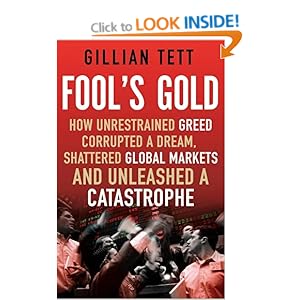
Fool's Gold: How Unrestrained Greed Corrupted a Dream, Shattered Global Markets and Unleashed a Catastrophe

That’s to distract from the rather obvious origins of the financial crisis in government policy abetted by the criminal actions of connected firms, and not in some generic evil capitalist greed curling around Wall Street like a miasma.

Mr Das also highlighted the “glaring” contrast between an erratic and slow-moving Indian legal system that often protects the well-connected, and the swift and harsh punishment handed out by the powerful US courts. “We sometimes catch [people] but we don’t convict,” he said.

“What the US system is saying is that no one is above the law.”

Poor dear Mr. Das. He must have been struck blind and deaf in the past decade if he believes that “in the US system no one is above the law”.

But I guess, even though Das is doing the talking, he’s really a sock puppet, for his masters.

Like this chap, remember him?

But back to Goldman footing Gupta’s bills. Say it’s not just clever PR from Goldman. Say it’s true.

Why would they do that?

Probably because they really wanted Gupta to get off?  If he’s been a corporate wise man all these years, he’s bound to know where some bodies are buried. Lord knows what he’s going to start saying around sentencing time.

[Or maybe they want to make sure the crowd gets someone to pay for all the excesses of the last few decade.  At Forbes, Richard Levick apparently thinks Gupta deserves the harshest sentence possible just because he didn’t make money on the tip, but wanted to become a bigger player..]

Still, I had no idea that criminal defense teams were part of the severance package at these places. Maybe it has to be.

Given what we know about Wall Street culture,  an individually-wrapped securities lawyer is a non-negotiable perk, like stock options, or something.

Or maybe, I wonder if it doesn’t tell us something else.  May be if they’re footing the bill for Gupta, they’re also picking the lawyer. (Naftalis and Bharara are old friends (I originally wrote Rakoff, but I now read that Bharara is a friend of Naftalis, as well, and I can’t find the place I read the reference to Rakoff, so I’ve deleted it))

And maybe if that’s the case, this is even more of a set-up than I thought.

Rajat Gupta Verdict: Bharara Aiming At NY Governorship?

From Shadow Warrior:

“About Preet Bharara, the attorney who went after Rajat Gupta. He simply won’t go after Jon Corzine of MF Global whose committed massive fraud.

http://www.nypost.com/p/news/opinion/opedcolumnists/political_slowdown_in_corzine_probe_nSVAZMDLP4Neo2z3UjiwhM

The publicity hungry and hyper-ambitious Preet Bharara, the US attorney for the Southern District, as well as the heads of the Securities and Exchange Commission and the Commodity Futures Trading Commission, are all longtime Democrats.

Some, like Bharara, are fairly partisan Democrats looking for bigger future jobs. They have much to gain if the investigation doesn’t blow up before Election Day — so it’s pretty convenient that they keep hitting what we’re told are dead ends.

Bharara is rumored to be on the short list of possible successors to Attorney General Eric Holder in a second Obama term, as is FBI chief Robert Mueller.

In other cases, Bharara’s been so eager to drum up good press that’s he’s falsely taken credit for personally recording wiretapped conversations of alleged insider traders. Which makes it odd that he’s said so little about MF Global, the biggest scandal to develop on his watch — especially when we’ve got real victims here, whereas it’s usually impossible to trace investors’ losses in insider-trading cases.”

Arvind said… I do not think it is the crab syndrome. Bharara went after Bernie Madoff. He is part of the Democratic Party machinery.

He seems to be setting himself up for a run at the Governorship of NY. It is SOP to arrest some Wall Street tycoons and then use it as a talking point in elections.

Jon Corzine is a Democrat who was a Senator from NJ and was also its Governor”

Conrad Black: American Justice Is A Pile Of Manure

Conrad Black at the Huffington Post

“But in the blame game, the political class locked arms to scream from the Capitol and White House steps and from the skyscraper tops that “greed” was the problem, in the private sector of course. The tangible encouragements heaped by unsound countrywide on, inter alia, Chris Dodd of Dodd Frank, didn’t count — i.e. the politicians aren’t counting. And Attorney General Holder and his acolytes in the federal prosecution service such as Time‘s current cover heart-throb, set out to end the debate by indicting the opposition debating team, with the enthusiastic collusion of most of America’s bovine, law and order-deluded national media.

Thus the instant pantheonizee, Preet Bharara, who is in fact chasing after alleged inside traders, an activity which had nothing to do with the economic crisis, “collars the masters of the meltdown.” He may be a capable and even, against the odds, a principled prosecutor, but this fatuous bit of Time-puffery does not incite optimism on that score.

If Time had had the privilege of a Damascene bolt of revelatory lightning (that it did not mistake for a UFO), it would have mentioned, as more serious magazines such as the New Yorker‘s Adam Gopnick and the Economist recently have, that the U.S. criminal justice system is a compost-heap of corruption and hypocrisy. All is governed by the plea bargain system, the wholesale extortion and subornation of perjury in exchange for immunity or a reduced sentence. The Fifth, Sixth, and Eighth Amendment guaranties of the grand jury as an assurance against capricious prosecution, of no seizure of property without due compensation, of due process, an impartial jury, access to counsel, prompt justice, and reasonable bail, have long since shrivelled into figments of the imagination of the sentimental, without that erosion being noticed by the national media or even the Supreme Court.

Comment:

Well, as to promptness, the system here is prompt enough, at least compared to, say, India.  But that’s the problem. Sometimes, it’s better for things to take a long time. It would make prosecutors less inclined to prosecute anything but the most egregious offenses, and it would make citizens less willing to go to court, unless they’d suffered the worst kind of injury.

Bharara Sees No American Wrong-Doers, Only Foreigners…

Sonofagun.

More evidence below of the dangerous proclivities of this dangerous man, who, I suspect is carrying on some covert agenda.

I mean wire-tapping businessmen doesn’t only endanger civil liberties. It also threatens the intellectual property of businessmen.

All those trading records, and company filings, and personal information are now on the government’s files.

That can shade ever so easily into corporate espionage, right?

How do you know the government doesn’t send the information it collects to favored corporations?

The FBI has just rolled out a big campaign against foreign espionage on American businesses. Nothing wrong about that.There’s a lot of theft of trade secrets.

But then, maybe it should start looking closer to home.  Google, Facebook, Hotmail, Yahoo, all the hosting companies and even the encryption software – all of them are reading your files, your folders, your emails, your documents, your voip chat.  But of course, they would never be trading on that inside knowledge, would they? And what about the phone companies? And the software in the Justice Dept or at Homeland Security?  Between Amdocs (Israeli firm), CACI (Israeli-American), NSA (USG), Echelon (USG) and the rest of them, every single word, keystroke, and maybe even your thoughts (mind-reading software) is being logged and kept on file with the government and its buddies. And they don’t make a dime off all that, do they?

Is Preet Bharara spying for the empire, under the guise of conducting criminal investigations? Is he spying out where the money is, so under some flimsy legal pretext, the government can seize it? Is this just war by other means?

Dealbook

“Mr. Bharara himself appears to have shifted his focus — at least publicly — away from the prosecution of financial fraud. In recent months, cybercrime has become a top concern, with Mr. Bharara mentioning the subject with increasing frequency in articles and speeches, just as he had in past years with insider trading. Indeed, even as his office was busy trying Mr. Gupta, Mr. Bharara wrote an op-ed article in The New York Times, saying that he had “come to worry about few things as much as the gathering cyberthreat.” At a cybersecurity conference in January, he listed it as his top concern.

“Of all the issues I face as United States attorney — and there are many, many things that I have to deal with that are scary — cyberthreat in all of its breadth, variety and complexity is what worries me the most, the absolute most,” he told attendees.

So far, his office has brought just a handful of such cases, and not all have been home runs. In January, prosecutors charged two Russians with stealing personal and financial information from United States citizens through the use of computer programs. Last year, an appeals court vacated the conviction of a Goldman Sachs computer programmer accused of stealing trading programs from the investment bank.

It is unlikely, however, that insider trading investigations will grind to a halt anytime soon. Several cases remain outstanding, including the prosecution of Anthony Chiasson, a co-founder of the once-prominent hedge fund Level Global Investors. And examinations of other hedge funds continue, as the remnants and offshoots of the Rajaratnam investigation wend their way through the pipeline.”

Comment:

Yep. Now they’ve got a Sri Lankan, an Indian born dude, and a Russian, time to move along…nothing to see here.

Rajat Gupta: Government Seeking To Prevent Brady Reform

In the Rajat Gupta case, the government was eventually forced to turn over Brady material to the defense, though the prosecutor did everything he could to delay from the arraignment in October 2011.

Nonetheless, the Brady disclosure was made only two months (February 2012) before the case went to trial (May 21, 2012). It sent a bill of particulars (specific charges) only at the end of March, less than two months before trial.

That is an incredibly short time for defense to prepare itself, when the government has had five years (2007-2012, if we include the prior SEC investigation) to prepare its case, when there are millions of documents including trading records, phone transcripts, board discussions, and financial analysis, covering scores, if not hundreds, of firms doing business with Galleon and Goldman, or involved tangentially in some other way. [Lila: Actually, a group Rajaratnam funded was raided for suspected ties to terrorism in 2006, so I suspect Big Raj had been under investigation even before that]

Besides the documents, there were 2000 wire-taps and scores of possible witnesses.

Yet, incredibly, a bill of particulars – list of specific charges – was sent to the defendant only at February, the end of March, all while the Galleon trial and tapes got replayed endlessly in the media.

Yet the DOJ is still bent on preventing Brady reform, which might make it easier for defendants to actually get access to the material in time to defend themselves.

Guest blogger Jon May in LawProfessors Blog points out:

“Fundamentally, the flaw in Mr. Cole’s testimony comes from the very examples he cites. Under the current system, witnesses are sometimes harmed. He fails to make a convincing case that either a broader standard or earlier disclosure will lead to an increased risk. And he ignores the fact that the proposed legislation provides for a protective order where the government can show a reasonable basis to believe that a required disclosure would lead to an effort to tamper with a witness. Similarly in claiming that the proposed legislation would undermine national security he fails to explain why the Classified Information Procedures Act is insufficient to protect our nation’s secrets. He just claims it is.

Mr. Cole also relies upon a statistical analysis that purports to show that serious allegations of government mishandling of Brady material has occurred in only a very small percentage of cases, less than three hundredth of one percent of the nearly 800,000 case brought in the last ten years. This is a significant argument because the burden is on the proponents of reform to demonstrate that there exists a problem that is in need of remedy. Mr. Cole’s analysis fails to take into consideration the fact that some 90% of the cases brought by the government result in pleas. Since there is no obligation to provide Brady material during plea negotiations such material is not provided unless the accused actually goes to trial. Mr. Cole’s statistical analysis also contains a built in bias since allegations of Brady violations are almost always evaluated under a harmless error standard. The upshot here is that regardless of the language of the Supreme Court’s decision in Kyles, circuit courts will rarely find a Brady violation absent a showing that the material withheld contributed to the jury’s verdict. Under such a standard, Mr. Coles can contend that reform is not needed since there has been no demonstration of systemic failure; systemic failure defined in such a way as to insure that no such showing could be made.

Finally, Mr. Cole contends that the government already provides greater discovery than is required by the law. Once again, there is no evidentiary support for this contention. While it may be DOJ policy that such evidence should be disclosed, because the law does not currently require such disclosure, prosecutors are under no legal obligation to actually apply DOJ guidelines and suffer no punishment when they fail to do so. Indeed, the current regime incentivizes prosecutors to evade Brady since prosecutors can enhance the odds of conviction through non-disclosure knowing that after a conviction appellate courts are loath to reverse.”