Continuing my impressions of Kuala Lumpur. It’s rained on and off nearly every day, so my chakkars have been limited to the Bukit Bintang area and Chinatown (below). But that’s a lot just there, this being the heart of the city.
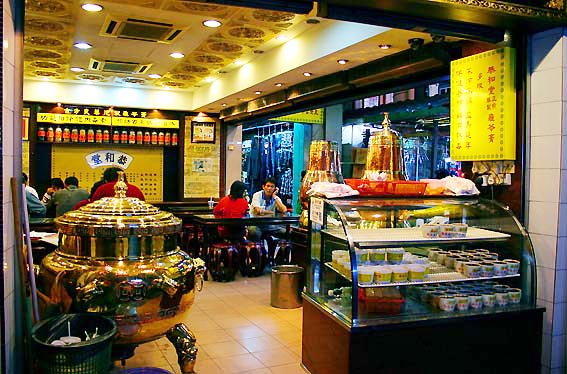
Food. There are restaurants everywhere you turn – Indonesian, Indian, Thai, Italian, Chinese. And so far, they’ve been very good.
The architecture is fascinating, a mixture of tiled Malay buildings and Chinese shop fronts, terraced housing (this is the most common residential style since land is limited in the city), glass and chromium high-rises, with every so often the domes and minarets of the city’s spectacular mosques.
The Indian restaurant below is where a group of us, some backpackers, others professionals traveling on business, meet to compare notes every night.
K, a Muslim cook from London, of mixed Berber and Libyan heritage looks like Bob Marley and identifies with Africa. He divides his time between anti-Arab and anti-European invective that sounds good-natured to me but seems to rub the Swedish student the wrong way. The Swede is quiet mostly, but throws in a question now and again. The questions become quite pointed after K arrives chattily at his conclusion — which is that the quotas against non-Malays in Malaysia make sense. The Malays (the Bhumiputra) ought to be protected in their own home.
The Malay girl, who runs a guest house on the side and deals with travelers from around the world, agrees. Fortunately, the Saudis are too dumb to take advantage of the Malays, she says. But the Chinese? Why do they need help? After all, they’re from some place else….and the Indians too. Malaysia should belong to the Malaysians.
The Swede’s head turns evenly between the two, who are unaware that their views won’t fly in Europe, at least not under current European law. K’s anger against the Arabs for effacing Berber culture is deep-seated. It’s why he insists on calling himself African. They wiped out our culture, he says. They want to pretend we don’t have thousands of years behind us. How dare they call us barbarians?
What he said reminded me almost comically of the complaints of an Arab friend in DC, who often says – just as bitterly – that the Iraq war was a war waged by a modern culture envious of the ancient history of Iraq that was bent on wiping it out and replacing it with McDonalds and Starbucks.
(Actually, I believe Ann Coulter, the right-wing’s human daisy-cutter, did say something like that about ancient Mesopotamian culture: AC: “Now the biggest mishap liberals can seize on is that some figurines from an Iraqi museum were broken ? a relief to college students everywhere who have ever been forced to gaze upon Mesopotamian pottery.” )
If I had a daughter, says K, I would never let her marry one of those Arabs. If they spoke to me I would ignore them. I wouldn’t let them get away with their injustice. I wouldn’t let them forget it.
So, says the Swede, do you think because you were oppressed by them it would be fine for you to oppress them now? Are you waiting for that?
The Swede asks it levelly but there’s an edge to his voice. K feels it and squirms. But he decides to stand his ground, anyway. Yes, why not? If they did it first?
But don’t you see, the Swede persists, then you become like them.
K looks at me helplessly. I accept the challenge.
Well, yes….and no. Of course, you have bitterness over the injustice. The bitterness is an appropriate feeling. It’s deserved. There’s nothing wrong with the anger at all. But practically, where does it get you? If you stew in it and let it poison you then you’ve added your own self-injury – a laceration – to the original harm.
In Europe, we believe there should be no discrimination under the law, says the Swede firmly. All races should be the same. He pets his chubby Malay girl friend who’s paying no attention at all but chatting over wifi about why the US won’t let her into the country as a tourist because of her religion. Most Malays are Muslim.
But there’s plenty of discrimination in Europe, insists K excitedly. Plenty. They hate immigrants there.
Still, the law says they should be treated equally, says the Swede.
K is upset now.
So what? Why does the law matter? It’s all hypocrisy.
It was interesting to hear arguments about race and quotas on the other side of the world no longer defined in terms of European and African, or European and Hispanic, First World and Third World.
My Malay acquaintances openly call the Tamils and Bangladeshis here “stupid” and “retarded.” So does the Swede, though much more gently and without the visceral feeling. Some of the Tamil workers I’ve seen here (and my experience is extremely limited) do indeed act and sound unfocused, even disoriented. But having worked with retarded and disturbed children, slow learners (as well as with the gifted) and seen a somewhat similar deportment among children who don’t make the cut in the regular classroom but aren’t really intellectually inferior in any serious way, I wonder if the problem isn’t mainly cultural. The Tamil workers, being dark-skinned and culturally quite different from the westernized Chinese and Malays, could be retreating into a kind of passive indifference. It doesn’t look like stupidity so much as the aftermath of cultural shock and anxiety. Many workers here are the descendants of indentured labor sent to Malaysia by the British from India. They have the disoriented air of people who aren’t conscious of having their own will… who wait for something to be done to them…or for them. And yes, there may also be a genetic component to differentials in intellectual performance.
But the harsh rhetoric from the Malays, themselves brown-skinned, was unsettling. Especially since foreigners in this country have always had to pay for their own education, whereas even under the British, the Malays had it for free……and were still out performed (as libertarian economist, Thomas Sowell has noted).
This is not the First or Second or Third World. And the whites (here they are the Chinese) and the browns (the Malays) and the blacks (the Indians, the darkest- skinned) may be all Asian – but they come from different races.
Europeans and most Middle Easterners (and a large number of Indians), on the other hand, are not racially different, but different in color only. They are Caucasians, only of different colors.
Hi Lila,
Thanks for this very illuminating story of your time in KL. It’s almost kind of slice-of-life.
There are quite a few issues here, but I shall focus mainly on one: the Bumiputra policy.
If I’m not mistake, the original rationale for the such ‘positive’ discrimination laws arose because of Malaysian independence and the anti-colonial mindset that (rightly) came with it. This was also a time when the Malays were seen as an ethno-religious minority (but a significant one) that needed some form of affirmative action.
However, this is no longer the case. Malay Muslims are now the majority (about 60%) and also the political (and I daresay, military) elite. Never mind Europe’s standards – but in a time where it has been proven that most Malays are still relatively poor-to-middle class compared to the small segment of the ‘Bumis’ who have actually reaped the best of the policies and are very wealthy, one has to question (as I do) the wisdom of retaining such policies.
In an age of globalization where every society on earth is experiencing a more pronounced class system and the widening divide between rich and poor, it just doesn’t seem right, or just, that a country such as Malaysia still has this form of affirmative action policy in place, one that ultimately only uplifts a small segment of their Bumi population, at the same time succumbs to globalization and the very obvious creation of socio-economic classes within the Bumis themselves.
And I won’t even go into the conflation of Malay with being Muslim to require them to be Bumis. Or the status of the Malaysian Chinese and Indians (not just Tamils). Those are whole new cans of worms.
It’s interesting the way you described the perceptions about race and colour in Malaysia. I myself thought that Chinese were considered ‘yellow’, or in some cases, a nice light tan 🙂
Hi Rod –
Sorry to take so long to get back on this…
I’ll start with the obvious one. Yes, I didn’t make it clear that the Bhumi does not equate with Malay Muslim. If you were a Hindu Malay who converted to Muslim in order to marry a Muslim, you would not become Bhumi.
The comments about the Chinese, Indians and Malays was only my impressionistic account. I am aware that Indian professionals and business class have done very well.
I was simply recounting my experiences at the time.
Chinese are sometimes tan, sometimes white and sometimes light gold-yellow.
But they are “white” in relation to the others, just as pinko-gray Europeans are seen as “white” by “colored” populations.
These aren’t purely physical descriptors.
Thanks for the comment.
Lila
Pingback: Bubble, bubble, toil and trouble: Mt. Gox goes poof! | The Mind-Body Politic