China Beware: Gold Price Skating on Thin Data (Update)

Update (November 14, 2009)

This isn’t an update so much as an additional note on the Van Eeden excerpt below.

*Van Eeden has a good track record, but he’s also a disbeliever in any CB or Fed conspiracy to intervene in the markets. Since that intervention is not conspiracy but fairly well-documented, I’m less confident of his opinion.

*Faber, on the other hand, seems to have his ear much closer to the ground.
For instance, he called the RBI one of the best banks in the world on November 6 (see my blog post).

That was just before the Indian bank’s gold purchase. Now, doesn’t it look as if he knew something was coming up? Either that, or he is doing some clever PR for the IMF.

*Faber’s recently (Nov 11) called $1000 the floor for the gold price and has said that it won’t be breached to the downside again.

[However, just a few days ago, on November 6th, he also said gold could drop to $800. I don’t know how to explain this sudden change. It wasn’t the IMF gold sale to the RBI, because that was completed in mid-October and went public on November 3, before both of Faber’s comments].

*Faber argues for much higher inflation than Van Eeden…who doesn’t believe we have inflation..yet.

Now, Faber’s analysis might be overblown, but his conclusion could still be right. Since he’s based in Asia, he could be privy to information that American money managers might miss.

Conclusion: while Faber’s analysis doesn’t seem as sound to me as Van Eeden’s, Faber might just end up being right because he’s factored in market manipulation.

*In response to a reader comment below:- I know Eric Janszen has also called for very high inflation in the 4th Q, which would indicate a high gold price.

************************

From Paul van Eeden:

“The Chinese Communist Party apparently learned from America that debt financed consumption was not a sustainable economic model. Their solution, it seems, is even more absurd: debt financed production in the absence of demand…..

Earlier we reached the conclusion that interest rates could potentially start increasing and cause the US dollar exchange rate to strengthen, which, in turn, would cause the gold price to fall. We can now add that the massive inflation of China’s money supply can cause the renminbi to collapse and send another currency crises rippling through financial markets. A collapse of the Chinese renminbi could also result in a stronger dollar and lower gold price…….

What would happen if China were the epicenter of an economic collapse? What happens when the gold and commodity bulls realize China cannot continue to consume at an even greater pace than it had been when the world was buying its goods, but, instead, now has to work down the excess inventory it built up? It would be a good bet that the US dollar would rally and the gold price would fall.

Given that the gold price is trading at a 25% premium to its fair value and that we can imagine several scenarios whereby the US dollar could rally and the gold price could fall, it seems to me that betting on a higher gold price right now is merely a bet on the Greater Fool Theory.”
Shock! Hedge-Funds Trading On Insider Info

Bloomberg reports:

“Since the arrests (of Rajaratnam and associates) were announced, the SEC has seen an “uptick” in individuals coming forward with information on misconduct, Khuzami said, adding that people trading on confidential information “should be worried.”

Khuzami, 53, said prosecutors will continue using undercover techniques including informants and front businesses to attract wrongdoing and wiretaps to “ferret out” misconduct. The SEC has endorsed legislation that would let the agency pay whistleblowers for information leading to a case.

Khuzami, a former federal prosecutor who joined the agency in March, is reorganizing the division to add front-line investigators, speed inquiries and create specialized units after the agency was faulted for missing Bernard L. Madoff’s Ponzi scheme. He’s also seeking to bolster his attorneys’ powers by gaining greater access to grand-jury evidence and expanding deal-making and cooperation with informants. “

The SEC is also looking “closely” at laws in the 2002 Sarbanes-Oxley Act, which let the SEC punish executives for misconduct at firms even when they aren’t involved in the wrongdoing, he said last month.”

My Comment:

I’m all for busting the bad guys on Wall Street. And RICO laws are the best way to do that because the scams are so extensive. But given that the corruption goes up to the very top, there’s the real risk that the SEC could simply proceed selectively, targeting political enemies or making examples of relatively small players. Selective justice isn’t justice.

I also don’t care for the way informants are being used. When informants are being rewarded and are able to cut deals, what you get is  what you always get when you offer an incentive, more of the activity. We’ll get more informants and more information. How good that information will be is another story. 

When incentives were introduced into intelligence gathering (the outsourcing of information gathering and interrogation to private contractors like Titan and Caci), what did we get? Better information? No. We got torture and abuse.  I’m afraid that’s what we’re going to get with this, as well. The SEC may end up just settling political scores…

Virginia Tech Connections of Major Hasan

At Lew Rockwell, Michael Gaddy asks the pertinent questions about the Fort Hood shooter Major Hasan:

“We know Hasan graduated from Virginia Tech with a degree in biochemistry from the school’s Center for Applied Behavior Systems, most likely on the taxpayer’s dime. While at Virginia Tech did Hasan have any associations with the Defense Advanced Research Projects Agency (DARPA); was he in any way associated with them since his graduation, if so, in what capacity? DARPA states on its website, “DARPA programs focus on high-risk research that will have payoffs that could provide dramatic advances in military capabilities.” DARPA has been rumored to be associated with the MKULTRA program of mind control and Virginia Tech. Cathy O’Brien stated in her book, Trance-Formation of America that “Virginia Tech is good for two things, engineering and mind control.” and that “most of the east coast M.K. Ultra Mind Control experiments happened in this DARPA facility.” 

Another question that deserves an answer is, “Exactly what position did Major Hasan hold in the U.S. Army’s PSYOP community and how did that relate to his dealings with his patients? Also, what was Major Hasan’s position with the US Center for the Study of Traumatic Stress and how did this relate to his duties with the Army’s Warrior Combat Reset Program? Did Major Hasan’s assignment to Ft. Hood have anything to do with a program the Army initiated to “electronically prepare” soldiers for redeployment to Iraq and Afghanistan?”

My Comment

Check out my posts on Virginia Tech from 2007-08 from the category “V-Tech” and also google for subsequent posts.  I haven’t revisited the subject and don’t intend to. There’s enough material on the web for the public to enlighten itself and tripping yourself up on irrelevant details doesn’t help that task.

Mass shootings have been rife in American society recently.  The same elements recur each time: the disarmament of the victims, the association of the perpetrator with the military/intelligence, association with Virginia Tech (in some cases); paramilitary trappings; prescription drugs of some kind; trauma.

Note: I know nothing about the book, “Trance-formation of America”  or its authenticity. But the questions about MKUltra, Darpa and behavioral research are pertinent and need to be looked into.

Feds Seize Four US Mosques Linked to Iran

In the news:

“In what could prove to be one of the biggest counterterrorism seizures in U.S. history, prosecutors filed a civil complaint in federal court seeking the forfeiture of more than $500 million in assets of the Alavi Foundation and an alleged front company.

The assets include Islamic centers in New York City, Maryland, California and Houston, more than 100 acres in Virginia, and a 36-story office tower in New York.

Seizing the properties would be a sharp blow against Iran, which has been accused by the U.S. government of bankrolling terrorism and seeking a nuclear bomb.

A telephone call and e-mail to Iran’s U.N. Mission seeking comment were not immediately answered.

It is extremely rare for U.S. law enforcement authorities to seize a house of worship, a step fraught with questions about the First Amendment right to freedom of religion.”

The Miscreant’s Ball

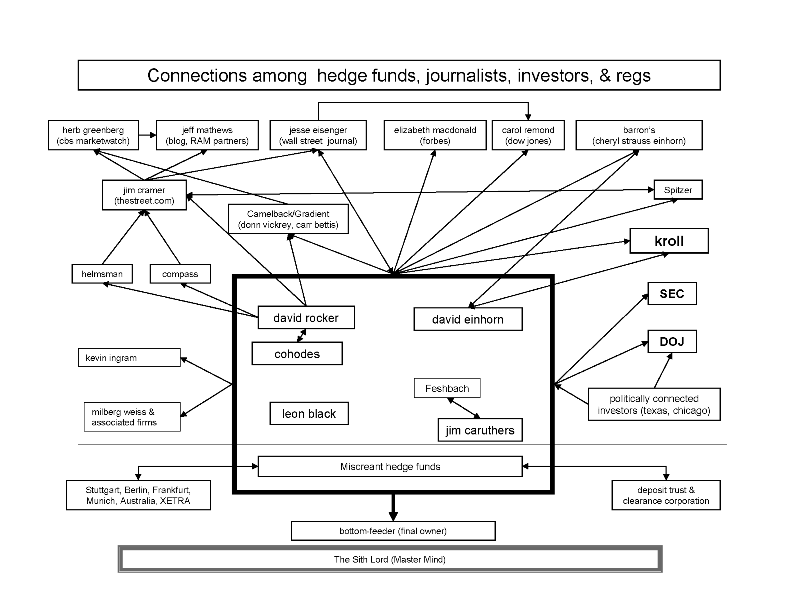
An interesting, if incomplete, chart on the relationship between major hedge funds, journalists, and some pols. Please note that the Jim Chanos -Bethany McLean connection (from Enron) isn’t included.

Chanos is the same short-seller who’s recent comments (that China’s growth was exaggerated) seem to have made the risk currencies give back some of their gains and gold take a slight breather…at least for the moment.  (At least, that’s my insight into it).

So who’s short and who’s long gold and which journalists are in which pockets? Take your pick because that’s probably got everything to do with the various tidbits of news that get floated in the media and then disappear…

Welcome to the free and independent media of the free and independent, liberty-loving, morally superior, culturally advanced, genetically gifted wonder world of the “international community” of nations, aka, crap-shoot-cum-criminal syndicate.

Shop-lifting On the Rise

The global recession has cut into the retail business another way. World-wide shoplifting is on the rise..by about 6% (versus a normal increase of 1.5%)., says the Global Retail Theft Barometer. That’s putting a $115 billion dent in businesses.

The interesting angle here is that, besides the usual suspects, there’s an upswing in middle-class thieves who simply must have that bottle of wine or the Gucci bag that the economic downturn is denying them.

Here’s how the new crime-spree breaks down globally:

 “In terms of total losses, retailers in North America topped the charts at $46 billion, followed by Europe’s $44 billion and $17.9 billion in the Asia-Pacific region. In North America and Latin America, store owners and employees were the leading pilferers; in Europe, Asia and the Middle East, it was customers who were swiping the most loot.”

Now a good part of the theft is still by criminals who resell the stuff. But the middle-class folks who are doing it are not doing it to keep body and soul together. They’re doing it because they think the whole system is rotten from top to bottom and there’s no reason they shouldn’t get their piece of the pie too. Which is the thinking that drove the housing bubble, and before it the tech bubble.

But the more fundamental reason for the crime-wave lies elsewhere. People become de-moral-ized in every sense of the word when the ground on which they stand starts shifting.

Whatever you wish to keep, you better grab it fast,” said Bob Dylan, little knowing at the time he had nailed the philosophy of the financial industry for the next several decades.

When goal-posts move, when rules are changed post-facto, when it’s clear that cronyism not competence is the way ahead – then, anything goes. This is the subject of  “Hyperinflation and Hyperreality”,  an excellent piece by Paul Cantor on Thomas Mann’s short story, “Disorder and Early Sorrow.” Its theme is the moral effect of one form of severe economic dislocation – hyperinflation.

Hyperinflation is not our problem now, but it might be wise to think about what it might entail ahead of time.

Marcie Angell on Fixing Health Care

Marcie Angell on how to fix health care simply:

“Recommendation #1: Drop the Medicare eligibility age from 65 to 55. This should be an expansion of traditional Medicare, not a new program. Gradually, over several years, drop the age decade by decade, until everyone is covered by Medicare. Costs: Obviously, this would increase Medicare costs, but it would help decrease costs to the health system as a whole, because Medicare is so much more efficient (overhead of about 3% vs. 20% for private insurance). And it’s a better program, because it ensures that everyone has access to a uniform package of benefits.

Recommendation #2: Increase Medicare fees for primary care doctors and reduce them for procedure-oriented specialists. Specialists such as cardiologists and gastroenterologists are now excessively rewarded for doing tests and procedures, many of which, in the opinion of experts, are not medically indicated. Not surprisingly, we have too many specialists, and they perform too many tests and procedures. Costs: This would greatly reduce costs to Medicare, and the reform would almost certainly be adopted throughout the wider health system.

Recommendation #3: Medicare should monitor doctors’ practice patterns for evidence of excess, and gradually reduce fees of doctors who habitually order significantly more tests and procedures than the average for the specialty. Costs: Again, this would greatly reduce costs, and probably be widely adopted.

Recommendation #4: Provide generous subsidies to medical students entering primary care, with higher subsidies for those who practice in underserved areas of the country for at least two years. Costs: This initial, rather modest investment in ending our shortage of primary care doctors would have long-term benefits, in terms of both costs and quality of care.

Recommendation #5: Repeal the provision of the Medicare drug benefit that prohibits Medicare from negotiating with drug companies for lower prices. (The House bill calls for this.) That prohibition has been a bonanza for the pharmaceutical industry. For negotiations to be meaningful, there must be a list (formulary) of drugs deemed cost-effective. This is how the Veterans Affairs System obtains some of the lowest drug prices of any insurer in the country.

Costs: If Medicare paid the same prices as the Veterans Affairs System, its expenditures on brand-name drugs would be a small fraction of what they are now.”

My Comment

Point one. Some libertarians take the purist position that the simple solution would be to get the government entirely out of health.  But I wonder if that isn’t utopian at this point

Point two. Since the financial crisis has obviously resulted in a huge and criminal wealth transfer, it’s morally untenable to use a libertarian argument, when it wasn’t used to stop the bail-outs of the banks. In other words, now that we’re in the wealth redistribution business, we can’t suddenly become principled when the population demanding the transfer isn’t the financial industry. 

Point three.  An incremental improvement of the dislocations caused by years of market intervention is the least likely to cause more problems. Angell’s ideas seem like one good place to start.

That said. I still think paying in cash as you go, with small private insurance pools, is the only libertarian solution. 


Trauma and Healing

“A psychologist in the field of trauma, Bessle Van der Kert, made an observation several years ago; he noted that survivors heal when they find a greater passion for something other than their trauma. For me, this is my research on Centeotzintli or sacred maiz. It is a many-years story, but it involves the search for origins and migrations. At a certain point, I was told by elders from throughout the continent: “If you want to know who you are, follow the maiz.” That’s what I do now. In the process, I learned that the stories I had been looking for were right in my own home… from my own parents who are 86 and 81… the stories they had told me when I was growing up that became the basis for my dissertation: Centeotzintli: Sacred maize – a 7,000-year ceremonial discourse.

To be beaten is dehumanizing. To be treated as a suspect population and to be told to go back to where you came from is violating. To be denied one’s human rights makes us less than human. To fight for one’s rights is rehumanizing. To find one’s roots – one’s connections to that which is most sacred on this continent – to that which is many thousands of years old and part of one’s daily life – is affirming and it is to find one’s humanity.”

from “Running Past PTSD,” by Roberto Rodriguez

Chanos Bearish on China

Is China Headed Toward Collapse” asks Politico, relying on legendary short-seller, Jim Chanos, of Enron fame, who is China-bearish.

So are we, as we’ve been hearing the numbers in China are as frothy as souffle. But on the other hand, we’ve also become bearish about hedge-fund managers in bed – ahem, we’re talking metaphors here – with the media, since dipping into the naughty dirt dished up at Deep Capture.

“Chang argues that inconsistencies in Chinese official statistics — like the surging numbers for car sales but flat statistics for gasoline consumption — indicate that the Chinese are simply cooking their books. He speculates that Chinese state-run companies are buying fleets of cars and simply storing them in giant parking lots in order to generate apparent growth.

 Another data point cited by the bears: overcapacity. For example, the Chinese already consume more cement than the rest of the world combined, at 1.4 billion tons per year. But they have dramatically ramped up their ability to produce even more in recent years, leading to an estimated spare capacity of about 340 million tons, which, according to a report prepared earlier this year by Pivot Capital Management, is more than the consumption in the U.S., India and Japan combined.” 

 My Comment

We’re obviously in the middle of info-wars. 

First there was “green shoots,” the mother of all rumors. Then there were the rumors about the US government asking embassy officials to use local currency (we heard that one down here in August); then there was the one about the Chinese walking away from oil derivative contracts; then came the Fisk report about the Gulf Arabs (and others) diversifying away from the dollar; next came rumors about China buying gold from the IMF; following on that it was actually India that stepped up and bought half of the IMF’s gold  – although since the purchase is against IMF SDRs (Special Drawing Rights) and since the Federal Reserve uses several CBs around the world as depositories, this may be just a book-keeping entry for ought we peasants know.

 Mixed in with the financial psyops comes a healthy doze of fear-mongering over swine flu and random shooters….while what we should really be terrified about* slips by under the radar with nary a squawk from the populace.”

*for eg. the approach of biometric IDs, the restriction of free speech, the end of banking secrecy, and the centralization of medical information online

Brazil Blacked Out For Hours…

Half of Brazil was plunged in darkness from 10:15 PM Tuesday for four-six hours, ostensibly because a storm shorted one (or in some reports, three) of five transmission lines at the Itaipu hydroelectic power station that straddles the border between Paraguay and Brazil. The outage affected 50 million people in BrazilThe station also supplies 90% of Paraguay’s power so that Paraguay was blacked out for 15 minutes. 

The company in charge, Furnas, which is owned by the Brazilian state, denies that there was any problem in the transmission from Itaipu to the national grid and dismissed the reports as speculative, though they were affirmed by several other officials

More at AP:

“Despite Furnas’s statement, the ministry’s secretary, Marcio Zimmerman, speculated that an unspecified “adverse meteorological condition” set off a “domino effect” through the grid.

Itaipu has an output of 14,000 megawatts, which supplies 20 percent of the energy needs of Brazil, Latin America’s most economically active nation. All of that was off-line overnight.

The blackout occurred two nights after the US television network broadcast a report in which unidentified former US national security officials claimed massive power outages in Brazil in 2005 and 2007 were caused by cyber hackers attacking control systems.”

This is the CBS report  mentioned in the AP article. For those concerned this is a cybercrime of some sort, here’s a ranking of countries by their contribution to malware – malicious software that takes over your computer to send out spam or anything else your attacker might fancy (Note this is not a report on cybercrime in general, to which China’s contribution is minimal, but just a ranking of where malware comes from. In cybercrime overall, the US accounts for over 60% – more later..)

1. Americans and other non-British English speakers (more than 30% of world’s total, with the Americans contributing about 23%)

2. China (30 %)

3. Brazil (14.2%)

4. Russia (4.1 %)

Two technologically strong countries that use English, the UK and India, both ranked low, jointly contributing only 1.3%, with most of that from the UK, according to this Forbes report. According to the report, Russian security guru, Eugene Kaspersky, explains this as due to cultural differences. A Businessweek-Symantec report from September 7, 2007 puts India’s contribution at 3%. (the report can be found in a more user friendly format here at engimasoftware).