Note Ban Targets Informal Finance, Small Biz, Small Farmers

NOTE BAN FALL-OUT:

(In Progress)

1.  Silk-weaving:

(Varanasi, Uttar Pradesh, Dec. 24, 2016)

50% drop in demand and in production among bigger weavers. Sale of previous inventory at much lower prices. Smaller weavers even worse hit. Half of the 30,000 daily wage workers,  or 15,000 people, put out of work. No money to pay workers or suppliers.

2. Timber:

(Haryana, Uttar Pradesh, Uttarkhand, Punjab, Kashmir, Jan 12, 2017)

At least 500,000 workers out of work. Total loss to the industry of at least Rs. 180 crores or Rs. 18,00,000,000 (1.8 billion).

The entire timber industry shut down within one week of demonetization. The losses are from the 30-day shut down.

3. Chit funds:

(December 28, 2016)

55% of the chit fund industry’s cash flow has been lost. In urban areas the monthly flow is Rs. 3-5 crores (300-500,000) Rural chit funds have been hit even worse, because of smaller cash flows. Chit funds are a unique savings and borrowing for lower and middle-income families, but they cannot tap in bank loans like other non-bank financial institutions to tide over the crisis.

Indeed, the entire informal financial sector (chit funds, nidhis, hundis) – some 26% of GDP and 40% of formal bank lending –  has been permanently damaged.

Informal finance is one of the two primary targets of DeMo, fronted by Modi, but pushed by the globalist financial cabal.

4.  Ceramics:

(Surat, Gujarat, December 14, 2016)

25% of ceramic units in Morbi, hub of Gujarat’s  ceramics industry shut down (responsible for 4,200 crores exports).  Another article dated December 5 (see below) says 60% of the ceramics business was likely to be shuttered. 200 out of 650 large ceramics factories in Surat were closed as of November 26th. Business down from 65-70 crores/day to 25. Over 2000 auxiliary industries affected.

5. Diamonds:

(December 5, 2016)

The Surat (Gujarat) diamond industry, worth 95,000 crores (a crore is Rs. 10 million) has seen a decline of 25%.  The business traditionally relied on the angadia cash payments  (a local hawala system using couriers). This was banned in 2002 but still accounts for 30% of the business. It has ground to a halt.  200 factories shut down in the first week of December.

6 Farming:

(Maharashtra, Dec. 16, 2016)

Farm auctions could not be held for 10 days because there was no cash, so red onions that could not be stored sold at half price, putting many marginal small farmers out of business permanently. The same situation plays out in elsewhere in the country.

In Delhi, by Nov. 11, perishable horticultural produce has been badly hit. Onion and potato prices have halved.Rabi or winter crop sowing in farming areas across the country have been affected because of lack of money to buy inputs.

7. Fish markets

(Bengal, November 13, 2016)

Malancha the gigantic fish market 100 km south of Kolkata is 40-50% dry. The largest of some 12 mega fish markets in south Bengal, it normally sells 15000 kg of fish every day. Azibor Rehman, the owner of the biggest fish depot there, says it is the biggest depression he has seen in 50 years. Small farmers who keep notes at home and have no bank accounts are being fleeced by 20% rates to change their notes.

In Goa, fish vendors throw away fish and lose business, as customers prefer to pay for fish with cash.

8. Tourism:

(Goa, Dec. 23, 2016)

90% of tourists at Anjuna have left. Restaurants have shut down and workers are out of jobs. Tourism in India employs 50 million people, 10% of the Indian work-force (more than the population of Colombo) and they are all affected by the note ban. Foreigners can only exchange 2.5% ( Rs. 5000) of what they could before the ban, which was about Rs. 200,000/week or $3000.

9.  Bicycle manufacturing

(Ludhiana, Punjab, November 26, 2016)

Production is down by 50%, there are no fresh orders, and parts cannot be ordered. Ludhiana is the hub of India’s bicycle manufacturing industry. It produces 1.4 crore bicycles at a value of 7000 crores or Rs. 70,000,000000 or $70 billion. 1/3 of migrant workers in the industry have lost their job and gone home to Bihar and Orissa. The bicycle ancillary industry, which employs 300,000 people, have reduced hours by a third.

10.  Small and medium enterprises

(Delhi, Dec. 11, 2016)

A death knell for India’s small and medium enterprises, says the chief executive of Ambit Capital.  Indian  regulations deliberately favor small and medium enterprises over big businesses.  The cash crunch delivered a death blow to them, leaving the market open for big business. Entering the “white” world, would force these businesses to pay taxes, legal minimal wage, and regulatory fees, making their margins too small for them to continue. 30 million Indians work in manufacturing, with 10 million working as self-employed,  with no hired hands outside the family. Those with hired labor on average have 7 or fewer employees.

Here were see another primary target of the globalists’ plan for India.


Modi Retracts DeMo Jail Penalty Day After Proclaiming It

Any reputation for efficient management that Modi might have acquired has been permanently destroyed by the demonetization fiasco, which whiplashes between tragedy and farce.

Economic Times:

A day after approving an ordinance regarding punishment for those holding old notes in possession, government officials on Thursday clarified that keeping demonetised notes will not land you in jail, according to a PTI report. It also said that the minimum fine for holding old notes beyond March 31 will be Rs 10,000. “
[Lila: Down from 50,000 or 5x the value of the illegal notes.]

India Cash Lock-Down To Last Into Late 2017

How is this not economic warfare?

Nilakantha Rath at Livemint:

My latest informal information about the capacity of the four presses is: The two government presses together can print 18 million pieces a day and the two RBI presses can print 43-45 million pieces a day. Let us assume their capacity at 44 million pieces a day. This is significantly smaller than the 100 million pieces per day capacity assumed by former Union finance minister P. Chidambaram. I stick to my estimate.

Let us assume that the printing of the new Rs2,000 notes started in the two RBI presses in Mysuru and Salboni in early September. These two presses together can print 44 million pieces a day. So, if they were to print these every day, except Sundays, then a total of 3.43 billion Rs2,000 notes can be printed in 78 working days, which is 13 working weeks, or three months, from the beginning of September—that is, early December.

According to some reports, the design of the new Rs500 note arrived at the Nashik printing press in the beginning of November and printing started soon after. However, within three weeks, RBI found defects in the new note. So, the printing of the new Rs500 notes was shifted to the RBI press in Mysuru. Therefore, there was only one RBI press printing the Rs2,000 note, in Salboni, from around 21 November.

From this day, only one press would have been printing the total of 800 million notes. That would require 10 more days. So, by around 10 December all new Rs2,000 notes, valued at Rs6.86 trillion, should have been printed. And before the end of December they should be available in the market.

But as of today, the total value of new notes put into circulation is said to be just above Rs5 trillion. This implies that, apart from the lag involved in putting out the newly printed notes in the market, printing has been slower than assumed above.

Now let us turn to the new Rs500 notes. Exactly 17.17 billion pieces of these new notes have to be printed. Assuming that the printing of these notes started in the two government presses and the one RBI press from 21 November, the amount printed by 10 December (when the fourth press would also take up this work) should have been 680 million notes (at 40 million per day x 17 working days). From 11 December, printing of the new Rs500 notes could start in all the four presses. The work of printing the remaining 16.49 billion notes should take 266 working days, that is, 45 weeks, which is seven weeks short of a year. So this work will only be over by the first week of December 2017.

There was hope that a significant part of the old notes would not come back to RBI through banks. But the latest data on the return of old notes to banks appears to belie that expectation.

In light of the slower-than-expected flow of the Rs2,000 notes, which should all have been in the market by now or in a few more days, there is reason to doubt the speed of printing assumed in this calculation. We have not taken into account the possibility of breakdown of the old presses in Nashik and Dewas, holidays other than Sundays, and other delay-causing circumstances. There is also the need to print Rs100 notes and even notes of lower denomination.

Even by the end of May 2017, only about half the number of Rs500 notes will have been printed. This means, only a little over Rs9 trillion worth of new notes, in place of the more than Rs15.44 trillion in old notes, will be available in the market. This is about 59% of the total value of high denomination notes taken out of circulation. That surely does not imply any great easing in the cash availability situation by the end of May 2017.

The shortage of currency has caused a loss of income, employment and the ability to spend from one’s income/savings for a wide section of the population. In Mathura and Surat, the country’s two major textile centres, nearly half the powerlooms are closed and many workers have reportedly gone back to their villages. The same is reportedly the case with leather units. Indeed, this is so for a wide range of small industrial units across the country.

There is a shortage of cash with farmers at the beginning of the rabi, or winter crop season. The end of the kharif (summer crop) season has found traders unable to buy different farm products from farmers due to a shortage of cash. And the farmers, with little income in hand, are unable to repay loans. The banks are unable to help. Small traders are struggling to find ways of meeting customer needs without cash. It is difficult to assess the all-round distress in employment and income as well as consumption.

Can digital transactions help? According to the RBI, there were 26.3 million credit cards and 712.4 million debit cards in the country by the end of August this year. This is a sizeable number. But, apart from cards held by offices and shops, there are people with multiple bank accounts who have more than one such card each. Many members of one family would also be having such cards.

But the most important thing is that many cardholders use the cards to withdraw cash from their bank accounts. Think of the long queues at ATMs after 1 December and one will realize the main purpose for which most people use their cards. For the bulk of the non-cardholder population and even for those with cards, cash is very important.

All this will get reflected in a lower gross domestic product (GDP) at the end of this financial year. That situation is not likely to become normal before the middle of the next financial year. The hope of a substantial part of the old currency not returning to banks has been belied. So, no new currency can be borrowed from the RBI by the government in its place. The indirect taxes of the states and the centre are already showing signs of decline. The total budgetary situation does not appear rosy at all.

A cool consideration of the above facts will show us clearly why former prime minister Manmohan Singh called this “strike” “monumental mismanagement”. Whom shall we blame but ourselves!”

Lila: Who is “ourselves”? The hapless population which had nothing to do with it?

The RBI staff, who apparently were shut out of the decision?

The government, which was informed after the fact?

Or was it Modi, a small group of conspirators and the global cabal that bribed and backed those conspirators to implement a black-operation equal to 9-11 that has brought financial and digital dictatorship to India.

Bill Gates Reaps Mega Profits From Cashless India

From Wolfstreet.com:

Another person who has come out strongly in favor of the government’s actions, for very different reasons, is the world’s richest (official) billionaire, Bill Gates, who just happened to be in India on business a few days after the government’s decree.

“The world as a whole will go cashless, but predicting for any country when that will happen is very hard,” he told the Indian prime minister. In Gates’ opinion, India’s latest move should put it at the forefront of the fintech revolution: “All of the pieces are coming together,” he said. “I think in the next several years India will become the most digitized economy, not just by size but by percentage as well.”

Gates has good reason to be excited at such a prospect. After all, both, Microsoft and the Bill and Melinda Gates Foundation stand to benefit enormously from a more digitized Indian economy. As the Indian financial daily Business Standard notes, Gates wants to partner with the Indian government on a whole raft of major initiatives, including cyber crime, digital health, digital literacy, e-agriculture and, of course, e-payments.

During his stay in India, Gates had a meeting with the government’s Minister of Information Technology, Law and Justice Ravi Shankar Prasad to discuss those collaborative opportunities. Industry experts say that Microsoft is already providing back-end support to a number of payment banks in India, which are set to launch in the next few months. According to Business Standard, the Ministry has requested the Bill and Melinda Gates Foundation to be part of the digitizing process.

“It’s a very exciting time in India and some of these digital platform opportunities are really quite amazing,” Gates gushed after the meeting. “The government has invested manpower and the payments banks and payment infrastructure. It is now a case of building the applications on top of those. We need to work on health issues, health applications. Our Foundation is committed to working on those areas – our relationship with this Ministry will be very critical for us,” Gates said.

That the Bill and Melinda Gates Foundation should emerge as an important advocate and beneficiary of India’s demonetization drive should come as little surprise. The foundation has carved out an important role for itself in India since launching operations there in the early 2000s. It is also one of the most vocal proponents of a cashless economy. As Gates himself wrote in the Bill and Melinda Gates’ Foundation’s 2015 annual letter, poor communities in emerging economies — in particular Africa — represent a wonderful untapped potential for e-payments providers (emphasis added):

“(B)ecause there is strong demand for banking among the poor, and because the poor can in fact be a profitable customer base, entrepreneurs in developing countries are doing exciting work – some of which will “trickle up” to developed countries over time.”

In 2012, the BMG Foundation helped launch the Better Than Cash Alliance (BTCA), a UN-hosted partnership of governments, companies and international organizations whose stated mission is to “accelerate the transition from cash to digital payments globally through excellence in advocacy, knowledge and services to members.”

As we’ve pointed out before, in light of the inexorable advance of electronic payment systems, cash’s days may well be numbered. But there is a whole world of difference between a slow natural death and euthanasia. It is now clear that an extremely powerful, albeit loose, alliance of governments, banks, central banks, start-ups, large corporations, and NGOs are determined to pull the plug on cash — and their vehicle of choice is the BTCA.

The BTCA’s membership list reads like a Who’s Who of some of the world’s most influential corporations and institutions. They include Coca Coca, Visa and Mastercard, the Citi Foundation, the US Agency for International Development (USAID), the World Saving Banks Institute, which represents 7,000 retail and savings banks worldwide, the Ford Foundation, the Clinton Development Initiative, and a bewildering alphabet soup of UN organizations.

But as we warned in October, it’s BTCA’s member governments that matter the most, for it is they who will ultimately be shaping or even bending the laws and traditional practices of their respective lands to “accelerate the transition from cash to digital payments.”

BTCA currently has 18 member governments among its ranks, all of them representing emerging and developing economies, the most important testing grounds for cashless economics. They include India, which joined the organization on September 1, 2015, exactly a year after the launch of Modi’s flagship financial inclusion program Pradhan Mantri Jan-Dhan Yojana, which saw 175 million new bank accounts created. In BTCA’s own words, its new partnership with India is an “extension of the Indian Government’s commitment to reduce cash in its economy.”

It’s a commitment that the government has now more than honored. And amidst all the chaos and impoverishment that its actions have unleashed, Bill Gates hopes to reap the benefits. By Don Quijones, Raging Bull-Shit.

This is how “Economic Shock & Awe” turned into “Nightmare without End.” Read…  India Launches War on Corruption, Hits Cash, Chaos Ensues

Na(chiket)Mo(r) Hatao, Desh Bachao

Bengal CM Mamta Banerjee needs to revise her anti-demonetization slogan, Modi hatao, desh bachao (remove Modi and save the country) to Mor hatao, desh bachao
(remove Mor and save the country).

Behind professional patriot NaMo (Narendra Modi), we find career globalist NaMo (Nachiket Mor), Bill Gates’ emissary in India.

A RTI (Right to information) request uncovers that the demonetization decision was hurried through hours before the announcement by Modi by a small cabal on the RBI board, which normally should have 21 members.

In response to a right to information request, which Hindustan Times has sought, the RBI said the bank’s central board of directors made the recommendation at its meeting in New Delhi on November 8. Only eight of the 10 board members attended the crucial meet.

Apart from RBI chief Urjit Patel and economic affairs secretary Das, the meeting had RBI deputy governors R Gandhi and SS Mundra, Nachiket M Mor (Na Mo, by a bizarre coincidence) the country director for the Bill and Melinda Gates Foundation, Bharat Narotam Doshi, former chairman of Mahindra and Mahindra Financial Services Limited, former Gujarat chief secretary Sudhir Mankad, and financial services secretary Anjuly Chib Duggal.

The law provides for a 21-member board, including 14 independent members, but the central bank has been operating with less than half.

Between the RBI board meeting and Modi’s demonetisation announcement, the government just had a couple of hours to process the bank’s formal recommendation.

Prime Minister Modi had convened a meeting of his cabinet later in the day when they were told about the decision. The ministers — who had to leave their mobile phones outside — were told to stay back till his address was telecast.

It isn’t that the RBI or the government hadn’t been making preparations for the mammoth notes recall exercise. The bank had already printed Rs 4.94 lakh crore in Rs 2,000 notes by November 8.

But former RBI officials said this implies that the board’s approval was a formality.

The way the demonetisation decision was taken was “highly irregular”, said a former top RBI official, who didn’t wish to be named. He said he did not believe the government and RBI had taken “adequate steps” to minimise harassment of people.

Another said he was concerned at the large number of vacancies in the central board. Of the 14 independent directors, the board has just four.

“According to the RTI reply, only three of them were present (at the meeting). That is the quorum,” he said.”

So, a board that is supposed to have 21 members, operates with 10. Of the 21, 14 are supposed to be independent, but only 4 of the 10 are.  Of the ten,  only 8 attended the crucial meeting. Of the 4 independents, only 3 attended.

Why so many Gujarati hands?

And who knew that the Bill and Melissa Gates Foundation, represented by Nachiket Mor, and Mahindra and Mahindra (constantly promoted by Rush Limbaugh, by the way) have a say in RBI policy?

A little googling shows that the Gates Foundation is a big supporter of bringing all Indians into the banking system:

September 07, 2015

India’s banking sector is on the cusp of change. With the RBI’s recent licensing of 11 Payments Banks, the sector is poised for much-needed disruption that will bring millions of Indian households into the formal financial system for the first time.

The World Bank (2014) estimates that 47% of Indian adults are cut off from the formal financial system. This forces poor households to live their financial lives in the physical cash economy, which is both precarious and expensive. Imagine being able to save only in cash, jewelry, or livestock. Imagine having no option but to turn to a local moneylender in an emergency, or having to rely on informal couriers to send money to your family. Imagine having to go through a local official every time you want to access your social welfare transfer or pension payment. The cost and stress of conducting even simple financial transactions would be stifling.

The Prime Minister’s Jan Dhan Yojana financial inclusion program is closing this gap by encouraging banks to open accounts in poor and rural communities. Since August 2014, banks have opened 177 million accounts under PMJDY, making it the largest account opening drive in history. However, as with India’s previous mass account opening drives, banks are more focused on opening accounts than building a strong network of last-mile banking agents to service those accounts. A recent MicroSave (2015) survey of 2,682 banking agents found that India’s agents were the least trained and least profitable among the six countries surveyed. This is where Payments Banks are a game changer.”

Nichiket Mor is a Yale Greenberg World Fellow and a prominent voice for financial inclusion, which, on its face, sounds like a good thing.

Financial inclusion projects purport to save poor Indians from the grasp of local money-lenders and put to use idle stores of cash and gold.

As usual, empowering the poor is the cover:

Nachiket Mor is a renowned financial expert committed to financial inclusion and health care sector reform. In 2016, he was named director of the India office of the Bill and Melinda Gates Foundation. Previously, he was chairman of the board for CARE India, a nonprofit working toward the empowerment of women and girls from poor and marginalized communities, as well as member of the Boards of Reserve Bank of India (RBI), National Bank for Agriculture and Rural Development (NABARD), CRISIL, Institute for Financial Management and Research, CIPLA, and IKP Trust. He is chair of RBI’s Advisory Committee for the Licensing of Payment Banks; and a member of the government of India’s Task Force on Primary Health Rollout, the Health Commission for the State of Himachal Pradesh, and the Task Force on Global Health at the Institute of Medicine in Washington, D.C. From 1987 to 2007, he worked with ICICI Bank, India’s largest private lender, and was a member of its board of directors from 2001 to 2007. He left his position within ICICI to serve as the founding president of the ICICI Foundation for Inclusive Growth, the bank’s corporate social responsibility wing. “

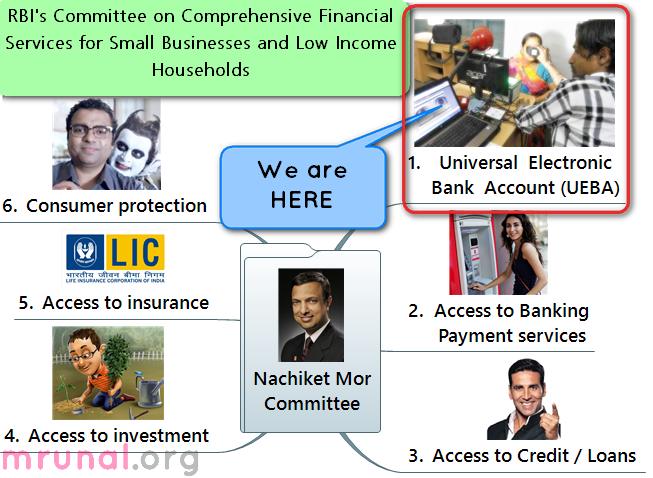
Mor’s 6 point vision for India:

universal electronic bank accounts for financial inclusion Nachiket Mor Committee

So, Mor seems to be a proponent of  linking bank accounts to the Aadhar card (India’s biometric id, the largest of its kind in the world).

The Modi govt is forcing Aadhar through, although the Supreme Court claims it is voluntary, through  schemes such as the  Jio free sim for Aadhar-linked cards (in Tamil Nadu). Jio is a product of billionaire Mukesh Ambani’s Reliance company.

Using the pretext of helping poor people out of the fire of debt to the money-lender in the village, the Mor 6-point vision moves the poor, middle-class and rich into the frying-pan of debt to the global banking system and casino capitalism.  The global markets, as I’ve shown repeatedly on this blog,  are heavily rigged in favor of the big banks and the global cabal.

The Mor/Gates Foundation vision is also fully involved in extending “health-care” to Indians – via vaccines, big pharma experimental drugs, and the rest of the toxic brew that has poisoned even highly-educated and politically-aware Western populations.


Myths and Facts About Black Money

In the headlong pursuit of a completely digitalized economy some fundamental truths have been denied or distorted by the media and replaced with popular myths:

I MYTH: Digitalization is a feature of advanced economies. Less developed countries should be moving toward it.

FACT: According to the Wall Street Journal, 80 percent of German transactions are in cash, while in the US, the figure is 32%. Hoarding of cash is common where negative interest rates prevail or are threatened by the government. Hoarding occurs widely in Switzerland and Japan.

FACT: Digitalization is a BUG, not a feature, of advanced economies. It is digitalization that enables the banking system to manipulate people’s financial habits. The aggressive marketing of debit and credit cards traps unwary consumers into greater and greater indebtedness.

II MYTH: Income from non-criminal activities hidden from the tax-man is as “black” as income from immoral, criminal, or subversive activity hidden from the tax-man.

FACT:   Merchants and traders who hide their money from the tax-man are simply not anti-social elements like terrorists or drug-peddlers. For one thing,  merchants do pay other taxes besides income taxes. Secondly, since they are self-employed and create jobs, they act as the engine of the real economy, from which the professional and bureaucratic classes derive their own income.  Many would not remain in business if they had to comply with the regulatory and tax burden imposed by the government, not only for financial reasons but because such transparency would compromise their trade secrets and expose them to business theft, very likely from the corrupt nexus of big business and the state.  Third, having a large part of the economy based in cash protects the whole economy from the direct manipulation of global finance capital.  Rather than eliminating the cash-based kulaks, the rest of India should be emulating them.

III MYTH

Demonetization is a temporary “inconvenience” that a patriotic Indian must put up with for the greater good.

FACT: Expropriating the savings  of people across the board for WHATEVER scheme, even if it were the most brilliantly conceived and executed,  is a monstrous act, unique in the annals of constitutional republics with a functioning judiciary and press.

And expropriation it is. The notes theoretically are being “exchanged.” In practice, people cannot withdraw their own money for living or business expenses beyond stringent limits, and this state of affairs is likely to last for at least 7-9 months, if not longer. Those businesses and individuals that cannot survive with these restrictions have been eliminated. Permanently. Whole industries are closing down. The country is extremely vulnerable to foreign military attack or embargo in this state.

On top of that, the demo has set off a huge migration of the population back to the villages.

Modi now claims that that was his intention all along. (Adding a third explanatory layer to his constantly revised narrative about black money).

But explanations are redundant at this point.

It is shocking that an Indian PM even suggests that such a sweeping, radical project can be imposed unilaterally, no matter what the cost.

Such a utilitarian calculus, sacrificing whomever the PM wishes to whatever vision he thinks is necessary, is no better than that employed by Hitler, Stalin, Mao or any other totalitarian dictator from the right or left.

It is an assault on the people’s right to property and life in the most fundamental way.

Shame on the media for covering this fact over with phony rhetoric about “poor planning” and “poor implementation.”

Carpet-bombing an entire nation in ostensible pursuit of a handful of terrorists is a war-crime, irrespective of its planning or execution.

It is genocidal in effect.

So is seizing an entire economy’s cash supply.


Modi Indonesian Partnership Follows Reuben, Rothschild Investments

Modi’s strategic interest in Indonesia seems to follow investments made by the Reuben brothers and the Rothschild family:

London – Britain’s billionaire Reuben brothers are setting up a partnership with Transasia Minerals Holdings to tap Indonesia’s coal and metals deposits, lured by the country’s vast mineral wealth.

The project means a return to natural resources for the siblings, who built their fortune with Russian aluminium company Trans-World Metals, but later sold out and put their money in private equity and property.

The pair will buy a 30 percent stake in the venture, the Asian Metal Resources Corporation (AMRC), the parties told Reuters on Friday. Transasia, which is owned by the Aslanov family from Uzbekistan, will hold the rest.

“Reuben Brothers has huge experience and knowledge in terms of the business of natural resources, and attracts the support of the world’s largest institutions as a result,” a spokesman for Transasia said in an emailed statement.

The two parties did not disclose financial details, but a source close to the two families said that the brothers would pay an initial $500 million in equity and debt, valuing the entire venture including debt at $1.7 billion.

The brothers, who are making their investment through Reuben Brothers Resources, have also negotiated the right to raise their stake to 49 percent at a later stage.

The deal follows Nat Rothschild’s venture into Indonesia, where the banking family’s scion holds 11.7 percent in miner Bumi Plc after a tie-up with the politically well-connected Bakrie family.

Spread across 17,000 islands, Indonesia has some of the world’s largest deposits of coal, gold, copper and tin, and there is increasing interest from investors in the strategic potential of Southeast Asia’s largest economy.

The joint venture between the two families will acquire and develop mining interests in Indonesia, specifically coal in Borneo, copper and gold in Sumbawa and surrounding islands, and nickel on Sulawesi, the parties said.”


Evidence Of Birla, Sahara Bribing Modi

From the Wire:

In 2013, there was a CBI raid on the Aditya Birla Group of companies, in particular Hindalco, in connection with the coalgate scam. In that raid, apart from recovering Rs 25 crores in cash, the CBI also recovered some information stored in the computer of the CEO of the Birla group – Amitabh. Several documents were recovered – some of them showed bribes being paid to some Environment Project J, which is obviously to the ministry or to the minister of environment. We know that around the same time the Birla group of companies was trying to secure environmental clearances from the ministry of environment for a large number of their projects. So those clearly represented bribes paid for getting the environmental clearances. There was another set of documents which was recovered from the computer of Shubhendu Amitabh, which said, “Gujarat CM – Rs 25 crores. 12 paid. 13?”

Unfortunately, though these documents showed payment of bribes and therefore, offences under Prevention of Corruption Act, the CBI did not register any FIR on this matter but just passed the papers on to the income tax (IT) department.

Income tax department did a somewhat detailed investigation into the matter. They questioned Amitabh many times in which he admitted that he had written, “Gujarat CM – Rs 25 crores. 12 paid. 13?” But he said that “Gujarat CM” meant Gujarat Alkalis and Chemicals. When asked what the C and M stood for he was unable to answer and the IT department concluded that he was lying.

They also found that there was a large amount of cash which was being received through Hawala by the Birla group and was apparently being paid to various people. But despite this the IT department did not refer the matter back to the CBI for investigation of these ostensible offences under the Prevention of Corruption Act and the matter was sought to be buried at that level. After that we understand that the Birla group has approached the IT settlement commission for settling the matter and the hearings have been concluded; the matter is likely to be settled after which there is this apprehension that the papers seized in the raids will be returned back to the Birla group.

The Sahara raid took place on November 22, 2014. In this raid Rs 137 crores of cash was seized from their offices in Noida, from the corporate office of the chairman, and a large number of documents, some loose sheets, computer data from his personal staff were seized, which showed details of proposed as well as actual payments made to various senior political figures. One of the documents which was seized – a printout of a detailed spreadsheet – in which the first three columns represent the cash the Sahara group received on different dates from different sources and the total comes to Rs 115 crores. Thereafter, this document also represents cash payments to different people on different dates and the places where the payment has been made, and the persons who have taken the payment are also mentioned. It is signed by the IT officer, two witnesses and one of the Sahara officials. Several such documents were recovered in this raid. There was another one which was partly overlapping with minute differences. For example, in the previous one the payments which were referred to as, “cash given at Ahmedabad, Modiji”, in other documents they are referred to as, “cash given to CM Gujarat”. There are Rs 40 crores given at Ahmedabad to Modiji, Rs 10 crores given to CM of Madhya Pradesh, Rs 4 crores to CM of Chhattisgarh, Rs 1 crore to CM of Delhi which at that time was Ms Sheila Dikshit. These are all payments made between 2013 and March 2014.

Despite recovery of such incriminating documents and in such detail which showed pay-offs made to various senior political figures, the IT department did not refer this matter to the CBI for investigation under the Prevention of Corruption Act. They apparently prepared some appraisal report which according to my understanding does not deal with these papers and the pay-offs, and these documents were buried. The person who was responsible for burying the documents of both Birla and Sahara was K. V. Chowdary, who was heading the IT investigations at the time and thereafter was appointed, apparently as a reward, as the chief of central vigilance commissioner of the Central Vigilance Commission (CVC). It was the first time a revenue officer was appointed although there were a number of complaints against him; his name appeared several times in the entry register of the infamous former CBI director, Ranjit Sinha, who was involved in interfering with the income tax assessment of Ponty Chadha. He was also involved in the stock guru scam which is apparently still under investigation. Despite that, Chowdary was still appointed. We challenged his as well as the appointment of another person in the CVC. Because of our information that he played a major role in suppressing the information, we have filed an application. When I got these documents in October, I sent a complaint to CVC, CBDT, the Enforcement Directorate, CBI and to the SIT on black money, saying that these are highly incriminating documents and according to the principles laid by the Supreme Court in the Jain Hawala case these should have been investigated – whether these payments were made, why were they were made, if these were bribes or some other kind of payments – but none of that was done. The matter was sought to be buried.

Therefore, we have eventually moved the Supreme Court, filed an application in the petition that we had filed challenging the appointment of the CVC and that application will be heard on Friday.

Sahara diaries mention a lot of names but they don’t specifically name the politicians, for example, like you said the Delhi CM and so on. Are there more? Who are the other prominent politicians mentioned in the list?

There’s Madhya Pradesh CM Shivraj Singh Chouhan, Delhi CM at the time, Sheila Dikshit, Chhattisgarh CM Raman Singh and the Gujarat CM at the time, Mr Modi. Mr Modi is also personally mentioned as Modiji. Largest payments are made to him in the Sahara diaries, more than Rs 40 crores. One other politician which is mentioned prominently is Shaina NC of the BJP and one of the documents says that she was being asked to intercede with the advocate general of Maharashtra for withdrawal of some case which was pending against Sahara. Perhaps the Sebi case (which was mentioned as the Bombay case in the papers).

The Modi government is already in the know of these papers because you have already written to various agencies. What are the kind of replies you got from the government?

Well, I only received one response from the CVC after ten days saying, “Will you please confirm whether you have sent this complaint?” I immediately confirmed that I sent this complaint and I am not aware as to what they have done, or whether they have done anything in this matter because unfortunately, it seems that the CVC himself, as the head of investigation of income tax was responsible for suppressing this.”

Modi Bribed By Globalist-connected Sahara

Rahul Gandhi has come out with the revelations he’s been promising for a few days – evidence that Modi was bribed in his Gujarat days by the now-jailed owner of the Sahara group conglomerate.

Glancing at Sahara’s resume, I was struck by this piece at Crain’s that suggests that Sahara works closely with and is beholden to the powers-that-be:

Next month’s auction for the Plaza Hotel in Manhattan was canceled after the holders of the mortgage reached a deal to give the borrowers more time to sell the property and pay back the loan, said a person with knowledge of the matter.

The hotel’s ownership has been in limbo for two years. Billionaire brothers David and Simon Reuben [Lila: Iraqi Jews born in India] hold the mortgage on the five-star hotel and had scheduled a foreclosure auction for April 26, according to the person, who asked not to be named because the deal is private. The Reubens bought the loan from Bank of China Ltd. after a default by the property’s current majority owner, Sahara India Pariwar, last year. Sahara is controlled by Subrata Roy, who was imprisoned in India in early 2014 for defrauding investors.

A spokesman for the Reuben brothers didn’t immediately respond to an e-mailed request for comment.

The chateau-like Plaza, located at the corner of Fifth Avenue and Central Park South, has changed owners many times over its 109-year history. Presidential candidate Donald Trump bought the Plaza in 1988 and married his second wife, Marla Maples, there. Trump sold it to a group including Prince Alwaleed bin-Talal of Saudi Arabia, who then sold it to Israel’s Elad Group, which converted some of the hotel rooms to condominiums. Bin-Talal retains a minority stake in the Plaza, as does an entity tied to hotelier Sant Singh Chatwal.

For sale were the Plaza’s hotel rooms, its restaurants and retail space, according to the person with knowledge of the matter. It was to be sold in a package with the Dream Downtown hotel, a trendy property in Manhattan’s Chelsea neighborhood that is located one block from the elevated High Line park, the person said.

The two hotels serve as collateral for the Bank of China loan and are cross-collateralized with the Grosvenor House hotel in London. The Dream hotel is owned by Sahara’s Roy and Chatwal. The combined mortgages for the New York properties total about $500 million, the person with knowledge of the matter said.”

So who is Sant Singh Chatwal? The Sikhs have been working closely with the NWO elites and it is a religion with a large number of Jewish (in the modern ethnic sense)  converts.

Well, first, he is an Indian hotel magnate  who got caught skirting federal campaign finance rules between 2007 and 2011 to donate to Hillary Clinton, among others.

Chatwal’s position as a major donor to Ms. Clinton, along with Lyn Forester de Rothschild, is depicted at Muckety.com.

The Reuben brothers come from the immensely powerful Iraqi Jewish family of the Sassoons, long-term associates of the Rothschilds.

Like Rothschild-front Khodorkovsky, the Reubens got rich buying Russian public assets at auction during the shock-therapy administered in that country under Yeltsin,  until Vladimir Putin came into power:

A profile of the two in The Guardian notes that what paid off for them was the entry into Russia when other investors were wary of doing anything in the post-Soviet, “chaotic capitalist” market. Transworld bought large chunks of the privatised Russian aluminium sector but had to sell it off for 300 million pounds to oil giant Sibneft in 2000 as the business climate in the country turned hostile for them under Vladmir Putin. “Transworld enjoyed 7 percent market share in the global aluminium market.”

According to the piece from which the above is excerpted, the brothers have ties to the Russian Mafia, which, as noted elsewhere on this blog, works with the globalist elites.

All this, including the presence of Prince Alwaleed bin Talal and Donald Trump, in the mix,  makes it certain that Sahara was an agent or front for Rothschild interests in the first place.

Which means Modi, Sahara’s bribed errand boy, is nothing more than their agent too.

Which is why Rahul Gandhi made mention of the 99 percent and the 1 percent in his diatribes.

On the face of it, this was a denunciation of the ruling elites of the NWO.

But Gandhi’s language betrays him as controlled opposition.

The 99 and the 1 percent is a Kabbalistic meme used by the powers-that-be to frame the debate about globalism in terms of inequality, about the rich versus the poor.

But inequality in itself is not the problem.

It is, at its worst, a symptom.

The problem is totalitarianism, the end to which the centralization of finance tends.

The problem is central banks and the fiat money system and their corrosive effect on every aspect of  life.