Forbes: DeMo Is Sickening, Bizarre, Immoral

Ucnews.in references Steve Forbes’ scathing denunciation of the immorality of demonetization, one of the few pieces in the media that gets to the nub of the matter: this is not about poor implementation or lack of foresight; this is about a fundamental violation of basic rights:

Steve Forbes, in a no-holds-barred column, has said: “What India has done to its money is sickening and immoral.” Well that’s just the title of the column.

Forbes has written, and it must be quoted: “India’s government perpetrated an unprecedented act that is not only damaging its economy and threatening destitution to countless millions of its already poor citizens but also breathtaking in its immorality.”

Further: “Not since India’s short-lived forced-sterilization program in the 1970s – this bout of Nazi-like eugenics was instituted to deal with the country’s ‘overpopulation’ – has the government engaged in something so immoral. It claims the move will fight corruption and tax evasion by allegedly flushing out illegal cash, crippling criminal enterprises and terrorists and force-marching India into a digitized credit system.”

“India is the most extreme and destructive example of the anti-cash fad currently sweeping governments and the economics profession. Countries are moving to ban high-denomination bills, citing the rationales trotted out by New Delhi. But there’s no misunderstanding what this is truly about: attacking your privacy and inflicting more government control over your life.”

“What India has done is commit a massive theft of people’s property without even the pretense of due process – a shocking move for a democratically elected government.”

Steve Forbes has not held back. He has said that by “further impoverishing the least fortunate among its population and undermining social trust, thereby poisoning politics and hurting future investment, India has immorally and unnecessarily harmed its people, while setting a dreadful example for the rest of the world”.

In other words, Forbes is saying that India has just demonstrated how it feels to commit a financial genocide with élan, turning the entire country into a laboratory of extremely unethical fiscal eugenics experiments, turning citizens to guinea pigs of monetary mayhem.

However, the cheerleaders of the prime minister are busy positing this as a global conspiracy against India, a concerted attempt to write off a move that is morally superior because ostensibly it would purge the country of wrongdoers such as black money hoarders and terrorists using counterfeit notes. Those claims have been razed to dust already.

But what is terrifying is the meekness expected of citizens en masse at present. Any Indian echoing Forbes, and there are many, would be branded as an anti-national.”


RBI Refuses to Release Minutes Of Nov. 8 Meeting

Business Standard:

The Reserve Bank of India (RBI) has refused to allow access to of meetings held to decide on the issue of of Rs 1000 and Rs 500 notes announced by Prime Minister Narendra Modi on November 8.


Responding to an RTI application filed by activist Venkatesh Nayak, the bankers’ bank refused to disclose the of the crucial meetings of Central Board of Directors on the issue of citing section 8(1)(a) of the transparency law.


The section exempts disclosure of information which would prejudicially affect the sovereignty and integrity of India, the security, strategic, scientific or economic interests of the state, relation with foreign state or lead to incitement of an offence.


Nayak said he will appeal against the decision, adding, “While confidentiality prior to the making of the decision is understandable, continued secrecy after the decision is implemented is difficult to understand when crores of Indians including this author have faced difficulties due to the shortage of cash in the economy.”


The Doomsday Seed Bank, Control Of Food, and Biowar

Bill Engdahl at Global Research on the Bill Gates Foundation, its doomsday seed bank, and biological warfare using food:

We can legitimately ask why Bill Gates and the Rockefeller Foundation along with the major genetic engineering agribusiness giants such as DuPont and Syngenta, along with CGIAR are building the Doomsday Seed Vault in the Arctic.

Who uses such a seed bank in the first place? Plant breeders and researchers are the major users of gene banks. Today’s largest plant breeders are Monsanto, DuPont, Syngenta and Dow Chemical, the global plant-patenting GMO giants. Since early in 2007 Monsanto holds world patent rights together with the United States Government for plant so-called ‘Terminator’ or Genetic Use Restriction Technology (GURT). Terminator is an ominous technology by which a patented commercial seed commits ‘suicide’ after one harvest. Control by private seed companies is total. Such control and power over the food chain has never before in the history of mankind existed.

This clever genetically engineered terminator trait forces farmers to return every year to Monsanto or other GMO seed suppliers to get new seeds for rice, soybeans, corn, wheat whatever major crops they need to feed their population. If broadly introduced around the world, it could within perhaps a decade or so make the world’s majority of food producers new feudal serfs in bondage to three or four giant seed companies such as Monsanto or DuPont or Dow Chemical.

That, of course, could also open the door to have those private companies, perhaps under orders from their host government, Washington, deny seeds to one or another developing country whose politics happened to go against Washington’s. Those who say ‘It can’t happen here’ should look more closely at current global events. The mere existence of that concentration of power in three or four private US-based agribusiness giants is grounds for legally banning all GMO crops even were their harvest gains real, which they manifestly are not.

These private companies, Monsanto, DuPont, Dow Chemical hardly have an unsullied record in terms of stewardship of human life. They developed and proliferated such innovations as dioxin, PCBs, Agent Orange. They covered up for decades clear evidence of carcinogenic and other severe human health consequences of use of the toxic chemicals. They have buried serious scientific reports that the world’s most widespread herbicide, glyphosate, the essential ingredient in Monsanto’s Roundup herbicide that is tied to purchase of most Monsanto genetically engineered seeds, is toxic when it seeps into drinking water.9 Denmark banned glyphosate in 2003 when it confirmed it has contaminated the country’s groundwater.10

The diversity stored in seed gene banks is the raw material for plant breeding and for a great deal of basic biological research. Several hundred thousand samples are distributed annually for such purposes. The UN’s FAO lists some 1400 seed banks around the world, the largest being held by the United States Government. Other large banks are held by China, Russia, Japan, India, South Korea, Germany and Canada in descending order of size. In addition, CGIAR operates a chain of seed banks in select centers around the world.

CGIAR, set up in 1972 by the Rockefeller Foundation and Ford Foundation to spread their Green Revolution agribusiness model, controls most of the private seed banks from the Philippines to Syria to Kenya. In all these present seed banks hold more than six and a half million seed varieties, almost two million of which are ‘distinct.’ Svalbard’s Doomsday Vault will have a capacity to house four and a half million different seeds.

GMO as a weapon of biowarfare?

Now we come to the heart of the danger and the potential for misuse inherent in the Svalbard project of Bill Gates and the Rockefeller foundation. Can the development of patented seeds for most of the world’s major sustenance crops such as rice, corn, wheat, and feed grains such as soybeans ultimately be used in a horrible form of biological warfare?

The explicit aim of the eugenics lobby funded by wealthy elite families such as Rockefeller, Carnegie, Harriman and others since the 1920’s, has embodied what they termed ‘negative eugenics,’ the systematic killing off of undesired bloodlines. Margaret Sanger, a rapid eugenicist, the founder of Planned Parenthood International and an intimate of the Rockefeller family, created something called The Negro Project in 1939, based in Harlem, which as she confided in a letter to a friend, was all about the fact that, as she put it, ‘we want to exterminate the Negro population.’ 11

A small California biotech company, Epicyte, in 2001 announced the development of genetically engineered corn which contained a spermicide which made the semen of men who ate it sterile. At the time Epicyte had a joint venture agreement to spread its technology with DuPont and Syngenta, two of the sponsors of the Svalbard Doomsday Seed Vault. Epicyte was since acquired by a North Carolina biotech company. Astonishing to learn was that Epicyte had developed its spermicidal GMO corn with research funds from the US Department of Agriculture, the same USDA which, despite worldwide opposition, continued to finance the development of Terminator technology, now held by Monsanto.

In the 1990’s the UN’s World Health Organization launched a campaign to vaccinate millions of women in Nicaragua, Mexico and the Philippines between the ages of 15 and 45, allegedly against Tentanus, a sickness arising from such things as stepping on a rusty nail. The vaccine was not given to men or boys, despite the fact they are presumably equally liable to step on rusty nails as women.

Because of that curious anomaly, Comite Pro Vida de Mexico, a Roman Catholic lay organization became suspicious and had vaccine samples tested. The tests revealed that the Tetanus vaccine being spread by the WHO only to women of child-bearing age contained human Chorionic Gonadotrophin or hCG, a natural hormone which when combined with a tetanus toxoid carrier stimulated antibodies rendering a woman incapable of maintaining a pregnancy. None of the women vaccinated were told.

It later came out that the Rockefeller Foundation along with the Rockefeller’s Population Council, the World Bank (home to CGIAR), and the United States’ National Institutes of Health had been involved in a 20-year-long project begun in 1972 to develop the concealed abortion vaccine with a tetanus carrier for WHO. In addition, the Government of Norway, the host to the Svalbard Doomsday Seed Vault, donated $41 million to develop the special abortive Tetanus vaccine. 12

Is it a coincidence that these same organizations, from Norway to the Rockefeller Foundation to the World Bank are also involved in the Svalbard seed bank project? According to Prof. Francis Boyle who drafted the Biological Weapons Anti-Terrorism Act of 1989 enacted by the US Congress, the Pentagon is ‘now gearing up to fight and win biological warfare’ as part of two Bush national strategy directives adopted, he notes, ‘without public knowledge and review’ in 2002. Boyle adds that in 2001-2004 alone the US Federal Government spent $14.5 billion for civilian bio-warfare-related work, a staggering sum.

Rutgers University biologist Richard Ebright estimates that over 300 scientific institutions and some 12,000 individuals in the USA today have access to pathogens suitable for biowarfare. Alone there are 497 US Government NIH grants for research into infectious diseases with biowarfare potential. Of course this is being justified under the rubric of defending against possible terror attack as so much is today.

Many of the US Government dollars spent on biowarfare research involve genetic engineering. MIT biology professor Jonathan King says that the ‘growing bio-terror programs represent a significant emerging danger to our own population.’ King adds, ‘while such programs are always called defensive, with biological weapons, defensive and offensive programs overlap almost completely.’ 13

Time will tell whether, God Forbid, the Svalbard Doomsday Seed Bank of Bill Gates and the Rockefeller Foundation is part of another Final Solution, this involving the extinction of the Late, Great Planet Earth.

Notes
Gates Foundation: From Gvt Radar To RBI Policy Maker

Only last year, in May 2015, the Bill Gates Foundation was being investigated for discrepancies between its accounts and those of the Public Health Foundation of India (in Ahmedabad in Gujarat), a prominent institution in India.

This was part of the Indian government’s decision to put under the scanner a number of subversive NGOs, from the Ford Foundation to Greenpeace.

A little over a year, and the Gates Foundation now has its representative on the RBI board, giving the run around to senior board members and hurrying through an unprecedented cash ban on a scale that is gigantic.

What a transformation.

And what could have led to it?


Bill Gates Reaps Mega Profits From Cashless India

From Wolfstreet.com:

Another person who has come out strongly in favor of the government’s actions, for very different reasons, is the world’s richest (official) billionaire, Bill Gates, who just happened to be in India on business a few days after the government’s decree.

“The world as a whole will go cashless, but predicting for any country when that will happen is very hard,” he told the Indian prime minister. In Gates’ opinion, India’s latest move should put it at the forefront of the fintech revolution: “All of the pieces are coming together,” he said. “I think in the next several years India will become the most digitized economy, not just by size but by percentage as well.”

Gates has good reason to be excited at such a prospect. After all, both, Microsoft and the Bill and Melinda Gates Foundation stand to benefit enormously from a more digitized Indian economy. As the Indian financial daily Business Standard notes, Gates wants to partner with the Indian government on a whole raft of major initiatives, including cyber crime, digital health, digital literacy, e-agriculture and, of course, e-payments.

During his stay in India, Gates had a meeting with the government’s Minister of Information Technology, Law and Justice Ravi Shankar Prasad to discuss those collaborative opportunities. Industry experts say that Microsoft is already providing back-end support to a number of payment banks in India, which are set to launch in the next few months. According to Business Standard, the Ministry has requested the Bill and Melinda Gates Foundation to be part of the digitizing process.

“It’s a very exciting time in India and some of these digital platform opportunities are really quite amazing,” Gates gushed after the meeting. “The government has invested manpower and the payments banks and payment infrastructure. It is now a case of building the applications on top of those. We need to work on health issues, health applications. Our Foundation is committed to working on those areas – our relationship with this Ministry will be very critical for us,” Gates said.

That the Bill and Melinda Gates Foundation should emerge as an important advocate and beneficiary of India’s demonetization drive should come as little surprise. The foundation has carved out an important role for itself in India since launching operations there in the early 2000s. It is also one of the most vocal proponents of a cashless economy. As Gates himself wrote in the Bill and Melinda Gates’ Foundation’s 2015 annual letter, poor communities in emerging economies — in particular Africa — represent a wonderful untapped potential for e-payments providers (emphasis added):

“(B)ecause there is strong demand for banking among the poor, and because the poor can in fact be a profitable customer base, entrepreneurs in developing countries are doing exciting work – some of which will “trickle up” to developed countries over time.”

In 2012, the BMG Foundation helped launch the Better Than Cash Alliance (BTCA), a UN-hosted partnership of governments, companies and international organizations whose stated mission is to “accelerate the transition from cash to digital payments globally through excellence in advocacy, knowledge and services to members.”

As we’ve pointed out before, in light of the inexorable advance of electronic payment systems, cash’s days may well be numbered. But there is a whole world of difference between a slow natural death and euthanasia. It is now clear that an extremely powerful, albeit loose, alliance of governments, banks, central banks, start-ups, large corporations, and NGOs are determined to pull the plug on cash — and their vehicle of choice is the BTCA.

The BTCA’s membership list reads like a Who’s Who of some of the world’s most influential corporations and institutions. They include Coca Coca, Visa and Mastercard, the Citi Foundation, the US Agency for International Development (USAID), the World Saving Banks Institute, which represents 7,000 retail and savings banks worldwide, the Ford Foundation, the Clinton Development Initiative, and a bewildering alphabet soup of UN organizations.

But as we warned in October, it’s BTCA’s member governments that matter the most, for it is they who will ultimately be shaping or even bending the laws and traditional practices of their respective lands to “accelerate the transition from cash to digital payments.”

BTCA currently has 18 member governments among its ranks, all of them representing emerging and developing economies, the most important testing grounds for cashless economics. They include India, which joined the organization on September 1, 2015, exactly a year after the launch of Modi’s flagship financial inclusion program Pradhan Mantri Jan-Dhan Yojana, which saw 175 million new bank accounts created. In BTCA’s own words, its new partnership with India is an “extension of the Indian Government’s commitment to reduce cash in its economy.”

It’s a commitment that the government has now more than honored. And amidst all the chaos and impoverishment that its actions have unleashed, Bill Gates hopes to reap the benefits. By Don Quijones, Raging Bull-Shit.

This is how “Economic Shock & Awe” turned into “Nightmare without End.” Read…  India Launches War on Corruption, Hits Cash, Chaos Ensues

Na(chiket)Mo(r) Hatao, Desh Bachao

Bengal CM Mamta Banerjee needs to revise her anti-demonetization slogan, Modi hatao, desh bachao (remove Modi and save the country) to Mor hatao, desh bachao
(remove Mor and save the country).

Behind professional patriot NaMo (Narendra Modi), we find career globalist NaMo (Nachiket Mor), Bill Gates’ emissary in India.

A RTI (Right to information) request uncovers that the demonetization decision was hurried through hours before the announcement by Modi by a small cabal on the RBI board, which normally should have 21 members.

In response to a right to information request, which Hindustan Times has sought, the RBI said the bank’s central board of directors made the recommendation at its meeting in New Delhi on November 8. Only eight of the 10 board members attended the crucial meet.

Apart from RBI chief Urjit Patel and economic affairs secretary Das, the meeting had RBI deputy governors R Gandhi and SS Mundra, Nachiket M Mor (Na Mo, by a bizarre coincidence) the country director for the Bill and Melinda Gates Foundation, Bharat Narotam Doshi, former chairman of Mahindra and Mahindra Financial Services Limited, former Gujarat chief secretary Sudhir Mankad, and financial services secretary Anjuly Chib Duggal.

The law provides for a 21-member board, including 14 independent members, but the central bank has been operating with less than half.

Between the RBI board meeting and Modi’s demonetisation announcement, the government just had a couple of hours to process the bank’s formal recommendation.

Prime Minister Modi had convened a meeting of his cabinet later in the day when they were told about the decision. The ministers — who had to leave their mobile phones outside — were told to stay back till his address was telecast.

It isn’t that the RBI or the government hadn’t been making preparations for the mammoth notes recall exercise. The bank had already printed Rs 4.94 lakh crore in Rs 2,000 notes by November 8.

But former RBI officials said this implies that the board’s approval was a formality.

The way the demonetisation decision was taken was “highly irregular”, said a former top RBI official, who didn’t wish to be named. He said he did not believe the government and RBI had taken “adequate steps” to minimise harassment of people.

Another said he was concerned at the large number of vacancies in the central board. Of the 14 independent directors, the board has just four.

“According to the RTI reply, only three of them were present (at the meeting). That is the quorum,” he said.”

So, a board that is supposed to have 21 members, operates with 10. Of the 21, 14 are supposed to be independent, but only 4 of the 10 are.  Of the ten,  only 8 attended the crucial meeting. Of the 4 independents, only 3 attended.

Why so many Gujarati hands?

And who knew that the Bill and Melissa Gates Foundation, represented by Nachiket Mor, and Mahindra and Mahindra (constantly promoted by Rush Limbaugh, by the way) have a say in RBI policy?

A little googling shows that the Gates Foundation is a big supporter of bringing all Indians into the banking system:

September 07, 2015

India’s banking sector is on the cusp of change. With the RBI’s recent licensing of 11 Payments Banks, the sector is poised for much-needed disruption that will bring millions of Indian households into the formal financial system for the first time.

The World Bank (2014) estimates that 47% of Indian adults are cut off from the formal financial system. This forces poor households to live their financial lives in the physical cash economy, which is both precarious and expensive. Imagine being able to save only in cash, jewelry, or livestock. Imagine having no option but to turn to a local moneylender in an emergency, or having to rely on informal couriers to send money to your family. Imagine having to go through a local official every time you want to access your social welfare transfer or pension payment. The cost and stress of conducting even simple financial transactions would be stifling.

The Prime Minister’s Jan Dhan Yojana financial inclusion program is closing this gap by encouraging banks to open accounts in poor and rural communities. Since August 2014, banks have opened 177 million accounts under PMJDY, making it the largest account opening drive in history. However, as with India’s previous mass account opening drives, banks are more focused on opening accounts than building a strong network of last-mile banking agents to service those accounts. A recent MicroSave (2015) survey of 2,682 banking agents found that India’s agents were the least trained and least profitable among the six countries surveyed. This is where Payments Banks are a game changer.”

Nichiket Mor is a Yale Greenberg World Fellow and a prominent voice for financial inclusion, which, on its face, sounds like a good thing.

Financial inclusion projects purport to save poor Indians from the grasp of local money-lenders and put to use idle stores of cash and gold.

As usual, empowering the poor is the cover:

Nachiket Mor is a renowned financial expert committed to financial inclusion and health care sector reform. In 2016, he was named director of the India office of the Bill and Melinda Gates Foundation. Previously, he was chairman of the board for CARE India, a nonprofit working toward the empowerment of women and girls from poor and marginalized communities, as well as member of the Boards of Reserve Bank of India (RBI), National Bank for Agriculture and Rural Development (NABARD), CRISIL, Institute for Financial Management and Research, CIPLA, and IKP Trust. He is chair of RBI’s Advisory Committee for the Licensing of Payment Banks; and a member of the government of India’s Task Force on Primary Health Rollout, the Health Commission for the State of Himachal Pradesh, and the Task Force on Global Health at the Institute of Medicine in Washington, D.C. From 1987 to 2007, he worked with ICICI Bank, India’s largest private lender, and was a member of its board of directors from 2001 to 2007. He left his position within ICICI to serve as the founding president of the ICICI Foundation for Inclusive Growth, the bank’s corporate social responsibility wing. “

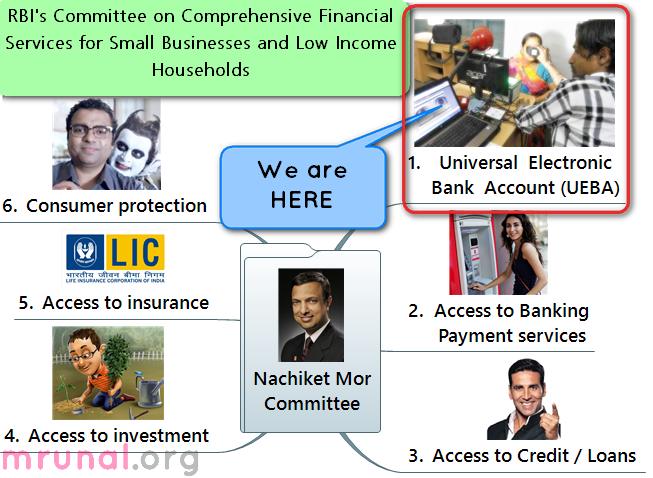
Mor’s 6 point vision for India:

universal electronic bank accounts for financial inclusion Nachiket Mor Committee

So, Mor seems to be a proponent of  linking bank accounts to the Aadhar card (India’s biometric id, the largest of its kind in the world).

The Modi govt is forcing Aadhar through, although the Supreme Court claims it is voluntary, through  schemes such as the  Jio free sim for Aadhar-linked cards (in Tamil Nadu). Jio is a product of billionaire Mukesh Ambani’s Reliance company.

Using the pretext of helping poor people out of the fire of debt to the money-lender in the village, the Mor 6-point vision moves the poor, middle-class and rich into the frying-pan of debt to the global banking system and casino capitalism.  The global markets, as I’ve shown repeatedly on this blog,  are heavily rigged in favor of the big banks and the global cabal.

The Mor/Gates Foundation vision is also fully involved in extending “health-care” to Indians – via vaccines, big pharma experimental drugs, and the rest of the toxic brew that has poisoned even highly-educated and politically-aware Western populations.


Myths and Facts About Black Money

In the headlong pursuit of a completely digitalized economy some fundamental truths have been denied or distorted by the media and replaced with popular myths:

I MYTH: Digitalization is a feature of advanced economies. Less developed countries should be moving toward it.

FACT: According to the Wall Street Journal, 80 percent of German transactions are in cash, while in the US, the figure is 32%. Hoarding of cash is common where negative interest rates prevail or are threatened by the government. Hoarding occurs widely in Switzerland and Japan.

FACT: Digitalization is a BUG, not a feature, of advanced economies. It is digitalization that enables the banking system to manipulate people’s financial habits. The aggressive marketing of debit and credit cards traps unwary consumers into greater and greater indebtedness.

II MYTH: Income from non-criminal activities hidden from the tax-man is as “black” as income from immoral, criminal, or subversive activity hidden from the tax-man.

FACT:   Merchants and traders who hide their money from the tax-man are simply not anti-social elements like terrorists or drug-peddlers. For one thing,  merchants do pay other taxes besides income taxes. Secondly, since they are self-employed and create jobs, they act as the engine of the real economy, from which the professional and bureaucratic classes derive their own income.  Many would not remain in business if they had to comply with the regulatory and tax burden imposed by the government, not only for financial reasons but because such transparency would compromise their trade secrets and expose them to business theft, very likely from the corrupt nexus of big business and the state.  Third, having a large part of the economy based in cash protects the whole economy from the direct manipulation of global finance capital.  Rather than eliminating the cash-based kulaks, the rest of India should be emulating them.

III MYTH

Demonetization is a temporary “inconvenience” that a patriotic Indian must put up with for the greater good.

FACT: Expropriating the savings  of people across the board for WHATEVER scheme, even if it were the most brilliantly conceived and executed,  is a monstrous act, unique in the annals of constitutional republics with a functioning judiciary and press.

And expropriation it is. The notes theoretically are being “exchanged.” In practice, people cannot withdraw their own money for living or business expenses beyond stringent limits, and this state of affairs is likely to last for at least 7-9 months, if not longer. Those businesses and individuals that cannot survive with these restrictions have been eliminated. Permanently. Whole industries are closing down. The country is extremely vulnerable to foreign military attack or embargo in this state.

On top of that, the demo has set off a huge migration of the population back to the villages.

Modi now claims that that was his intention all along. (Adding a third explanatory layer to his constantly revised narrative about black money).

But explanations are redundant at this point.

It is shocking that an Indian PM even suggests that such a sweeping, radical project can be imposed unilaterally, no matter what the cost.

Such a utilitarian calculus, sacrificing whomever the PM wishes to whatever vision he thinks is necessary, is no better than that employed by Hitler, Stalin, Mao or any other totalitarian dictator from the right or left.

It is an assault on the people’s right to property and life in the most fundamental way.

Shame on the media for covering this fact over with phony rhetoric about “poor planning” and “poor implementation.”

Carpet-bombing an entire nation in ostensible pursuit of a handful of terrorists is a war-crime, irrespective of its planning or execution.

It is genocidal in effect.

So is seizing an entire economy’s cash supply.


Modi Indonesian Partnership Follows Reuben, Rothschild Investments

Modi’s strategic interest in Indonesia seems to follow investments made by the Reuben brothers and the Rothschild family:

London – Britain’s billionaire Reuben brothers are setting up a partnership with Transasia Minerals Holdings to tap Indonesia’s coal and metals deposits, lured by the country’s vast mineral wealth.

The project means a return to natural resources for the siblings, who built their fortune with Russian aluminium company Trans-World Metals, but later sold out and put their money in private equity and property.

The pair will buy a 30 percent stake in the venture, the Asian Metal Resources Corporation (AMRC), the parties told Reuters on Friday. Transasia, which is owned by the Aslanov family from Uzbekistan, will hold the rest.

“Reuben Brothers has huge experience and knowledge in terms of the business of natural resources, and attracts the support of the world’s largest institutions as a result,” a spokesman for Transasia said in an emailed statement.

The two parties did not disclose financial details, but a source close to the two families said that the brothers would pay an initial $500 million in equity and debt, valuing the entire venture including debt at $1.7 billion.

The brothers, who are making their investment through Reuben Brothers Resources, have also negotiated the right to raise their stake to 49 percent at a later stage.

The deal follows Nat Rothschild’s venture into Indonesia, where the banking family’s scion holds 11.7 percent in miner Bumi Plc after a tie-up with the politically well-connected Bakrie family.

Spread across 17,000 islands, Indonesia has some of the world’s largest deposits of coal, gold, copper and tin, and there is increasing interest from investors in the strategic potential of Southeast Asia’s largest economy.

The joint venture between the two families will acquire and develop mining interests in Indonesia, specifically coal in Borneo, copper and gold in Sumbawa and surrounding islands, and nickel on Sulawesi, the parties said.”


Evidence Of Birla, Sahara Bribing Modi

From the Wire:

In 2013, there was a CBI raid on the Aditya Birla Group of companies, in particular Hindalco, in connection with the coalgate scam. In that raid, apart from recovering Rs 25 crores in cash, the CBI also recovered some information stored in the computer of the CEO of the Birla group – Amitabh. Several documents were recovered – some of them showed bribes being paid to some Environment Project J, which is obviously to the ministry or to the minister of environment. We know that around the same time the Birla group of companies was trying to secure environmental clearances from the ministry of environment for a large number of their projects. So those clearly represented bribes paid for getting the environmental clearances. There was another set of documents which was recovered from the computer of Shubhendu Amitabh, which said, “Gujarat CM – Rs 25 crores. 12 paid. 13?”

Unfortunately, though these documents showed payment of bribes and therefore, offences under Prevention of Corruption Act, the CBI did not register any FIR on this matter but just passed the papers on to the income tax (IT) department.

Income tax department did a somewhat detailed investigation into the matter. They questioned Amitabh many times in which he admitted that he had written, “Gujarat CM – Rs 25 crores. 12 paid. 13?” But he said that “Gujarat CM” meant Gujarat Alkalis and Chemicals. When asked what the C and M stood for he was unable to answer and the IT department concluded that he was lying.

They also found that there was a large amount of cash which was being received through Hawala by the Birla group and was apparently being paid to various people. But despite this the IT department did not refer the matter back to the CBI for investigation of these ostensible offences under the Prevention of Corruption Act and the matter was sought to be buried at that level. After that we understand that the Birla group has approached the IT settlement commission for settling the matter and the hearings have been concluded; the matter is likely to be settled after which there is this apprehension that the papers seized in the raids will be returned back to the Birla group.

The Sahara raid took place on November 22, 2014. In this raid Rs 137 crores of cash was seized from their offices in Noida, from the corporate office of the chairman, and a large number of documents, some loose sheets, computer data from his personal staff were seized, which showed details of proposed as well as actual payments made to various senior political figures. One of the documents which was seized – a printout of a detailed spreadsheet – in which the first three columns represent the cash the Sahara group received on different dates from different sources and the total comes to Rs 115 crores. Thereafter, this document also represents cash payments to different people on different dates and the places where the payment has been made, and the persons who have taken the payment are also mentioned. It is signed by the IT officer, two witnesses and one of the Sahara officials. Several such documents were recovered in this raid. There was another one which was partly overlapping with minute differences. For example, in the previous one the payments which were referred to as, “cash given at Ahmedabad, Modiji”, in other documents they are referred to as, “cash given to CM Gujarat”. There are Rs 40 crores given at Ahmedabad to Modiji, Rs 10 crores given to CM of Madhya Pradesh, Rs 4 crores to CM of Chhattisgarh, Rs 1 crore to CM of Delhi which at that time was Ms Sheila Dikshit. These are all payments made between 2013 and March 2014.

Despite recovery of such incriminating documents and in such detail which showed pay-offs made to various senior political figures, the IT department did not refer this matter to the CBI for investigation under the Prevention of Corruption Act. They apparently prepared some appraisal report which according to my understanding does not deal with these papers and the pay-offs, and these documents were buried. The person who was responsible for burying the documents of both Birla and Sahara was K. V. Chowdary, who was heading the IT investigations at the time and thereafter was appointed, apparently as a reward, as the chief of central vigilance commissioner of the Central Vigilance Commission (CVC). It was the first time a revenue officer was appointed although there were a number of complaints against him; his name appeared several times in the entry register of the infamous former CBI director, Ranjit Sinha, who was involved in interfering with the income tax assessment of Ponty Chadha. He was also involved in the stock guru scam which is apparently still under investigation. Despite that, Chowdary was still appointed. We challenged his as well as the appointment of another person in the CVC. Because of our information that he played a major role in suppressing the information, we have filed an application. When I got these documents in October, I sent a complaint to CVC, CBDT, the Enforcement Directorate, CBI and to the SIT on black money, saying that these are highly incriminating documents and according to the principles laid by the Supreme Court in the Jain Hawala case these should have been investigated – whether these payments were made, why were they were made, if these were bribes or some other kind of payments – but none of that was done. The matter was sought to be buried.

Therefore, we have eventually moved the Supreme Court, filed an application in the petition that we had filed challenging the appointment of the CVC and that application will be heard on Friday.

Sahara diaries mention a lot of names but they don’t specifically name the politicians, for example, like you said the Delhi CM and so on. Are there more? Who are the other prominent politicians mentioned in the list?

There’s Madhya Pradesh CM Shivraj Singh Chouhan, Delhi CM at the time, Sheila Dikshit, Chhattisgarh CM Raman Singh and the Gujarat CM at the time, Mr Modi. Mr Modi is also personally mentioned as Modiji. Largest payments are made to him in the Sahara diaries, more than Rs 40 crores. One other politician which is mentioned prominently is Shaina NC of the BJP and one of the documents says that she was being asked to intercede with the advocate general of Maharashtra for withdrawal of some case which was pending against Sahara. Perhaps the Sebi case (which was mentioned as the Bombay case in the papers).

The Modi government is already in the know of these papers because you have already written to various agencies. What are the kind of replies you got from the government?

Well, I only received one response from the CVC after ten days saying, “Will you please confirm whether you have sent this complaint?” I immediately confirmed that I sent this complaint and I am not aware as to what they have done, or whether they have done anything in this matter because unfortunately, it seems that the CVC himself, as the head of investigation of income tax was responsible for suppressing this.”