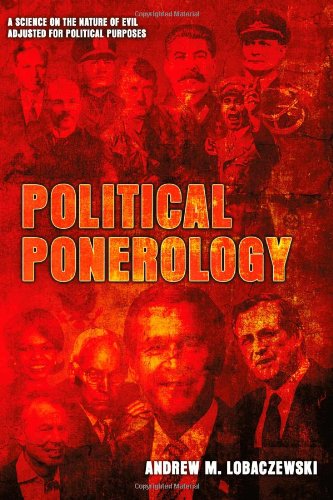
From Ponerology.com
http://www.ponerology.com/evil_1.html#link2
PSYCHOPATHY: THE CAUSE OF EVIL
Inherited and acquired psychological disorders and ignorance of their existence and nature are the primal causes of evil.
The magic number of 6% seems to represent the number of humans who either carry the genes responsible for biological evil or who acquire such disorders in the course of their lifetime. This small percent is responsible for the vast majority of human misery and crime, and for infecting others with their flawed view of the world.
The scope of evil does not respect any boundaries of race, doctrine, or ideology. All races carry the genes, and all schools of thought are susceptible to their influence. These pathological factors that influence behaviour form a complex web. It is only in such a web that the “environmental evil” wherein circumstances can influence a normal person to commit harmful acts can be understood.
Of 5000 psychotic, neurotic and healthy patients, Lobaczewski identified 384 (7.7%) who caused serious harm (physical and/or emotional) to others. Some of these had been penalized for their actions and some had been protected by Communist government of the time.
Contrary to the common moralistic interpretation of evil actions (“evil consists of making evil choices”), and also contrary to legal systems which views psychopaths as sane and thus responsible for their actions, the vast majority (85%) of these 384 individuals showed psychopathological factors influencing their behaviour. It is likely that, without these factors present, the harmful actions would not have taken place. These psychological factors limit the subject’s ability to control their actions. In this sense, a moralistic interpretation to psychopathic behavior is fundamentally flawed. While a moral sense (lacking in psychopaths) can be seen as necessary to be held morally responsible, that is not to say that psychopaths should have free rein to destroy lives.
Psychopathic individuals can have a number of effects on normal people: they can fascinate, traumatize, cause pathological personality development, or inspire vindictive emotions (a result of viewing evil as simply a “choice”). An example of this variety can be seen in the host of groupies, pen pals, supporters, and love-struck fans that flocks towards dangerous serial killers like Richard Ramirez and Ted Bundy. One fan of Ramirez said, “When I look at him, I see a real handsome guy who just messed up his life because he never had anyone to guide him.”
These effects and the confusion they engender can then lead to, and reinforce our collective ignorance of such individuals. We rarely hold responsible the individual who influences another to commit evil, but instead moralistically punish only the agent of an act. The true cause of ‘evil’ actions goes unpunished, much like an Army Private punished for the crimes of his superiors.
In fact, the true source of ‘evil’ may be separated from a specific action by both vast stretches in time (i.e., in literature and tradition) and by large distances (i.e., by mass media).
“The practical value of our natural world view generally ends where psychopathology begins.” (Lobaczewski, 145) PONEROLOGY: A NEW SCIENCE No matter how eloquently and accurately authors (novelists, dramatists, poets, historians) describe the occurrence of evil, a disease cannot be cured through description alone. Our natural language cannot adequately explain the concepts surrounding such phenomena. Only a scientific understanding drawing from psychological, social, and moral concepts can approach the understanding necessary to prevent the emergence of mass madness seen so many times in the history of our planet.
Ponerology describes the genesis, existence, and spread of the macrosocial disease called evil. Its causes are traceable and can be repeatedly observed and analyzed. When humanity manages to incorporate this knowledge into its natural worldview, it will have defensive potential as yet unrealized.”
Hi Lila,
I have read this book several times. Predating Martha Stout’s The Sociopath Next Door, the book argues what appears plausible – that some people don’t have, for the lack of better term, the “compassion” gene.
From my studies and perspective, I am not sure that the tendency depicted of sociopaths is unique to sociopaths. I think, as the late Hannah Arendth had demonstrated in her book: Eichman in Jerusalem – A Report on the Banality of Evil, evil is indeed banal, and anyone of us can rise to those dizzying heights of sociopathy given the right “tickling”, nurturing. The Milgram experiment on obedience to authority figures conducted at Yale University demonstrated that anyone can become part of that space. Absolutely anyone.
But one thing that transpires uniquely among human beings under those conditions, which is what the Milgram experiment uncovered, at least initially, until perhaps they learn to suppress it completely, is “cognitive dissonance”. Leon Festinger discovered, proved its existence, and labeled that psychological tension by that name. Just pscyh 101, which I am sure everyone already knows.
To the point here however, I think Andrew Lobaczewski, like Martha Stout, believe that this “cognitive dissonance” is naturally suppressed, or entirely absent, in sociopathy as they have defined it: the 6% (3 or 4 for Stout, I forget) who they argue live among us like normal peoples and almost always rise to phenomenal positions of power in every domain, show no remorse for inflicting primacy upon others which normal people do.
Unless medical studies can establish that model, it is mererly a theory. But I think something else explains it entirely.
It is the yin and yang of humanity: the built-in instinct for primacy which exists in all of us to some degree, vs. the spiritual teachings to tame that instinct by striving for higher levels of consciousness.
I have fleshed it out here and I hope you might shed some more light on it.
http://faith-humanbeingsfirst.blogspot.com/2014/05/the-road-to-no-where-by-zahir-ebrahim.html
Thanks.
Zahir Ebrahim
Project Humanbeingsfirst.org
ps. your website new design looks fine to me. If you ask me, I’d like to see wider text. This 600 pixel window time is past. Most screens are wide, and wordpress automatically switches to their mobile format when you access it on the narrower mobile devices. So going wider permits looking at the context of what one is reading more holistic. Going too wide makes reading difficult. I found that 1000 pixels is a good width.
Hi thanks Zahir,
Re the ponerology thesis, I agree that there are people who are psychopaths and are deficient in normal feeling. I have met them. I think there is a chemical problem, exacerbated by upbringing and habit.
I think such people are bred by license and the lack of anything internal or external to check their behavior by confronting it with a mirror or a sword.
But I agree 100 percent with you that the problem is not the 5% (or whatever) of psycho and socio paths. It’s the 95% of normal people who go along.
Re the new format. I tried the wider screens but they don’t look neat or professional and the ones that did had other things missing..
I will keep an eye out for something easier to read. Appreciate the input.
Additionally, just fyi in case you haven’t read that website completely, it links to an interview: In Memoriam: Andrzej M. ?obaczewski
http://www.sott.net/article/159686-In-Memoriam-Andrzej-M-obaczewski
Which makes this bizarre statement that Dr. Zbigniew Brzezinski, former President Jimmy Carter’s National Security Advisor, and today’s unmatched grandmaster of the Grand Chessboard, the king of sociopaths if I might be so bold as to anoint him thusly, tried to suppress its publication. Here is an excerpt from that link:
begin excerpt
Q: In other words it means that high Soviet authorities were aware…
A: So, the book was forwarded to our “elder brother” [i.e. the Soviet Union] – it has already been translated to Russian – and it played there some role, but what role? Well, I will never know. In the introduction of my book I ask that if readers know anything, to let me know about it. I know nothing more on this subject. And whether the book threw Gorbachev against the wall, well… So, this is the history of the book. And finally I wanted to publish it in America. Mr Zbigniew Brzezinski read it. He was full of enthusiasm both towards the book itself and its translation. He said that the translator had done an excellent job and that he would take care of its publication. And so I believed him in my naivete.
Q: I would personally not believe him so easily…
A: Unfortunately, I believed him. And then some strange difficulties occurred… He started to answer me somewhat negatively. Something was happening. I was writing letters; I have an entire file of correspondence with him. Eventually, only his secretary answered me, and then I reached him and he said, “Pity that it did not work out”, in other words…
Q: It did not succeed.
A: …he strangled the matter, treacherously.
Q: Either he or somebody else behind him.
A: Yes, because he is an “insider” of that entire enormous system. I mean, he is not on the top, he does not belong to the “order”, he is merely an “insider”, and there are about three hundred of them. [?obaczewski is possibly referring to the “Committee of 300”, the subject of Dr. John Coleman’s book Conspirator’s Hierarchy.]
Q: And who in your opinion is on the top? What do you mean by the “order”?
A: The “Order”? Well, I cannot know who is there in the “order”.
Q: Well, you think something about it, so what is your opinion?
A: I have a certain opinion. Well, this “order” is the center [of the pathocratic ‘brotherhood’], which is located in England outside of London… The Trilateral Commission belongs to that center.
Q: And the fact that Mr. Brzezinski was the president of the Trilateral Commission… However, it is only one of the organizations and not necessarily…
end excerpt
Any way, it was that interview which finally found me the time to read this book after a friend of mine had brought it my attention several years ago and kept asking me to read it. Having read it once, it automatically prompts for multiple readings because of its many insights.
But, as per reservations expressed in my first comment above, this general sentence of our indomitable American hero, Dr. Zbigniew Brzezinski, from his first book: Between Two Ages, sums up my natural inclination towards any sort of reductionism which lends itsself to pat formulations, whether it is for the parsing of current affairs and international relations, or to atoms and molecules which is the natural purview of science. So we might as well let the empiricism of science weigh in on the 6% and tracing missing neuronal states to missing genes and DNA first:
From page 5 begin quote
Time and space shape our perception of reality. The specific moment and the particular setting dictate
the way international estimates and priorities are defined. Sometimes, when the moment is historically “ripe,” the
setting and the time may coalesce to provide a special insight. A perceptive formula is easier to articulate in a
moment of special stress. Conditions of war, crisis, tension are in that sense particularly fertile. The situation of
crisis permitssharper value judgments, in keeping with man’s ancient proclivity for dividing his reality into good
and evil. (Marxist dialectic is clearly in this tradition, and it infuses moral dichotomy into every assessment.) But
short of that critical condition—which in its most extreme form involves the alternatives of war or peace—
global politics do not lend themselves to pat formulations and clearcut
predictions, even in a setting of extensive
change. As a result—in most times—it is extraordinarily difficult to liberate oneself from the confining influence
of the immediate and to perceive—from a detached perspective—the broader sweep of events.
end quote
Thanks
Zahir Ebrahim
Project Humanbeingsfirst.org