I Feel Dread

I feel dread when I read the news.

The patterns by now are so familiar to me.

The same lies. The same liars. The same events, washing up like dirty spume from relentless waves.

They are waves from far out.

They are shadows cast ahead by something dark and terrible.

I know how it must have felt in the years before the world wars.

One must have smelled in the salty air what the future held.

It is terrible to look back and see how in less than twenty-five years, half of one immigrant’s adult life, a nation could have changed so utterly as this country did.

Even the surface of things doesn’t look the same. Smiles are harder, eyes are emptier, words more shapeless and soiled with overuse.

I can hardly bear to read through opinion in the regular press. I have to have it sifted through congenial websites.

We were free as late as 1984 – that fabled year. We were celebrating the victory of freedom in the world only five years later.

And now, thirty years later, we…the whole world…has wandered in broad daylight into  prison and the gates have been shut.

Semitic Semantics

The word Jew is a very protean term, referring at times to race and at times to culture or religion. The correct term today should be Judaic or Judaist.

This leads to constant confusion, misdirection, and contradiction, to the advantage of the ruling class, which claims the mantle of ancient Israel.

But what we call Jews today are a mixed race people quite different from the Hebrew Israelites, who are now, retroactively and erroneously, equated with them.

The correct term for today’s “Jews” should be Judaics or Judaists.


ASHKENAZY JEWS

Most of the people who call themselves Jews today have partial descent from converts from Khazaria, a medieval East European kingdom wedged between the Muslim and the Christian world, which chose the Hebrew faith as a way to survive.

The Khazarians intermingled with Eastern European people in the surrounding regions and later moved into Germany, becoming today’s Ashkenazy (European) Jews.

The Ashkenazim constitute much of modern Jewry (Khazarian Judaists), it is said.

This may or may not be true, because statistics about Jews (Khazarians of Judaist culture) seem to vary wildly.

The Khazarian theory of Ashkenazy origin has been vindicated, according to some people, by the research of Israeli geneticist Elhaik, but it has its detractors.

They claim it is simply an anti-Semitic canard.

Even critics of the theory, however, admit that there is ample European (in the maternal line) and “non-Semitic” Middle-Eastern blood (in the paternal line) in modern Ashkenazy Jews (Khazarian Judaists).

But, shockingly, their maternal descent from Europeans means that the Ashkenazim are irrefutably not ethnic Jewish (Judahites), according to Jewish (Judahite) law.

I repeat, the DNA evidence proves that according to Jewish law, Ashkenazim are not of Jewish (Judahite) descent, because Jewish (Judahite) law requires the mother to be Jewish.

SEPHARDIC JEWS

The rest of the modern Jews (Judaics), a far fewer number, is descended from the Edomites (Idumeans) who were living in Judea at the time of Jesus.

That is why they were called Jews, to begin with.

Jew is simply the short form for the word, Judean or “of Judea.”

The word Judean/Jew thus had nothing to do with race or ethnicity.

It referred simply to people living in the region of Judea.

The Idumeans/Edomites living in Judea were forcibly circumcised and incorporated into the Israelite (Hebrew) religion under John Hyrcanus, in the 2nd century BC.

Their numbers included many of the Pharisees who lived in the time of Jesus, most of whom were killed in the siege of Jerusalem in 70 AD.

This was the fate of most of the male population in Jerusalem.

The females were enslaved by the victorious Romans.

The Jewish men who survived the destruction lived on in the land, converting to Christianity and then Islam.

Eventually, they became the people we know today as Palestinians, who are thus also a mixed race, although probably less so than the dispersed Edomites.

The converted Idumeans (including, probably, some Idumean-Israelites) living in Judea were the people whom Jesus claimed in Revelation 3:9  were of the “synagogue of Satan” and were not really Jews (Judahites).

To be clear, in saying this, Jesus was not really referring to the Idumean ethnic heritage.

Some of the Idumeans had mixed with the native Israelites around them by then, so that some of the converts  may actually have been partly descended from the northern Israelite tribes that had been conquered by the Assyrians in the 8th century BC (722 BC) and then dispersed in Assyria, Babylon, and in Israel and Judea.

Credit: keyway.ca

Map Of The Assyrian Empire

These dispersed tribes were the so-called Lost Tribes.

That suggests that some  of the Idumeans too probably had some Israelite or even Judean blood in them.

But Jesus was really talking about the beliefs of the Idumean converts, not their genes.

They followed a mixture of the pure faith taught by Moses and the Prophets with the pagan beliefs of the Canaanites and Hittites, with whom the Edomites, since the days of Esau, had intermarried.

The Idumean (Edomite) converts to Israelite faith were after all descended from Abraham, as they claimed.

But, they were not – and never had been –  descendants of Judah (Judahites).

As I noted earlier, Judahite is one of the two origins of the abbreviated term, “Jew.”

The other is Judean – referring to the area, Judea.

The Idumeans/Edomites  did not follow Jewish customs fully but added pagan beliefs.

These semi-pagan mixed Idumean-Israelites in Judea, along with other Idumean-Israelites in the surrounding regions and in the Hebrew or Israelite diaspora that was settled in Babylon and in Egypt, supposedly emigrated all over the Middle East and into regions of Europe (Spain, Italy, Germany, England) in the centuries immediately after Christ. These dispersed tribes became what we call today Sephardic Jews. Sephardic is derived from the old Jewish name for Spain, Sefarad.

Some claim that the Jews were scattered because the Romans dispersed them, although exiling conquered people was not characteristic of the Romans, who usually left some of the vanquished to till the soil.

Of course, is always possible that the Romans made an exception for the Jews, in response to the ferocity with which they resisted conquest.

More likely, the Jews who intermarried with European women in the first and second centuries after Christ were traders who were Levantine converts, rather than original Israelites of any kind.

In any case, it is a fact that the maternal stock of current Sephardic Jews is European, not Near Eastern, and dates back to this Jewish diaspora.

To repeat, Jewishness is traced through the maternal line, and since these diasporic Idumean-Israelites spawned what we call the Sephardic Jews, they too, by Jewish law, are not Jews.

Like the Ashkenazy, but even more so, the Sephardim took with them the pagan lore of Babylon and Egypt.

This religion contradicted the Torah teachings of the Israelites.

It was replete with astrology, gnosticism, ritual practices, esoteric texts, angelology and demonology.

TALMUDIC JEWS VERSUS TORAH JEWS

Now, the Hebrew Bible of the Ashkenazy and Sephardic Jews is called TaNaKh  and it includes the Law, the Prophets, and other writings.

But these are not held in as much veneration as the interpretations of the TaNaKh by the Jewish sages (Rabbis).

The Rabbinical interpretations were codified in the centuries after 200 AD and form the written text (Talmud) of what in Jesus’ time was still oral and referred to as the Tradition of the Elders.

IDUMEAN JEWS OF JESUS’ TIME VERSUS ASKHENAZY JEWS OF TODAY

Jesus felt that the Elders had subverted the original faith in Yahweh with a ritualistic, formulaic legalism that killed the spirit of true faith and substituted notions of racial purity for purity of faith.

Jesus denounced this perversion of the Hebrew faith in the strongest possible terms.

But since the current crop of Ashkenazy Jews is most likely unrelated to the original Idumean-Israelite Judeans whom Jesus denounced, it is quite incorrect to claim that animosity by non-Jews toward the Ashkenazy leadership today (the Rothschild financial cabal) has anything whatsoever to do with the enmity between the Idumean-Edomite Judeans and Idumean-Israelite Judeans, on the one hand and Jesus, on the other.

In short, the accusation that the Gospels are the origin of current “anti-Semitism” is bogus  and an anti-Christian slander.

The current Jews are not the descendants of the Israelite-Idumean mixture whom Jesus cursed.

They were utterly destroyed in 70 AD.

Moreover, the genealogical records necessary to prove genetic descent from any of the tribes of Israel, were destroyed with the Temple at the time.

Without these, any subsequent claims of descent are either tenuous or completely specious.

What Jesus said then to the Judeans and Judahites of his time does not and can not automatically attach to the Ashkenazy and Sephardim today, on the grounds of genetic descent.

Contemporary Judaists are mostly a Euro-Turko-Mongolic people, with, at most (although not certainly), some small admixture of the original Israelite blood.

This is true also of the Sephardic Jews, who have a better claim to a partial descent from the Idumean-Israelite mixture.

They too cannot be blamed for deicide, as it used to be called.

According to the Gospel, in the final destruction of Jerusalem, all of Jesus’ enemies during his ministry were judged for the blood they had shed in their own life-times.

They were judged, as well, for the blood-shed of all past history, from the archetypal crime of Abel’s murder onward to the death of Jesus.

That chapter in history was closed on the cross.

It is finished, as Jesus said.

Neither the current Ashkenazy Jews nor the current Sephardic Jews have anything to do with it.

But, in so far as they adopt attitudes and beliefs that resemble those of the Pharisees, they, as well as all other people of any or no faith, are culpable for their own wrong beliefs and actions.

To sum up, there is very little or no genetic descent of current Jews from the ancient Idumean-Edomites (and Idumean-Israelites) who persecuted Jesus.

There is only the possibility of  spiritual descent.

And that possibility is shared equally by Jews, Christians, Muslims, Hindus and anyone else who hurls curses at Jesus Christ.

Spiritual descent is a matter of choice and belief.

It comes about when people adopt the attitudes and beliefs of the Pharisaic persecutors of Jesus.

TALMUDIC JUDAISM AND KABBALISM

The writings of the Elders were codified in the Talmud in 200 AD and 500 AD, and thereafter, and to them were added, in the later middle ages, texts like the Zohar and Kabbalah.

The Talmud, Zohar, and Kabbalah explicate, in sometimes mystic, sometimes racial, sometimes moral or legal terms, the TaNaKh, formulated in writing some thousand years earlier (approximately 500 BC) by the Hebrew-speaking people that constituted the ancient nation called Israel.

The Talmud, Zohar, and Kabbalah also add completely new teachings, esoterica, occult texts, and mysticism, some of which is deeply antagonistic to the austere spirit of the Torah.

Some of the Talmud’s and Kabbalah’s teachings are truly amoral and perverse.

Others are profoundly wise and could have been spoken by Jesus himself.

The ancients Israelites included both the Judeans (the Israelite tribes living in Judea, descended from Judah and Benjamin) and the northern tribes (the descendants of the other sons of Israel/Jacob:- Reuben, Naphtali, Dan, Gad, Manasseh, etc.).

Is any of this Hebrew stock to be found among contemporary Jews?

Surely there could be some genetic ties, or, at least, similarities, between both groups.

But, equally surely, these genetic markings are mingled with the genetic markers of many other groups, because of centuries of intermarriage.

Race-mixing was always in the history of the Israelites.

EDOMITES, HITTITES, AND MOABITES

Esau, the brother of Jacob in Genesis, who is the forefather of the nation of Israel, intermarried with the pagan Hittites.

But, so did Jacob’s own descendants, the Israelites.

So did the sons of Judah or the Judahites (Jews, in short form).

Ruth, the ancestress of  Jesus, belonged to the Moabites, one of the deadliest enemies of the Israelites and Judahites.

ABRAHAM’S SEED IS JESUS

Given this history, how can anyone claim that Israelite or Judahite is a term for a pure genetic stock?

Yet, they do.

Many naive Jewish people today – and Christian dupes –  consider modern Jews both a pure ethnicity and a unique religion.

A people set apart and a culture set apart.

The Bible states otherwise.

Abraham and Isaac were counted as righteous, long before Jacob was called Israel and long before Judah sired Judahites and before Israelites ever set foot in Judea.

Righteousness preceded both Israel and Judea, both Judah and the Judahites.

The seed of Abraham in whom the whole world was blessed was not any supposed Master Race of Israelites or Jews, with genetic superiority to the rest of mankind.

This is a toxic carnal and ethnocentric revision of the Hebrew scriptures.

The blessed seed (singular) of Abraham was not a people, but a person – a unique prophet, like Moses.

He was the uniquely begotten and uniquely sacrificed “son,” like Isaac.

The blessed seed was Jesus, to whom all nations were to be gathered, according to the divine covenant with Abraham.

As a matter of record, people of all nations have been gathered into belief in Jesus.

The moral reign of Jesus Christ is visible all around us, despite all the blood-shed and mayhem wrought by those who would erase God from the history of man.

The Good Shepherd who gave his life for his flock is a figure beloved all over the world. 

Christ’s moral reign does not offend anyone but reprobates, no matter what their religion.

Muslims and Hindus accept Jesus as a divine messenger.

Righteous Jews have seen through the calumnies of the Rabbinate and accepted Christ’s moral status.

But there is no nation in the world that would accept without a fight the divine right of a Master Race of Jews to rule as overlords of the earth.
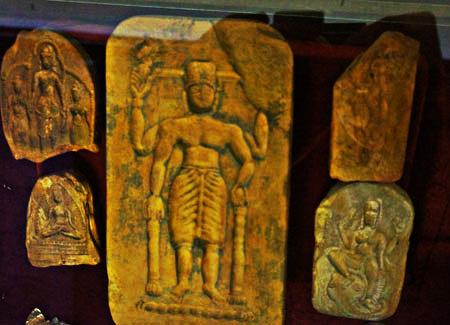


4000 Year Old Vishnu Demolishes Aryan Invasion Theory

From IndiaDivine.org:

A recent news report from Vietnam features an exquisite and very ancient sculpture of Lord Vishnu. According to a press release from the Communist Party of Vietnam’s Central Committee (CPVCC) the Vishnu sculpture is described as “Vishnu stone head from Oc Eo culture, dated back 4,000-3,500 years.” Recently the Government of Vietnam, despite its official Communist doctrine, has developed many programs and projects highlighting Vietnam’s ancient religious heritage. Its scholarly and archeological research and investigations are legitimate and its conclusions are authoritative. This discovery of a 4,000 to 3,500 year old Vishnu sculpture is truly historic and it sheds new light upon our understanding of the history of not only Hinduism but of the entire world.

Vishnu

The fact is there are no other ‘officially’ recognized Vedic artifacts that have been dated back to such an early date. This would make Vietnam home to the world’s most ancient Vedic artifact. While there are indeed many other ancient artifacts that represent the same Deity, they are not presented in the ‘Indic’ tradition and cannot be directly recognized as the Vishnu of the Indic Vaishnava tradition……..

The significance of this discovery cannot be overestimated. The entire history of Hinduism and Vedic culture, as taught is the academic institutions of the world, has been built upon a false construct. According to mainstream academia Vedic ‘religion’ or Hinduism did not exist until the alleged ‘Aryans’ invaded India circa 1500 BC. An even later date is given to Vaishnavism which is speculated to have been derived from animist Sun worship. Yet here we have a highly evolved art form depicting Lord Vishnu in the Far South East region of Asia dated to somewhere between 2000 BC to 1500 BC.

[Vaishnavism, with its repeatedly incarnating “savior” Chrish-na thus predates Christianity by some 2000 years and is older than the date of the writing of the Old Testament. ]

This completely undermines the entire historic timeline developed by mainstream academia in regards to the development of both Vedic/Hindu civilization and Indian history.

The region of modern India has always been the epicenter of High Vedic/Hindu Civilization and culture. No one anywhere has ever suggested the region of modern Vietnam to be the origin of Hindu civilization yet it is in Vietnam that we now have the world’s most ancient example of Indic style Vedic Vaishnava art. Thus it stands to reason that if Vedic Vaishnava art, culture and religion flourished 4000 years ago in prehistoric Vietnam it was undoubtedly flourishing in ancient India as well.

Once again science and archeology have confirmed the Vedic conclusion. As the Vedic literature states 5000 years ago India was home to a highly evolved and advanced civilization. This civilization was centered on its sacred traditions. The worship of the Supreme Lord Vishnu, Lord Shiva, Lakshmi and Durga was widespread and in fact spanned the entire globe.

These traditions presented themselves in diverse manners, as seen in modern India, yet among this diversity was a commonality based upon the authority of the Vedic scriptures and traditions. The recognizably Indic forms of the Vedic traditions spanned the globe from the Philippines to the Middle East and Siberia to Australia. Yet the same Divinities were worshiped and the same traditions were practiced throughout the world.

The many recent Vedic discoveries from Vietnam are providing a new and sensational view into the authentic history of the world. Not only this, it presents a challenge to Modern India and its leadership. India is home to many startling and amazing artifacts yet they sit ignored and crumbling. In many cases looters and vandals have destroyed many priceless examples of India’s ancient heritage. India’s leading academics and governing bodies are silent and if they do speak of India’s ancient Hindu heritage it is only to cast doubts and disparage India’s indigenous Vedic culture and Hindu traditions.”

Catholic “Spirit Of Francis” Is Treacle, Not Manna

An excellent piece by Rod Dreher, explaining why he left the Roman Catholic Church and joined the Orthodox:

In 2002, when the clerical-sex-abuse scandal broke nationwide, the full extent of the rot within the church became manifest. All that post-Vatican II happy talk and non-judgmentalism had been a facade concealing what then Cardinal Joseph Ratzinger — later Pope Benedict XVI — would call the “filth” in the church. Many American bishops deployed the priceless Christian language of love and forgiveness in an effort to cover their own foul nakedness in a cloak of cheap grace.

During that excruciating period a decade ago, rage at what I and other journalists uncovered about the church’s corruption pried my ability to believe in Catholic Christianity out of me, like torturers ripping fingernails out with pliers. It wasn’t the crimes that did it as much as the bishops’ unwillingness to repent and the Vatican’s disinterest in holding them to account. If the church’s hierarchy cannot commit itself credibly to justice and mercy to the victims of its own clergy and bishops, I thought, do they really believe in the doctrines they teach?

All this put the moral unseriousness of the American church in a certain light. As the scandal raged, one Ash Wednesday, I attended Mass at my comfortable suburban parish and heard the priest deliver a sermon describing Lent as a time when we should all come to love ourselves more.

If I had to pinpoint a single moment at which I ceased to be a Roman Catholic, it would have been that one. I fought for two more years to hold on, thinking that having the syllogisms from my catechism straight in my head would help me stand firm. But it was useless. By then I was a father, and I did not want to raise my children in a church where sentimentality and self-satisfaction were the point of the Christian life. It wasn’t safe to raise my children in this church, I thought — not because they would be at risk of predators but because the entire ethos of the American church, like the ethos of the decadent post-Christian society in which it lives, is not that we should die to ourselves so that we can live in Christ, as the New Testament demands, but that we should learn to love ourselves more.

Flannery O’Connor, one of my Catholic heroes, famously said, “Push back against the age as hard as it pushes against you. What people don’t realize is how much religion costs. They think faith is a big electric blanket, when of course it is the cross.” American Catholicism was not pushing back against the hostile age at all. Rather, it had become a pushover. God is love was not a proclamation that liberated us captives from our sin and despair but rather a bromide and a platitude that allowed us to believe that and to behave as if our lust, greed, malice and so forth — sins that I struggled with every day — weren’t to be despised and cast out but rather shellacked by a river of treacle.

I finally broke. Losing my Catholic faith was the most painful thing that ever happened to me. Today, as much as I admire Pope Francis and understand the enthusiasm among Catholics for him, his interview makes me realize that the good, if incomplete, work that John Paul II and Benedict XVI did to restore the church after the violence of the revolution stands to be undone. Though I agree with nearly everything the Pope said last week in his interview and cheer inwardly when he chastises rigorist knotheads who would deny the healing medicine of the church to anyone, I fear his merciful words will be received not as love but license. The “spirit of Pope Francis” will replace the “spirit of Vatican II” as the rationalization people will use to ignore the difficult teachings of the faith. If so, this Pope will turn out to be like his predecessor John XXIII: a dear man, but a tragic figure……

There is, of course, no such thing as the perfect church, but in Orthodoxy, which radically resists the moralistic therapeutic deism that characterizes so much American Christianity, I found a soul-healing balance. In my Russian Orthodox country mission parish this past Sunday, the priest preached about love, joy, repentance and forgiveness — in all its dimensions. Addressing parents in the congregation, he exhorted us to be merciful, kind and forgiving toward our children. But he also warned against thinking of love as giving our children what they want as opposed to what they need.“Giving them what they want may make it easier for us,” he said, “but we must love our children enough to teach them the hard lessons and compel them toward the good.”

Martyrdom At Jacob’s Well

The martyrdom in 1979 of Father Philoumenos at the monastery of Jacob’s Well near ancient Samaria:

What a good shepherd he was, more worthy than some of the episcopate! Yet the policies and needs of the patriarchate saw Father Philoumenos assigned to other positions. Whenever Palestinian faithful were scandalized by some unworthy priest, whenever Orthodox neglect or European money drove the faithful to wonder whether they would not receive better pastoral care from Uniates, it was Father Philoumenos that the Patriarch of Jerusalem sent as the true defender of the Faith, a man of more than blameless life, a man from whom no one could even imagine any immodest or improper word, a man whose faith and integrity were a model for all………

Three things were most remarkable about the blessed martyr. The first might have been partly from nature, but assuredly aided by Grace: this was his soft sweet voice, which I can still hear today. The second was a meticulous fidelity to small things, but specifically to the Divine Service. He never omitted one word of any day’s service. When we were alone in some remote monastery, particularly for Matins, he slowly and carefully chanted each word of every psalm and canon. Not even at the Monastery of St. Sabba was the reading done so well. But when there were pilgrims for the Divine Liturgy and vespers, he made the usual abridgements lest the service be too long and some be tempted to leave. Later on, privately, he would read every word that had not been chanted in the church. Those who stayed with him for some time saw the copies of the menaion, horologion, synaxarion, etc. and noticed that the markers were always in place and the volumes never dusty, which earned the Divine Promise, Well done thou good and faithful servant, because thou hast been faithful over little things, I will set thee over great things Enter thou into the joy of the Lord (Matt. 25:21).

Third, and as unobtrusive, almost secret, was his humility. What a perfect patriarch he would have made, and were the election by the Palestinian faith fill he might well have been. Instead, God gave him an eternal crown and throne among the elders who offer incense before the throne of the Lamb (Rev. 5:8)……..

The glorious martyrdom of this servant of God came to pass in November,1979. The week before, a group of fanatical Zionists came to the monastery at Jacob’s Well, claiming it as a Jewish holy place and demanding that all crosses and icons be removed. Of course, our father pointed out that the floor upon which they were standing had been built by Emperor Constantine before 331 A.D. and had served as an Orthodox Christian holy place for sixteen centuries before the Israeli State was created, and had been in Samaritan hands eight centuries before that, (The rest of the original church had been destroyed by the invasion of the Shah Khosran Parvis in the seventh century, at which time the Jews had massacred all the Christians of Jerusalem.) The group left with threats, insults and obscenities of the kind which local Christians suffer regularly. After a few days, on November 16/29, during a torrential downpour, a group broke into the monastery; the saint had already put on his epitrachelion for Vespers. The piecemeal chopping of the three fingers with which he made the Sign of the Cross showed that he was tortured in an attempt to make him deny his Orthodox Christian Faith. His face was cloven in the form of the Cross. The church and holy things were all defiled. No one was ever arrested.

His body was buried on Mt. Zion, and when it was exhumed after four years, as is customary, It was found to be substantially incorrupt…”

Correction: The Israeli government did finally arrest a mentally disturbed Jewish man, who was not a settler, for this and other crimes. However, nothing was done about the dozens of other people who’d called and made violent threats for weeks to the Archimandrite, before his murder.

Is Pope Francis Practicing Talmudism Covertly?

Why did Pope Francis mention Moses and not Jesus in his addresses to the White House and the UN?

Is it because he wanted to cite a figure that would not “offend”?

But Muslims venerate Jesus, even if they do not regard him as the Son of God. They would not be offended.

It follows that Francis avoided Jesus, to avoid giving offense to religious Jews.

Historically, many – but not all – Jews have regarded Jesus as a blasphemer and apostate.

But, if interfaith peace is the goal, why not mention Abraham, who is the fountain-head of all three faiths?

Why Moses?

The answer lies in looking at Jewish texts.

Moses is held up as the greatest of the prophets by Maimonides, one of the most authoritative of Jewish rabbis and the codifier of the Shloshah Asar Ikkarim (“Thirteen Fundamental Principles”), a distillation of the Taryag mitzvoth (613 regulations) binding on orthodox Jews.

From Chabad.org:

1. Belief in the existence of the Creator, who is perfect in every manner of existence and is the Primary Cause of all that exists.

2. The belief in G-d‘s absolute and unparalleled unity.

This would conflict with the doctrine of the Trinity in orthodox Christianity – that is why Francis praises Chagall’s White Crucifixion – because it effaces the divine Jesus and substitutes the human Jewish rabbi, thereby erasing the core of Christianity.]

3. The belief in G-d’s non-corporeality, nor that He will be affected by any physical occurrences, such as movement, or rest, or dwelling.

[Again, this conflicts with the doctrine of the Incarnation most fundamentally.]

4. The belief in G-d’s eternity.

5. The imperative to worship G-d exclusively and no foreign false gods.

[Maimonides and many great Rabbis saw Jesus as a heretic, sorcerer, and blasphemer.]

6. The belief that G-d communicates with man through prophecy.

The belief in the primacy of the prophecy of Moses our teacher

[This diminishes Jesus, who is superior to all the prophets, according to Christian teaching.]

8. The belief in the divine origin of the Torah.

9. The belief in the immutability of the Torah.

[Jesus taught that the Mosaic law was given because of the degradation of the people and that it did not fully reflect God’s law, as his perfection of it did.]

10. The belief in G-d’s omniscience and providence.

11. The belief in divine reward and retribution.

12. The belief in the arrival of the Messiah and the messianic era.

[Christians believe that the Messiah has already arrived. As for the Messianic era, some Christians regard this as heresy and others as true.]

13. The belief in the resurrection of the dead.


Pope Francis: Public Heresy

Paragraph 247 Pope Francis’ exhortation Evangelii Gaudium:

[I have underlined the passages containing explicit heresies.]

247. We hold the Jewish people in special regard because their covenant with God has never been revoked, for “the gifts and the call of God are irrevocable” (Rom 11:29).

The Church, which shares with Jews an important part of the sacred Scriptures, looks upon the people of the covenant and their faith as one of the sacred roots of her own Christian identity (cf. Rom 11:16-18).

As Christians, we cannot consider Judaism as a foreign religion; nor do we include the Jews among those called to turn from idols and to serve the true God (cf. 1 Thes 1:9).”

Some Thoughts On Anti-Christian Speech

Thinking about the power elite’s incessant anti-Christian imagery and rhetoric, both covert and explicit, I had some thoughts about how Christians should react to it.

And my thoughts were these:

Anti-Christian speech should make Christians realize how powerful and destructive words can be.

And it should make us recall the powerful and destructive ways in which Christianity itself was used to destroy other people’s beliefs and gods.

Sometimes, this was to the good – when the targets were temple prostitution and child-sacrifice, for instance.

But sometimes, the destructiveness was unwarranted- as when Muslim or Hindu or Jewish prayer is denounced by some Christians as inherently demonic.

So how should Christians react to anti-Christian speech?

Well, Jesus said that all manner of blasphemies by men against the Son of Man (Jesus) would be forgiven them.

But blasphemies against the Holy Spirit would not.

For many powerful Jews and Jewish sympathizers, it seems to be cathartic to denigrate Jesus.

So be it.

Jesus was not injured by such insults then..and he is not injured now. And Christians need not be more offended than Jesus.

But it is a different thing when what is good in the Church is inverted. 

Cursing Jesus Christ is one thing.

Calling what is good evil is quite another.


Evangelical Poverty: Not For Everyone

From Tradition in Action, a conservative Catholic blog:

The Church must have differentiated states of perfection:

“There is need in the Church, which is the body of Christ, for the members to be differentiated by various duties, states and grades” (II, II, q.183, a.2, ad 2).

Lila: This is very similar to the Hindu notion of stages of life necessary for most people to go through – Brahmacharya (celibate youth/studentship), Grahastha (married house-holder’s life), Vanaprastha (retirement from active life to the forest) and Sanyasin (renunciation in search of spiritual goals).

In another place he stresses: “Our Lord in proposing the evangelical counsels, always mentions of man’s fitness for observing them. For in giving the counsel of poverty He begins with these words: ‘If thou wilt to be perfect …’” (I, II, q. 108, a. 4, ad 1).

Therefore, the state of perfection is not for everyone, but only to the elite who received such vocation. These counsels must inspire all, but be practiced only by a few, a proportionally small number, just as the head or the heart are small members compared to the whole body.

Hence, these counsels should not be transformed into laws applicable to the whole of society. This is understandable in principle, because given original sin, in a Catholic society only a few seek perfection, while the majority of persons are satisfied to lead an upright life. In practice, moreover, this becomes even clearer, because if one tries to apply the counsels of perfection to everyone, society would be destroyed. Let me demonstrate this point with regard to each of the three counsels.

The easiest to understand is the vow of chastity. As everyone knows chastity, as an evangelical counsel, is to abstain from sexual relations. If you apply chastity to the whole of society, it is doomed to live just for the period of one generation. Since no one would have children, society would disappear.

Some heresies of the past, such as that of the Albigensians, tried to apply chastity to the whole of society. The medieval world would have been defeated by nature if the Church had not condemned their doctrines and stopped their march.

Obedience, as an obligation to do always the will of another under penalty of sin, if applied to the entire society, would create the most radical despotism. It would destroy the natural liberty that the common man possesses in his actions, and would consequently create a whole society of slaves.

In some ways the ephemeral communist republic of Savonarola in Florence was an example of this.

Poverty, understood as a complete abandonment of temporal goods and living from a common burse according to one’s needs, if applied to the whole society destroys any encouragement for progress, levels the competent and the incompetent, and smashes the natural differences of personalities, creating a society of penury.

It appears that some heresies of the past, such as the Fraticelli, attempted to realize this utopia and faced complete failure and the condemnation of the Church.

I believe that this demonstrates that the practice of the evangelical counsels is for a few, not for everyone in society. As a general rule, the various members of society should marry, have property, and enjoy a proportional natural freedom. At the same time, for society to have balance, the example of those who practice the evangelical counsels is indispensable:

For couples to be faithful to one another in their matrimonial duties, for youth to be chaste until marriage, for persons to look to the pleasures of Heaven instead of earth, it is indispensable to know that some men and women live in a state of perfect chastity out of love for God and Heaven.

For subjects to properly accept the orders of their civil superiors, for citizens to not revolt against just laws, for society to respect the highest classes, it is indispensable to know that a few who chose the state of perfection obliged themselves to live in a state of perpetual obedience.

For superiors of all kinds, be they ecclesiastic or temporal, to know that some of their neighbors chose to renounce all earthly power in order to follow Our Lord Jesus Christ, gives a good example that helps them moderate their use of power and be clement with their subjects.

For all members of society to know that some of its members renounced their legitimate properties to live in complete poverty, helps them limit and balance the use they make of their own properties and money.

The conclusion is simple and clear. The practice of the evangelical counsels is an extraordinary call to a few members of society. They are not the rule for all, they are the exception. Being an exception, they balance the life of the entire society. However, if someone tries to apply these counsels to all of society, he goes against natural order, he creates a monster, and he is destined to fail.

It seems to me that Fr. Vincent McNabb missed his target. As long as he struggles for evangelical poverty to be applied to all of society, he promotes a utopia. He is proposing something that is impossible and sooner or later alienates his more sensible followers.

To promote such an error as we are seeing Distributists do in the U.S. is just another attempt to mislead traditionalist Catholics toward the long, winding and sinister river of Socialism.”

Dorothy Day: Catholic Saint?

Pope Francis recently paid his respects to four “great Americans.”

They were Abraham Lincoln, Martin Luther King,  Dorothy Day, and Thomas Merton.

I was disappointed but not surprised, as this pope seems to be very much in step with the spirit of the times, something one neither wants…nor expects…from the leader of a two thousand-year-old religious tradition that claims eternal validity.

The pope’s picks are all very political ones.

ARE there no “great Americans” among the millions who lead lives in the private sector, uninterested in politics?

Lincoln was a president; King was a political activist; Day was very political, indeed, a former communist; Merton was the conscience, so it is said, of the non-violent civil rights movement of the 1960s.

I find it disquieting that the Pope could not find at least one great contemplative or visionary or healer or scientist or businessman or scholar or artist outside the realm of politics, among the tens of thousands of Americans born since the inception of the republic.

People like

George Washington Carver,

Herman Melville,

Clara Barton

and Walt Disney.

I fell under the influence of Hegel and (for about 6 weeks) Marx when I was around 12. Then I went to a cartoon festival. The Russian cartoons, if they can be called that, were a revelation.

What kind of a system killed man’s sense of humor so thoroughly?

I was converted to “free markets” by  Tom & Jerry, Mickey Mouse, Beep-Beep, Sylvester & Tweetie bird.

At the very least, Pope Francis shows questionable judgment.

It is poor judgment for someone in such a profoundly influential position to pick political sides and make the Catholic church, which he represents, a partisan actor.

I read that Dorothy Day is being considered for canonization.

Perhaps she deserves it. I don’t know.

But there are some things that need to be considered first:

Day might have converted to Catholicism, but she openly admired the most blood-thirsty communists.

She praised Marx not merely as a theoretician, but as a human being. She considered the murderous Lenin admirable.

I don’t know how representative these statements are.

It’s something to think about though.

Given Pope Francis’ economic and political activism, it is a good guess that there is more to Dorothy Day than meets the eye.