Tom Tancredo takes out Mecca, US forces take out al-Badri

On July 31, 2007 Republican rep from Colorado, and presidential hopeful, Tom Tancredo, whose position on Mexican immigrants has made him the darling of nativists, urged the bombing of Mecca and Medina as a deterrent to future terrorist attacks.

Actually, his statement was not anywhere as clear as that. In the second half, the CNN report said Tancredo would bomb in retaliation for a terrorist attack on the homeland (Bushspeak for America); in the first half, that it would preemptively bomb to deter such an attack.

Then again, linguistic precision hasn’t been a noted attribute of this administration, which for the last half a decade has pretended that preemption is no more than deterrence and prevention.

Take President Bush himself:

“If necessary, however, under long-standing principles of self defense, we do not rule out use of force before attacks occur, even if uncertainty remains as to the time and place of the enemy’s attack, when the consequences of an attack with WMD are potentially so devastating, we cannot afford to stand idly by as grave dangers materialize.”

In this piece, even before attacks materialize – whose time and place are uncertain – Bush urges self—defense, by which, naturally, he means attack.

And what would we be attack-er-defending against? Oh, that would be potential. As in, defending against potential terrorism.

Attack in self-defense to deter the potential of an uncertain terrorist attack. You get it.

Or perhaps the point is you don’t.

Of course, “potential” also remains in the eye of the beholder.
Tancredo doesn’t see much potential for terrorism, for instance, in repressive, nuke-wielding crony-capitalist gambling den, China. Oh no. The Chinese only sit on a large chunk of US treasuries and their every financial flutter turns Ben Bernanke at the Federal Reserve a sicklier shade of yellow as the global credit binge turns into a global hangover. But not to worry.

No, as a social conservative and Christian Right activist from a district largely constituted of middle-class and affluent Caucasian voters, Tancredo’s position on immigration and the Middle East is lit by the eerie flames of civilizational war, a la Samuel Huntington. So, naturally, he finds terrorist potential solely in Mecca and Medina in Saudi Arabia, which (whatever we might think of the objects of its financial patronage) at last count was still an ally.

Perhaps Tancredo, recognizing the potential for Allies to turn into Axis (Of Evil), is only deterring that potential. Or preventing it. Or pre-empting it. Or perhaps he recognizes the potential a run on the Bank of Mecca would have to destroy the last shred of credit America has and turn the Iraq war into an outright Crusade against a billion Muslims.

Of course, some people think that’s already what’s going on.

Bay (Pat, without the winsome charm) Buchanan, chief Tancredo Wazir, reassures us, nonetheless, that the man is “open-minded and willing to embrace other options.”

Could that mean he will be content to take out only the Ka’aba in a surgical strike and leave the rest of Mecca alone, thus reassuring Muslims the world over about the precise precision both of US weaponry and US language? Or does it mean he will just content himself with a border war with Mexican immigrants in the south?

At this point, it’s hard to figure out.

Just as hard as figuring out why the State Department is throwing a hissy fit over this anyway. [Tom Casey, a deputy spokesman for the State Department, told CNN’s Elise Labott that the congressman’s comments were “reprehensible” and “absolutely crazy” etc. etc.]

After all, Tancredo said about the same thing in 2005.

“If this [a nuclear attack] happens in the United States, and we determine that it is the result of extremist, fundamentalist Muslims, you know, you could take out their holy sites,” he said on July 15, 2005.

And he had plenty of company among people who aren’t conservative Christians.

One right-wing journal claimed that the “nuke Mecca” threat was the only reason America had remained free of terrorist attack post 9-11 (“Intelligence expert says nuke option is reason bin Laden has been quiet,” WorldNet, January 1 2005).

Meanwhile, Robert Spencer, scholar of Islamic history, theology, and law and the director of the Jihad Watch thought it was a bad idea only because it might not have worked out:

“It is likely that a destruction of the Ka’aba or the Al-Aqsa Mosque would have the same effect: it would become [a] source of spirit, not of dispirit. The jihadists would have yet another injury to add to their litany of grievances,” he wrote in FrontPage Magazine on July 28, 2005, almost wistfully.

In fact, nuking Mecca is as popular a meme in Washington as a Paris Hilton video on YouTube.

On February 6, 2007, Don Imus said on MSNBC’s Imus in the Morning – “It might be [a] good start with somebody who’s willing to take three big ones and drop one on Mecca, one on Jeddah, and one on Saudi — one on Riyadh.”

On March 2002, The National Review’s senior editor, Rich Lowry, suggested in an online forum that there was “…lots of sentiment for nuking Mecca… Mecca seems extreme, of course, but then again few people would die and it would send a signal.”

[In 2004 the city had 1,294,167 residents, according to wiki, so it’s hard to figure out what Mr. Lowry could have been thinking when he referred to “few people”. On the other hand, in the context of the ground swell of hype from the nuclear industry in recent years about “resource wars” supposedly driven by burgeoning populations east of the Suez, a million may indeed be few].

Such are the cultural and racial anxieties that Tancredo’s rhetoric plays on. Whatever the merits of his position on immigration in other respects. And it does have some.

Those resource wars were probably what the Pentagon had in mind, when three years after Lowry made his remark, it revised its 1995 nuclear strike doctrine to include enemies who were using “or intending to use WMD” against the U.S. or its allies, their forces and their civilian populations. Imminent intentions at Mecca or elsewhere would thus be preemptively deterred or defended by nuclear attack.

But besides metaphysical provocation from the swarthy and fecund, another potential provocation for a nuclear preemptive strike by the Pentagon was laid out decades earlier, in January 1975 in Commentary magazine. That was just after the Saudis had embargoed oil and sent prices soaring in the west. In response, Robert Tucker promoted the radical notion of invading Arab oil fields in a piece with the snappy title, “Oil: The Issue of American Intervention.”

Fast forward a quarter of a century, post 9-11, and get to Rand Corp. analyst Laurent Murawiec’s notorious power point presentation on July 10, 2002, to the Defense Policy Board, an influential committee of ex and current defense officials chaired by Richard Perle, Iraq-war hawk nonpareil.

After accusing the Saudis of “supporting our enemies and attacking our allies,” Murawiecz advised US officials to target Saudi Arabia’s economic assets should their rulers disobey US ultimatums that included a ban on Islamic charities and “anti-Israeli” writings.

Love us or we’ll bomb you.

Murawiecz, senior fellow at the Hudson Institute and Rand, adviser to the French Ministry of Defense, some -time writer for Lyndon LaRouche, and founder and managing director of the obscure and dubious consulting firm, GeoPol Corp. in Geneva, (with close ties to questionable arms dealers) laces his work with references to Saudi reproduction and fecundity (see the November 17, 2005 discussion at the Hudson Institute of his book “Princes of Darkness: The Saudi Assault on the West”).

In his sensational 2002 presentation, he urged the confiscation of both oil fields in Arabia as well as Saudi assets in the US, as a first step. And as a second step, he urged that the Saudis be informed that their holy places were targets and that “alternatives are being canvassed”. His recommendation was that Muslim pilgrims just take their Hajj elsewhere and stop ruining all that oil for the civilized world, i.e. us.

A year later, Congress released its 9-11 report, with its heavily censored pages under the impressively sinister title, “Certain Sensitive National Security Matters.” Naturally, that was leaked. Naturally it became unofficially known (but never officially charged) that Saudi nationals with known contacts to two of the 9-11 hijackers also received money and had contact with Saudi officials, and that the Saudis have willfully provided al-Qaeda with assistance through Muslim charities. What didn’t become unofficially known was the official view by “a host of senior intelligence and law enforcement officials” (“Saudis on the Defensive,” Gary Leupp, Counterpunch, August 8, 2003) that “there is a lot of information in there that’s inflammatory but not accurate, or inferential or open to interpretation. Some of it is based on information that is partial, fragmentary and wrong. It is certainly not conclusive.”

Despite seeing through the Bush line on immigration, Christian cultural warrior Tancredo is still a big fan of the Bush global war on terror, and especially of its Middle Eastern front on the Tigris. An ardent supporter of the defense industry in general, Tancredo, it seems, is also a convert to the Tucker-Murawiec vision of a de-Saudified Middle East.

He is also given to that favorite leisure sport of under worked DC lawmakers– regime change in Iran. There, Tancredo, a conservative Christian, supports the ultra left-wing People’s Freedom Fighters (MEK), which has been identified as a terrorist organization by the State Department and is led by the charismatic Marxist feminist, Miriam Rajavi.

Tancredo, a co-chair of the House Iran caucus, offered support to a pro-MEK rally in Washington on January 19, 2006 and wrote to the organizers, the Council for Democratic Change in Iran, “We believe a possible alternative to the current government can be achieved through supporting the people of Iran and the Iranian resistance.”

That means that Tancredo, the conservative, is allied with the most radical faction in the ongoing debate about how the U.S. effects Iranian regime change. (Note: No party to that debate suggests that perhaps Iranian regime change might not be the business of the US government).

On the surface, that’s an odd place for a self-described cultural conservative.

Since it is coincidentally also the vision of neo-conservative theorist, democratic revolutionary, connoisseur of fascist belles-lettres, and Iran Contra go-between, Michael Ledeen..

You remember him.

He’s the guy who was selling weapons to the mullahs he’s busy denouncing now. And he’s the guy who was promoting the Afghan mujahadeen — including Osama Bin Laden — back then as our chief allies against communist totalitarianism.

He was also involved with the neo-fascist Masonic lodge P2 (Propaganda Due) and a network of Italian secret service agents associated with the CIA-coordinated “stay-behind” strategy. As part of its Cold War vision, “stay-behind” members attempted to “destabilize” the Italian government in the 1980s through terrorist attacks and false flag operations blamed on socialists.

Ledeen, an avid admirer of Machiavelli, has argued that the US must be “imperious, ruthless, and relentless” against the Muslim world until there has been “total surrender.”

And more:

“We will not be sated until we have had the blood of every miserable little tyrant in the Middle East, until every leader of every cell of the terror network is dead or locked securely away, and every last drooling anti-Semitic and anti-American mullah, imam, sheikh, and ayatollah is either singing the praises of the United States of America, or pumping gasoline, for a dime a gallon, on an American military base near the Arctic Circle.” [National Review, 12/7/2001, republished in the Jewish World Review, 12/11/2001]

Iraq just isn’t enough for Ledeen.

“We do not want stability in Iran, Iraq, Syria, Lebanon, and even Saudi Arabia; we want things to change. The real issue is not whether, but how to destabilize.” [Wall Street Journal, 9/4/2002.

Ledeen, probably unlike Tancredo in this respect, is not a useful tool.

Keep those points in mind and consider that just yesterday, August 5, only a week after the Tancredo eruption, U.S. troops claim to have killed the al-Qaida mastermind (al Badri) behind the bombing of the golden dome of al Askariya shrine in Samarra, one of the most sacred of Shiite holy places. It was the act that set off waves of sectarian killing last year.

Actually, the mosque itself was then guarded by local police, presumably under US authority. Some describe Shia having taunted the police with slogans prior to the bombing which might have provoked the Sunni response. Or not. There’s no way of knowing now, except that now, Tancredo gets a lucky break.

The take out of al-Badri should set Muslim hearts at rest, if they don’t actually flutter for Uncle Sam again. Tancredo can stop explaining himself to CAIR and go back to his work — for regime change in Iran and Saudi Arabia.

And Laurent Murawiec, polyglot scholar of cultural identity, who has analyzed how pigs affect Muslims differently from Christians and proclaimed publicly that the global war on terror is not a war on terror really, but “a war on jihad and an Islam that has, for all practical purposes, throw its lot with the jihadis,” can get back to his.

And what is Murawiec’s work? Closely connected to the RMA (Revolution in Military Affairs), it turns out.

In case you didn’t know, the RMA is Donald Rumsfeld’s pet project and makes Information War (IW), including netcentric war, its center piece. Imagery is its language.
Murawiec even has a book on the subject (“Greek Rhetoric Meets Cyberspace: Toward a Theory of Information Warfare”).

This is how he describes IW in an article for the Hudson Institute (“Military Action in Cyberspace,” December 15, 2003):

“For instance, a pig may mean something different to a Muslim and a Christian. A Muslim might see an impure and accursed animal, whereas a Christian might see ham on legs or one of Walt Disney’s Three Little Pigs. Effective use of visual images across cultures requires great knowledge and sophistication……..

In all these cases, IW involves creating phantom cyber-images, which can include phantasms of nonexistent trains, airplanes, stock market orders, and bank transfers; false impressions of the enemy’s troop strength and one’s own, of supplies and movements, of fake attacks and all-too-real defenses; and phantom images of the enemy’s leaders doing evil things on screen because one has video-morphed images of them doing them so.
Information warfare is not about machines or even electrons. It is about people’s minds, society’s functions, and armies’ strategies. Cyberspace endows us—and our enemies—with new and extraordinary means with which to achieve our respective aims. “We have only begun to cyber-fight.”

Indeed.
Iraq War Mongering: psychologists “brand” the war..

Thanks to a reader for this tip:

“The key to boosting the image and effectiveness of U.S. military operations around the world involves “shaping” both the product and the marketplace, and then establishing a new identity that places what you are selling in a positive light, said clinical psychologist Todd C. Helmus, the author of “Enlisting Madison Avenue: The Marketing Approach to Earning Popular Support in Theaters of Operation.” The 211-page study, for which the U.S. Joint Forces Command paid the Rand Corp. $400,000, was released this week.Helmus and his co-authors concluded that the “force” brand, which the United States peddled for the first few years of the occupation, was doomed from the start and has lost ground to enemies’ competing brands. While not abandoning the more aggressive elements of warfare, the report suggested, a more attractive brand for the Iraqi people might have been “We will help you….”

More here at MSNBC.

Mandelstam on thinking..

“If you gain every morsel of your bread from the powers that be, and you wish to be sure of getting that little bit extra, then you are wise to give up thinking altogether,”

Nadezhda Mandelstam, cited in “Democracy, Fascism, and the New World Order, ” Ivo Mosley.

Castro: On Being a Target of the CIA

“The Killing Machine: Reflections from a target of the CIA,”

Fidel Castro, June 9, 2007.

It was announced that the CIA would be declassifying hundreds of pages on illegal actions that included plans to eliminate the leaders of foreign governments. Suddenly the publication is halted and it is delayed one day. No coherent explanation was given. Perhaps someone in the White House looked over the material.The first package of declassified documents goes by the name of “The Family Jewels”; it consists of 702 pages on illegal CIA actions between 1959 and 1973. About 100 pages of this part have been deleted. It deals with actions that were not authorized by any law, plots to assassinate other leaders, experiments with drugs on human beings to control their minds, spying on civil activists and journalists, among other similar activities that were expressly prohibited.

The documents began to be gathered together 14 years after the first of the events took place, when then CIA director, James Schlessinger became alarmed about what the press was writing, especially all the articles by Robert Woodward and Carl Bernstein published in The Washington Post, already mentioned in the “Manifesto to the People of Cuba”. The agency was being accused of promoting spying in the Watergate Hotel with the participation of its former agents Howard Hunt and James McCord.

In May 1973, the Director of the CIA was demanding that “all the main operative officials of this agency must immediately inform me on any ongoing or past activity that might be outside of the constituting charter of this agency”. Schlessinger, later appointed Head of the Pentagon, had been replaced by William Colby. Colby was referring to the documents as “skeletons hiding in a closet”. New press revelations forced Colby to admit the existence of the reports to interim President Gerald Ford in 1975. The New York Times was denouncing agency penetration of antiwar groups. The law that created the CIA prevented it from spying inside the United States.

Kissinger himself warned that “blood would flow” if other actions were known, and he immediately added: “For example, that Robert Kennedy personally controlled the operation for the assassination of Fidel Castro”. The President’s brother was then Attorney General of the United States. He was later murdered as he was running for President in the 1968 elections, which facilitated Nixon’s election for lack of a strong candidate. The most dramatic thing about the case is that apparently he had reached the conviction that John Kennedy had been victim of a conspiracy. Thorough investigators, after analyzing the wounds, the caliber of the shots and other circumstances surrounding the death of the President, reached the conclusion that there had been at least three shooters. Solitary Oswald, used as an instrument, could not have been the only shooter. I found that rather striking. Excuse me for saying this but fate turned me into a shooting instructor with a telescopic sight for all the Granma expeditionaries. I spent months practicing and teaching, every day; even though the target is a stationary one it disappears from view with each shot and so you need to look for it all over again in fractions of a second.

Oswald wanted to come through Cuba on his trip to the USSR. He had already been there before. Someone sent him to ask for a visa in our country’s embassy in Mexico but nobody knew him there so he wasn’t authorized. They wanted to get us implicated in the conspiracy. Later, Jack Ruby, –a man openly linked to the Mafia– unable to deal with so much pain and sadness, as he said, assassinated him, of all places, in a precinct full police agents.

Subsequently, in international functions or on visits to Cuba, on more than one occasion I met with the aggrieved Kennedy relatives, who would greet me respectfully. The former president’s son, who was a very small child when his father was killed, visited Cuba 34 years later. We met and I invited him to dinner.

The young man, in the prime of his life, and well brought up, tragically died in an airplane accident on a stormy night as he was flying to Martha’s Vineyard with his wife. I never touched on the thorny issue with any of those relatives. In contrast, I pointed out that if the president-elect had then been Nixon instead of Kennedy, after the Bay of Pigs disaster we would have been attacked by the land and sea forces escorting the mercenary expedition, and both countries would have paid a high toll in human lives. Nixon would not have limited himself to saying that victory has many fathers and defeat is an orphan. For the record, Kennedy was never too enthusiastic about the Bay of Pigs adventure; he was led there by Eisenhower’s military reputation and the recklessness of his ambitious vice-president.

I remember that, exactly on the day and minute he was assassinated, I was speaking in a peaceful spot outside of the capital with French journalist Jean Daniel. He told me that he was bringing a message from President Kennedy. He said to me that in essence he had told him: “You are going to see Castro. I would like to know what he thinks about the terrible danger we just experienced of a thermonuclear war. I want to see you again as soon as you get back.” “Kennedy was very active; he seemed to be a political machine”, he added, and we were not able to continue talking as someone rushed in with the news of what had just happened. We turned on the radio. What Kennedy thought was now pointless.

Certainly I lived with that danger. Cuba was both the weakest part and the one that would take the first strike, but we did not agree with the concessions that were made to the United States. I have already spoken of this before.

Kennedy had emerged from the crisis with greater authority. He came to recognize the enormous sacrifices of human lives and material wealth made by the Soviet people in the struggle against fascism. The worst of the relations between the United States and Cuba had not yet occurred by April 1961. When he hadn’t resigned himself to the outcome of the Bay of Pigs, along came the Missile Crisis. The blockade, economic asphyxiation, pirate attacks and assassination plots multiplied. But the assassination plots and other bloody occurrences began under the administration of Eisenhower and Nixon.

After the Missile Crisis we would have not refused to talk with Kennedy, nor would we have ceased being revolutionaries and radical in our struggle for socialism. Cuba would have never severed relations with the USSR as it had been asked to do. Perhaps if the American leaders had been aware of what a war could be using weapons of mass destruction they would have ended the Cold War earlier and differently. At least that’s how we felt then, when there was still no talk of global warming, broken imbalances, the enormous consumption of hydrocarbons and the sophisticated weaponry created by technology, as I have already said to the youth of Cuba. We would have had much more time to reach, through science and conscience, what we are today forced to realize in haste.

President Ford decided to appoint a Commission to investigate the Central Intelligence Agency. “We do not want to destroy the CIA but to preserve it”, he said.

As a result of the Commission’s investigations that were led by Senator Frank Church, President Ford signed an executive order which expressly prohibited the participation of American officials in the assassinations of foreign leaders.

The documents published now disclose information about the CIA-Mafia links for my assassination.

Details are also revealed about Operation Chaos, carrying on from 1969 for at least seven years, for which the CIA created a special squadron with the mission to infiltrate pacifist groups and to investigate “the international activities of radicals and black militants”. The Agency compiled more than 300,000 names of American citizens and organizations and extensive files on 7,200 persons.

According to The New York Times, President Johnson was convinced that the American anti-War movement was controlled and funded by Communist governments and he ordered the CIA to produce evidence.

The documents recognize, furthermore, that the CIA spied on various journalists like Jack Anderson, performers such as Jane Fonda and John Lennon, and the student movements at Columbia University. It also searched homes and carried out tests on American citizens to determine the reactions of human beings to certain drugs.

In a memorandum sent to Colby in 1973, Walter Elder who had been executive assistant to John McCone, CIA Director in the early 1970s, gives information about discussions in the CIA headquarters that were taped and transcribed: “I know that whoever worked in the offices of the director were worried about the fact that these conversations in the office and on the phone were transcribed. During the McCone years there were microphones in his regular offices, the inner office, the dining room, the office in the East building, and in the study of his home on White Haven Street. I don’t know if anyone is ready to talk about this, but the information tends to be leaked, and certainly the Agency is vulnerable in this case”.

The secret transcripts of the CIA directors could contain a great number of “jewels”. The National Security Archive is already requesting these transcripts.

A memo clarifies that the CIA had a project called OFTEN which would collect “information about dangerous drugs in American companies”, until the program was terminated in the fall of 1972. In another memo there are reports that manufacturers of commercial drugs “had passed” drugs to the CIA which had been “refused due to adverse secondary effects”.

As part of the MKULTRA program, the CIA had given LSD and other psycho-active drugs to people without their knowledge. According to another document in the archive, Sydney Gottlieb, a psychiatrist and head of chemistry of the Agency Mind Control Program, is supposedly the person responsible for having made available the poison that was going to be used in the assassination attempt on Patrice Lumumba.

CIA employees assigned to MHCHAOS ­the operation that carried out surveillance on American opposition to the war in Vietnam and other political dissidents ­expressed “a high level of resentment” for having been ordered to carry out such missions.

Nonetheless, there is a series of interesting matters revealed in these documents, such as the high level at which the decisions for actions against our country were taken.

The technique used today by the CIA to avoid giving any details is not the unpleasant crossed out bits but the blank spaces, coming from the use of computers.

For The New York Times, large censored sections reveal that the CIA still cannot expose all the skeletons in its closets, and many activities developed in operations abroad, checked over years ago by journalists, congressional investigators and a presidential commission, are not in the documents.

Howard Osborn, then CIA Director of Security, makes a summary of the “jewels” compiled by his office. He lists eight cases ­including the recruiting of the gangster Johnny Roselli for the coup against Fidel Castro ­but they crossed out the document that is in the number 1 place on Osborn’s initial list: two and a half pages.

“The No. 1 Jewel of the CIA Security Offices must be very good, especially since the second one is the list for the program concerning the assassination of Castro by Roselli,” said Thomas Blanton, director of the National Security Archive who requested the declassification of “The Family Jewels” 15 years ago under the Freedom of Information Act.

It is notable that the administration which has declassified the least information in the history of the United States, and which has even started a process of reclassifying information that was previously declassified, now makes the decision to make these revelations.

I believe that such an action could be an attempt to present an image of transparency when the government is at an all time low rate of acceptance and popularity, and to show that those methods belong to another era and are no longer in use. When he announced the decision, General Hayden, current CIA Director, said: “The documents offer a look at very different times and at a very different Agency.”

Needless to say that everything described here is still being done, only in a more brutal manner and all around the planet, including a growing number of illegal actions within the very United States.

The New York Times wrote that intelligence experts consulted expressed that the revelation of the documents is an attempt to distract attention from recent controversies and scandals plaguing the CIA and an Administration that is living through some of its worst moments of unpopularity.

The declassification could also be an attempt at showing, in the early stages of the electoral process that the Democratic administrations were as bad, or worse, than Mr. Bush’s.

In pages 11 to 15 of the Memo for the Director of the Central Intelligence Agency, we can read:

“In August 1960, Mr. Richard M. Bissell approached Colonel Sheffield Edwards with the objective of determining whether the Security Office had agents who could help in a confidential mission that required gangster-style action. The target of the mission was Fidel Castro.

“Given the extreme confidentiality of the mission, the project was known only to a small group of people. The Director of the Central Intelligence Agency was informed and he gave it his approval. Colonel J. C. King, Head of the Western Hemisphere Division, was also informed, but all the details were deliberately concealed from officials of Operation JMWAVE. Even though some officials of Communications (Commo) and the Technical Services Division (TSD) took part in initial planning phases, they were not aware of the mission’s purpose.

“Robert A. Maheu was contacted, he was informed in general terms about the project, and he was asked to evaluate whether he could get access to gangster-type elements as a first step for achieving the desired goal.

“Mr. Maheu informed that he had met with a certain Johnny Roselli on several occasions while he was visiting Las Vegas. He had only met him informally through clients, but he had been told that he was a member of the upper echelons of the ‘syndicate’ and that he was controlling all the ice machines on the Strip. In Maheu’s opinion, if Roselli was in effect a member of the Clan, he undoubtedly had connections that would lead to the gambling racket in Cuba.

“Maheu was asked to get close to Roselli, who knew that Maheu was a public relations executive looking after national and foreign accounts, and tell him that recently he had been contracted by a client who represented several international business companies, which were suffering enormous financial losses in Cuba due to Castro. They were convinced that the elimination of Castro would be a solution to their problem and they were ready to pay $ 150,000 for a successful outcome. Roselli had to be made perfectly aware of the fact that the U.S. government knew nothing, nor could it know anything, about this operation.

“This was presented to Roselli on September 14, 1960 in the Hilton Plaza Hotel of New York City. His initial reaction was to avoid getting involved but after Maheu’s persuasive efforts he agreed to present the idea to a friend, Sam Gold, who knew “some Cubans”. Roselli made it clear that he didn’t want any money for his part in all this, and he believed that Sam would do likewise. Neither of these people was ever paid with Agency money.

“During the week of September 25, Maheu was introduced to Sam who was living at the Fontainebleau Hotel in Miami Beach. It was not until several weeks after meeting Sam and Joe ­who was introduced as courier operating between Havana and Miami ­that he saw photos of these two individuals in the Sunday section of Parade. They were identified as Momo Salvatore Giancana and Santos Trafficante, respectively. Both were on the Attorney General’s list of the ten most wanted. The former was described as the boss of the Cosa Nostra in Chicago and Al Capone’s heir, and the latter was the boss of Cuban operations of the Cosa Nostra. Maheu immediately called this office upon learning this information.

“After analyzing the possible methods to carry out this mission, Sam suggested that they not resort to firearms but that, if they could get hold of some kind of deadly pill, something to be put into Castro’s food or drink, this would be a much more effective operation. Sam indicated that he had a possible candidate in the person of Juan Orta, a Cuban official who had been receiving bribery payments in the gambling racket, and who still had access to Castro and was in a financial bind.

“The TSD (Technical Services Division) was requested to produce 6 highly lethal pills.

“Joe delivered the pills to Orta. After several weeks of attempts, Orta appears to have chickened out and he asked to be taken off the mission. He suggested another candidate who made several unsuccessful.”

Everything that was said in the numerous paragraphs above is in quotes. Observe well, dear readers, the methods that were already being used by the United States to rule the world.

I remember that during the early years of the Revolution, in the offices of the National Institute for Agrarian Reform, there was a man working there with me whose name was Orta, who had been linked to the anti-Batista political forces. He was a respectful and serious man. But, it could only be him. The decades have gone by and I see his name once more in the CIA report. I can’t lay my hands on information to immediately prove what happened to him. Accept my apologies if I involuntarily have offended a relative or a descendent, whether the person I have mentioned is guilty or not.

The empire has created a veritable killing machine that is made up not only of the CIA and its methods. Bush has established powerful and expensive intelligence and security super-structures, and he has transformed all the air, sea and land forces into instruments of world power that take war, injustice, hunger and death to any part of the globe, in order to educate its inhabitants in the exercise of democracy and freedom. The American people are gradually waking up to this reality.

“You cannot fool all of the people all of the time”, said Lincoln.

The CIA’s literary lapses…

Short Cuts

– J. Hoberman

From the London Review Bookshop, courtesty of Lew Rockwell.

In the annals of American intelligence, the mid-1950s were the golden years: the CIA overthrew elected governments in Iran and Guatemala, conducted experiments with ESP and LSD (using its own operatives as unwitting guinea pigs), ran literary journals and produced the first general-release, feature-length animation ever made in the UK.

It was Howard Hunt who broke the story that the CIA funded Animal Farm, John Halas and Joy Batchelor’s 1954 version of George Orwell’s political allegory of the Russian Revolution and its aftermath, played out in a British farmyard. Cashing in on his Watergate notoriety, the rogue spook and sometime spy novelist took credit in Undercover: Memoirs of an American Secret Agent (1974) for initiating the project, shortly after Orwell’s death in 1950. The self-aggrandising Hunt may have exaggerated his own importance in the operation – possibly inventing the juicy detail that Orwell’s widow, Sonia, was wooed with the promise of meeting her favourite star, Clark Gable – but, as detailed by Daniel Leab in Orwell Subverted: The CIA and the Filming of ‘Animal Farm’ (Pennsylvania, $55), the operation was real.

Leab is a historian who has done extensive research into the production of Hollywood’s Cold War movies; the central figure in his account is Louis de Rochemont, the former newsreel cameraman who supervised Time magazine’s innovative monthly release The March of Time and, beginning in 1945 with The House on 92nd Street, produced a number of so-called ‘journalistic features’ for 20th Century Fox (which were praised by James Agee, among others, for their extensive use of location shooting). De Rochemont was also well connected to various government agencies. The House on 92nd Street dramatised the FBI’s role in arresting Nazi agents; its 1946 follow-up, 13 Rue Madeleine, celebrated the wartime exploits of the Office of Strategic Services, the CIA’s precursor, but a dispute between the studio and the OSS director, ‘Wild Bill’ Donovan, resulted in the organisation’s being disguised as an intelligence outfit called ‘0-77’.

De Rochemont subsequently became an independent producer affiliated with the Reader’s Digest. In 1951, while preparing a new FBI collaboration, Walk East on Beacon (adapted from an article by J. Edgar Hoover originally published in the Digest), he was recruited by the CIA’s blandly titled Office of Policy Co-Ordination to produce an animated Animal Farm. The CIA was already engaged in spreading the Orwellian gospel – as was the clandestine Information Research Department of the British Foreign Office. (Both agencies had been engaged in making translations and even comic-book versions of Animal Farm and 1984.) Nor were the CIA and the IRD the only interested parties: according to Leab, both the US Army and the producers of Woody Woodpecker cartoons also made inquiries as to the availability of Animal Farm’s film rights.

The trade press reported that de Rochemont financed Animal Farm with the frozen British box-office receipts from his racial ‘passing’ drama Lost Boundaries; in fact, Animal Farm was almost entirely underwritten by the CIA. De Rochemont hired Halas and Batchelor (they were less expensive and, given their experience making wartime propaganda cartoons, politically more reliable than American animators) in late 1951; well before that, his ‘investors’ had furnished him with detailed dissections of his team’s proposed treatment. Animal Farm was scheduled for completion in spring 1953, but the ambitious production, which made use of full cell animation, was delayed for more than a year, in part because of extensive discussion and continual revisions. Among other things, the investors pushed for a more aggressively ‘political’ voice-over narration and were concerned that Snowball (the pig who figures as Trotsky) would be perceived by audiences as too sympathetic.

Most problematic, however, was Orwell’s pessimistic ending, in which the pigs become indistinguishable from their human former masters. No matter how often the movie’s screenplay was altered, it always concluded with a successful farmyard uprising in which the oppressed animals overthrew the dictatorial pigs. The Animal Farm project had been initiated when Harry Truman was president; Dwight Eisenhower took office in January 1953, with John Foster Dulles as his secretary of state and Allen Dulles heading the CIA. Leab notes that Animal Farm’s mandated ending complemented the new Dulles policy, which – abandoning Truman’s aim of containing Communism – planned a ‘roll back’, at least in Eastern Europe. As one of the script’s many advisors put it, Animal Farm’s ending should be one where the animals ‘get mad, ask for help from the outside, which they get, and which results in their (the Russian people) with the help of the free nations overthrowing their oppressors’.

Animal Farm’s world premiere was held at the Paris Theatre in December 1954, then as now Manhattan’s poshest movie-house, and was followed by a gala reception at the United Nations. The movie received respectful reviews – as it did when it opened several months later in London – but performed poorly at the box office. (Its major precursor as a ‘serious’ animation, Disney’s 1943 collaboration with the aviator Alexander de Seversky, Victory through Air Power, was also a flop.) Halas and Batchelor did achieve a reasonable approximation of stretchy, rounded Disney-style character animation but, as the New York Times critic Bosley Crowther observed, ‘the shock of straight and raw political satire is made more grotesque in the medium of cartoon.’ This was a dark cuteness. While praising Animal Farm as ‘technically first-rate’, Crowther concluded his review by advising parents to not ‘make the mistake of thinking it is for little children, just because it is a cartoon.’

Actually, Animal Farm was ultimately seen mainly by schoolchildren – particularly in West Germany. Possibly the movie was perceived by this captive audience as an unaccountably dour and violent version of Walt Disney’s Dumbo. But, however the CIA’s fervent call for an anti-Soviet revolt (with ‘help from the outside’) was received by the world, it was rendered moot some eighteen months after Animal Farm’s European release by the much encouraged and subsequently abandoned Hungarian uprising.”

I did a piece on this in Countercurrents on the CIA and modern art.

Classified CIA papers released: “the family jewels”

From George Washington University’s National Security Archives

(god bless ’em)

Update – June 26, 2007, 1 p.m. The full “family jewels” report, released today by the Central Intelligence Agency and detailing 25 years of Agency misdeeds, is now available on the Archive’s Web site. The 702-page collection was delivered by CIA officers to the Archive at approximately 11:30 this morning — 15 years after the Archive filed a Freedom of Information request for the documents.

The report is available for download in its entirety and is also split into five smaller files for easier download.

My note: Please check out the mind-control experiments tucked away in these files, as this article notes.

CIA’s “Family Jewels” – full report (27 MB)

CIA’s “Family Jewels” – Part 1 | Part 2 | Part 3 | Part 4 | Part 5

Today’s release includes a newly-declassified version of a memo first released 30 years ago in 1977 with substantially fewer excisions (see comparison below).

below).

1977 release

2007 release

Update – June 26, 2007, 11:00 a.m.The Central Intelligence Agency has promised to deliver the long-secret “family jewels” report to the Archive within the hour. The complete report, as released by CIA, will be posted here as soon as we can scan it.

In the meantime, the Archive has posted the original memorandum, signed by then-CIA director James R. Schlesinger, ordering the “family jewels” study and calling on CIA employees to report to him any activities “which might be construed to be outside the legislative charter of this Agency.”


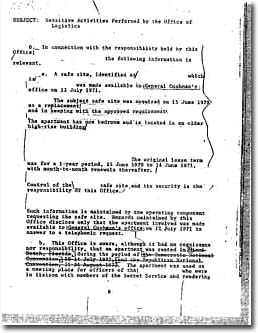
Washington D.C., June 21, 2007 – The Central Intelligence Agency violated its charter for 25 years until revelations of illegal wiretapping, domestic surveillance, assassination plots, and human experimentation led to official investigations and reforms in the 1970s, according to declassified documents posted today on the Web by the National Security Archive at George Washington University.CIA director Gen. Michael Hayden announced today that the Agency is declassifying the full 693-page file amassed on CIA’s illegal activities by order of then-CIA director James Schlesinger in 1973–the so-called “family jewels.” Only a few dozen heavily-censored pages of this file have previously been declassified, although multiple Freedom of Information Act requests have been filed over the years for the documents. Gen. Hayden called the file “a glimpse of a very different time and a very different Agency.” The papers are scheduled for public release on Monday, June 25.”This is the first voluntary CIA declassification of controversial material since George Tenet in 1998 reneged on the 1990s promises of greater openness at the Agency,” commented Thomas Blanton, the Archive’s director.Hayden also announced the declassification of some 11,000 pages of the so-called CAESAR, POLO and ESAU papers–hard-target analyses of Soviet and Chinese leadership internal politics and Sino-Soviet relations from 1953-1973, a collection of intelligence on Warsaw Pact military programs, and hundreds of pages on the A-12 spy plane.The National Security Archive separately obtained (and posted today) a six-page summary of the illegal CIA activities, prepared by Justice Department lawyers after a CIA briefing in December 1974, and the memorandum of conversation when the CIA first briefed President Gerald Ford on the scandal on January 3, 1975.Then-CIA director Schlesinger commissioned the “family jewels” compilation with a May 9, 1973 directive after finding out that Watergate burglars E. Howard Hunt and James McCord (both veteran CIA officers) had cooperation from the Agency as they carried out “dirty tricks” for President Nixon. The Schlesinger directive, drafted by deputy director for operations William Colby, commanded senior CIA officials to report immediately on any current or past Agency matters that might fall outside CIA authority. By the end of May, Colby had been named to succeed Schlesinger as DCI, and his loose-leaf notebook of memos totaled 693 pages [see John Prados, Lost Crusader: The Secret Wars of CIA Director William Colby (Oxford University Press, 2003, pp. 259-260.]Seymour Hersh broke the story of CIA’s illegal domestic operations with a front page story in the New York Times on December 22, 1974 (“Huge C.I.A. Operation Reported in U.S. Against Antiwar Forces, Other Dissidents in Nixon Years”), writing that “a check of the CIA’s domestic files ordered last year… produced evidence of dozens of other illegal activities… beginning in the nineteen fifties, including break-ins, wiretapping, and the surreptitious inspection of mail.”On December 31, 1974, CIA director Colby and the CIA general counsel John Warner met with the deputy attorney general, Laurence Silberman, and his associate, James Wilderotter, to brief Justice “in connection with the recent New York Times articles” on CIA matters that “presented legal questions.” Colby’s list included 18 specifics:1. Confinement of a Russian defector that “might be regarded as a violation of the kidnapping laws.”
2. Wiretapping of two syndicated columnists, Robert Allen and Paul Scott.
3. Physical surveillance of muckraker Jack Anderson and his associates, including current Fox News anchor Brit Hume.
4. Physical surveillance of then Washington Post reporter Michael Getler.
5. Break-in at the home of a former CIA employee.
6. Break-in at the office of a former defector.
7. Warrantless entry into the apartment of a former CIA employee.
8. Mail opening from 1953 to 1973 of letters to and from the Soviet Union.
9. Mail opening from 1969 to 1972 of letters to and from China.
10. Behavior modification experiments on “unwitting” U.S. citizens.
11. Assassination plots against Castro, Lumumba, and Trujillo (on the latter, “no active part” but a “faint connection” to the killers).
12. Surveillance of dissident groups between 1967 and 1971.
13. Surveillance of a particular Latin American female and U.S. citizens in Detroit.
14. Surveillance of a CIA critic and former officer, Victor Marchetti.
15. Amassing of files on 9,900-plus Americans related to the antiwar movement.
16. Polygraph experiments with the San Mateo, California, sheriff.
17. Fake CIA identification documents that might violate state laws.
18. Testing of electronic equipment on US telephone circuits.


Read the Documents
Note: The following documents are in PDF format.
You will need to download and install the free Adobe Acrobat Reader to view.
Document 1: Summary of the Family Jewels
Memorandum for the File, “CIA Matters,” by James A. Wilderotter, Associate Deputy Attorney General, 3 January 1975
Source: Gerald R. Ford Presidential Library
On New Years’ eve, 1974, DCI Colby met with Justice Department officials, including Deputy Attorney General Laurence H. Silberman, to give them a full briefing of the “skeletons.”Document 2: Colby Briefs President Ford on the Family Jewels
Memorandum of Conversation, 3 January 1975
Source: Gerald R. Ford President Library
Ten days after the appearance of Hersh’s New York Times story, DCI William Colby tells President Ford how his predecessor James Schlesinger (then serving as Secretary of Defense) ordered CIA staffers to compile the “skeletons” in the Agency’s closet, such as surveillance of student radicals, illegal wiretaps, assassination plots, and the three year confinement of a Soviet defector, Yuri Nosenko.Document 3: Kissinger’s Reaction
Memorandum of Conversation between President Ford and Secretary of State/National Security Adviser Henry Kissinger, 4 January 1975
Source: Gerald R. Ford President Library
An apoplectic Kissinger argues that the unspilling of CIA secrets is “worse than the days of McCarthyism” when the Wisconsin Senator went after the State Department. Kissinger had met with former DCI Richard Helms who told him that “these stories are just the tip of the iceberg,” citing as one example Robert F. Kennedy’s role in assassination planning. Ford wondered whether to fire Colby, but Kissinger advised him to wait until after the investigations were complete when he could “put in someone of towering integrity.” The “Blue Ribbon” announcement refers to the creation of a commission chaired by then-vice president Nelson A. Rockefeller.Document 4: Investigations Continue
Memorandum of Conversation between Kissinger, Schlesinger, Colby et al., “Investigations of Allegations of CIA Domestic Activities,” 20 February 1975

Source: Gerald R. Ford Presidential Library
Cabinet and sub-cabinet level officials led by Kissinger discuss ways and means to protect information sought by ongoing Senate (Church Committee) and House (Pike Committee) investigations of intelligence community abuses during the first decades of the Cold War. Worried about the foreign governments that have cooperated with U.S. intelligence agencies, Kissinger wants to “demonstrate to foreign countries that we aren’t too dangerous to cooperate with because of leaks.”

How the state brainwashes children….

“The Pledge of Allegiance was written for the popular children’s magazine Youth’s Companion by socialist author and Baptist minister Francis Bellamy on September 7, 1892…..
….In 1923 and 1924 the National Flag Conference called for the words my Flag to be changed to the Flag of the United States of America. The reason given was to ensure that immigrants knew to which flag reference was being made. The U.S. Congress officially recognized the Pledge as the official national pledge on December 28, 1945.

In 1940 the Supreme Court, in deciding the case of Minersville School District v. Gobitis, ruled that students in public schools could be compelled to recite the Pledge, even Jehovah’s Witnesses like the Gobitises, who considered the flag salute to be idolatry. In the wake of this ruling, there was a rash of mob violence and intimidation against Jehovah’s Witnesses. In 1943 the Supreme Court reversed its decision, ruling in West Virginia State Board of Education v. Barnette that “compulsory unification of opinion” violated the First Amendment.

Before World War II, the Pledge would begin with the right hand over the heart during the phrase “I pledge allegiance”. The arm was then extended toward the Flag at the phrase “to the Flag”, and it remained outstretched during the rest of the pledge, with the palm facing upward, as if to lift the flag.

An early version of the salute, adopted in 1892, was known as the Bellamy salute. It also ended with the arm outstretched and the palm upwards, but began with the right hand outstretched, palm facing downward. However, during World War II the outstretched arm became identified with Nazism and Fascism, and the custom was changed: today the Pledge is said from beginning to end with the right hand over the heart….(Wikipedia)

My Comment:

Actually, the pledge in itself would be harmless. But it adds to what’s called civic religion, doesn’t it?

Neurolinguistic programming (NLP) techniques demonstrate that you can change your emotional state by forcing yourself to smile or by adopting a posture or making a gesture which you’ve already associated with that emotion. Every time you make the gesture, you then automatically switch into that emotional state. The pledge is a form of NLP….
If this conditioning is repeated through out your life, from childhood, every day (sometimes more than once), how likely is it that you’ll be able to avoid feeling a surge of emotion everytime you see or hear something connected to the flag and the government? And would the average person be likely to separate that programming from the genuine love he has for his country, its traditions and religion, its music and art, the land, the people….Wouldn’t he be likely to think of that programmed emotion and his individual feelings toward his community or toward its music and art as one and inseparable?

Are they? Is the state the same as culture and is culture one single thing? Can we keep the English language, parliaments, P.G. Wodehouse, and tea and crumpets and throw out Churchill, imperialism and taxation without representation?

Of course, we can.

Psychologists helped frame US torture techniques

Details of the declassified Inspector General’s Report on how the torture at Abu Ghraib and Guantanamo was taught through a program that was framed in league with the psychology profession, in this article by psychologist and activist, Stephen Soldz:

“As part of the SERE program, trainees are subjected to abuse, including sleep deprivation, sexual and cultural humiliation, and, in some instances, waterboarding, described by one SERE graduate thus:
“[Y]ou are strapped to a board, a washcloth or other article covers your face, and water is continuously poured, depriving you of air, and suffocating you until it is removed, and/or inducing you to ingest water. We were carefully monitored (although how they determined these limits is beyond me), but it was a most unpleasant experience, and its threat alone was sufficient to induce compliance, unless one was so deprived of water that it would be an unintentional means to nourishment.”

More at his blog, “Psyche, Science and Society,” which has plenty of information on how the mind sciences are deployed in the services of the state. Put that next to the information we have about programs like TeenScreen and TMAP, and it should be clear that the sciences are not immune to the temptations of power and money.

We know we liive in a propaganda state. Now we know the extent to which the state is willing to employ science against any population, even its own. Several of the tortured detainees were American whistle-blowers who had alerted authorities to corruption in the military.

More Oddities in V-Tech Shooting

Jihadi and Psyops Speculations:

The blogs, left and right, have their theories about Cho.

The right-wing blogs are concerned about the jihadi aspects of the case – viz., the name Ismail (need to verify exact spelling) Ax in ink on Cho’s arm and on the return address of the video packet sent to NBC; also his high kill rate and the execution-style killing (using a chain purchased at Home Depot to fasten outer doors of Norris Hall) and the use of words like al-qaed and anti-terror in the files on the video sent to NBC.

The left wing blogs are looking at the possibility of a military psy-op of some kind. They are noting that Cho’s sister, who graduated from Princeton, worked for the government. This is the piece that is heading the popular wordpress blog posts on the subject now:

Quote:

“His older sister, Sun-Kyung, graduated from Princeton University in 2004. A source, who asked to be identified as a senior Administration official, said she works for McNeil Technologies, a firm contracted by the State Department to manage reconstruction efforts in Iraq (my emphasis). Woh. Ok. Stop right there.

“What does McNeil Technologies do?

“Oh, the usual black bag intelligence agency cut out kind of stuff… Actually, there’s more here than you can shake a stick at.

“The McNeil Technologies Services page lists the following categories: Language Services, Information Management Services, Program Support Services, Security Services, Intelligence Services.”

End of quote.

My Comment: I honestly don’t know if that’s enough to go on, since DC is filled with people who work for the government in some way or other. I taught at a school in the area for a while, and there were people on the school board, connected to the US government and to the CIA, but the school functioned as any school would. Intelligence is a huge business and recruiters look for people with language skills. Since they pay well, first or second generation immigrants are often attracted to that kind of work – which is mostly not cloak and dagger stuff. So, it’s interesting, certainly, but proves nothing much, IMHO.

However, I did find this rather odd:

“Cho’s high school has produced TWO psychotic young adults who went on gun rampages within one year of each other. Last May, Michael Kennedy, a student at Westfield High School in Chantilly, Virginia, went on a shooting rampage at a police station, killing two police officers before being fatally shot himself (my emphasis). Authorities consider this just a “horrible coincidence”. Adding to the coincidence is that Michael’s father, Brian Kennedy, was just recently released from jail in charges related to that killing. In fact, he was due in court the day after the Cho killings.”

Take a look at this article, cited in the above post, which details the trove of weapons found in Kennedy’s possession:

“The nightmare began May 8, 2006, around 3:40 p.m., when Michael Kennedy carjacked a van and drove into the rear lot of the Sully District Police Station. Unarmed, Garbarino was inside his cruiser after his shift, preparing to leave on vacation. Suddenly, from a few yards away, Kennedy fired more than 20 rounds at him with an AK-47 rifle.

“Garbarino was struck five times; yet though gravely wounded and in pain, he radioed other officers, alerting them to the danger. He provided suspect information, directed responding officers and told the police helicopter where to land.

“Armel went outside to respond to the carjacking and, when she reached her cruiser, Kennedy arrived and began shooting at Garbarino. Drawing Kennedy’s fire away from Garbarino, she and Kennedy exchanged gunfire, and a bullet from his 30.06-caliber rifle pierced her ballistic vest and struck her in the chest.

“ARMED WITH FIVE handguns, an AK-47 assault weapon, a high-powered rifle and more than 300 rounds of ammunition, Kennedy fired 70 rounds-plus before other officers killed him. Later that night, armed with a warrant, Det. Craig Paul and other police officers searched Kennedy’s home at 6200 Prince Way for three hours, seizing a veritable arsenal of weapons and more than 2,500 rounds of ammunition.

“The indictment states that Brian Kennedy illegally possessed 20 firearms, including an AK-47 and several bolt-action and semi-automatic rifles and shotguns. He also owned a large variety of handguns — among them a .38 Special Taurus and a 9 mm Luger Commander semi-automatic pistol.

“Weapons were everywhere in the Kennedy home; the inventory list of items seized is 10 pages long. Under the mattress in the master bedroom were a Colt 9 mm handgun with one round in the chamber and a leather sheath containing a 9-inch knife. On the nightstand were a bayonet plus high-velocity ammunition for a Remington, semi-automatic shotgun.

“A Smith & Wesson knife was under the left, loveseat cushion in the living room, and both a 12-gauge shotgun and a 22-caliber long rifle stood in the corner of the hallway to the basement. An M80 explosive was tucked inside a kitchen cabinet to the right of the stove, and an Atlanta Sharptec knife was stored in the ceiling above the utility-room door.”

My Comment: Whew! My interest is not only in the coincidence of a psychiatric killer with multiple weapons coming out of the same high school, but also in what that suggests about VA Tech police procedures.

Surely, as a state school and with the state already having encountered this classic school shooter incident, they would have had specialized training and a specialized response ready. But they didn’t, despite this shooting and then the Morva shooting, in just the previous year. It would be good to find out why the record of arson and stalking at the school – which they knew about – did not lead them to suspect Cho in the bomb threats – at least to the extent of questioning him.

More on Psyops:

This other thread here strikes me as much more speculative but not unworthy of investigation.

For me right now, though, these are the questions I want to pursue:

Main Questions:

1. What accounts for the failure to enter Cho’s psychiatric condition into the state or federal record (do I have this right)? Or for the university not following up in some way on his treatment?

2. What accounts for the failure of the police to close down the campus after two people were killed and there were two recent bomb threats? Also, the behavior of the police was extremely lax, as this piece by Alexander Cockburn, indicates.

3. Where or how did Cho acquire his expertise in shooting?

4. How does the methodical nature of the killing and the posting of a video in the middle of it all square with the rest of the profile we have of Cho?

5. Cho is said to have had a speech impediment or autism early on, but on the video his voice seems clear enough. Puzzled.

Oddities with regard to possessions and contacts:

I have posted this separately, but felt the contents of his room, emails, and books also warranted classification as oddities, as they may contain clues to his state of mind and his connections:

Contents of Search Warrant

Here is a list of items found in Cho’s room. As you can see there are not video games (so far). I mentioned earlier that the Counterstrike obsession may have been more a rumor set off by accounts from high school classmates that were never fully substantiated, because Karan Grewal, his suite mate said that he never saw evidence of it. But I would still like to learn more.

Results of search of his room, courtesy of gaygamer:

*Chain from top left closet shelf
• Folding knife & combination padlock
• Compaq computer from desktop
• Assorted documents, notepads, writings from desktop
• Combination lock
• Dremel tool and case
• Nine books, two notebooks, envelopes, from top shelf
• Assorted books & pads from lower shelf
• Compact discs from desktops
• Items from desktop & drawers: winchester multi tool, 3 notebooks, mail, checks, credit card
• Items from 2nd door: Kodak digital camera, Citibank statement
• Two cases of compact discs from dresser top
• Drive: Seagate: 80 Gb
• Six sheets of green computer paper
• Mirror with blue plastic housing
• Dremel tool box with receipt
• Dell Latitude service tag

More about those books and CDs from this report:

“Cho, 23, also used the eBay account to sell items ranging from Hokies football tickets to horror-themed books, some of which were assigned in one of his classes.

A search warrant affidavit filed Friday stated that investigators wanted to search Cho’s e-mail accounts, including the address Blazers5505@hotmail.com. Durzy confirmed Cho used the same blazers5505 handle on eBay.

Virginia State Police spokeswoman Corinne Geller said investigators are “aware of the eBay activity that mirrors” the Hotmail account.

One question investigators hope to answer is whether Cho had any e-mail contact with Emily Hilscher, one of the first two victims. Investigators plan to search her Virginia Tech e-mail account.

Experts say that when the subject of an investigation is a loner like Cho, his computers and cell phone can be a rich source of information. Authorities say Cho had a history of sending menacing text messages and other communications — written and electronic.

On March 22, Cho bought at least two 10-round magazines for the Walther P22. A day later, he made a purchase from a vendor named “oneclickshooting,” which sells gun accessories and other items. It appears that he bought three Walther P22 clips in that purchase, but the seller could not be reached for comment.

Cho sold tickets to Virginia Tech sporting events, including last year’s Peach Bowl. He sold a Texas Instruments graphics calculator that contained several games, most of them with mild themes.

“The calculator was used for less than one semester then I dropped the class,” Cho wrote on the site.

He also sold many books about violence, death and mayhem. Several of those books were used in his English classes, meaning Cho simply could have been selling used books at the end of the semester.

His eBay rating was superb — 98.5 percent. That means he received one negative rating from people he dealt with on eBay, compared with 65 positive.

“great ebayer. very flexible,” the buyer said of his Chick-fil-A Peach Bowl tickets, which went for $182.50.

Andy Koch, Cho’s roommate from 2005-06, said he never saw Cho receive or send a package, although he didn’t have much interaction with the shooter. Students can sign up for a free lottery on a game-by-game basis, and the tickets are free.

“We took him to one football game,” he said. “We told him to sign up for the lottery, and he went and he left like in the third quarter, and that was it. He never went again. He never went to another game.”

Cho sold the books on the eBay-affiliated site half.com. They include “Men, Women, and Chainsaws” by Carol J. Clover, a book that explores gender in the modern horror film. Others include “The Best of H.P. Lovecraft: Bloodcurdling Tales of Horror and the Macabre”; and “The Female of the Species: Tales of Mystery and Suspense” by Joyce Carol Oates — a book in which the publisher writes: “In these and other gripping and disturbing tales, women are confronted by the evil around them and surprised by the evil they find within themselves.”

End of Quote
My Comment:
I have more on the eBay handle in my post about Cho’s emails/books (see categories, where I have classified the VTech posts into three categories. Obviously, they overlap, but they will help organize the posts into materal that relates to

1. The failure of the police response

(including nature of killings, wounds, crime scene footage, autopsy, victim and witness accounts)
2. The Psychiatric/Legal failure

(centering around the history of pathological or criminal failure, the laws of privacy, the failure to report or follow up on these, lack of information given to the Feds, failure of the background check to find Cho’s history, gun laws and policy, mental illness and civil rights laws, privacy laws).

3. The theories and evidence for some kind of terrorist or intelligence related activity

(centering around Cho, including the Ismail Ax name and related material. Much of the material will overlap with the other categories too).

Final Oddity:

A report on the crime scene has this:
“Crime scene technicians recovered 17 spent magazines of ammunition, the majority of which were for Cho’s 9mm handgun, a law enforcement official said.

“He ended up buying a load of mags from Wal-Mart and Dick’s Sporting Goods,” said an official, who asked not to be identified. “This was a thought-out process. He thought this through.”

Autopsy:
I am adding this quote about the autopsy findings, which show repeated shooting at the victims, as it is also peculiar:

“The reports on the victims, including Cho, show that he caused more than 100 wounds, hitting victims several times,”

This is from an earlier report on the multiple wounds –

” The official said investigators believed that most of the 32 dead were shot a minimum of three times, and that many of the 28 wounded were shot more than once.”

Partly answering one of my questions (how did he get so good at shooting) is this account of his practicing in the week before the killing. Obviously that doesn’t explain the whole thing, but taken together with the account of his getting up early and going to the gym, you can see he practiced for this).

“In the weeks before the violence, the investigator said, Cho went to a shooting range in Blacksburg, not far from campus, spending an hour practicing with the weapons and buying more magazines there.

“Investigators believe, based on interviews with an employee at the range, that Cho recorded part of his video statement in a van in the range parking lot because, they said, the employee described an Asian youth recording himself there.”

On Sunday, state police also indicated that so far they have not definitely been able to tie Cho to the first killing at Ambler Johnston, although his gun was “linked” to it.

(My Comment: Was it used there, found there, or did the bullets match up..more research needed here? Needs clarification).

There is still a possibility, in other words, that there could have been two different killers. The whole scenario of Cho killing two people and then walking a couple of miles to and fro to post his videos (at least, the reports I read did not mention that he drove), in time to massacre 30 more students does seem strange to me, although, you don’t really expect normalcy in this sort of business.