Rothschild Climate-Controllers behind the Gina Rinehart Story?

[h/t Becky Akers, at LRC for the lead]

As soon as I read this quote in a story about Aussie mining magnate and multi-billionaire, Gina Rinehart, I knew something more was going on than a debate over the nastiness of a rich woman mouthing off in the press.

Here’s the quote from “The Iron Lady,” Sidney Morning Herald, January 12, 2012:

“Prince Philip had just met Gina Rinehart, ranked by US business media company Forbes as the 19th most powerful woman in the world – 30 places ahead of Queen Elizabeth II. Rinehart is the richest Australian in history (and far richer than the Queen), with a net worth of about $10 billion. At least, that is one recent estimate.”

Oh? Someone wants to let you know that there are much richer people than the Queen? Could that be because the Queen (the Crown) is entwined with the Rothschilds and the City of London?

That might explain the extremely negative slant of the major media toward Ms. Rinehart’s no doubt thoughtless, heartless, and superficial remarks (like that doesn’t apply to the content of most newspapers).

Articles peppered with demeaning personal references pop up.

In the piece I just mentioned, I found  this:

“He said he wanted to remember her as the ‘neat, trim, capable and attractive young lady’ she had been rather than ‘the slothful, vindictive and devious baby elephant that you have become’.

Not too often anyone refers to the richest woman in the world in those terms.

So what’s really going on?

Some conspiratorial folks seem to have got the real story:

The Rothschild related climate-controllers (backed by the CIA/Rockefeller funding) are attacking rich magnates opposed to the climate-scam tax.

See, “Palmer says green groups funded by CIA .”

And here’s more at Barnaby is Right :

“Apparently the Canberra media gallery and the social mediasphere are all abuzz over comments by anti-CO2-derivatives-scam activist, self-made billionaire and recently honoured National Living Treasure, Clive Palmer….. here is a news article from the Brisbane Times this afternoon that does at least include a number of complete quotes from Mr Palmer’s press conference.

Since you will only see/hear selectively edited sound bites on the TV and radio news this evening – because after all, it is vital to smear the character of anyone threatening a legal challenge to the bankers’ CO2 derivatives scam – I’ll reproduce the Brisbane Times’ piece in full.

I assume that readers of this blog are significantly less predisposed to hasty judgements and attacking the messenger rather than dispassionately assessing the message, than the average egotistical narcissist twit on Twitter … and in the Canberra press gallery:

Mining magnate Clive Palmer has accused the Australian Greens and Queensland environmental campaigners of “treason” in conspiring with US powers to destroy the nation’s coal industry.

Mr Palmer was expected to give his response to the passing of the Gillard government’s mining tax at a media conference called this afternoon, but the multi-billionaire was concerned only with perceived collusion between the United States’ Central Intelligence Agency and the environmental lobby.

Mr Palmer turned his attention to a report by Greenpeace and other anti-coal groups, titled Stopping the Australian Coal Export Boom, which outlined an environmental campaign designed to disrupt and delay the expansion of the industry.

While brandishing a copy of the report this afternoon, Mr Palmer said it was the result of a CIA conspiracy involving the US-based Rockefeller Foundation.

“This is funded by the CIA,” he said.

“You only have to go back and read … the reports to the US Congress that sets up the Rockefeller Foundation as a conduit of CIA funding.

“You only have to look at the secret budget which was passed by Congress last year – bigger than our whole national economy – with the CIA to ensure that.

“You only have to read the reports to US Congress where the CIA reported to the president that their role was to ensure the US competitive advantage – that’s how you know it’s funded by the CIA.”

Mr Palmer argued descendants of US oil magnate John Rockefeller had bankrolled the report, in a bid to disrupt and damage the Australian coal industry.

He went on to say that the document confirmed local environmental campaigners, including Lock the Gate Alliance president Drew Hutton and Greens leader Bob Brown, were improperly collaborating with foreign multinationals.

“The Greens have not been providing you with the full information about where their money comes from or what it’s about,” he said.

“I think the Greens [candidates] in this upcoming state election … should resign if they’re being funded by an offshore political power.

“It’s paramount [sic] to treason and something needs to be done about it.”

Mr Palmer made little mention of mining tax legislation, passed last night in the Senate, saying he had no concern with it.

“I don’t care about any tax. It won’t affect my life one way or the other,” he said.

Mr Palmer said the controversial tax, which aims to distribute the spoils of Australia’s mining boom, would have no affect on his businesses.

“It probably won’t cost me anything, because I’m not mining anything that comes under the classification of it. So, you know, it’s not something that’s worried me,” he said.

Mr Palmer said he would not join Australia’s third largest iron ore miner, Fortescue Metals, owned by Andrew “Twiggy” Forrest, in mounting a legal challenge.

“Certainly Andrew Forrest has indicated he’ll do that – he has major concerns with it, because it affects him, affects his business and affects the ability of his workers,” Mr Palmer said.

UPDATE:

Andrew Bolt at least shows some restraint in joining the mockers, but does make one worthy observation (emphasis added) –

The Opposition will be thinking, oh, damn.

That’s not to say there wasn’t a straw from which this grass castle was built. From the CIA’s website, this book review:

She also does a fine job in recounting the intriguing story of how the CIA worked with existing institutions, such as the Ford Foundation and the Rockefeller Foundation, and established numerous “bogus” foundations to “hide” its funding of the Congress for Cultural Freedom and its other covert activities. Everything came a cropper in 1967, however, as a result of press articles, especially revelations in the long-gone Ramparts magazine.

Celebrity “alternative”: the case of Alex Jones

An interesting post from  FauxCapitalist on the “mainstreaming” of alternative activists. You can also call this commodification of dissent or dissent-porn:

“For someone who is, by his own words, allegedly one of the biggest threats to the New World Order, Alex Jones certainly has some high-powered connections into mainstream media, as mostly vividly demonstrated by his February 28, 2011 appearance on The View.

His June 8, 2012 Infowars.com article, Alternative Media Becoming Mainstream, may have been a sign of things to come, given this celebrity lineup in the two months since, as shown on his prisonplanet.tv show archives:

Richard Belzer – August 16
“Alex is also joined by actor, stand-up comedian and author Richard Belzer. Mr. Belzer has an expansive career as an actor and has appeared in NBC police dramas such as Homicide: Life on the Street and Law & Order: Special Victims Unit.”

John Rocker – August 15
“On the Wednesday, August 15 edition of the Alex Jones Show, Alex talks with John Rocker, the retired American Major League Baseball relief pitcher who played for the Atlanta Braves and other teams.”

Dave Mustaine – July 26
“On the Thursday July 25th edition of the Alex Jones Show, Alex airs an interview he recorded this past weekend with American virtuoso guitarist and legendary lead vocalist for the almost three-decade strong, highly influential thrash-metal band Megadeth, Dave Mustaine.”

Charlie Daniels – July 20
“Alex also welcomes back to the show to country and southern rock music legend Charlie Daniels.”

A look at the college debt bubble in 2006

I dug up this piece on “good debt” and its problems from the Baltimore Chronicle (2006). It’s my second “Penny Whys” column. There were only two, because I got busy with writing “Mobs, Messiahs and Markets” after that.

As you can see, I was sounding off against college education a long time back.

And folks who know me know that the sounding off goes back to childhood. Getting me to even stick with high school was a protracted battle.

I wanted out at around 11 or 12. I day-dreamed  of working my way around the world.

If I couldn’t be a sailor (like Conrad), I could at least do something practical.

I would have liked to work for National Geographic. For which education wasn’t necessary, I thought. I could write. Why wouldn’t they hire me? Well, apparently, they wouldn’t.

I’m sure they don’t open letters from thirteen year olds in India.  I wrote to Boris Spassky around the same time,  asking about his latest strategy against Fischer. He didn’t reply either.

It wasn’t that I wasn’t a good student. I was.  But I learned much better on my own, had interests that didn’t match my subjects, and hated all the extra things that went with school.

As some kind of bitter karma, I ended up getting a Master’s in India (the minimum needed to get a job above starvation wages) and then had to redo my education in the US, which tends not to accept degrees from other countries. Out the door went all the books I had pent up inside. Between working several badly paid jobs, household duties, a small business, and night-school, there was less and less time for writing.

I wanted to go to a Catholic school and study theology and music theory. But I didn’t drive in those days, and I couldn’t make the classes on the bus. So I ended up in political science at Hopkins, which was the only place that offered classes that fit.

Course by course, working my way through at the rate of a couple a semester, I Iearned the Byzantine treacheries of the academic world, its ghettos, mafias, and Tammany Halls.

I don’t regret going through it, any more than soldiers regret going to war or mothers regret having children. It’s not possible to regret something that takes up half your life. You can only live with it as well as possible.

[The first column was “A Twelve Step Program for Debtaholics.”]

“In our last little chat, I talked about the addiction that drives consumers to spend in America, an addiction driven by a desperate loss of control over their financial future. No longer is a house, an education, or good health care a genteel burden your average upstanding citizen can shoulder on his own. Instead, it has become debt bondage….life-long servitude. And the enslaved ones yank at their chains in the only way they know—by recklessly throwing away money on consumer goods they hope will compensate them for their slavery. They buy to fill the queasy emptiness unsettling the pit of their stomachs.

But salvation by stuff is not in any gospel that Penny ever read. King Solomon—he of the supernumerary wives—had plenty of stuff too. But didn´t he sigh wearily that it was all vanity? Or was that the preacher in Ecclesiastes? Twenty years out of school, these things can get foggy.

The point is, the urge to look outside yourself for solutions to problems that stem within yourself is the source of addictive behavior. And buying stuff you don´t need is the definition of looking outside your self for solutions.

But Penny realizes that not all stuff is stuff you don´t need. In fact, the largest part of the modern consumer´s debt in the United States and the source of her perpetual anxiety is necessary debt, “good debt.” The kind that she feels proud to own up to, the kind that she staggers under for the natural term of her adult life with the game smile of a Christian being escorted into the catacombs. All for a good cause, it says, before it sets into rigor mortis.

Now, anyone who has picked up a newspaper or even switched on his TV has surely absorbed every nuance of the first of the “good debt” traps lying in wait for the unwary—the great housing hustle of the early twenty-first century. Actually, in America today it would be hard to find even a borderline member of the human species who had not slapped up hard against the phenomenon of home-as-honey-pot. And we also haven’t lacked for warnings about the advanced state of deterioration of another “good debt” trap—our health care system—since überwench Hillary decided to play Nurse Ratched with it in the boisterous days of William Jefferson’s regnum.

But the third “good debt” trap—the gargantuan price tag of education, lower, higher, and all sizes in between—seems to have slipped through our fiscal early-warning system, no doubt because a mega-tsunami of debt suddenly becomes manageable, worthy, and indeed downright righteous when it’s driven not just by vulgar splurging on run-of-the-mill consumer junk but by the sweat-and-blood payments of the solid citizenry on something so rarefied (and thus obviously much too elevated for us plebes to debate) as education.

Well—time to debate.

First, college costs rise faster than inflation and have done so for the last ten years. According to the report, “Trends in College Pricing 2005,” of the College Board, a non-profit association of 4,500 schools, colleges and universities, tuition costs at four-year private colleges grew at about the same rate as in 2004—5.9 percent—to $21,235.

The rate fell at four-year public universities to 7.1 percent (from 10.5), but the actual costs still increased by $5,491.

Second, Kal Chaney, author of Paying for College Without Going Broke, forecasts that “For the foreseeable future, college cost increases are going to exceed inflation…”

Add room and board to tuition, and the cost of a private college averages out to $29,026 per year, and at a four-year public college to $12,127. Over four years, that works out to the price of a modest bungalow and condominium. At least in Pittsburgh, Pennsylvania.

But of course, it’s completely worth delivering this samurai chop to the family piggy bank because when Junior grows up to be a hair-transplant surgeon, bankruptcy lawyer, used car salesman, or—better yet—beltway lobbyist, it pays off big time. That’s the theory, anyway. But what the theory overlooks is that counting on a professional in the family means doubling the bill to fit in professional school fees. Three years of education at one of the nation’s tonier law schools, for instance, and you rack up at least a hundred twenty grand on the ..er..bar tab. So now we’re looking at something over two hundred grand for the whole business.

But so what? Aren’t we all worth it? Don’t we all deserve the very best? Don’t we love us enough to do this for us?

Apparently, vast numbers of college-intoxicated adults think so. But Penny—who has eyeballed more ivy halls than she cares to admit to—is here to tell you otherwise. No. Don´t do it. Think again. Need to get a job? There are much quicker ways. Need to make more money? Take that college fund and buy an education franchise…or a gas station. Need to get an education? Just remember it was Mark Twain who said he never let his schooling get in the way of his education. And he wasn´t kidding. Twain, Jack London, Benjamin Franklin, George Gershwin, Galileo…just a few of the geniuses who never finished college…and never needed to.

There is no longer any need to accept debt—even respectable debt—as a badge of honor of your socio-economic aspirations. From now on, the highest mark for smarts will go to those who avoid any kind of debt.

And even if you insist on going, there is no reason whatsoever for contracting a terminal case of insolvency.. Penny knows several ways you can get yourself a college degree for substantially less than the going rate, and do it with a lot less effort.

The point is there is no longer any need to accept debt—even respectable debt—as a badge of honor of your socio-economic aspirations. From now on, the highest mark for smarts will go to those who avoid any kind of debt.

Next time: How to get an education without getting into debt….or even into your car.

Until then,
Penny, giving you the whys of thrift, not just the hows.

Penny Whys is a column of personal finance written by Lila Rajiva, a political journalist and writer for the Daily Reckoning, a libertarian financial magazine headquartered in Baltimore.

Rousas Rushdoony: What Jesus taught about taxes

Rousas Rushdoony gives the traditional Christian understanding of the great subversive parable of Jesus, regarding the payment of tribute to Caesar, notwithstanding the attempt by some to use Jesus to support libertarian beliefs.

Rushdoony’s understanding is supported by the readings of others (per Wikipedia):

Mennonite Dale Glass-Hess wrote:

It is inconceivable to me that Jesus would teach that some spheres of human activity lie outside the authority of God. Are we to heed Caesar when he says to go to war or support war-making when Jesus says in other places that we shall not kill? No! My perception of this incident is that Jesus does not answer the question about the morality of paying taxes to Caesar, but that he throws it back on the people to decide. When the Jews produce a denarius at Jesus’ request, they demonstrate that they are already doing business with Caesar on Caesar’s terms. I read Jesus’ statement, “Give to Caesar…” as meaning “Have you incurred a debt in regard to Caesar! Then you better pay it off.” The Jews had already compromised themselves. Likewise for us: we may refuse to serve Caesar as soldiers and even try to resist paying for Caesar’s army. But the fact is that by our lifestyles we’ve run up a debt with Caesar, who has felt constrained to defend the interests that support our lifestyles. Now he wants paid back, and it’s a little late to say that we don’t owe anything. We’ve already compromised ourselves. If we’re going to play Caesar’s games, then we should expect to have to pay for the pleasure of their enjoyment. But if we are determined to avoid those games, then we should be able to avoid paying for them.[13]

Mohandas K. Gandhi shared this perspective. He wrote:

Jesus evaded the direct question put to him because it was a trap. He was in no way bound to answer it. He therefore asked to see the coin for taxes. And then said with withering scorn, “How can you who traffic in Caesar’s coins and thus receive what to you are benefits of Caesar’s rule refuse to pay taxes?”

At the same time, Gandhi, certainly saw that Jesus would have supported non-cooperation and civil resistance through non payment of taxes:

“Jesus’ whole preaching and practice point unmistakably to noncooperation, which necessarily includes nonpayment of taxes.[14]

In Rushdooney’s reading,  Jesus’ teaching is more submissive than it is in Gandhi’s. But it is submissive in a subversive way, similar to the reading of Jacques Ellul:

“Render unto Caesar…” in no way divides the exercise of authority into two realms….They were said in response to another matter: the payment of taxes, and the coin. The mark on the coin is that of Caesar; it is the mark of his property. Therefore give Caesar this money; it is his. It is not a question of legitimizing taxes! It means that Caesar, having created money, is its master. That’s all. Let us not forget that money, for Jesus, is the domain of Mammon, a satanic domain!
My sense is that Jesus’ parables should not be taken out of context to support a dogmatic and anachronistic reading. They should be read in the general spirit of his other teachings.
Elsewhere, Jesus taught that worldly power and wealth were obstacles to the soul. This is hardly the same as libertarian anti-state ideology, but it is subversive and unworldly.
Rousas Rushdoony:

“6. The Tribute Money

One of the best-known stories of the New Testament is the one con­cerning the tribute money question: “Is it lawful to give tribute unto Caesar or not?” Christ’s answer, “Render therefore unto Caesar the things which are Caesar’s; and unto God the things that are Gods” (Matt. 22:15-22; Mark 12:13-17; Luke 20:20-26), is one of the most familiar sentences of Scripture. The general implications have long been recognized; in the specific application, there has been much variation.

The purpose of the Pharisees is again to “entangle him in his talk” (Matt. 22:15); Luke is more specific, “And they watched him, and sent forth spies, which should feign themselves just men, that they might take hold of his words, that so they might deliver him unto the power and authority of the governor” (Luke 20:20-26). The Roman governor was meant. Apparently the expectation was that Jesus, in faithfulness to the law, would declare that only a theocracy was valid in Israel, not Roman rule and law. Behind this strategy were the Phari­sees and the Herodians (Matt. 22:16; Mark 12:13), a minor, political, non-religious party of the day. The Herodians favored the Roman tax and the Herodian dynasty, which they regarded as preferable to direct Roman rule. The Pharisees were normally hostile to the Herodians, but they joined forces in hostility to Jesus. If Jesus opposed the tax, He could be denounced and delivered to the Roman authorities for arrest and trial.

The question was prefaced with fulsome flattery; the questioners asked as if motivated by a tender conscience rather than a desire to entrap. They attempted to push Jesus into an answer heedless of con­sequences by asserting that “thou art true, and carest for no man; for thou regardest not the person of men, but teachest the way of God in truth” (Mark 12:14). Such an integrity, they hoped, would compel Him to deny the legitimacy of the Roman tax. “Is it lawful for us to give tribute unto Caesar, or no?” (Luke 20:22).

The Greek text makes clear that the tax was a “capitation tax,” not an indirect tax.[1] “Luke uses phoros, the wider word for ‘tribute’ as it is paid by one nation to another; Matthew and Mark use the more specific kenos or poll tax that is levied upon every individual for his own person and is thus especially galling as a mark of servitude to the Roman power.”[2]

Israel already had a poll tax, that required by God’s law in Exodus 30:11-16. Its purpose was to provide for civil atonement, i.e., the covering or protection of civil government. Every male twenty years old or older was required to pay this tax to be protected by God the King in His theocratic government of Israel. This tax was thus a civil and religious duty (but not an ecclesiastical one).

There was thus a particular aggravation in the fact that Rome also required a poll or head tax. The Roman Empire and emperor were progressively assuming divine roles, requiring religious assent, and claiming priority over religion. The poll tax was thus a particularly offensive tax, in that it seemed to require a polytheistic faith, the worship of a god other than the true God. Moreover, the Herodian tax was so heavy that twice the imperial government compelled Herod to reduce his tax demands in order to avoid serious trouble. Judas Galilaeus had earlier presented himself as the messiah and had summoned Israel, in the name of God and Scripture, to refuse to pay the tax. The Romans were merciless in putting down the rebellion (Acts 5:37).

The matter had been aggravated as early as A.D. 29 by Pilate, who for a time issued coinage “bearing the lituus, the priest’s staff, or the patera, the sacrificial bowl-two symbols of the imperial philosophy which were bound to be obnoxious to the people.”[3]These coins were later withdrawn, but they did serve to underscore the fact that their bondage to Rome had religious overtones.

The right to issue coins had religious overtones for Israel as I Maccabees 15:6 implies, and it was thus important to them. “‘Coin’ and ‘power’ were regarded as synonyms, so that the coin was the symbol of the ruler’s dominance.”[4] In the second century A.D., Bar Kochba, the false messiah, replaced Roman coinage with his own coins as a means of asserting his power. To give tribute to Caesar thus meant to acknowledge Caesar’s power; to approve of giving tribute to Caesar was to acknowledge the legitimacy of Caesar’s power. The question implicit, in the Herodian’s statement was whether any government other than God’s has any legitimacy. Christ’s assertion of His messiahship was seen by his accusers as a denial of Caesar’s right to tax (Luke 23:2), since the Messiah as King had to have exclusive sovereignty, in their perspective. For Jesus to have denied Caesar’s right to tax Israel was a mark of insurrection and would make Him liable to arrest. For Jesus to have affirmed Caesar’s right to tax would have been, in the eyes of the people, a denial of His messiahship.

The answer of Jesus was to ask for a denarius; He asked it of His questioners. As Stauffer, whose chapter on “The Story of the Tribute Money” is very important, has written:

Jesus asked for a penny, a denarius. Why? There were a great many coins in the wide Roman empire which passed as legal cur­rency, old and new, large and small, imperial and local, gold, silver, copper, bronze and brass. In no country did so many different kinds of money circulate as in Palestine. But the prescribed coin for taxation purposes throughout the empire was the denarius, a little silver coin of about the worth of a shilling. (It can only be the sil­ver denarius which is intended in Mark 12:16, Luke 20:24 and Matt. 22:19, not a gold coin as Titian supposed, in his representa­tion of the tribute scene, nor a Herodian coin, as is often asserted; for the Herodian coins were not called denarii and were not tribute coins, but were local copper coins.) Jesus knew this, and so He asked for the silver imperial tax coin, using the Latin word, the Roman technical expression, which had become current in Palestine along with the coin itself. Bring me a denarius, He said. He did not produce one from His own pocket. Why not? The point now is not whether Jesus had such a coin in His pocket but whether His opponents had. With Socratic irony, he added: “That I may see it?” Why? He had the maieutic purpose with his questioners, He wanted to deliver them, in the Socratic manner, not a priori, but a posteriori. Not their logical or moral sense, but their historical situation and attitude would bring the truth to light. Something is to be seen, and deduced, from the denarius itself.[5]

When the coin was handed to Jesus, He did not yet answer their question, “Is it lawful to give tribute to Caesar, or not?” Instead, He asked another question: “Whose is this image and superscription?” (Matt. 22:20; Mark 12:16; Luke 20:24). The answer was, of course, “Cae­sar’s.” According to Geldenhuys,

After their acknowledgment that it is Caesar’s, the following two facts are vividly brought to light through Jesus’ masterly handling of the situation:

(1) Coins with Caesar’s image and superscription are in use among the Jews.
(2) The coins are evidently the property of Caesar, otherwise they would not have borne his image and superscription.
From these two facts it thus follows that the Jews had accepted the imperial rule as a practical reality, for it was the generally current view that a ruler’s power extended as far as his coins were in use.[6]

The practical reality was thus made clear. These men used the coins of Tiberius which carried a “bust of Tiberius in Olympian nakedness, adorned with the laurel wreath, the sign of divinity.” The inscription read, “Emperor Tiberius August Son of the August God,” on the one side, and “Pontifex Maximus” or “High Priest” on the other. The symbols also included the emperor’s mother, Julia Augusta (Livia) sitting on the throne of the gods, holding the Olympian sceptre in her right hand, and, in her left, the olive branch to signify that “she was the earthly incarnation of the heavenly Pax.”[7] The Coins thus had a re­ligious significance. Israel was in a certain sense serving other gods by being subject to Rome and to Roman currency. The point made by implication by His enemies, that tribute to Caesar had religious over­tones, was almost confirmed by Jesus, even as He proved their own submission to Caesar.

Then came His great answer: Render to Caesar the things that are Caesars [sic], and to God the things that are God’s (Mark 12:17). Ac­cording to Stauffer, render here means “give back.” “That is the first great surprise in this verse, and its meaning is: the payment of tribute to Caesar is not only your unquestioned obligation; it is also your moral duty.”[8] St. Paul used the same term in Romans 13:7, “Render to all their dues: tribute to whom tribute is due; custom to whom custom. . . .”

Judea was living within the Roman Empire, gaining military and economic benefits from that empire whether it wanted them or not. Even if the benefits of the empire were outweighed by its liabilities, the people were still to render Caesar his due.

The fact still remained that two poll taxes stood in opposition, one paid to the emperor, the other to God. The imperial tax provided “for the daily sacrifice for the welfare of the Roman emperor”; it maintained the empire as a religious entity.[9] The other tax, called then the temple tax, was God’s tax for maintaining His holy order. How could both taxes be paid? According to Stauffer, “He affirmed the symbolism of power, but He rejected the symbolism of worship. But this reservation was not made as a negative statement, but rather as a positive command. ‘Render to God what is God’s’ “[10] Stauffer is right in asserting that, ac­cording to Numbers 8:13 ff., this means that “Everything belongs to God.”[11] At the time that Jesus spoke, the Biblical poll tax was being collected in the spring, in the month of Adar. More specifically, Jesus asked that Caesar’s tax be rendered to Caesar, and God’s tax be rendered to God. The early church was apparently aware of this fact. Jerome, commenting on Matthew 22:21, declared, “Render unto Caesar the things that are Caesar’s, namely, coins, tribute, money; and to God the things that are God’s, namely, tithes, first-fruits, vows, sacrifices.”[12] Israel’s departure from God’s rule and law had placed them under Roman rule and law; they owed to Rome the tribute due to Rome. Rome did not serve God, but neither did Israel. Obedience is due to all authorities under who we find ourselves (Rom. 13:1-7). Rome was now their master, and Rome had to be obeyed. Obedience to God requires obedience to all those whom we find ourselves in subjection to. In the temptation in the wilderness, Satan had tempted Jesus to follow a way of empire: give the people bread and miracles; enable them to walk by sight. Now, through other tempters, the temptation was offered of rejecting all empires, all earthly powers.

Christ conquered this temptation afresh with His words about the double duty of obedience to the way and to the goal of history, to the kingdom of the world and to the kingdom of God. Mark 12:17 is spoken by Christ in conspectu mortis, in the sight of the messianic death. Holy Week is the existential exegesis of His words: submission to the dominion of Caesar, submission to the dominion of God — united in the acceptance of that monstrous judicial murder by which Caesar’s most wretched creature fulfils sub contrario the work of God (Matt. 26:52 ff.; John 19:11)[13]

Let us return to St. Jerome’s words. Two kinds of taxation exist, and Christ requires our obedience to both. The world of Caesar seeks to create a new world without God, and without regeneration; it exacts a heavy tax and accomplishes little or nothing. We are, as sinners, geared by our fallen nature to seeking Caesar’s answer. We pay tribute to Caesar thus, in our faith and with our money. The answer to Caesar’s world is not civil disobedience, the final implication of which is revolution. This is Caesar’s way, the belief that man’s effort by works of law can remake man and the world.

The answer rather is to obey all due authorities and to pay tribute, custom, and honor to whom these things are due. This is the minor aspect of our duty. More important, we must render, give back to God what is His due, our tithes, first-fruits, vows, and sacrifices. The re­generate man begins by acknowledging God, the author and Redeemer of his life, as his lord and savior, his King. At every point in his life, he renders to God His due service, thanksgiving, praise, and tithe. His salvation is God’s gift; the bounty he enjoys is God’s gift and providence; the regenerate man therefore renders, gives back to God, God’s appointed share of all things.

The way of resistance to Rome chosen by Judea led to the world’s worst war and to the death of the nation. Neither the Roman imperial answer nor the Judean revolutionary answer offered anything but death and disaster. Self-consciously, the Christians followed their Lord. Justin Martyr wrote:

And everywhere we, more readily than all men, endeavour to pay to those appointed by you the taxes both ordinary and extraordinary, as we have been taught by Him; for at that time some came to Him and asked Him, if one ought to pay tribute to Caesar; and He answered, “Tell me, whose image does this coin bear?” And they said, “Caesar’s”; And again He answered them, “Render therefore to Caesar the things that are Caesar’s, and to God the things that are God’s.” Whence to God alone we render worship, but in other things we gladly serve you, acknowledging you as kings and rulers of men, and praying that with your kingly power you be found to possess also sound judgment. But if you pay no regard to our prayers and frank explanations, we shall suffer no loss, since we believe (or rather, indeed, are persuaded) that every man will suffer punishment in eternal fire according to the merit of his deed, and will render account according to the power he has received from God, as Christ intimated when He said, “To whom God has given more, of him shall more be required.”[14]

Christ’s answer did not prevent His enemies from charging Him with “perverting the nation, and forbidding to give tribute to Caesar” (Luke 23:2). His answer in reality had demolished all grounds for any accusation against Him.

Their duty, Jesus had declared, was “to render back” “to pay what is owing”[15] to Caesar and to God. What is due to Caesar is due to Caesar only by the providence, purpose, and counsel of God. What is due to God, what all men owe Him, is everything. Jesus set forth “God’s absolute and peculiar right in respect of every man individually and of all men collectively-an exclusive and paramount right possessed by God alone.”[16]

Those who reduce this great sentence of Christ’s to a declaration about church and state have missed the point of the incident.


[1] Plummer, Luke, p.465.[2] Lenski, Luke, p.988.

[3] Ethelbert Stauffer, Christ and the Caesars (Philadelphia: Westminster Press, 1955), p. 119.

[4] Ibid., p. 125.

[5] Ibid., p.122 f

[6] Geldenhuys, Luke, p.504.

[7] Stauffer, op. cit., p. 124f.

[8] Ibid., p. 129.

[9] Ibid., p.131.

[10] Ibid., p.132.

[11] Ibid.

[12] Ibid.

[13] Ibid., p. 135.

[14] Justin Martyr, First Apology, chap. XVII.

[15] Geldenhuys, op. cit., p.507.

[16] Ibid., p.508.


Jesus and the Tax Revolt – The Chalcedon Foundation – Faith for All of LifeRender Unto Caesar
Did science-military complex create flesh-eating bacteria?

Farmwars.info discusses another unmentionable in political discourse – the nature and extent of biological “interventions” by the US government:

“Can the military simply experiment on the American public at will? It would seem so.

PUBLIC LAW 105—85—NOV. 18, 1997: USE OF HUMAN SUBJECTS FOR TESTING OF CHEMICAL OR BIOLOGICAL AGENTS

SEC. 1078. RESTRICTIONS ON THE USE OF HUMAN SUBJECTS FOR TESTING OF CHEMICAL OR BIOLOGICAL AGENTS.

(a) PROHIBITED ACTIVITIES.—The Secretary of Defense may not conduct (directly or by contract)

(1) any test or experiment involving the use of a chemical agent or biological agent on a civilian population; or

(2) any other testing of a chemical agent or biological agent on human subjects.

(b) EXCEPTIONS.—Subject to subsections (c), (d), and (e), the prohibition in subsection (a) does not apply to a test or experiment carried out for any of the following purposes:

(1) Any peaceful purpose that is related to a medical, therapeutic, pharmaceutical, agricultural, industrial, or research activity.

(2) Any purpose that is directly related to protection against toxic chemicals or biological weapons and agents.

(2) Any law enforcement purpose, including any purpose related to riot control.

Notice that the exceptions negate the prohibitions. If an act is for a purpose labeled “peaceful,” such as for supposed “defense” experimentation, medical (vaccines), therapeutic, pharmaceutical (drugs), agricultural (GMOs), industrial, or research activity (this encompasses just about everything else) or law enforcement purposes, the use of biological agents is allowed on the public most likely without their permission or consent.

More experiments HERE.

Monsanto and Atlas Venture

And now Monsanto has recently signed a deal with Atlas Venture for funding of, well, who knows? Monsanto does. And Monsanto isn’t telling. But we do know that it will most likely be some sort of “disruptive innovation” because that is Atlas Venture’s specialty. “Atlas Venture is an early stage investment firm dedicated to financing disruptive innovation in Life Sciences and Technology.”

Definition of disruptive innovation/technology:

A new technology that has a serious impact on the status quo and changes the way people have been dealing with something, perhaps for decades. Music CDs all but wiped out the phonograph industry within a few years, and digital cameras are destined to eliminate the film industry. The most disruptive technologies in history have been the telephone, the computer (and all of its offshoots) and the Internet.

BP, Synthetic Genomics, and Atlas Venture

Just where does BP and the Gulf fit into this picture? Well, it just so happens that BP has a long term research and development deal with Synthetic Genomics, who’s founder is Craig Venter, who created Synthia – the flesh eating bacteria in the Gulf.

For more information about the Gulf Blue Plague and Synthia, the synthetic organism created by Craig Venter, see “The BP/Synthetic Genomics Project: The Gulf Blue Plague” by Michael Edward.

Craig Venter of Synthetic Genomics co-founded Celera Genomics with Atlas Venture team member Peter Barrett. These men have a mutual history of partnership in sequencing the human genome.

Peter Barrett (co-founder of Celera Genomics with J. Craig Venter of Synthetic Genome) is a Partner in the Life Sciences group and joined Atlas Venture in 2002. He spent 20 years in operating roles before becoming passionate about genomics and co-founding the first company to sequence the human genome, Celera Genomics.

About Celera:

Celera was founded in 1998 with the mission to sequence the human genome and provide clients with early access to the resulting data. Using state-of-the art sequencing technology supplied by Applied Biosystems and sophisticated internally-developed informatics, Celera pioneered the application of “shotgun” sequencing. While this “shotgun” approach was widely criticized at the time, it has subsequently become a standard method for sequencing complex organisms that is now broadly accepted and routinely used by many of the same scientists who originally scorned the approach. Scores of organisms have now been sequenced using the Celera “shotgun” method.

Accidental Mayhem or Planned Genocide?

Is the ongoing BP incident an experiment gone wrong, or a planned genocidal maneuver? We have yet to find out. We do know that Peter Barrett, who was involved in sequencing the human genome with Craig Venter, the man who created Synthia, is a member of Atlas Venture, the company now funding Monsanto. And we know that past collaboration between Monsanto and the military industrial complex brought us Agent Orange live and in color. Should we be concerned?

It seems that certain organizations with a rather homicidal history of mayhem are working together. They say it’s for our good. But let me ask you this: Will these organizations, bonded together like flies on flypaper, suddenly change their course and use what they devise for good? Any technological breakthrough comes with the responsibility of determining just how it will be used. It is a two-edged sword. It can be used for good or bad, and it is up to the owners of that technology to make the right decisions. Have these organizations made the right decisions in the past? Are they making them now? And considering their past actions, can we really expect any good to come of this collaboration? If your answer is yes, then you are not one of the children who grew up playing on the toxic soil so graciously given to the residents of Anniston Alabama by Monsanto, or one of the Veterans who was poisoned by Agent Orange at Fort Detrick, or one of the people living in the Gulf who can’t breath and is having his/her flesh eaten by a synthetic organism unleashed for who knows what reason by BP and Synthetic Genomics.

Considering the long term and recent history of these agencies and their proclivity for destruction with no regard for human consequences, one has to wonder… what’s next? Just what is Fort Detrick’s conglomeration of ne’er do wells plotting this time? You can be sure that Monsanto and the rest of the gang aren’t telling. Keeping secrets is what they do best, besides wholesale destruction and mayhem, that is. I can hear the silent screams of nature being ripped apart by madmen, and all I can do is scream back – STOP IT!!! STOP IT NOW!!!

© 2011 Barbara H. Peterson

Yet another ayurvedic therapy “discovered” by Western science

From Activist Post:

” Mainstream science has now fully recognized the ‘miracle’ powers of coconut oil to not only combat tooth decay and drastically improve overall mouth health, but also to specifically crush a yeast known as candida albicans that can lead to deadly infections. This ‘news’ likely comes as nothing more than further confirmation for many, as natural health practicioners have been recommending coconut oil for years.

The research comes from the Athlone Institute of Technology, where Ireland-based scientists examined the effects of natural and digested coconut oil on common strains of bacteria within the mouth. What they found was that not only did the coconut oil effectively inhibit a majority of the bacteria strains single-handedly, but it was also particularly harmful to candida albicans. This is important when considering the fact that an excessive amount of the yeast known as candida albicans can be brought upon by a poor diet consisting of processed foods and sugar.

Candida infection, also known as candida overgrowth or the ‘candy disease’, can be associated with symptoms like chronic tiredness, recurring yeast infections, and digestive issues. It can also lead to a mouth infection known as thrush — a condition typically ‘treated’ using anti-fungal medications preceeded by an x-ray of your esophagus. Now, researchers are highlighting how coconut oil intake can be an alternative solution with far less side effects and concerns.

In their report, the scientists state that coconut oil could be ‘an effective alternative to chemical additives’ in most dental hygiene products. This refers to the many sulfate chemicals linked to numerous conditions, added fluoride, and many others.”

Notice how, as usual, these scientists do not acknowledge that “coconut oil” has been used for thousands of years in India for its healthful and beautifying properties. Every Ayurvedic regime recommends “oil-pulling” (gargling) with virgin cold-pressed coconut oil; Indian women use it to condition their hair and skin; it is used to cook and is also drunk on its own.

Coconut, like turmeric,  cayenne, and dozens of other medicinal plants and herbs, has long been known in India as a curative for dental, skin, and hair problems.  It has been studied in India’s scientific institutions and recommended by its clinics and yoga centers for decades. It is a traditional oil familiar to the poorest people on the street.

But the ethnocentrism of Western science is such that none of this is even acknowledged, let alone appreciated, in mainstream reports, giving rise to the pervasive false history that ensures that even educated people in the West remain in a bubble of chauvinistic self-delusion.

This is a bubble central to the high levels of acceptance of empire in Western society.

After all, if everything has been discovered, invented, or created by the West, Western imperialism has to be good for the world.

US is the mother of all police states

Glen Ford at The Black Agenda Report:

“When U.S. corporate media operatives use the term “police state,” they invariably mean some other country. Even the so-called “liberal” media, from Democracy Now to the MSNBC menagerie, cannot bring themselves to say “police state” and the “United States” without putting the qualifying words “like” or “becoming” in the middle. The U.S. is behaving “like” a police state, they say, or the U.S. is in danger of “becoming” a police state. But it is never a police state. Since these privileged speakers and writers are not themselves in prison – because what they write and say represents no actual danger to the state – they conclude that a U.S. police state does not, at this time, exist.

[Lila: Please note that line –  US activists are usually not put in jail because their activism is NO THREAT  to the state, but, as is quite obvious, a quite lucrative industry encouraged BY the state, to channel  discontent, mark the boundaries of dissent, hide or obscure more effective dissent, and to lend credibility to the “freedoms” of the police state.]

Considering the sheer size and social penetration of its police and imprisonment apparatus, the United States is not only a police state, but the biggest police state in the world, by far: the police state against whose dimensions all other police systems on Earth must be measured.

By now, even the most insulated, xenophobic resident of the Nebraska farm belt knows that the U.S. incarcerates more people than any country in the world. He might not know that 25 percent of prison inmates in the world are locked up in the U.S., or that African Americans comprise one out of every eight of the planet’s prisoners. But, that Nebraska farmer is probably aware that America is number one in the prisons business. He probably approves. God bless the police state.

For the American media, including lots of media that claim to be of the Left, it is axiomatic that China is a police state. And maybe, by some standards, it is. But, according to United Nations figures, China is 87th in the world in the proportion of its people who are imprisoned. China is a billion people bigger than the United States – more than four times the population – yet U.S. prisons house in excess of 600,000 more people than China does. The Chinese prison population is just 70 percent of the American Gulag. That’s quite interesting because, non-whites make up about 70 percent of U.S. prisons. That means, the Black, brown, yellow and red populations of U.S. prisons number roughly the same as all of China’s incarcerated persons. Let me emphasize that: The American People of Color Gulag is as large as the entire prison population of China, a country of nearly 1.4 billion people.”

Source and full piece: Glen Ford, Black Agenda Report, 28 August 2012

Elis Regina: We are still the same as before..

Como os nossos pais [Elis Regina]

Não quero lhe falar, meu grande amor
Das coisas que aprendi nos discos
Quero lhe contar como eu vivi e tudo o que aconteceu comigo

Viver é melhor que sonhar
E eu sei que o amor é uma coisa boa
Mas também sei que qualquer canto é menor do que a vida de qualquer pessoa

Por isso cuidado, meu bem, há perigo na esquina
Eles venceram e o sinal está fechado pra nós que somos jovens
Para abraçar seu irmão e beijar sua menina na rua
É que se fez o seu braço, o seu lábio e a sua voz

Você me pergunta pela minha paixão
Digo que estou encantado como uma nova invenção
Eu vou ficar nesta cidade, não vou voltar pro sertão
Pois vejo vir vindo no vento o cheiro da nova nova estação
Eu sei de tudo na ferida viva do meu coração

Já faz tempo eu vi você na rua cabelo ao vento gente jovem reunida
Na parede da memória essa lembrança é o quadro que dói mais
Minha dor é perceber que apesar de termos feito tudo que fizemos
Ainda somos os mesmos e vivemos
Como nossos pais

Nossos ídolos ainda são os mesmos e as aparências não se enganam, não
Você diz que depois deles não apareceu mais ninguém
Você pode até dizer que tou por fora ou então que tou inventando
Mas é você que ama o passado é que não vê
É você que ama o passado é que não vê
Que o novo sempre vem

Hoje eu sei que quem deu me deu a idéia de uma nova consciência e juventude
Está em casa guardado por Deus contando vil metal
Minha dor é perceber que apesar de termos feito tudo tudo o que fizemos
Nós ainda somos os mesmos e vivemos
Ainda somos os mesmos e vivemos
Como os nossos pais

English
As lived our parents

I don’t want to talk, my greatest love,
About things that I’ve learned from my vinyls
I want to tell you how my life was like
And about all that betided me

To live is better than dreaming .
I know that love is a pretty good thing
But I also know that any place is smaller than anyone’s life

For this reason, watch out, darling,
The danger is waiting around the corner
They won and the way is now barred to us, the youngs.
To embrace your brother and kiss your girl in the street
is what your arms, your lips and your voice are made for

You ask me what’s my new passion
I say I’m wondered at all this, it feels like a new invention
I’m going to stay at this city, I’m not coming back to the backwoods
Because I sense the smell of the new season hovering in the wind
I can learn anything through this wound, that lives within my heart

It’s been a while since I saw you in a street
With the wind blowing in your hair,
Along young people, all joined together.
Hanging up on my mind’s wall,
The memory of this is the frame that hurts me most
My pain is to realize that despite all we have done
We are still the same as before and live…

We are still the same and live as lived our parents
Our idols are still the same
And the appearances don’t disguise it at all
You say that after them, no new idols have ever existed
You may even say that I’m out-of-date, that I made up all this
But it’s you the one who loves the past and can’t see that
new times will always come

Now I’ve learned that the man who taught me of a new conscience and youth
is now sitting at home, guarded by Lord, counting coins of vain money
My pain is to realize that despite all we’ve done
We are still the same as before and live…
We are still the same and live as lived our parents

http://lyricstranslate.com

Ford Foundation: Funding Espionage & Subversion In India

Haindava Keralam reports on the Ford Foundation’s multi-year funding of research in support of policy-making by Indian parliamentarians, via The Institute for Policy Research. Apparently, the researchers were using their work as an excuse to access Indian government files. The Ford Foundation has also been funding Teesta Setalvad, a notoriously  unethical and anti-Hindu journalist and faux secularist.

“Ford Foundation , an International NGO hit the news other day following their interference in policy making of Indian MP’s. To provide assistance to MP’s in ‘Research and Analysis’ , The Institute for Policy Research Studies applied for approval to Home Ministry to receive US $8,55,000 (around `4,70,25,000) from Ford Foundation under this project. The project drew flak when the Institute’s staffers started accessing Government files under the garb of providing assistance to MPs. These “researchers” had free access to Parliament Library and been sourcing crucial documents for the last six years under this project.

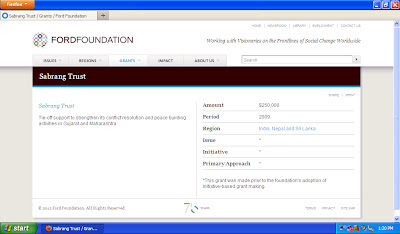
This very same Ford Foundation based in US was also behind funding huge funds to Sabrang – An NGO Ran by notorious Teesta Setalvad. Ford Foundation. The Foundation was created by Edsel and Henry Ford , pioneers in car manufacturing. In 2009 Ford foundation has donated $250,000 to feed Teesta’s mouth which in turn have used to propagate Anti Hindu propagandas and to target Narendra Modi personally.