US “Strip-Search”: Same As Soviet Gulag’s

http://gulaghistory.org/nps/onlineexhibit/stalin/women-src/images/nightsearch.jpg

Gulag history: online exhibit

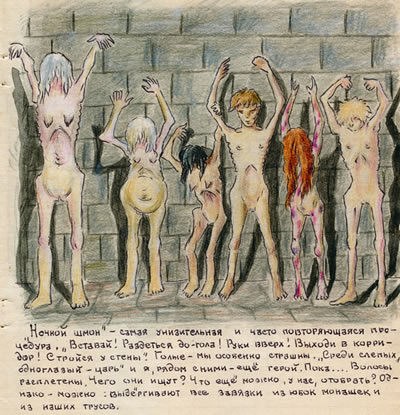
This is a drawing by Evfrosiniia Kersnovskaia, a former prisoner of the Soviet Union, of prisoners stripped of their clothes by prison guards in the Soviet gulag.

[Courtesy of Evfrosiniia Kersnovskaia Foundation, Moscow.]

Note: These are political prisoners in a concentration camp in the Soviet Russia.

Note: “Strip-searches” that humiliate the subject in exactly the same way as in Soviet Russia, and to the same extent (and worse), are conducted routinely as “standard procedure” in the United States, without any kind of sustained questioning from the media and academic institutions.

QUOTE (Preet Bharara about Khobragade’s strip-search)

“He said she was “fully searched” by a female deputy marshal in private and called it standard procedure for “every defendant, rich or poor, American or not.”

[The red herring is the emphasis by Bharara on the notion of equality.

Of course, the treatment of a diplomat as though she were a random citizen is in itself an issue.

A gross violation of international protocol/law is clearly a hostile act by the Dept. of State and the NY attorney.

But the outrage among Indians over the matter was perfectly appropriate, even beside the question of the immunity of foreign diplomats in a host country.

Strip-searches, regardless of the status of the victim, are barbaric and violate human rights.]

In the US, such searches are being used for mere suspects, people not yet found guilty of anything at all, people arrested for any charge whatsoever.  In practice, people have been strip-searched for trivial offenses like unpaid traffic-tickets.

Please note that visual inspection of cavities which is a part of all standard strip-searches requires the subject to bend over and part the buttocks for inspection of the anus, often with a flash-light. It also requires the subject to move the testicles or bare the labia for visibility.

Often, the subject is asked to squat on his haunches and cough while baring his genitals. These are, by any standard, deeply humiliating and self-demeaning acts for any one, innocent or guilty, to perform in public, especially in front of a uniformed stranger, subject to few or no restraints. and especially when the procedure is also video-taped, ostensibly for security, thus harnessing the subjects not only into acts of voyeurism but into their pornographic representation and subsequent replication ad infinitum in contexts and for audiences over which he/she has no control, practical or legal.

Strip-searches – whether they include visual inspection of the body-cavities or digital probes of body-cavities  – constitute a type of custodial rape or sexual molestation, and have been deemed so by the laws of some countries.

But they have been defined as constitutionally sanctioned behavior permissible to the state, even in the case of minor offenses, by decree of the US Supreme Court:

QUOTE:

Every detainee who will be admitted to the general population may be required to undergo a close visual inspection while undressed,” Justice Kennedy wrote, adding that about 13 million people are admitted each year to the nation’s jails.

The procedures endorsed by the majority are forbidden by statute in at least 10 states and are at odds with the policies of federal authorities. According to a supporting brief filed by the American Bar Association, international human rights treaties also ban the procedures.”

Gulag: Soviet Forced Labor Camps and the Struggle for Freedom:

“The arrival at the corrective labor camp turned out to be the culmination of the humiliation. First we were made to strip naked and were shoved into some roofless enclosures made out of planks. Above our heads the stars twinkled; below our bare feet lay frozen excrement. An enclosure measured 3 square feet. Each held three to four naked, shivering, and frightened men and women. Then these ’kennel cages’ were opened one after the other and the naked people were led across a courtyard‘the camp version of a foyer‘into a special building where our documents were ’formulated’ and our things were ’searched.’

The goal of the search was to leave us with rags, and to take the good things ’sweaters, mittens, socks, scarves, vests, and good shoes’for themselves. Ten thieves shamelessly fleeced these destitute and barely alive people.

‘Corrective‘ is something that should make you better, and ‘labor‘ ennobles you. But ‘camp‘? A camp wasn‘t a jail. So then what on earth was going on? ”

“The night search, the most degrading procedure, was frequently repeated. “Get up! Get undressed! Hands up! Out into the hall! Line up against the wall.” Naked we were especially frightened. “Among the blind, the one-eyed is king,” and next to them I was still a hero—for the time being. Our hair was undone. What were they looking for? What more could they take away from us? There was something, however: they pulled out all the ties that had been holding up the nuns’ skirts and our underwear.”

Courtesy of Evfrosiniia Kersnovskaia Foundation, Moscow. Translation by Deborah Hoffman.

US is the mother of all police states

Glen Ford at The Black Agenda Report:

“When U.S. corporate media operatives use the term “police state,” they invariably mean some other country. Even the so-called “liberal” media, from Democracy Now to the MSNBC menagerie, cannot bring themselves to say “police state” and the “United States” without putting the qualifying words “like” or “becoming” in the middle. The U.S. is behaving “like” a police state, they say, or the U.S. is in danger of “becoming” a police state. But it is never a police state. Since these privileged speakers and writers are not themselves in prison – because what they write and say represents no actual danger to the state – they conclude that a U.S. police state does not, at this time, exist.

[Lila: Please note that line –  US activists are usually not put in jail because their activism is NO THREAT  to the state, but, as is quite obvious, a quite lucrative industry encouraged BY the state, to channel  discontent, mark the boundaries of dissent, hide or obscure more effective dissent, and to lend credibility to the “freedoms” of the police state.]

Considering the sheer size and social penetration of its police and imprisonment apparatus, the United States is not only a police state, but the biggest police state in the world, by far: the police state against whose dimensions all other police systems on Earth must be measured.

By now, even the most insulated, xenophobic resident of the Nebraska farm belt knows that the U.S. incarcerates more people than any country in the world. He might not know that 25 percent of prison inmates in the world are locked up in the U.S., or that African Americans comprise one out of every eight of the planet’s prisoners. But, that Nebraska farmer is probably aware that America is number one in the prisons business. He probably approves. God bless the police state.

For the American media, including lots of media that claim to be of the Left, it is axiomatic that China is a police state. And maybe, by some standards, it is. But, according to United Nations figures, China is 87th in the world in the proportion of its people who are imprisoned. China is a billion people bigger than the United States – more than four times the population – yet U.S. prisons house in excess of 600,000 more people than China does. The Chinese prison population is just 70 percent of the American Gulag. That’s quite interesting because, non-whites make up about 70 percent of U.S. prisons. That means, the Black, brown, yellow and red populations of U.S. prisons number roughly the same as all of China’s incarcerated persons. Let me emphasize that: The American People of Color Gulag is as large as the entire prison population of China, a country of nearly 1.4 billion people.”

Source and full piece: Glen Ford, Black Agenda Report, 28 August 2012

Alexander Solzhenitsyn: The Line Between Good And Evil

Alexander Solzhenitsyn, Russian dissident writer, in Part II of The Gulag Archipelago:

“It has granted me to carry away from my prison years on my bent back, which nearly broke beneath its load, this essential experience: how a human being becomes evil and how good.  In the intoxication of my youthful successes I had felt myself to be infallible, and I was therefore cruel.  In the surfeit of power I was a murderer, and an oppressor.  In my most evil moments I was convinced that I was doing good, and I was well supplied with systematic arguments.  And it was only when I lay there on rotting prison straw that I sensed within myself the first strivings of good.  Gradually it was disclosed to me that the line separating good and evil passes not through states, nor between classes, nor between political parties either—but right through every human heart—and then all human hearts… And even within hearts overwhelmed by evil, one small bridgehead of good is retained.  And even in the best of all hearts, there remains… an unuprooted small corner of evil.”

Solzhenitsyn On Conscience

Alexandr Solzhenitsyn on developing a point of view:

“In First Circle, the young diplomat Innokenty Volodin lived a life of prosperity and comfort. As the privileged child of a hero of the Revolution he had married into a prominent family and advanced in the Soviet diplomatic service. But he became alienated from it all: he “lack(ed) something: he didn’t know what” (p. 341).
Upon examining the old fashioned ideas of his deceased mother in her diaries, his perspective on life changed from one of an Epicurean pleasure-seeking to one of ethical regard. He developed a “point of view”: Up to then the truth for Innokenty had been: you have only one life.

Now he came to sense a new law, in himself and in the world: you also have only one conscience. And just as you cannot recover a lost life, you cannot recover a wrecked conscience [p. 345]

Moral choices are often the consequence of accumulated culture, happenstance or social institutions, and as such judging others’ moral choices must be done with compassion and humility. Solzhenitsyn contemplates rather extensively his rejection of an offer to join the Soviet internal police force, the NKDV, when he was a young communist in Rostov in the late 1930’s:

“The NKVD school dangled before us special rations and double or triple pay …
It was not our minds that resisted but something inside our breasts. People can shout at you from all sides: “you must!”… inside our head can be saying also: “You must!” But inside your breast there is a sense of revulsion, repudiation. I don’t want to. It makes me feel sick. Do what you want without me; I want no part of it …. Without even knowing it ourselves, we were ransomed by small change in copper that was left from the golden coins our great-grandfathers had expended, at a time when morality was not considered relative and when the distinction between good and evil was very simply perceived by the heart.” —

[Gulag Archipelago, p. 160].

This leads to a rather subtle and non-judgmental view of good and evil. Evil is very real and very wrong, but no human being is authorized to become too self-righteous in its condemnation: but for the grace of God go I.

In Gulag Archipelago Solzhenitsyn says quite emphatically:

“So let the reader who expects this book to be a political expose slam its covers shut right now. If only it were all so simple! If only there were evil people somewhere insidiously committing evil deeds, and it were necessary only to separate them from the rest of us and destroy them. But the line dividing good and evil cuts through the heart of every human being. And who is willing to destroy a piece of his own heart? During the life of any heart this line keeps changing place; sometimes it is squeezed one way by exuberant evil and sometimes it shifts to allow enough space for good to flourish. One and the same human being is, at various ages, under various circumstances, a totally different human being. At times he is close to being a devil, at times to sainthood. But his name we ascribe the whole lot, good and evil.

Socrates taught us: Know thyself!

“Confronted by the pit into which we are about to toss those who have done us harm, we halt, stricken dumb: it is after all only because of the way things worked out that they were the executioners and we weren’t.” [p. 169]

“To do evil a human being must first of all believe that what he’s doing is good, or else that it’s a well-considered act in conformity with natural law. Fortunately, it is in the nature of the human being to seek a justification for his actions. Macbeth’s self-justifications were feeble – and his conscience devoured him. Yes, even Iago was a little lamb too. The imagination and the spiritual strength of
Shakespeare’s evildoers stopped short at a dozen corpses. Because they had no ideology.

Ideology – that is what gives evildoing its long-sought justification and gives the evildoer the necessary steadfastness and determination. That is the social theory which helps to make his acts seem good instead of bad in his own and others’ eyes, so that he won’t hear reproaches and curses but will receive praise and honors.”