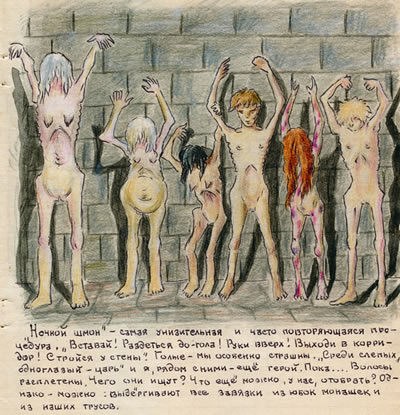
This is a drawing by Evfrosiniia Kersnovskaia, a former prisoner of the Soviet Union, of prisoners stripped of their clothes by prison guards in the Soviet gulag.
[Courtesy of Evfrosiniia Kersnovskaia Foundation, Moscow.]
Note: These are political prisoners in a concentration camp in the Soviet Russia.
Note: “Strip-searches” that humiliate the subject in exactly the same way as in Soviet Russia, and to the same extent (and worse), are conducted routinely as “standard procedure” in the United States, without any kind of sustained questioning from the media and academic institutions.
QUOTE (Preet Bharara about Khobragade’s strip-search)
“He said she was “fully searched” by a female deputy marshal in private and called it standard procedure for “every defendant, rich or poor, American or not.”
[The red herring is the emphasis by Bharara on the notion of equality.
Of course, the treatment of a diplomat as though she were a random citizen is in itself an issue.
A gross violation of international protocol/law is clearly a hostile act by the Dept. of State and the NY attorney.
But the outrage among Indians over the matter was perfectly appropriate, even beside the question of the immunity of foreign diplomats in a host country.
Strip-searches, regardless of the status of the victim, are barbaric and violate human rights.]
In the US, such searches are being used for mere suspects, people not yet found guilty of anything at all, people arrested for any charge whatsoever. In practice, people have been strip-searched for trivial offenses like unpaid traffic-tickets.
Please note that visual inspection of cavities which is a part of all standard strip-searches requires the subject to bend over and part the buttocks for inspection of the anus, often with a flash-light. It also requires the subject to move the testicles or bare the labia for visibility.
Often, the subject is asked to squat on his haunches and cough while baring his genitals. These are, by any standard, deeply humiliating and self-demeaning acts for any one, innocent or guilty, to perform in public, especially in front of a uniformed stranger, subject to few or no restraints. and especially when the procedure is also video-taped, ostensibly for security, thus harnessing the subjects not only into acts of voyeurism but into their pornographic representation and subsequent replication ad infinitum in contexts and for audiences over which he/she has no control, practical or legal.
Strip-searches – whether they include visual inspection of the body-cavities or digital probes of body-cavities – constitute a type of custodial rape or sexual molestation, and have been deemed so by the laws of some countries.
But they have been defined as constitutionally sanctioned behavior permissible to the state, even in the case of minor offenses, by decree of the US Supreme Court:
QUOTE:
“Every detainee who will be admitted to the general population may be required to undergo a close visual inspection while undressed,” Justice Kennedy wrote, adding that about 13 million people are admitted each year to the nation’s jails.
The procedures endorsed by the majority are forbidden by statute in at least 10 states and are at odds with the policies of federal authorities. According to a supporting brief filed by the American Bar Association, international human rights treaties also ban the procedures.”
Gulag: Soviet Forced Labor Camps and the Struggle for Freedom:
“The arrival at the corrective labor camp turned out to be the culmination of the humiliation. First we were made to strip naked and were shoved into some roofless enclosures made out of planks. Above our heads the stars twinkled; below our bare feet lay frozen excrement. An enclosure measured 3 square feet. Each held three to four naked, shivering, and frightened men and women. Then these ’kennel cages’ were opened one after the other and the naked people were led across a courtyard‘the camp version of a foyer‘into a special building where our documents were ’formulated’ and our things were ’searched.’
The goal of the search was to leave us with rags, and to take the good things ’sweaters, mittens, socks, scarves, vests, and good shoes’for themselves. Ten thieves shamelessly fleeced these destitute and barely alive people.
‘Corrective‘ is something that should make you better, and ‘labor‘ ennobles you. But ‘camp‘? A camp wasn‘t a jail. So then what on earth was going on? ”
“The night search, the most degrading procedure, was frequently repeated. “Get up! Get undressed! Hands up! Out into the hall! Line up against the wall.” Naked we were especially frightened. “Among the blind, the one-eyed is king,” and next to them I was still a hero—for the time being. Our hair was undone. What were they looking for? What more could they take away from us? There was something, however: they pulled out all the ties that had been holding up the nuns’ skirts and our underwear.”
Courtesy of Evfrosiniia Kersnovskaia Foundation, Moscow. Translation by Deborah Hoffman.