Tag Archives: India
Japan Tries Anti-Russian Provocation, Fails
A scandal suddenly erupted within the Quad earlier this week after India refused to allow a plane from fellow partner Japan’s “Self-Defense Forces” (SDF) to pick up humanitarian supplies in the country that were destined for Poland and Romania. New Delhi quickly clarified, however, that “We have conveyed our approval for picking of such supplies from India using commercial aircraft.” The Hindu noted that the use of civilian aircraft is obviously preferred by India over military ones like the SDF plane that was initially dispatched on this mission since the South Asian state very proudly practices a policy of principled neutrality. It continues to do so despite immense American pressure to publicly condemn Russia for its ongoing special military operation in Ukraine. Since the scandal has now been clarified, it’s time to analyze exactly why it even happened at all and what everything related to it might mean.
India and Japan have excellent relations and closely cooperate bilaterally and through the Quad alongside America and Australia. They’re officially driven by their pursuit of mutually beneficial outcomes that supposedly aren’t directed against any third party even though most observers suspect that shared concerns about their mutual Chinese neighbor’s rise played a role in bringing them closer together over the past decade at the accelerated pace that their relations have since developed. Whether that’s the case or not, there’s also no denying that these two strategic partners practice different policies towards Russia: India’s is one of principled neutrality while Japan has dutifully complied with its American overlord’s demands to sanction that Eurasian Great Power even though it’s declined to quit its Sakhalin energy project on the pretext that doing so would somehow help Moscow.
Nevertheless, the Japanese leadership seems to believe that their national interests are best served by taking on a more prominent role in their American overlord’s anti-Russian campaign to the extent that’s realistically possible given Tokyo’s limitations in this respect. With that in mind, it seems to have plotted to rope India into an anti-Russian provocation by dispatching its SDF plane to pick up humanitarian aid in that country en route to Ukraine’s NATO neighbors in Central Europe. Had New Delhi approved its landing, then the optics would have been such that Moscow might have wondered why its special and privileged strategic partner would allow a military plane from a newly designated unfriendly country (the legal category of which refers to states like Japan and those in the EU that have sanctioned Russia) to carry out this humanitarian mission when a civilian one could have been used instead.
India’s strategists have very wise and know their Russian de facto allies very well, which is why they weren’t going to get roped into this provocation by their fellow Quad partner. That’s why they refused to authorize the SDF plane’s landing since Japan should have known better by dispatching a civilian aircraft for carrying out this humanitarian mission instead.
[Read the rest at One World Press.]
Indo-Russian Ties Are Tried And True; US Is Only Fair-Weather Ally
In Hindi, with visuals and captions in English, this video tell a clear story of Russia’s long-standing and loyal support of Indian interests and the USA’s inconsistent and treacherous behavior.
Indian Missile Accident: Cui Bono?
I wonder if the Indian missile accident involved sabotage.
Who would want to provoke dissension and possibly war between India and Pakistan?
And why now?
The act could tie into the current unhappiness in the US with the Indian response to the Ukraine war; India, along with China, abstained from condemning the Russian action in the UN and has joined China, Brazil and others in calling for an inquiry into American bioweapons labs in the Ukraine.
Or it could tie into American unhappiness with India for continuing to buy Russian military technology.
Or it could be both.
New US sanctions on Russian banks will make it harder for countries to buy major defence equipment from Moscow, a US diplomat said, though no decision had been reached on Washington granting a waiver to New Delhi to take delivery of Russian surface-to-air missiles under an earlier contract.
Testifying before the Senate Foreign Affairs Committee, the assistant secretary (of the US State Department) for South and Central Asia, Donald Lu hinted that the US may reconsider its position on waiving sanctions against India.
“The Biden administration will consider CAATSA [Countering America’s Adversaries Through Sanctions Act],” Lu said on Tuesday, March 2.
From the description of the missile by Pakistan [if that was accurate and not deliberately misleading, as I suspect], it was a BrahMos, one of the fastest anti ship supersonic cruise missiles in the world, a joint Russian and Indian venture. BrahMos is a portmanteau of the names of two rivers, the Brahmaputra in India and the Moskva in Russia.
……. Inter-Services Public Relations (ISPR) Director General Maj Gen Babar Iftikhar briefed the media about the incident, calling for an explanation from Delhi.
“On March 9, at 6:43pm, a high-speed flying object was picked up inside the Indian territory by Air Defence Operations Centre of the Pakistan Air Force (PAF),” he told media persons in Islamabad, adding the object suddenly manoeuvred towards Pakistani territory from its initial course and violated Pakistan’s air space, ultimately falling near Mian Channu at 6:50pm.
“It was a supersonic flying object, most probably a missile, but it was certainly unarmed,” he said at the time.
“It is important to highlight that the flight path of this object endangered many international and domestic passenger flights — both in Indian and Pakistani air space — as well as human life and property on ground,” he added.
“Whatever caused this incident to happen, it is for the Indians to explain. It, nevertheless, shows their disregard for aviation safety and reflects very poorly on their technological prowess and procedural efficiency,” he further stated. [Dawn, March 11, 2022]
A report in Reuters gives more details, including the height of 40,000 ft, the speed [3 x speed of sound] and the distance into Pakistani territory, 77 miles. But the source is anonymous, a common technique by which the Mockingbird media seeds their reports with narratives crafted in the intelligence community. Thus, “One senior Pakistani security official told Reuters, on the condition of anonymity….”]
The allegation that this is a BrahMos missile is actually speculative. Consider perhaps that a certain narrative needs this to be a BrahMos because the BrahMos has a range between 300 and 500 kms, which allows the Pakistani official to claim that Indian missiles are actually trained directly on Islamabad. It also damages the reputation of the Russian and Indian technology and sows suspicion of Russian bona fides.
The Pakistanis relied on a Chinese air defense system that was very accurate in spotting the missile.
Oddly, last year, there were reports of problems plaguing Pakistan’s Chinese made air defenses in the east.
But the system that tracked the wayward Indian missile was most likely the cutting-edge HQ 9/P HIMADS (High to Medium Air Defence System) procured from China in mid-October, 2021.
Pakistani media has speculated that this was no accident but a probe to test the new system, which performed as desired.
Another speculative report is that it was sabotage from within India and the saboteur wanted to discredit the BrahMos missile on behalf of those wanting to continue importing from other foreign manufacturers.
Last year, India was stunned by the crash of one of its safest helicopters and the deaths of General Rawat and more than half a dozen senior military personnel. Rawat was known to have been staunchly against the defense import lobby which profits from gargantuan kickbacks as middlemen.
He was a major proponent of self sufficiency in defense.
Rawat died in a suspicious accident over the Nilgiris in the south of India last year.
Now comes this mysterious BrahMos accident [if it was BrahMos], a PR disaster for Indian missile prowess, as the Pakistanis have been quick to point out.
On the other hand, it is a PR coup for Pakistan’s Chinese air defense system. Again, what message is sent? By whom?
US Biolabs Dot The Globe
I have excerpted articles from the Chinese and India media that substantiate Russia’s claims regarding US bioweapons labs in the Ukraine [will add to the list]:
From GreatGameIndia:
List of Ukraine biolabs documents removed by the US Embassy
Up until recently, the existence and details of these bioweapons labs were public knowledge. The US embassy had previously disclosed the locations and details of these laboratories in a series of PDF files online. On February 26, 2022, the official embassy website shut down the links to all 15 bioweapon laboratories.
All the documents associated with these labs have been removed from the internet. If you click on any of the links, the PDF files are no longer available. Thankfully, these files have been archived and can still be accessed. What is the US embassy trying to hide?
From The Global Times:
The United States has pushed the creation of biolabs via its so-called ‘Global Partnership Against the Spread of Weapons and Materials of Mass Destruction’, as well as bilateral ‘Joint Biological Commitments and Joint Threat Reduction’ programmes with individual nations.
Washington has long insisted that these programmes, which started being implemented after the end of the Cold War, are designed only to reduce biological weapons proliferation and production.
However, Russia, China, politicians in some of the countries in which the labs are situated, and reporters – led by independent Bulgarian journalist Dilyana Gaytandzhieva – have questioned these claims.
Last year, Ukrainian opposition politician Viktor Medvedchuk revealed to parliament that as many as 15 US-sponsored biological laboratories were operating on Ukrainian territory, with some of them said to be engaged in the storage of pathogens hazardous to humans and animals. Medvedchuk accused US and Ukrainian authorities of seeking to cover up the extent of these activities, and warned that some of the labs may be experimenting on human beings. He also highlighted repeated mysterious outbreaks of dangerous diseases in the country between 2009 and 2017, including haemorrhagic pneumonia, cholera, and hepatitis A. In 2016, he noted, at least 20 Ukrainian servicemen died from a strange flu-like virus, with 364 more people succumbing to swine flu the same year. Medvedchuk has been under house arrest since May 2021, ostensibly over an unrelated matter.
Along with Ukraine, the nation of Georgia has repeatedly come up in reporting on US military. In 2018, the country’s former minister of state security implored then-US President Donald Trump to open a formal investigation into worrying reports that personnel from the US’ Lugar Center biological lab outside Tbilisi were engaging in experiments on live human test subjects.”
From Xinhua.net:
The article noted that outbreaks of infections have begun to be observed in Uzbekistan in places where U.S. military biological facilities operated.
In August 2011, an unknown disease suddenly flared up in the Tashkent region, and the symptoms of the disease were very similar to cholera. In 2012, the country was hit by a new disease, which almost simultaneously killed more than 10 people.
In the spring of 2017, a chickenpox epidemic broke out in Uzbekistan, which affected a large number of adults. Since January 2019, 279 cases of measles have been reported. Also, meningococcal infections are rising in the Central Asian country.
Anna Popova, head of Russia’s consumer rights and human well-being watchdog Rospotrebnadzor, at a meeting of the heads of the Security Councils of the CIS countries, expressed concern over the outbreaks of previously unknown infections in places where the U.S. military labs had opened, the magazine said.
In Tajikistan and Kyrgyzstan, there are no DTRA facilities, but Washington works on biosafety issues in the two countries through its structures, non-government organizations (NGOs) or “scientific partnerships.”
Through such “scientific” partnerships, the Pentagon and the intelligence services of North Atlantic Treaty Organization (NATO) countries have gained access to top-secret technologies, intellectual property products of scientists from former Soviet Union countries and promising areas for future research, the magazine said. ”
From OpIndia.com
“On Tuesday, Chinese Foreign Ministry spokesman Zhao Lijian Tweeted a snippet from a press conference where he asked the US to release “relevant details as soon as possible” regarding alleged US biological laboratories in Ukraine. He captioned his Tweet as, “The US has 336 labs in 30 countries under its control, including 26 in Ukraine alone. It should give a full account of its biological military activities at home and abroad and subject itself to multilateral verification.”
Ukraine War Updates: Drugs, Sanctions, Students, Cauldrons
Latest developments:
1. India may be sanctioned by the US for buying weapons from Russia, following her neutral position on the UN vote condemning Russia
2. Labs making combat drugs, including captagon, have been found in Mariupol, suggesting that the reckless and stupid defiance of the Ukie army and its president might be drug fueled. Captagon has been used by ISIS. I saw two videos of Zelensky supposedly high on alcohol or drugs, but in both he could just have been exhausted. However, it was Zelensky himself who challenged Poroshenko in the presidential campaign a few years ago on the issue and then when Poroshenko publicly took and passed a drug test, Zelenksy backed out and only tested himself later at a clinic owned by a friend. Poroshenko then used the drug charge against Zelensky in the campaign, from where Putin picked it it up. So there seems to be some truth to the charge.
3. Indian students trapped at Mariupol and planning to march on foot to the Russian border carrying Indian flags have deferred the march after the Government of India advised against it.
Video of Putin charging the Ukrainians with holding hostage citizens and students, especially Indian students.
4. The Russians have total control of the skies over Ukraine and are now closing off several cauldrons [encirclements] on the grounds, cutting off the Ukie army from reinforcements
5. The Atlanticists are so desperate, they have decided to cut off Russia from all internet services of all kinds, very likely including cloud services. As with the economic sanctions, which probably had less of an impact on Russia than was hoped and have since been back tracked by France, there is likely going to be back tracking on this too.
6. The issue of US funded and supported biological weapons labs in the Ukraine is backed by opposition members in Ukraine, although US outlets continue to dismiss it as conspiracy theory.
How do you expect the Russians to rise up against Putin, if they don’t know what’s going on and can’t communicate with each other?
What happens to all the Western companies doing business in Russia or to all the other people doing business with us who have ties with Russia?
Whom do you suppose all that will affect?
What is the point of bringing Putin down, if you also bring down the EU and America?
Or is that the whole point and Putin just the pretext?
Who wants a global reset?
Who profits from chaos and restructuring?
Indian Jan 6?: Farmers Breach Republic Day Barriers, Clash With Police
The Republic Day parade in the Indian capital, Delhi, has turned chaotic, as protesting farmers, given permission to hold a rally after the parade, arrived early, broke through barriers, and clashed with lathi-charging police, in what looks like a reprise of the instigated and staged violence, at the January 6 Capitol protests in the USA. Violent riots, reportedly instigated, are now unfolding in Putin’s Russia as well. Billionaire leftist change maestro, George Soros, has poured money into attacking Trump, Putin, and others.
Meanwhile, the Italian PM has resigned.
Tamil Nadu holds key to possible BJP victory?
From Gulf News.com:
“As India’s Parliamentary elections enter the fourth week, there’s a supreme irony for the perceived front-runner — the Bharatiya Janata Party. It hardly has any presence in Tamil Nadu, yet that state may decide whether the BJP is able to get past the winning 272-seat mark.
For decades, voters in Tamil Nadu have hardly looked beyond the All India Anna Dravida Munnetra Kazhagam (AIADMK) and the Dravida Munnetra Kazhagam, with the Congress playing a side role at best.
The BJP has not been on the political radar here and yet its likelihood of forming a government in Delhi in 2014 may well hinge on securing a partner from Tamil Nadu, most likely the AIADMK.
Hopes of a post-election BJP-AIADMK tie-up appeared dented last week when AIADMK supremo and state chief minister Jayalalithaa Jayaram and BJP strongman Narendra Modi exchanged verbal volleys.
“They (the AIADMK and the DMK) have been ruling the state for decades, leaving the people with little choice”, remarked Modi during his recent rally in Chennai, going on to say that those “old tricks” would not work any longer.
Jayalalithaa wasted little time to hit back, pointing out that the “BJP stands no chance to win a single seat in Tamil Nadu”. Her ire was particularly directed at the previous BJP governments in neighbouring Karnataka, which she said sacrificed the interests of Tamil Nadu on the Cauvery water sharing issue.
Political observers believe that Jayalalithaa and Modi have good reasons to disagree with each other. While the BJP may already be dreaming of heading the government in Delhi, Jayalalithaa has every reason to believe that it cannot secure the requisite numbers without the AIADMK’s support.”
Meanwhile, both the Congress and the BJP have been receiving a lot of money from abroad:
“The Times of India reports on the Delhi High Court’s finding that both parties were receiving foreign funds in contravention of the law (Foreign Contribution (Regulation) Act).
A division bench comprising Justice Pradeep Nandrajog and Justice Jayant Nath asked the government and the Election Commission (EC) to act against the two political parties for accepting foreign funds from Vedanta subsidiaries. It asked MHA and EC to “relook and reappraise the receipts of the political parties and identify foreign contributions received by foreign sources” and take action within six months.
In addition, the bench also faulted the Congress for taking donations from public sector undertakings State Trading Corporation of India and Metals and Minerals Corporation of India. HC asked the authorities to investigate Congress’ defence that the money was donated to NSUI and accidentally reflected in Congress accounts.”
BBC: loud on ambiguous nun-rape, silent on verified swami-murder

Credit for the diagram of the dialectical struggle: http://www.al-ruh.org/hegelian.html
Note: I will be adding links to show the connection of the evangelizing of India to a long-term state-sponsored plan to Christianize India in the interests of Zionism and the global one-world government.
In this effort, Christian lobbies, like homosexual lobbies, are the shock-troops of the global cartel (the New World Order), while their followers are dupes, set up to be the fall guys when there is the inevitable back-lash.
Gay “shock-troops” are one pincer leg of the culture-war; religious zealots make up the other leg.
I am not now talking of religious conservatives reacting to gay propaganda. I am talking about evangelicals who are actively engaged in political work.
Thus, in India, the Hindu right, reacting to the forced conversion of fellow Hindus, looks to someone like Narendra Modi as their savior, whereas Modi himself seems to be in the thrall of the same Zionist billionaire to whom the entire Republican party leadership is beholden.
QUOTE: “I would say that Sheldon (Adelson) has aligned himself with most Baptists in South Carolina.”
Thus the pincer analogy…..
ORIGINAL POST
On March 14, 2014, the BBC reported on the conclusion of the Orissa nun-rape trial:
“A court in India has found three people guilty in connection with the rape of a Catholic nun in Orissa state in 2008.
The nun was raped by a Hindu mob in Kandhamal district, days after riots between Hindus and Christian there.
Riots began after a Hindu religious leader was shot dead.
Although left-wing Maoist rebels in the state claimed responsibility for the killing, hard-line Hindu groups blamed the minority Christian community for the death.”
Comment:
No one would condone the heinous crime allegedly committed against the nun, but why gloss over the equally heinous and completely verified crime that provoked the rape of the nun?
[For the ambiguities and contradictions in the story of the raped nun, see reports here and here.]
Instead, the BBC reports blandly that a “Hindu religious leader was shot dead.”
Why doesn’t the BBC do the minimally ethical thing and report that last October, seven Christians were found guilty of murdering the Hindu swami they mention, specifically because he spoke out against forced conversions?
For the same reason that the leftist media in India described the murderers in its headline WITHOUT reference to their religion, although the body of their story showed that all seven were Christian and committed the murder because of their outrage at Hindu resistance to conversions:
“All of the convicts are Christians and they had committed the crime because according to them the swami was forcing Christians to convert to Hinduism, the lawyer said.”
Furthermore, why does the BBC depict the Maoists who took responsibility as simply “left-wing rebels,” while they depict right-wing Hindus with the somewhat derogatory term, “hard-line,” and the addition of a religious label?
One would suppose that MaoIsts – followers of Chairman Mao who killed some 45 million Chinese in the name of communism – would be better termed “hard-line” than a random mob of Hindus.
And Maoists who are Christians and allied with Christians are perforce “hard-line Christian groups,” aren’t they?
But no, this is the BBC, a known propaganda outlet of the West, so it must play semantic games.
Secondly, why not mention that Maoists are closely connected to the Christian churches and that many Christian leaders actively support them?
This has been admitted by Marxists themselves, long ago:
Prakash Karat in “Naxalism Today” (The Marxist, 1985) writes:
“The S N Singh minority faction in its document makes serious charges against Vaskar Nandy and company. “In our organisation also, Nandy’s close associates established contacts with a foreign voluntary agency and a native voluntary agency financed by Western monopoly capital, keeping it secret from the POC and the general secretary of the party, S N Singh. They established contact with Rural Aid Consortium of Tagore Society which is financed by West European countries and the USA and with one Danish Organisation on the Plea of providing relief to the people of Gobiballabpur in West Bengal and some areas in Bihar. Lakhs of rupees were received for digging tanks, constructing school building opening a sewing training center and distributing chickens and cattle to the needy. It also came to our notice that money was being received by some of our leaders from the Lutheran Church. When it came to light to the PCC members, an intense ideological struggle burst forth in the party on this issue.” (Our differences with Nandy-Rana group, PCC-CPI(ML), p. 29)
It goes on to state: “We thoroughly investigated (among the cadres and people) in Gobiballapur and Bhargora, where relief work was carried on through money from the “Tagore Society”, Rohtas Channpatia and Mushhari, where schools were built up by the Dabes, and party and doubted our bonafides … Several cadres have been exposed to these agencies.” It concludes with the damming indictment: “It does not require intelligence of a high order to find out why some of the former members of the PCC adopted particular policies on the question of caste, tribe, Assamese and non-Assamese.” Following a blind anti-Soviet line, Satyanarian Singh found out a few months before his death that the majority of his PCC members sided with Nandy and company in whitewashing its links with the imperialist funded voluntary agencies, most having been, corrupted with foreign money.”
At a website called Kandhamal Justice, Sandhya Jain, a Hindu activist, has argued credibly that the rape case was concocted as damage-control in the wake of the murder of a Hindu priest, who was targeted for his resistance to crass proselytizing by Baptist ministers.
Many of his converts were also Maoists, none of which is mentioned in the BBC’s slimy report.
Kandhamal Justice reports:
“It may be appropriate to put the anti-missionary violence in context. The Kandhamal violence broke out after the murder of Swami Lakshmananda, whose tireless efforts to uplift the tribal communities and protect their religion and culture against aggressive proselytisation infuriated the evangelists and Maoist goons (mostly converts). The Swami was severely injured in an attack on Christmas Eve 2007, and had then accused a Congress MP and World Vision chief for the attack. He alleged a nexus between Maoist terrorists and missionaries; which is why when Maoists claimed responsibility for the killings, public ire was directed at the missionaries. Certainly the murders had a purely religious motivation; Orissa has in recent years seen an influx of rich American Baptists, for soul-harvesting purposes.
[Lila: Indeed, there is a close connection between the Maoists and the church in India.]
Kandhamal Justice:
“Beginning on December 26, 1970, Swami Lakshmananda was attacked eight times before he was finally struck down by AK-47-wielding assailants in 2008, according to the fact-finding commission chaired by Additional Advocate General of Rajasthan, G.S. Gill. Soon after the multiple murders in the ashram, state police arrested World Vision employee Pradesh Kumar Das while escaping from the district. Later, two men, Vikram Digal and William Digal were arrested from the house of a local militant Christian, Lal Digal, at Nugaon; they admitted having joined a group of 28 assailants.
Then, in July 2009, a Maoist couple, Surendra Vekwara and Ruby, also allegedly involved in the killings, surrendered to the Orissa police. One does not know how the state government intends to prosecute the cases against these persons, especially as the sensational rape case is silently falling apart!
However, as I have previously argued, the murder of Swami Lakshmananda closely resembles the murder of Swami Shanti Kaliji Maharaj in Tripura in August 2000. The latter was also shot in his own ashram by gun-wielding goons after several dire warnings against his anti-conversion activities in the tribal belt were ignored. Swami Lakshmananda’s murder prompted Biju Janata Dal MP Tathagata Satpathy to insist that there was an urgent need for an anti-conversion legislation as aggressive proselytisation was hurting the social fabric.”
Swami Lakshmananda Saraswati had, just before his murder, demanded a national debate on conversions and an end to the foreign funding to NGOs. This is an urgent imperative.”
No cost water-harvesting when you stop raking
From Brad Lancaster’s Rain-water Harvesting blog comes the welcome advice that less is more. Raking removes ground cover, encourages water evaporation, dries out soil. The result is poor soil quality, lower aquifers and dry, unhealthy vegetation. Leave the leaves alone!
“Fortunately, there is a way to harvest water, even during droughts. It costs nothing, and requires no expenditure of energy. Can this be true? Grab yourself a cool drink, take a seat, and let the litter fall. Leaf and stem litter, that is.
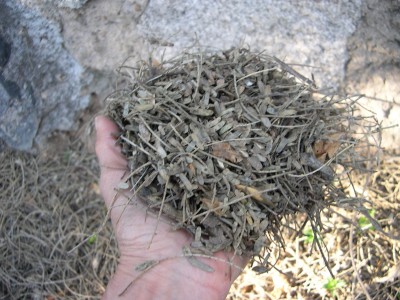
A handful of mesquite leaf litter, delivered free of charge by the canopy overhead, can help retain water on your landscape. Photo credit: Julia Fonseca You’ve been spending too much time raking and bagging those leaves, seed pods and twigs. They could be working for you, if you don’t throw them out. No, I’m not talking about composting. Composting is work too! But if you just left the litter where it fell, it would in time form a nice natural mulch that would slow erosion, build up the water-holding ability of the soil, and help make the soil easier to dig, if you do decide to dig a swale someday. Be a litter harvester!
Plant litter is so important that it is one of the three key measurements that the Natural Resources Conservation Service uses as a measure of watershed condition. Plant cover, litter, and rock all help stem erosion of sloping land. If it’s not raining, only litter and rock can retard runoff, and shade the soil, AND retain moisture. (But see my rant against crushed rock landscaping.)
A layer of litter will work for you every time it rains well enough to penetrate the litter layer, making it more difficult for the sun to evaporate moisture from the soil below. So, if you do need to rake up litter, then consider moving it to areas where it can mulch a plant.
Even when it isn’t raining, a layer of leaf litter recruits workers to improve your soil. Unlike rock, leaf and twig litter is readily colonized by tiny organisms, and those attract others and pretty soon you have unpaid laborers tunneling into your soil, creating “macropores” for better, deeper infiltration. In urban Tucson you can also get thrashers, cactus wrens and towhees tilling the ground and scratching for goodies!
All work together to decompose your litter into smaller pieces, and that helps pump extra carbon into the soil. Extra carbon in your soils is part of the magic. Soil carbon boosts the ability of the soil to hold water for later use by plants, resulting in a healthier and more drought-resistant landscape.”

Comment
My interest in rain-water harvesting is not theoretical. Apart from the rising cost of water in the US itself, which means higher bills during a time of recession, water has become a serious crisis in many countries, including India.
The southern state of Karnataka has a critical shortage of water and even in Tamil Nadu, which traditionally has torrential rains from two monsoons, water has become an election issue.
In part, this is because of a massive demand from increasing numbers of corporations, foreign and domestic, that flock to the state and receive preferential access at every level.
In part, it is because of the government subsidy of agricultural water-use that leads to waste and mis-allocation.
There’s also the government-subsidized real estate boom, which created in India exactly what it created in the US – a huge misdirection of funds into home-building . That’s led to shortages in building materials like concrete and sand.
It’s also put a big dent in the water table in many areas.
These days, bottled water is a necessity in many urban areas, but it’s expensive and makes for dependence on the water-supplier.
Water self-sufficiency is the answer, both at the level of the house-hold and of the nation.