How Lenin Looted Russia

From PassportMagazine.ru:

Since 1991, with the partial opening of archives in Russia, it has become apparent, through the work of historians like Edvard Radzinsky and Dmitri Volkogonov, that Lenin was at least as bad as Stalin, in terms of his thuggery………

Lenin did not have the apparatus of repression available to him which Stalin had. But the viciousness and violence with which he responded to even the slightest challenge to his authority seems to indicate that if he had had, he might well have used it as savagely (and counter- productively) as Stalin did. But that is speculation — at least it was until Sean McMeekin published the extraordinary book under review. In it he describes in minute detail how Lenin and his cohorts destroyed Russia in order to take power for themselves.

What is so interesting about Mc- Meekin’s approach to the subject is his primarily economic analysis — by their loots ye shall know them! This makes a refreshing change from tales of the Gulag and the Lubyanka. No one has yet made so careful a study of the Bolshevik’s economic crimes. Yet this story is central to any understanding of how the Communists killed Russia.

It is extraordinary to discover that Marxists, who operated on the axiom that economics determined everything, understood nothing whatsoever about the practical workings of an economy — any economy, whether capitalist or socialist. They really had no ideas in their collective head other than theft and destruction, plus arrest and murder for anyone who opposed them. If McMeekin drives one point home above all else, it is that the Bolshevik revolution was entirely negative. There was not a single redeeming aspect of idealism in the make-up of any of the major figures. Lenin was the worst of the lot.

Winston Churchill was one of the first to appreciate this. But even he, who wanted ‘to strangle Bolshevism in its cradle’, was only half right when he said of the Father of the Revolution: ‘His aim – to save the world; his method – to blow it up.’ The first part of that sentence, we now know, was nonsense. Lenin’s aim was to take power, keep it and to make sure the Russian people paid for everything he required in order to enslave them.

McMeekin starts by describing just how wealthy Russia was in 1914. Though a country with considerable economic problems, and burdened with a political regime which was medieval and inimical to progress, Russia nonetheless had the fourth largest industrial economy in the world, one which was growing at a rate of 8-9% per annum.

It was also the world’s largest exporter of food. It had Europe’s largest gold reserves — about 1,200 metric tonnes — due to running a continual trade surplus. The stock exchange was booming; agriculture was being modernized; and the arts and culture were all flourishing. It was a desirable place to be. McMeekin comments: ‘Russia in the last days of the tsars was a substantial net importer of both people and capital, a telling fact that, after 1917, would never be true again.’

In his Prologue, McMeekin poses the question his book aims to answer:

‘All this wealth taken together was the national patrimony of centuries… The riveting scenes of the Revolution, which saw desperate Russians selling priceless jewels and family heirlooms for food and fuel to survive the winter, would be repeated again after the collapse of Communism in 1991 — with one crucial difference. At the century’s end, in a crude measure of how badly the Bolsheviks had beggared the country, Russia’s dispossessed hawked not expensive jewellery, but ragged mittens and small handfuls of vegetables raised on dacha plots. It was an extraordinary fall: from world-famous opulence to subsistence agriculture in only seventyfi ve years. How did it happen?’

The short answer is that the Bolsheviks stole everything, then squandered it on armaments and their own comfort.

Lenin established a system whereby every item of value in the country was confi scated without compensation. This went from the gold reserves and the stock of rubles in the Central Bank, through to art treasures in public and private hands, and down to any items of value, like clocks, icons and silver spoons, which were held by individuals or the Church. Those family heirlooms sold on the streets were often disposed of simply in order to pre-empt the kommissars.

One of the most original parts of Mc- Meekin’s book is the long description of how all the money raised by selling this loot abroad was used for purchasing armaments with which to fight the people from whom it was stolen. Lenin made peace with the Germans at Brest–Litovsk in March 1918, then started trading with them, initially through sympathetic bankers in Stockholm. He bought pistols, machine guns, military uniforms, artillery, aircraft, trucks, field telephones, signalling equipment, locomotives and all the other apparatus necessary to wage war on his real enemy – the Russians.

Though the country was starving, the Bolsheviks bought food only for themselves — in fact considerable quantities of it. (Lenin also purchased spare parts for the Rolls-Royce he used, which can now be seen in the museum at Leninsky- Gorky.) The Red Army was the only well-fed group of people in the country, apart from the Communist leadership. The war, McMeekin says, was essentially a war for control of the food supply so that once the gold, roubles, art-works, jewellery and church silver ran out, the Communists could still feed themselves, courtesy of the now enslaved peasantry.

By this stage, even Lenin’s original power base in the urban factories had largely deserted him. McMeekin says that by the winter of 1919-20 only 2 percent of industrial laborers still belonged to the Bolshevik Party.

Why did the Germans co-operate? They did so because, McMeekin says, ‘they were blinded by anti-Allied rage and imperial greed.’ They had a dream of colonizing Russia with the aid of the Bolsheviks. Only Allied victory on the Western Front prevented that from happening.

Even after defeat, the Germans continued helping the Bolsheviks, right up to 1931. In that year, their government allowed the Soviet Union, now ruled by Stalin, to place orders worth $10 billion in today’s money for armaments to be used in the final showdown with the peasants during the collectivization of agriculture. The result was that ‘the Bolsheviks had imported enough German Mausers, machine-guns, and motorcars to ensure that resistance to Stalin’s collectivisation off ensive in the Ukraine could be suppressed with ease by army and secret police enforcers.’

Five months later, the Soviet Union, pleading poverty, defaulted on the bill for all of this, thereby getting it from impoverished Weimar Germany effectively for nothing, just at the time Hitler was emerging onto the political scene arguing that Bolshevism should be opposed rather than assisted.

Is it not legitimate to ask whether, in these circumstances, the Soviets themselves did not bear a small part of the responsibility for creating the public mood in Germany which made the Nazi revolution possible?”

Sanatana Dharma Of Jesus

Christian Gospel (John 1:1) :

In the beginning was the Word

And the Word was with God

And the Word was God.

[Written circa 50-100 AD]

Indian Vedas:

Prajapatir vai idam agre asit
Tasya vag dviitiya asit
Vag vai paraman Brahman

In the beginning was Prajapati (Brahman)
With whom was the Word;
And the Word was verily Brahman.

[Lila: Brahman and Prajapati both mean God, the former in his utterly transcendent and immanent form and the latter in his form as creator of the world.]

(Krishna Yajurveda, Kathaka Samhita, 12.5, 27.1; Krishna Yajurveda, Kathakapisthala Samhita, 42.1; Jaiminiya Brahmana II, Samaveda, 2244

Approximate date: 1000-1200 BC, with a strong possibility from internal evidence, of being even earlier.

Chesterton On A World Of Untamed Virtues

G. K. Chesterton, the great Catholic writer, describes what happens when societies are re-engineered:

“The modern world is not evil; in some ways the modern world is far too good. It is full of wild and wasted virtues. When a religious scheme is shattered…it is not merely the vices that are let loose. The vices are, indeed, let loose, and they wander and do damage. But the virtues are let loose also; and the virtues wander more wildly, and the virtues do more terrible damage. The modern world is full of the old Christian virtues gone mad. The virtues have gone mad because they have been isolated from each other and are wandering alone. Thus some scientists care for truth; and their truth is pitiless. Thus some humanitarians only care for pity; and their pity (I am sorry to say) is often untruthful.”

U of Tennessee Promotes New Pronouns For Old

The University of Tennessee at Knoxville loses  its collective mind and encourages you to do the same (h/t Karen de Coster at LRC):

KNOXVILLE, Tenn. (WATE) – The University of Tennessee is asking students to use “zehirhirs, and xexemxyr.”

No, those words are not another language. They’re actually the gender-neutral singular versions of pronouns.

(Writeworld.org)
(Writeworld.org)

The University of Tennessee Office for Diversity and Inclusion is asking students and faculty to use the pronouns in order to create a more inclusive campus. They say it alleviates a heavy burden for people expressing different genders or identities.

“We should not assume someone’s gender by their appearance, nor by what is listed on a roster or in student information systems,” Donna Braquet, the Director of the University of Tennessee’s Pride Center said. “Transgender people and people who do not identify within the gender binary may use a different name than their legal name and pronouns of their gender identity, rather than the pronouns of the sex they were assigned at birth.”

For the first week of classes, Braquet is also asking teachers to ask everyone to provide their name and pronoun instead of calling roll. “The name a student uses may not be the one on the official roster, and the roster name may not be the same gender as the one the student now uses,” ze said.

“These may sound a little funny at first, but only because they are new,” Braquet said. “The she and he pronouns would sound strange too if we had been taught ze when growing up.”

Braquet said if students and faculty cannot use ze, hir, hirs, xe, xem or xyr, they can also politely ask. “’Oh, nice to meet you, [insert name]. What pronouns should I use?’ is a perfectly fine question to ask,” ze said.”

Indians Say No To Fraudulent “Menstrual Revolution”

An eye-opening article from a woman who is involved with women’s public health in India who spots the “menstrual revolution” for what it is.

[For my previous posts on Kiran Gandhi’s free-bleeding stunt and Asha Impact (her family’s foundation, with extensive ties to the Western NGO circuit and the globalist foundations), see

“Behind “Tampon” Gandhi, menstrual hot-lines at $8/call”

“The Kotex-Industrial Complex II”

“The Kotex-Industrial Complex I: Another Indian Stooge“]

Also note that the magazine (Swarajya) from which I took the excerpt below is run by Indians with extensive ties to the right-wing of the globalist order, i.e., they are the “controlled opposition,” as you can see from the fact that they style themselves the “liberal right-wing”; seem to endorse globalist stooge Narendra Modi; and buy into some of the globalist memes themselves.

In other words, this site is not the authentic, Indian right, but a globalist-endorsed Indian right, much like large parts of the “Men’s rights” movement in the West is globalist-endorsed.]

The most often quoted statistic, is of a study done by A.C Nielson and Plan India, which states “Only 12% of India’s 355 million menstruating women use sanitary napkins (Sns). Over 88% of women resort to shocking alternatives like unsanitised cloth, ashes and husk sand.” Here is why this study and others like it are incorrect in representing Indian women:

  • The lesser known fact about this study is that it only interviewed 1033 women, i.e. < 0.00029% of India’s menstruating women! How this sample size is representative of a country as diverse as India is really questionable.
  • Even if 88%  women might be using cloth, it is absolutely incorrect to club the usage of sand, ash husk in the same percentage bracket. The usage of sand, ash husk or dried leaves for menstrual absorption happen in extreme conditions (less than 1%), such as in Rajasthan where some women have been using fine sand for ages since water is scarce. In these cases, we need to further investigate if indeed such usage has been detrimental to their health, since such practices have prevailed for hundreds of years. Obviously if such practices were harmful, people would have let it go a long time ago
  • On what basis are they calling the cloth ‘unsanitized’? Are the cloth pads being sold by foreign NGOs sanitized? In fact, if we look at the stitched cloth being sold by NGOs, it is more difficult to dry and sanitize it in sunlight because the inner layers are never exposed to sunlight. Whereas, the loose cloth used by rural Indian women can be opened and dried with complete exposure to sunlight. It is foolish to take a traditional practice such as using cloth, and package it to give it the look of a modern pad, and in the process missing out on the point of maintaining hygiene using cloth!

Pads for India, reusables for the West

The hypocrisy is such that while foreign organizations are promoting the need to introduce sanitary napkins in India by saying that 88% of Indian women are using cloth, in their own country they are promoting reusable cloth pads and menstrual cups, citing environmental reasons. If that is the case, then India is far ahead of the rest of the world in being environment friendly.

In the light of the latest wave of western feminism, movements (such as the Free Blood Movement) which promote women’s right to bleed without using any product are being applauded and encouraged. At the same time, international organizations look down upon indigenous women who for generations have bled naturally without using any product.

But what took the cake was when, at the conference, an excited American activist told me that I should tie up with one of these cloth-pad making NGOs (which I’d rather not name) to start distributing cloth pads to rural Indian women because it is environment friendly and a safer alternative to sanitary napkins! Imagine the drama of telling our rural women to throw away their piece of menstrual cloth and instead use my packaged version of it, which by the way will also cost them. Imagine teaching her about being environment friendly as a new concept, when all along she has not used a single bit of environmentally damaging menstrual product. Imagine trying to educate her about cloth being healthy, when she and all generations before her have been quietly following natural methods of managing menstruation.

The ridiculousness of the suggestion made me both laugh and seethe with anger.”


How Many Church-Going Americans Are There?

I often think about that insightful statement I read somewhere to the effect that America is a nation of Indians under a ruling class of Swedes. (It’s actually from sociologist Peter Berger).

It got me thinking about how different the average American is from the way he/she is portrayed in Hollywood or in the mainstream media.  Church hardly figures in the media except as the object of raised-eyebrows and patronizing smiles, if not outright scorn.

But a large percentage of the population goes to church and goes regularly. One in five goes every single week-end.

That says something. I am a believing Christian but I go only a handful of times in a year, although there are reasons for my lack of attendance that probably don’t hold good for most people.

Anyway, here are the numbers:

Q: What’s the size of U.S. churches?
A: The median church in the U.S. has 75 regular participants in worship on Sunday mornings, according to the National Congregations Study (NCS) http://www.soc.duke.edu/natcong/ . Notice that researchers measured the median church size — the point at which half the churches are smaller and half the churches are larger — rather than the average (186 attenders reported by the USCLS survey http://www.uscongregations.org/charact-cong.htm ), which is larger due to the influence of very large churches. But while the United States has a large number of very small churches, most people attend larger churches. The National Congregations Study estimated that the smaller churches draw only 11 percent of those who attend worship. Meanwhile, 50 percent of churchgoers attended the largest 10% of congregations (350 regular participants and up).
Want to know more? Check the websites for the National Congregations Study (NCS) at http://www.soc.duke.edu/natcong/ The US Congregational Life Survey (USCLS) website has statistics about congregations by religious traditions at http://www.uscongregations.org/ The Faith Communities Today national study of churches www.faithcommunitiestoday.org 2010 study also contains size and other congregational findings.

Approximate Distribution of U.S. Protestant and Other Christian Churches by size *based on NCS study
(excluding Catholic/Orthodox)

ATTENDANCE # OF CHURCHES WEEKLY WORSHIPERS PERCENT

7-99

177,000

  9 million 59%

100-499

105,000

25 million 35%

500-999

12,000

  9 million 4%

1,000-1,999

6,000

  8 million 2%

2,000-9,999

1,170

  4 million .4%

10,000-plus

40

  .7 million .01%

TOTALS

approx. 300,000

approx. 56 million 100%


upQ: How many people go to church each Sunday?
A: For years, the Gallup Research Organization has come up with a consistent figure — 40 percent of all Americans, or roughly 118 million people, who said they attended worship on the previous weekend. Recently, sociologists of religion have questioned that figure, saying Americans tend to exaggerate how often they attend. By actually counting the number of people who showed up at representative sample of churches, two researchers, Kirk Hadaway and Penny Marler found that only 20.4 percent of the population, or half the Gallup figure, attended church each weekend.
As added proof for the accuracy of this smaller percentage of churchgoers, if 20.4% of Americans (approximately 63 million in 2010) attended the nation’s 350,000 congregations weekly then the average attendance would be 180 people per congregation which is almost exactly the figure that numerous research studies have found.”

Natural Mosquito Control

From Jerry Baker’s Tips and Tonics:

Q: My yard is swarming with mosquitoes. How can I get rid of them so I can enjoy my backyard again?

A. Remember that any standing water in your yard or garden can turn into a mosquito breeding ground, so get rid of any puddles around your yard. Then, overspray your yard with my Buzz Buster Lemonade: 1 cup of lemon-scented ammonia and 1 cup of lemon-scented dishwashing liquid in a 20 gallon hose-end sprayer, filling the balance of the sprayer jar with warm water. Repeat this treatment 3 times a week in the evening, and the little buggers will be history.


Fall Of Jerusalem Was Biblical “End-Times”

Christian Zionists need to study Biblical prophecies in the light of 1st century politics in the Roman Empire, rather than 21st century politics under the American empire.

If they did, they would quickly realize that the textual and historical evidence points overwhelmingly to the Fall of Jerusalem in 70 AD as the “end-time” and “Day of the Lord.”

From Preterist Central.com:

Let’s survey some of the many passages whose characters and events tie the second coming to the fall of Jerusalem. 

Gen. 49:1, 10“And Jacob called unto his sons, and said, Gather yourselves together, that I may tell you that which shall befall you in the last days…the scepter shall not depart from Judah, nor a lawgiver from between his feet, until Shiloh come; and unto him shall the gathering of the people be.” 

This passage, spoken by the patriarch Jacob upon his deathbed, ties the “last days” to events bound up with Biblical Israel and the coming of Christ. Since the “last days” are tethered by this prophecy to Biblical Israel, when the nation terminated and ceased to exist so did the last days.     Indeed, the “last days” are coterminous with the last end and closing days of the Jewish state. Jacob does not directly describe the destruction of the Jewish nation, but his saying “what will befall you in the last days” certainly carries ominous overtones suggesting that event. In saying that the monarchical power would not depart from Judah until Shiloh (Christ) had come, Jacob alludes to the political end and existence of the nation. With the appearance of Christ, a new dynasty and world epoch would begin, in which the government would devolve upon Christ, who now reigns [sic] earth’s nations from his throne in heaven. In transferring the government to heaven, Christ removed the mantel of authority from national Israel upon earth. And since the Jews murdered Christ and persecuted his church, Jesus sent and destroyed the nation by the armies of Rome.

Num. 24:14-25 – “And now, behold, I go to my people: come therefore, and I will advertise thee what this people shall do to thy people in the latter days…I shall see him, but not now: I shall behold him, but now nigh: there shall come a Star out of Jacob, and a Sceptre shall rise out of Israel, and shall smite the corners of Moab and destroy all the children of Sheth. And Edom shall be a possession, Seir also shall be a possession for his enemies; and Israel shall do valiantly.”

This is Balaam’s prophecy of events that would occur in the latter days. Like Jacob’s prophecy, Christ was to appear in the latter days while Biblical Israel still existed. Jesus is referred to under the imagery of a “Star” and “Sceptre,” and “he that shall have dominion.”     Christ’s “possessing Edom and Seir” should be compared with the prophecy of Amos about the restored tabernacle (house/throne) of David, “that they may possess the remnant of Edom” (Amos 9:11, 12). James said the prophecy of Amos was fulfilled in the apostles’ day, as Christ reigned from heaven and the Gentiles came into the church (Acts 15:16, 17). As Balaam’s prophecy treats of the same events, it too was fulfilled in the first century. The last prediction in Balaam’s prophecy states (Num. 24:24):

“And ships shall come from Chittim and shall afflict Asshur, and shall afflict Eber, and he also shall perish for ever.”

The prophet Daniel mentions “Chittim” in a context that makes unmistakable reference to Rome (Dan. 11:30), and is witnessed by the Septuagint version of the Qumran community and the Vulgate in this place, both of which render “Chittim” “Romans.”[1]     “Asshur” is Assyria and represented the extreme eastern border of the Roman Empire. “Eber” was the forebear of Abraham (Gen. 10:21; 11:17, 26), and is believed to be the root of the word “Hebrew.” In saying “he also shall perish for ever,” Balaam’s prophecy becomes the first direct prediction the A.D. 70 destruction of Jerusalem by Rome. Spiritual Israel (the church) would do valiantly and conquer the world, but national Israel would be destroyed.”

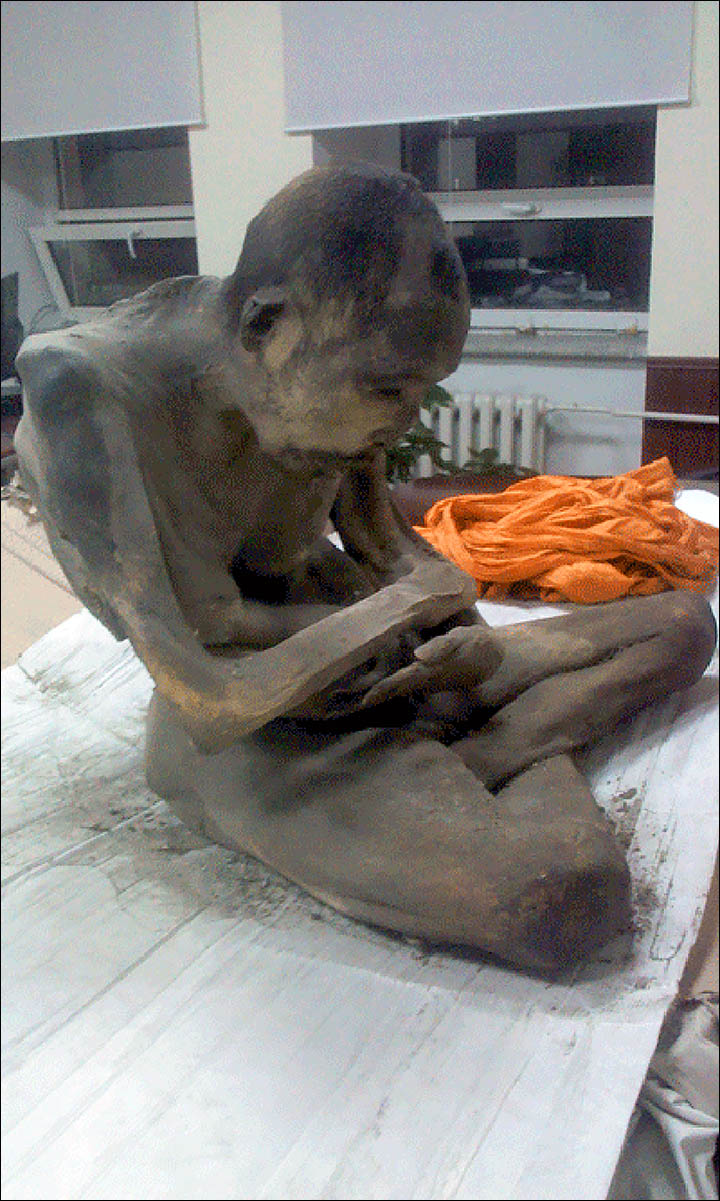
200-Yr-Old Body Of Monk Defies Decomposition

From The Siberian Times:

A mummified monk found in the lotus position in Mongolia is ‘not dead’ and is instead one stage away from becoming a real-life Buddha, it has been claimed.

Forensic examinations are under way on the amazing remains, which are believed to be around 200 years old, having been preserved in animal skin. But one expert has insisted the human relic is actually in ‘very deep meditation’ and in a rare and very special spiritual state known as ‘tukdam’.

Over the last 50 years there are said to have been 40 such cases in India involving meditating Tibetan monks.

Dr Barry Kerzin, a famous Buddhist monk and a physician to the Dalai Lama, said: ‘I had the privilege to take care of some meditators who were in a tukdam state.

‘If the person is able to remain in this state for more than three weeks – which rarely happens – his body gradually shrinks, and in the end all that remains from the person is his hair, nails, and clothes. Usually in this case, people who live next to the monk see a rainbow that glows in the sky for several days. This means that he has found a ‘rainbow body’. This is the highest state close to the state of Buddha’.

He added: ‘If the meditator can continue to stay in this meditative state, he can become a Buddha. Reaching such a high spiritual level the meditator will also help others, and all the people around will feel a deep sense of joy’.

Initial speculation is that the mummy could be a teacher of Lama Dashi-Dorzho Itigilov.

Born in 1852, Dashi-Dorzho Itigilov was a Buryat Buddhist Lama of the Tibetan Buddhist tradition, best known for the lifelike state of his body.

Mummified monk is ‘not dead’ and in rare meditative state, says expert


Ganhugiyn Purevbata, who is the founder and professor of the Mongolian Institute of Buddhist Art at Ulaanbaatar Buddhist University, said: ‘Lama is sitting in the lotus position vajra, the left hand is opened, and the right hand symbolizes of the preaching Sutra.

‘This is a sign that the Lama is not dead, but is in a very deep meditation according to the ancient tradition of Buddhist lamas’.

The mummified remains, which were covered in cattle skin, were found on January 27 in the Songinokhairkhan province of Mongolia.

However, there is more to the story and now police have revealed that the monk had been stolen from another part of the country and was about to be sold off.

An unnamed official said that it was taken from a cave in the Kobdsk region by a man who then hid it in his own home in Ulaanbaatar.

He had then been planning to sell it on the black market at a ‘very high price’, with local media claiming he wanted to take it over the Mongolian border. Police uncovered the plot and quickly arrested a 45-year-old, named only as Enhtor.

According to Article 18 of the Criminal Code of Mongolia smuggling items of cultural heritage are punishable with either a fine of up to 3million roubles ($43,000) or between five and 12 years in prison. The monk is now being guarded at the National Centre of Forensic Expertise at Ulaanbaatar.”

Rabbi’s Shemitah Prophecy Is NWO Fraud

Some Christian web-sites are skeptical of Jonathan Cahn’s Shemitah theory and his attempt to make America the duplicate of ancient Israel:

The Berean Call says:

This imposed Shemitah judgment was very specific and involved  only the nation of Israel . Since no Gentile nations were ever obligated to keep the Shemitah, there is no scriptural basis for suggesting that any other nation would ever experience an imposed Shemitah judgment. Yet, this is precisely what Jonathan Cahn suggests that America has experienced.

Cahn also wrongly implies that the Shemitah is essentially a universal  principle  that is somehow integrated into the order of the universe. Cahn makes the following assertion in his book:

[KAPLAN] “Seven years—the biblical period of time that concerns a nation’s financial and economic realms.” [This and all quotes are taken from: Jonathan Cahn,  The Harbinger  (Lake Mary, FL: Frontline, Charisma Media/Charisma House Book Group, 2011)]

Although Israel was on a seven-year economic cycle, no biblical passages support Cahn’s idea that natural economic cycles of seven years exist for nations in general. Furthermore, financial experts have not identified any seven-year economic cycle. —http://www.thebereancall.org/content/october-2014-extra-shemitah

If anything happens during The Shemitah (September 2015), it’s not because of God and a connection to Isaiah 9:10, it’s because the Freemasons who control this world are pushing the buttons and they are making things happen (in cycles of 7 as it’s a ‘magic’ number) for their own purposes to further the progress of a New World Order.”