Update: Antiwar has a good piece about Dr. Lani Kass, Senior Special Assistant to the Chief of Staff to the US Air Force General Norton A. Schwartz, who reached the rank of Major in the Israeli Defense Force (IDF) before rising to her present highly sensitive position at the Pentagon. Dr. Kass is also rumored to be an unofficial adviser to Admiral Mike Mullen, Chair of the Joint Chiefs of Staff, on Middle East Policy.
“There are indications that Dr. Kass is a major player in shaping US security policy. She has been described as a “key participant” in the development of the national strategy for combating terrorism, as well as the national military strategic plan for the Global War on Terrorism. In September 2007, The Times of London reported that she was a leading participant in “Project CHECKMATE, a “highly confidential strategic planning group tasked with ‘fighting the next war’ as tensions rise with Iran” that was “quietly established” by the US Air Force in June 2007 as a “successor to the group that planned the 1991 Gulf War’s air campaign.”
Also per The Times, CHECKMATE “consists of 20-30 top air force officers and defense and cyberspace experts with ready access to the White House, the CIA and other intelligence agencies.” Its director Brigadier-General Lawrence A. Stutzriem and Kass reported directly to General Michael Moseley, at the time chief of staff of the Air Force. The Times cited Defense sources saying, “detailed contingency planning for a possible attack on Iran has been carried out for more than two years.” Regarding Iran operations, Kass was quoted as saying “We can defeat Iran, but are Americans willing to pay the price?”
ORIGINAL POST
The Daily Bell asks a good question:
“Leaving aside the legal issues involved, one does wonder at America’s insistence that Iran remain nuke-free. Back in the 1950s, America participated in a regime change in Iran and there is considerable evidence that America might have destabilized Iran again in the late 1970s. And despite mistranslations, Iran has never directly threatened Israel with nuclear weapons – even if it had them. Israel on the other hand is said to have up to 400 nuclear missiles or more, though Israel has never confirmed their existence.
States, in fact, usually do not commit suicide. The idea that a nuclear Iran would suddenly start lobbing nukes at Israel strikes us as preposterous. Even if Israel did not strike back, the US has enough firepower to turn all of Iran into molten slag. The regime would not survive the first missile. But none of this seems to matter. The US is the de facto policeman of the new global “Power Elite” order. It is harrying nations around the world into falling in line with the US position that so long as there is any hint of a possibility that Iran is pursuing nuclear weapons, Iran ought to be severely boycotted, its economy squeezed and its businesses barred.
It is a serious situation. Boycotts are not inevitably a prelude to war, but they are often destabilizing and can well be a cynical prelude to action. In this case, we believe that certain US leaders seem to want to ratchet up the pressure on Iran to a point that is positively dangerous. Why would the US put world peace at risk over an atomic program that has not yet been proven to exist?”
Why?
Here is one answer: “The Zionist Power Configuration” (James Petras). (Note: The tone of this is shriller than necessary, but because it is a systematic and superbly documented critique that I can’t really find any where else, and because of Lieberman’s new, extremely dangerous call for war in Iran at a time of maximum global fragility (and with the very suspicious downing of the Polish plane in the background), I am going to post it anyway.
And here is more on the IL:
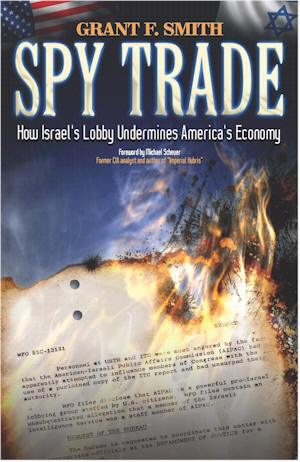
PY TRADE: How Israel’s Lobby Undermines America’s Economy
by Grant F. Smith
Foreword by Michael Scheuer, former chief, CIA Bin Laden unit
Large Cover Image
Buy now at:
Praise for Spy Trade:
“This terrific historical expose ought to be required background reading for those FBI agents assigned to investigate foreign espionage and public corruption matters. For many reasons, such cases are amongst the most challenging to investigate and prosecute, but are made even harder when undue political pressures enter into the picture. FBI officials responsible for setting investigative priorities and allocating resources would also do well therefore to read Spy Trade so they are aware of the historical linkage between Israel’s ‘Uzi diplomacy’ arms dealing, the Iran-Contra scandal, and the Jonathan Pollard spy incident with AIPAC’s nefarious ‘lobbying’ activities.” Coleen Rowley, former FBI agent and 2002 Time Magazine “Person of the Year.”
“Grant F. Smith’s excellent, deeply disturbing book..is a welcome addition to a growing scholarly literature.” Michael Scheuer, former senior CIA analyst and author of “Imperial Hubris”
“Like political parties, lobbies are groups of citizens with shared interests, an important part of a functioning democracy. When they have enormous power, however, and especially if their activities remain almost completely hidden, lobbies can be dangerous.
Meticulously detailed in this riveting addition to his earlier exposes, Grant Smith reveals yet another facet of the extent to which the pro-Israel Lobby is beyond dangerous, and has become a serious threat to a broad range of American ideals, objectives and interests abroad, as well as here at home. This book contains many highly disturbing, documented revelations. Read it.” Ambassador Edward L. Peck, former Chief of Mission in Iraq and Former Deputy Director, Cabinet Task Force on Terrorism, Reagan White House
“This book presents formidable and dangerous new evidence of spying by Israel and the corrosive long term influence of its lobby on US governance.” Paul Findley, member of Congress from 1961 to 1983 and author of three books on the US-Israeli relationship, including the Washington Post bestseller They Dare to Speak Out: People and Institutions Confront Israel’s Lobby
“Grant F. Smith is without peer as an archival scholar of the history of the Zionist power configuration operating in tandem inside and outside of the US government. His meticulous research on the long-term operations of AIPAC in shaping US Middle East policy provides the best contemporary framework for understanding our involvement in Middle East wars. He shows how American foreign policy in the Middle East follows Israel’s agenda and documents the enormous cost to our Treasury and economy as well as the loss of American lives. This is a book that should be read by all citizens who are concerned about the aggressive manipulation of our media and political institutions to enhance Israel’s power and further its privileged position in the Middle East.” James Petras, Bartle Professor (Emeritus) of Sociology at Binghamton University, New York
About the Book
Israel and its American lobby have committed audacious but generally unknown crimes against the United States. Government secrecy across the CIA, FBI, Department of Justice and Pentagon long kept files about Israeli espionage, weapons smuggling and covert operations on American soil classified…until now.
Spy Trade begins on the trail of a vast smuggler network funneling stolen and illegally purchased surplus WWII arms to Jewish fighters in Palestine. When the FBI threatened to crack down—a clandestine summit meeting yielded minor convictions for small time operators—but not the financial masterminds behind the scheme. This germ of immunity soon flowered into a full scale assault on American industry, the electoral system, national defense secrets and rule of law itself.
Spy Trade probes Israel lobby smuggling operations diverting uranium from the US to Israel’s Dimona nuclear weapons facility. The US Department Justice battled mightily to regulate two key enablers—the Jewish Agency and American Zionist Council—as Israeli foreign agents in the 1960s. But when the effort failed it generated a massive counterstrike.
Israel lobby campaign finance violations unleashed a network of coordinated stealth political action committees that intimidated American politicians and made a “pro-Israel” outlook and voting record requirements for staying in government. A new legal battle to regulate the American Israel Public Affairs Committee (AIPAC) as a political action committee—this time launched by concerned citizens—began two decades ago but has not yet been resolved.
Spy Trade also reveals the long term impact of a newly declassified “third scandal” that began in the 1980s. In the midst of both the Iran-Contra affair and Jonathan Pollard espionage incident AIPAC and the Israeli embassy conducted a spectacular clandestine operation against American industries and workers. It has so far cost the US economy $71 billion and a hundred thousand jobs each year by shutting down or diverting US exports. Trade privileges obtained by Israel under the treaty not only permit financing illegal settlement construction with proceeds from diamonds sold in the US. The US pharmaceutical industry faces an unrelenting onslaught against its capacity to innovate and protect its intellectual property.
Spy Trade is much more than a groundbreaking dissection of the tactics Israel and its American lobby repeatedly use to evade justice. The book also provides stunningly simple strategies for ending criminal immunity and subversion of law enforcement that may someday restore American governance.