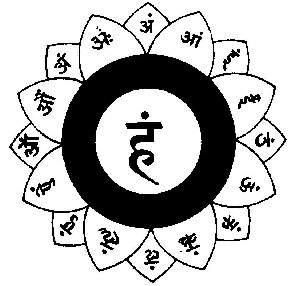
The fifth chakra = Vishuddha
“The throat wheel is an important centre in the Highest Yoga traditions of Vajrayana. It is circular, red, with 16 upward pointing petals or channels. It is of particular importance for the practice of Dream Yoga. Correctly meditating upon it before going to sleep should produce lucid dreams, within which one can continue to practice yoga.[1]
“Western occultists make various differing kabbalistic associations with Vishuddha. Some associate it with the hidden sephirah Da’at, where ‘wisdom’ and ‘understanding’ are balanced in the supernal realm by the aspect of ‘knowledge’, a tangible idea, which is then expressed, leading to the act of the creation, others associate it with the sephirah Chesed and Geburah, mercy and strength, which are sephirah intimately associated with morality, and the concept that both expansion, as expressed by Chesed, and limitation, as expressed by Geburah, are necessary for the creation of individual beings. In terms of ethics, this is expressed by the yamas and niyamas ( do’s and do nots ) of yoga.”
Yoga Sutras of Patanjali 3.39-3.49
“By samyama over the relation between space and the power of hearing, the higher, divine power of hearing comes.
(shrotra akashayoh sambandha samyamat divyam shrotram)
[Note: In some renditions this is sutra 3.40 or 3.41]
- shrotra = ear, the power of hearing
- akasha = space, ether
- sambandha = over the relation
- samyama = dharana (concentration), dhyana (meditation), and samadhi taken together (3.4)
- divyam = higher, divine
- shrotram = ear
Divine or psychic hearing: By samyama over the relation between space (one of the five elements) and the power of hearing, the higher, divine power of hearing comes.
Space, hearing, and the chakras: Space is one of the five elements (earth, water, fire, air, space) and hearing is one of the five karmendriyas. Both of these operate from the fifth chakra, which is at the throat. It is through samyama of one that mastery over the other is attained. The same principle applies to the other elements, karmendriyas, and jnanendriyas. (See the Chakras section of Kundalini Awakening).”