4000 Year Old Vishnu Demolishes Aryan Invasion Theory

From IndiaDivine.org:

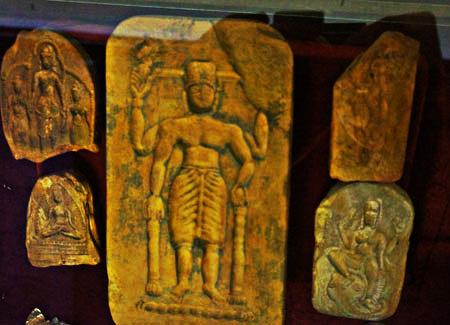
A recent news report from Vietnam features an exquisite and very ancient sculpture of Lord Vishnu. According to a press release from the Communist Party of Vietnam’s Central Committee (CPVCC) the Vishnu sculpture is described as “Vishnu stone head from Oc Eo culture, dated back 4,000-3,500 years.” Recently the Government of Vietnam, despite its official Communist doctrine, has developed many programs and projects highlighting Vietnam’s ancient religious heritage. Its scholarly and archeological research and investigations are legitimate and its conclusions are authoritative. This discovery of a 4,000 to 3,500 year old Vishnu sculpture is truly historic and it sheds new light upon our understanding of the history of not only Hinduism but of the entire world.

Vishnu

The fact is there are no other ‘officially’ recognized Vedic artifacts that have been dated back to such an early date. This would make Vietnam home to the world’s most ancient Vedic artifact. While there are indeed many other ancient artifacts that represent the same Deity, they are not presented in the ‘Indic’ tradition and cannot be directly recognized as the Vishnu of the Indic Vaishnava tradition……..

The significance of this discovery cannot be overestimated. The entire history of Hinduism and Vedic culture, as taught is the academic institutions of the world, has been built upon a false construct. According to mainstream academia Vedic ‘religion’ or Hinduism did not exist until the alleged ‘Aryans’ invaded India circa 1500 BC. An even later date is given to Vaishnavism which is speculated to have been derived from animist Sun worship. Yet here we have a highly evolved art form depicting Lord Vishnu in the Far South East region of Asia dated to somewhere between 2000 BC to 1500 BC.
[Vaishnavism, with its repeatedly incarnating “savior” Chrish-na thus predates Christianity by some 2000 years and is older than the date of the writing of the Old Testament. ]

This completely undermines the entire historic timeline developed by mainstream academia in regards to the development of both Vedic/Hindu civilization and Indian history.

The region of modern India has always been the epicenter of High Vedic/Hindu Civilization and culture. No one anywhere has ever suggested the region of modern Vietnam to be the origin of Hindu civilization yet it is in Vietnam that we now have the world’s most ancient example of Indic style Vedic Vaishnava art. Thus it stands to reason that if Vedic Vaishnava art, culture and religion flourished 4000 years ago in prehistoric Vietnam it was undoubtedly flourishing in ancient India as well.

Once again science and archeology have confirmed the Vedic conclusion. As the Vedic literature states 5000 years ago India was home to a highly evolved and advanced civilization. This civilization was centered on its sacred traditions. The worship of the Supreme Lord Vishnu, Lord Shiva, Lakshmi and Durga was widespread and in fact spanned the entire globe.

These traditions presented themselves in diverse manners, as seen in modern India, yet among this diversity was a commonality based upon the authority of the Vedic scriptures and traditions. The recognizably Indic forms of the Vedic traditions spanned the globe from the Philippines to the Middle East and Siberia to Australia. Yet the same Divinities were worshiped and the same traditions were practiced throughout the world.

The many recent Vedic discoveries from Vietnam are providing a new and sensational view into the authentic history of the world. Not only this, it presents a challenge to Modern India and its leadership. India is home to many startling and amazing artifacts yet they sit ignored and crumbling. In many cases looters and vandals have destroyed many priceless examples of India’s ancient heritage. India’s leading academics and governing bodies are silent and if they do speak of India’s ancient Hindu heritage it is only to cast doubts and disparage India’s indigenous Vedic culture and Hindu traditions.”

Catholic “Spirit Of Francis” Is Treacle, Not Manna

An excellent piece by Rod Dreher, explaining why he left the Roman Catholic Church and joined the Orthodox:

In 2002, when the clerical-sex-abuse scandal broke nationwide, the full extent of the rot within the church became manifest. All that post-Vatican II happy talk and non-judgmentalism had been a facade concealing what then Cardinal Joseph Ratzinger — later Pope Benedict XVI — would call the “filth” in the church. Many American bishops deployed the priceless Christian language of love and forgiveness in an effort to cover their own foul nakedness in a cloak of cheap grace.

During that excruciating period a decade ago, rage at what I and other journalists uncovered about the church’s corruption pried my ability to believe in Catholic Christianity out of me, like torturers ripping fingernails out with pliers. It wasn’t the crimes that did it as much as the bishops’ unwillingness to repent and the Vatican’s disinterest in holding them to account. If the church’s hierarchy cannot commit itself credibly to justice and mercy to the victims of its own clergy and bishops, I thought, do they really believe in the doctrines they teach?

All this put the moral unseriousness of the American church in a certain light. As the scandal raged, one Ash Wednesday, I attended Mass at my comfortable suburban parish and heard the priest deliver a sermon describing Lent as a time when we should all come to love ourselves more.

If I had to pinpoint a single moment at which I ceased to be a Roman Catholic, it would have been that one. I fought for two more years to hold on, thinking that having the syllogisms from my catechism straight in my head would help me stand firm. But it was useless. By then I was a father, and I did not want to raise my children in a church where sentimentality and self-satisfaction were the point of the Christian life. It wasn’t safe to raise my children in this church, I thought — not because they would be at risk of predators but because the entire ethos of the American church, like the ethos of the decadent post-Christian society in which it lives, is not that we should die to ourselves so that we can live in Christ, as the New Testament demands, but that we should learn to love ourselves more.

Flannery O’Connor, one of my Catholic heroes, famously said, “Push back against the age as hard as it pushes against you. What people don’t realize is how much religion costs. They think faith is a big electric blanket, when of course it is the cross.” American Catholicism was not pushing back against the hostile age at all. Rather, it had become a pushover. God is love was not a proclamation that liberated us captives from our sin and despair but rather a bromide and a platitude that allowed us to believe that and to behave as if our lust, greed, malice and so forth — sins that I struggled with every day — weren’t to be despised and cast out but rather shellacked by a river of treacle.

I finally broke. Losing my Catholic faith was the most painful thing that ever happened to me. Today, as much as I admire Pope Francis and understand the enthusiasm among Catholics for him, his interview makes me realize that the good, if incomplete, work that John Paul II and Benedict XVI did to restore the church after the violence of the revolution stands to be undone. Though I agree with nearly everything the Pope said last week in his interview and cheer inwardly when he chastises rigorist knotheads who would deny the healing medicine of the church to anyone, I fear his merciful words will be received not as love but license. The “spirit of Pope Francis” will replace the “spirit of Vatican II” as the rationalization people will use to ignore the difficult teachings of the faith. If so, this Pope will turn out to be like his predecessor John XXIII: a dear man, but a tragic figure……

There is, of course, no such thing as the perfect church, but in Orthodoxy, which radically resists the moralistic therapeutic deism that characterizes so much American Christianity, I found a soul-healing balance. In my Russian Orthodox country mission parish this past Sunday, the priest preached about love, joy, repentance and forgiveness — in all its dimensions. Addressing parents in the congregation, he exhorted us to be merciful, kind and forgiving toward our children. But he also warned against thinking of love as giving our children what they want as opposed to what they need.“Giving them what they want may make it easier for us,” he said, “but we must love our children enough to teach them the hard lessons and compel them toward the good.”

Martyrdom At Jacob’s Well

The martyrdom in 1979 of Father Philoumenos at the monastery of Jacob’s Well near ancient Samaria:

What a good shepherd he was, more worthy than some of the episcopate! Yet the policies and needs of the patriarchate saw Father Philoumenos assigned to other positions. Whenever Palestinian faithful were scandalized by some unworthy priest, whenever Orthodox neglect or European money drove the faithful to wonder whether they would not receive better pastoral care from Uniates, it was Father Philoumenos that the Patriarch of Jerusalem sent as the true defender of the Faith, a man of more than blameless life, a man from whom no one could even imagine any immodest or improper word, a man whose faith and integrity were a model for all………

Three things were most remarkable about the blessed martyr. The first might have been partly from nature, but assuredly aided by Grace: this was his soft sweet voice, which I can still hear today. The second was a meticulous fidelity to small things, but specifically to the Divine Service. He never omitted one word of any day’s service. When we were alone in some remote monastery, particularly for Matins, he slowly and carefully chanted each word of every psalm and canon. Not even at the Monastery of St. Sabba was the reading done so well. But when there were pilgrims for the Divine Liturgy and vespers, he made the usual abridgements lest the service be too long and some be tempted to leave. Later on, privately, he would read every word that had not been chanted in the church. Those who stayed with him for some time saw the copies of the menaion, horologion, synaxarion, etc. and noticed that the markers were always in place and the volumes never dusty, which earned the Divine Promise, Well done thou good and faithful servant, because thou hast been faithful over little things, I will set thee over great things Enter thou into the joy of the Lord (Matt. 25:21).

Third, and as unobtrusive, almost secret, was his humility. What a perfect patriarch he would have made, and were the election by the Palestinian faith fill he might well have been. Instead, God gave him an eternal crown and throne among the elders who offer incense before the throne of the Lamb (Rev. 5:8)……..

The glorious martyrdom of this servant of God came to pass in November,1979. The week before, a group of fanatical Zionists came to the monastery at Jacob’s Well, claiming it as a Jewish holy place and demanding that all crosses and icons be removed. Of course, our father pointed out that the floor upon which they were standing had been built by Emperor Constantine before 331 A.D. and had served as an Orthodox Christian holy place for sixteen centuries before the Israeli State was created, and had been in Samaritan hands eight centuries before that, (The rest of the original church had been destroyed by the invasion of the Shah Khosran Parvis in the seventh century, at which time the Jews had massacred all the Christians of Jerusalem.) The group left with threats, insults and obscenities of the kind which local Christians suffer regularly. After a few days, on November 16/29, during a torrential downpour, a group broke into the monastery; the saint had already put on his epitrachelion for Vespers. The piecemeal chopping of the three fingers with which he made the Sign of the Cross showed that he was tortured in an attempt to make him deny his Orthodox Christian Faith. His face was cloven in the form of the Cross. The church and holy things were all defiled. No one was ever arrested.

His body was buried on Mt. Zion, and when it was exhumed after four years, as is customary, It was found to be substantially incorrupt…”

Correction: The Israeli government did finally arrest a mentally disturbed Jewish man, who was not a settler, for this and other crimes. However, nothing was done about the dozens of other people who’d called and made violent threats for weeks to the Archimandrite, before his murder.

Orthodox View Of Catholic Dogmas

A list of the main doctrinal differences between the Orthodox Church and the Roman Catholic are given in a piece cautioning against unwise one-world ecumenism:

1. The Eastern Orthodox reject the Roman Catholic notion of purgatory (Ware, T. The Orthodox Church. Penguin Books, London, 1997, p.p. 255 and Aghiorgoussis, Maximos. The Dogmatic Tradition of the Orthodox Church. Copyright:  © 1990-1996. http://www.goarch.org/en/ourfaith/articles/article8038.asp 08/18/07).

2. The Eastern Orthodox number the ten commandments as they originally were (Mastrantonis, G. The Ten Commandments. Copyright:  © 1990-1996 Greek Orthodox Archdiocese of America. http://www.goarch.org/en/ourfaith/articles/article7115.asp 05/14/07) and not as the Roman Catholics number them.  Those of Rome combine the first two, even though that is not what those such as Clement of Alexander (2nd century) did (Clement of Alexandria. Stromata, Book VI).

3. The Eastern Orthodox believe in baptism by immersion (Ware, p. 278). The Roman Catholics usually employ sprinkling.

4. Most of the Eastern Orthodox (presuming no abortive devices are used), as do most others, believe in “the responsible use of contraception within marriage” (Ware, p.296 and Harakis S. The Stand of the Orthodox Church on Controversial Issues. http://www.goarch.org/en/ourfaith/articles/article7101.asp 8/20/05). The Roman Catholic position seems to be much more limited.

5. The Eastern Orthodox reject “the dogma of the immaculate conception of the Virgin” (Clendenin D.B. ed. Eastern Orthodox Theology, 2nd ed. Baker Academic, 2003, p.67).  That is a Roman Catholic dogma (Ott L.  Fundamentals of Catholic Dogma.  Translated into English by James Bastible. Nihil Obstat: Jeremiah J. O’Sullivan.  Imprimatur + Cornelius, 7 October 1954.  Reprint TAN Books, Rockford (IL), 1974, pp. 199-202).

6. The Eastern Orthodox teach that presbyters (which they call “priests,” but we in the Church of God) tend to call “ministers” or “elders”) can be married (Damaskinos Papandreou, Orthodox Metropolitan of Switzerland. The Orthodox Churches and Priestly Celibacy. http://www.orthodoxresearchinstitute.org/articles/misc/damaskinos_celibacy.htm viewed 02/04/08). The Roman Church requires celibacy for all presbyters, even though that was not its original position (Fortesque A. Transcribed by Marie Jutras. Eastern Monasticism. The Catholic Encyclopedia, Volume X. Copyright © 1911 by Robert Appleton Company. Online Edition Copyright © 2003 by K. Knight. Nihil Obstat, October 1, 1911. Remy Lafort, S.T.D., Censor. Imprimatur. +John Cardinal Farley, Archbishop of New York).

7. The Eastern Orthodox, similar to the Church of God, teach that, “Christians must always be ‘People of the Book’ “ (Ware, p.199). Yet, throughout history, the Church of Rome has tended to place more emphasis on the Living Magisterium and non-biblical sources for much of its doctrines.

8. The Eastern Orthodox do not observe Ash Wednesday.  The Church of Rome admits that it added this observance in the Middle Ages (Thurston, Herbert. “Ash Wednesday.” The Catholic Encyclopedia. Vol. 1. Nihil Obstat. March 1, 1907. Remy Lafort, S.T.D., Censor. Imprimatur. +John Cardinal Farley, Archbishop of New York. New York: Robert Appleton Company, 1907. 4 May 2009 ).

9. The Orthodox do not believe in the concept of “papal infallibility.” That concept became a dogma for the Church of Rome in the 19th century (at Vatican I) (McBrien, Richard P. Lives of the Popes: The Pontiffs from St. Peter to Benedict XVI. Harper, San Francisco, 2005 updated ed., pp. 20-22).

10. Many (though not all) of the Eastern Orthodox, like the Church of God, believe that God has a plan of salvation that can occur at the time of the final judgment. (Ware, p.255).  The Roman Church rejects the idea that salvation can be available after the first death and this has been clearly stated by Pope Benedict (Catechism of the Catholic Church, 1021. Imprimi Potest + Joseph Cardinal Ratzinger. Doubleday, New York, 1994, p. 153).

11. The Roman Catholic view of eternal torment is rejected by the The Eastern Orthodox (Ware, p. 262).

12. Neither the Orthodox nor Protestants believe that the jurisdiction of Rome has any real bearing on apostolic succession.

It perhaps should be pointed out that the Orthodox, who generally make less pronouncements than the Vatican tends to, condemned the papacy as a major heresy in 1848:

” 2. Hence have arisen manifold and monstrous heresies which the Catholic Church, even from her infancy, has been forced to combat with the panoply of God, and ‘ the sword of the Spirit, which is the Word of God,’ and has triumphed over all unto this day, and will triumph to the end, ever shining forth brighter and stronger after the struggle.

” 3. Of these heresies some have altogether perished, some are in their decline, but others nourish more or less, until the time of their overthrow, when, being struck with the lightning of the anathema of of the seven (Ecumenical Synods, they become extinct, even though they last for a thousand years; for the orthodoxy of the Catholic Apostolic Church, as inspired by the living Word of God, alone endures for ever, according to the infallible promise of our Lord…—Matt, xviii. 18.

” 4. Of these heresies widely-diffused was formerly Arianism, and now is the Papacy, which, though still flourishing, shall, like the former, pass away and be cast down, and a great voice from Heaven shall cry, ‘ It is cast down.’—Rev. xii. 10…

” 10. Every one of our brethren and children in Christ clearly perceives that the words of the present Bishop of Rome, like those of his anti-synodical predecessors, are not words of peace and compassion, as he says, but of deceit and quibbling, tending to self-aggrandisement; but the orthodox will not be beguiled therewith, for the Word of the Lord is sure—’ A stranger will they not follow, but will flee from him, for they know not the voice of strangers.’

(Encyclical Letter of the Eastern Orthodox, 1848. As cited in The Benares magazine, No. 31, 1851. W.H. Haycock, 1851. Original from Oxford University Digitized, Nov 24, 2006, pp. 370-371,373)

Perhaps it should be mentioned that “Rev. xii. 10” teaches about the “accuser of the brethren” (a reference to Satan in verse 9) being cast down. Thus the Orthodox officially seem to have condemned the papacy as Satan the devil.

Not only does the Orthodox Church consider the institution of the Papacy and the doctrine of Papal infallibility heretical, it considers many – not all – of the instances of stigmata and visions exhibited by Catholic saints to be evidence not of sanctity but of  delusion and vainglory, especially when they are sought out deliberately.

Although I wouldn’t go so far as to call such displays Satanic, I agree that more than a few are the results of a misguided effort of will, very similar to the efforts of some yogis and ascetics in Hinduism and similarly lacking in moral content, while sometimes providing grave opportunities for moral depravity.

Asceticism (what is called tapas in India) and mental focus can lead to psychosomatic symptoms (markings on the skin, sensations) as well as psychic abilities – siddhis -(levitation, bilocation) of all kinds, but whether this is always a saintly thing, or even good, is the question.

In many cases (not all), the Orthodox answer, “no,” is the correct one.

The heart, as the Bible points out, is endlessly self-deceiving.


Is Pope Francis Practicing Talmudism Covertly?

Why did Pope Francis mention Moses and not Jesus in his addresses to the White House and the UN?

Is it because he wanted to cite a figure that would not “offend”?

But Muslims venerate Jesus, even if they do not regard him as the Son of God. They would not be offended.

It follows that Francis avoided Jesus, to avoid giving offense to religious Jews.

Historically, many – but not all – Jews have regarded Jesus as a blasphemer and apostate.

But, if interfaith peace is the goal, why not mention Abraham, who is the fountain-head of all three faiths?

Why Moses?

The answer lies in looking at Jewish texts.

Moses is held up as the greatest of the prophets by Maimonides, one of the most authoritative of Jewish rabbis and the codifier of the Shloshah Asar Ikkarim (“Thirteen Fundamental Principles”), a distillation of the Taryag mitzvoth (613 regulations) binding on orthodox Jews.

From Chabad.org:

1. Belief in the existence of the Creator, who is perfect in every manner of existence and is the Primary Cause of all that exists.

2. The belief in G-d‘s absolute and unparalleled unity.

This would conflict with the doctrine of the Trinity in orthodox Christianity – that is why Francis praises Chagall’s White Crucifixion – because it effaces the divine Jesus and substitutes the human Jewish rabbi, thereby erasing the core of Christianity.]

3. The belief in G-d’s non-corporeality, nor that He will be affected by any physical occurrences, such as movement, or rest, or dwelling.

[Again, this conflicts with the doctrine of the Incarnation most fundamentally.]

4. The belief in G-d’s eternity.

5. The imperative to worship G-d exclusively and no foreign false gods.

[Maimonides and many great Rabbis saw Jesus as a heretic, sorcerer, and blasphemer.]

6. The belief that G-d communicates with man through prophecy.

The belief in the primacy of the prophecy of Moses our teacher

[This diminishes Jesus, who is superior to all the prophets, according to Christian teaching.]

8. The belief in the divine origin of the Torah.

9. The belief in the immutability of the Torah.

[Jesus taught that the Mosaic law was given because of the degradation of the people and that it did not fully reflect God’s law, as his perfection of it did.]

10. The belief in G-d’s omniscience and providence.

11. The belief in divine reward and retribution.

12. The belief in the arrival of the Messiah and the messianic era.

[Christians believe that the Messiah has already arrived. As for the Messianic era, some Christians regard this as heresy and others as true.]

13. The belief in the resurrection of the dead.


Pope Francis: Public Heresy

Paragraph 247 Pope Francis’ exhortation Evangelii Gaudium:

[I have underlined the passages containing explicit heresies.]

247. We hold the Jewish people in special regard because their covenant with God has never been revoked, for “the gifts and the call of God are irrevocable” (Rom 11:29).

The Church, which shares with Jews an important part of the sacred Scriptures, looks upon the people of the covenant and their faith as one of the sacred roots of her own Christian identity (cf. Rom 11:16-18).

As Christians, we cannot consider Judaism as a foreign religion; nor do we include the Jews among those called to turn from idols and to serve the true God (cf. 1 Thes 1:9).”

Is This Blog Anti-Semitic?

By the standards of the ADL (the Anti-Defamation League), yes, of course.

I think I subscribe to at least half of the beliefs they state qualify one as anti-Semitic:

I think that Jews are disproportionately represented in the media and government; that they wield too much unaccountable power for their numbers and that this fact is dangerous for the rest of society….

[…But I also believe that Jews are generally a productive and capable people.]

I believe – from the evidence – that Jews tend to be loyal before anything else to the Jewish ethno-state, even when they might not be pro-Israel.

[However, I also understand why that is so – trauma-conditioning orchestrated by the powers-that-be.]

As a Christian, I try not to hate any group of people.

But “loving your enemies” is not an instruction to acquire certain sentiments against your will.

It has nothing to do with superficial sentiment.

It is an instruction to treat others mercifully and not merely justly, as you would wish to be treated..

It is an instruction not to be vengeful and descend to the level of your enemies.

In that spirit, I do not denigrate nor regard as demonic or Satanic, Jewish religious faith, even if Jews do not return the favor.

[I do abhor certain practices and beliefs in Judaism, as I also do certain practices in other religions, including certain Christian heresies.]

However, I don’t see any instruction in the Gospel to laugh away behaviors that are detestable or to call one’s open enemies “one’s friends” or to claim that black is white and up is down.

If a Jew were accused unjustly, I would stand up for him, even though I knew the favor might not be returned.

If a Jew were being attacked physically, I would help him, even though I might not be able to count on the same help in return.

On this blog I have defended several neoconservative Jews like Donald Sterling, whose beliefs are anathema to me.

That is how I interpret “love your enemies.”

Would I go out of my way to befriend Jews personally?

Honestly, no.

I don’t know many Jews as friends and those I’ve known and liked were singularly unlike the majority of their co-ethnics, being artists or otherwise exceptional individuals.

Even so, there was a silent area of potential conflict that prevented me from getting too close.

That area was Christianity..or, rather, Jesus Christ.

The Psalms asks us not to sit in the seat of the scornful.

The Gospel repeats that message.

What about conservative Jews who are not disrespectful of Christianity?

Certainly, there are many of those. But they are respectful only of Zionist Christianity – that is, of Christianity that puts ethnic Jews and their tribalism at the center of the faith.

In the case of liberal Jews, their lack of  exceptional hostility to Christianity is only part of their general disbelief in all religion.

Of real Christianity, they are just as uncomprehending as the openly hostile Kabbalists, and, worse, by their incomprehension, they allow themselves to be used as tools by the powerful Kabbalists.

In fact, in my view, the hostile religious Jews, are to be preferred.

They have at least understood that man as he is, natural man, doesn’t cut it.

Blow hot or blow cold, says the Gospel.

There is no hope for the luke-warm.

My problem with Jews [as they are called today, a Euro-Turco-Mongolic people] is that they are not enough Jews [in the sense of Torah followers or Yahwists].


Some Thoughts On Anti-Christian Speech

Thinking about the power elite’s incessant anti-Christian imagery and rhetoric, both covert and explicit, I had some thoughts about how Christians should react to it.

And my thoughts were these:

Anti-Christian speech should make Christians realize how powerful and destructive words can be.

And it should make us recall the powerful and destructive ways in which Christianity itself was used to destroy other people’s beliefs and gods.

Sometimes, this was to the good – when the targets were temple prostitution and child-sacrifice, for instance.

But sometimes, the destructiveness was unwarranted- as when Muslim or Hindu or Jewish prayer is denounced by some Christians as inherently demonic.

So how should Christians react to anti-Christian speech?

Well, Jesus said that all manner of blasphemies by men against the Son of Man (Jesus) would be forgiven them.

But blasphemies against the Holy Spirit would not.

For many powerful Jews and Jewish sympathizers, it seems to be cathartic to denigrate Jesus.

So be it.

Jesus was not injured by such insults then..and he is not injured now. And Christians need not be more offended than Jesus.

But it is a different thing when what is good in the Church is inverted. 

Cursing Jesus Christ is one thing.

Calling what is good evil is quite another.


Pope Francis Praises Blasphemous Painting

Update:

Added: I want to correct the last paragraph of this post.

I now read that Chagall grew up in a religious Hasidic family, so he must have understood exactly what he was doing.

As for Francis, I should add that there is the possibility that he is being manipulated by more powerful people behind him….the crony-capitalist Jewish elites that use redistributionist rhetoric to con the gullible public. The support for the “climate-control” agenda suggests that Francis is not so much a leftist as an opportunistic “liberal” of the sort that has the backing of George Soros and the CIA.

That would account for the enormous media coverage that he gets.

ORIGINAL POST

The essence of Christianity is but the negation of the right of Judaism to exist…. The figure of Jesus is the figure of the universal enemy of Judaism, the eliminator and destructor of Jewish law [torat yisrael]. Thus, this figure was abhorred and despised in the eyes of many Jews with Jewish consciousness throughout the generations, and I share this despise and abomination”

—  Yeshayahu Leibowitz

[Lila: Of course, I do not accept that Christianity is the negation of Judaism…by which I mean Biblical Yahwism.

The Gospel, said Jesus, was the fulfillment of the Law (of Yahweh).

Yahweh of the Old Testament is the same merciful but righteous God as the one in the New Testament, although the OT scriptures have many misinterpretations, additions, alterations and corruptions that obscure that fact.]

Pope Francis’s fondness for the paintings of Marc Chagall has caught the attention of the media.

Forward.com:

In interviews with Francesca Ambrogetti and Sergio Rubin for the 2010 biography “ El Jesuita ,” Pope Francis identified “White Crucifixion,” which depicts a Jewish Jesus, wearing a tallit instead of a loincloth, as his favorite work of art. “He likes us, he really does,” Tweeted Miriam Shaviv , a columnist for Britain’s Jewish Chronicle, about the pope.

But there’s more to the painting than “owning” Jesus as a Jew.

[Lila: Jesus was an Israelite, but not a Jew in the modern sense, obviously.

In the classical sense, there is no “Jew,” as such. That is a propagandist coinage invented to conflate the post-Temple (Talmudic) beliefs of a contemporary mixed-race people of Middle-Eastern and European descent with the Torah faith (Yahwism) of a Semitic people of thousands of years ago.

In Biblical times, there was only the Judean (a resident of Judea) and the Judahite (descendant of Judah).

Now, Jesus was not a descendant of Judah on his mother’s side (despite the genealogies in Matthew and Luke) and since he was only grafted on to Joseph, he could not have descended genetically from him either.

Finally, he was a resident of Galilee, not Judea, although he did teach in Judea. He was an Israelite, a Galilean, and, most likely, a Levite, descended from Aaron.

Israelite is not the same thing as Israeli. The latter word is often inserted into modern Bibles to conflate the two in the minds of unsuspecting readers, in order to further Zionist goals.]

Surrounding Jesus, we see a synagogue, a Torah scroll and a shtetl burning, as armed men march carrying red flags. And in the bottom-right corner, the Wandering Jew, donning a blue cap and a green coat, lugs a sack as he trudges past the smoking Torah.

That the chief executive of the Catholic Church has an affinity for a painting that was created by a Russian Jewish artist and also includes the symbol of the eternal wanderer, who was punished for abusing Jesus and became the pretext for centuries of anti-Semitism, is drawing a range of reactions.”

Forward is a Jewish paper.
The creator of White Crucifixion is the famous Russian Jewish painter, Marc Chagall.
For insight into what is really going on in Francis’ public admiration of  White Crucifixion, take a closer look at the painting.
It is not problematic that Jesus’s suffering on the cross is identified with the suffering of Jews.
[Lila: I want to reiterate this. Innocent suffering can be rightfully identified with the suffering of Jesus.  There is nothing inherently blasphemous about that.]
It is problematic for Christians that Jesus’ atonement is displaced by collective Jewish suffering.
The displacement is pure Kabbalistic teaching:
Determined to obscure the aptness of the prophesies of the Messiah in the Old Testament to the life of Jesus, the medieval Rabbi Shlomo Yitzchaki (Rashi) came up with the notion that the “suffering servant” the Scriptures describe in Isaiah 53 was not a man at all.
The suffering servant was the Jewish people as a nation.
This Kabbalistic notion has become a mainstream Jewish notion.
Now look at the Chagall  painting close up:
http://1.bp.blogspot.com/-3HyKqo3jDlE/U3Kd-hmHJcI/AAAAAAAABdQ/V2lovO5wD_w/s1600/2094732310089814684UlOOJR_fs.jpg
The inscription above Jesus is the word, Yeshu, a variant of  Jesus’ name, used in the Jewish scriptures, the Talmud.
In the Babylonian Talmud (the more authoritative Talmud), Yeshu is mentioned as the one who led Israel into apostasy and was rightfully hanged on the Passover.
He is said to have had five disciples and to have performed sorceries.
Contemporary scholars claim that this and other references to Yeshu are descriptions of someone else, but there is ample historical and other testimony that Yeshu is none other than Jesus.
The name expresses the hostility of post-Temple (post 70 AD) rabbinate to Jesus.
Yeshu is an acronym for Yima  (YE) + Shemo (SH) +  Wezikhro (W)  meaning, May his name and memory be stricken out.
How to reconcile this curse with the depiction of Jesus with tallit and with the turban, characteristic of ancient Jewish rabbis?
The Polish Hasidic tradition, for instance, embraced the notion of a tzaddik (compare with Sanskrit sadhaka) or holy man,  whose being in this world was so close to the divine as to resemble that of incarnate deity.
And it is this rabid anti-Christian, incarnational Hasidism that permeates the painting.
Whether Chagall fully knew what he was doing is debatable, but Francis surely does.

Francis’ public embrace of  this anti- Christian art cannot be accidental.

He is too well-educated and, as we can see from his wildly popular sound-bytes, too well-versed in public relations.