200-Yr-Old Body Of Monk Defies Decomposition

From The Siberian Times:

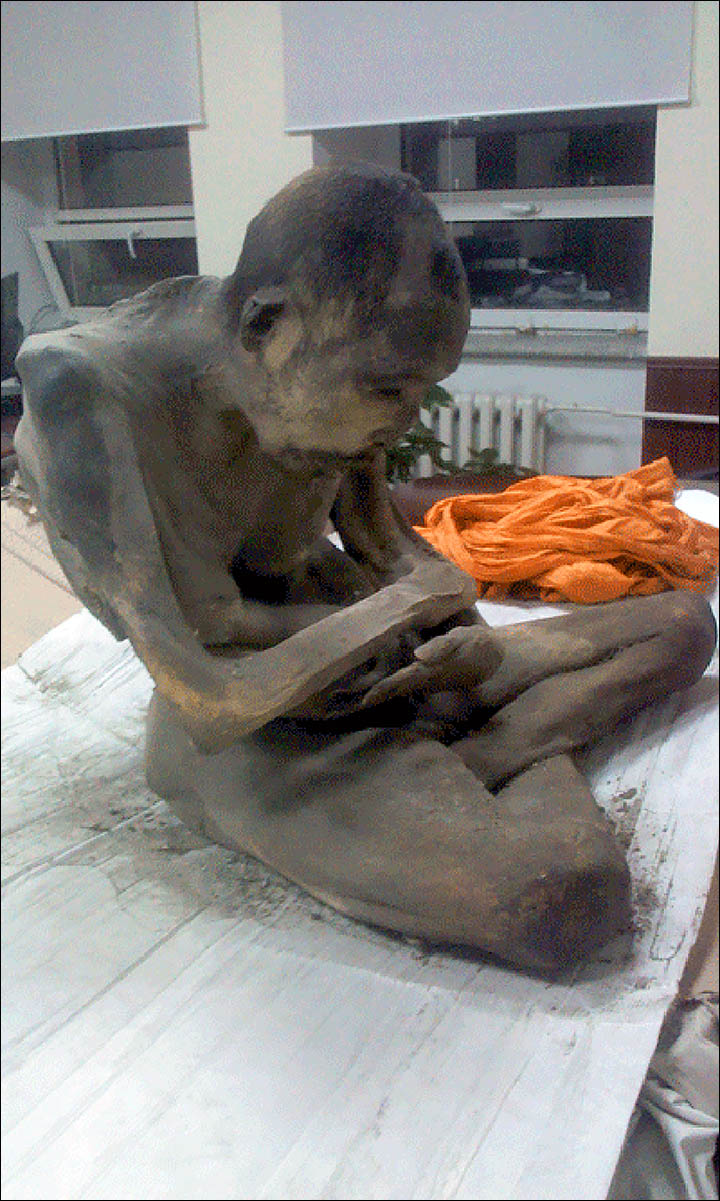
A mummified monk found in the lotus position in Mongolia is ‘not dead’ and is instead one stage away from becoming a real-life Buddha, it has been claimed.

Forensic examinations are under way on the amazing remains, which are believed to be around 200 years old, having been preserved in animal skin. But one expert has insisted the human relic is actually in ‘very deep meditation’ and in a rare and very special spiritual state known as ‘tukdam’.

Over the last 50 years there are said to have been 40 such cases in India involving meditating Tibetan monks.

Dr Barry Kerzin, a famous Buddhist monk and a physician to the Dalai Lama, said: ‘I had the privilege to take care of some meditators who were in a tukdam state.

‘If the person is able to remain in this state for more than three weeks – which rarely happens – his body gradually shrinks, and in the end all that remains from the person is his hair, nails, and clothes. Usually in this case, people who live next to the monk see a rainbow that glows in the sky for several days. This means that he has found a ‘rainbow body’. This is the highest state close to the state of Buddha’.

He added: ‘If the meditator can continue to stay in this meditative state, he can become a Buddha. Reaching such a high spiritual level the meditator will also help others, and all the people around will feel a deep sense of joy’.

Initial speculation is that the mummy could be a teacher of Lama Dashi-Dorzho Itigilov.

Born in 1852, Dashi-Dorzho Itigilov was a Buryat Buddhist Lama of the Tibetan Buddhist tradition, best known for the lifelike state of his body.

Mummified monk is ‘not dead’ and in rare meditative state, says expert


Ganhugiyn Purevbata, who is the founder and professor of the Mongolian Institute of Buddhist Art at Ulaanbaatar Buddhist University, said: ‘Lama is sitting in the lotus position vajra, the left hand is opened, and the right hand symbolizes of the preaching Sutra.

‘This is a sign that the Lama is not dead, but is in a very deep meditation according to the ancient tradition of Buddhist lamas’.

The mummified remains, which were covered in cattle skin, were found on January 27 in the Songinokhairkhan province of Mongolia.

However, there is more to the story and now police have revealed that the monk had been stolen from another part of the country and was about to be sold off.

An unnamed official said that it was taken from a cave in the Kobdsk region by a man who then hid it in his own home in Ulaanbaatar.

He had then been planning to sell it on the black market at a ‘very high price’, with local media claiming he wanted to take it over the Mongolian border. Police uncovered the plot and quickly arrested a 45-year-old, named only as Enhtor.

According to Article 18 of the Criminal Code of Mongolia smuggling items of cultural heritage are punishable with either a fine of up to 3million roubles ($43,000) or between five and 12 years in prison. The monk is now being guarded at the National Centre of Forensic Expertise at Ulaanbaatar.”

Behind “Tampon Gandhi”: Menstrual Hotlines @ $8/Call

TAMPON GANDHI – A  SCRIPTED BADASS

A Google search of Kiran “Tampon” Gandhi brings up pages and pages of uncritical praise from slick fashion, alternative, political, and media sites, even though, from the comments, most readers have reacted unfavorably.

Nearly every one of these sites applauds Tampon Gandhi as a “badass,” in such uniform terms that the articles must have been scripted.

AZADI.COM AND THE MENSTRUAL HOT-LINE

One such site is Azadi.com, which can be translated as Freedom.com, “freedom” being one of those multi-valent buzz-words typical of New World Order mob-speak.

Azadi.com signals it’s on board the global menstrual revolution, by sticking out the begging-bowl for its cutting-edge “Menstrual Hot-line,” manned by menstrual activists at the cost of $8 a phone-call.

8 dollars in India is a decent amount of money, close to 500 rupees.

The Azadi Toll-Free Menstrual (1-800-3000-2805) aims to fill critical knowledge and support gaps, providing adolescent girls with a trained counselor to learn and discuss menstruation, menstrual health and menstrual management. Given the ubiquity of mobile phones in rural India, the Azadi Menstrual Helpline has the capacity to bring information to thousands of girls.

Each call costs approximately $8 to service. This includes the cost of training our counselors, manning the lines, and doing outreach activities. If you would like to support this program, click here! here!”

MENSTRUAL MIND-CONTROL COMES TO INDIA

“Menstrual counseling” and “menses outreach”translate to radical feminist brainwashing and recruitment.

Now, the Indian government already has innumerable rural health schemes of all kinds, quite apart from the work of religious and secular charities.

So, the new, tax-subsidized, one-world government-backed, initiatives exist only to take tax-dollars and donations from Indian citizens on one hand and guilt-ridden Westerners on the other to fuel their parasitic existence.

It’s the most extraordinary chutzpah and immorality for the Crony-Corporate One-worlders (aka “international community”) to demand donations from ordinary people, crushed by the burden of taxes, the depreciation of their savings,  and the evisceration of their economies, all of which have been orchestrated by the very same people now trundling out Indian villages girls to pan-handle on their behalf.

“NON-PROFIT” AS A MARKETING GIMMICK FOR FOR-PROFIT SCHEMES

As I wrote earlier, these “non-profits” have “for-profit” investors lined up for miles behind them.

A few clicks on the web-site of  Azadi.com take us into the Byzantine world of Health NGOs’ and non-profits:

AZADI.COM has for its partners,

VILLGRO, PATH, WATER AID, IMPACT ENGINE, and WASH UNITED.

Deconstructing just two of these is enough to establish that the Menstrual Hot-line links back to the Globalists.

VILLGRO.COM

1.VILLGRO.COM has a web-site replete with globalist buzz-words (eco-system, thrive, sustainability – all of which are worthy enough in their own right, except that they are perpetually exploited to sell one-worldism.)

One of VILGRO’S initiatives is called “UNCONVENTION.”

“Unconvention” partners with

(among many other)

TIE (Indus Entrepreneurs), IIM- Ahmedabad, ASHA IMPACT (“Tampon” Gandhi’s family’s foundation), and the BRITISH COUNCIL..

These names represent the quintessence of academic respectability and knowledge-capital in the UK and India.

PATH

Azadi’s next partner is PATH.

PATH describes itself as “driving transformative innovations to save lives.”

Their slick website suggests why a single phone-call in India – capital of cheap cell-phones and free VOIP services – should need $8 bucks to back it up.

After all, a typical cell call in India might be a few cents and VOIP calls are often free.

A click on PATH’s “Executive Leadership” explains the high-cost:

PATH’S executives are all involved with the Centers of Disease Control or other initiatives of the US Govt, or with international health bodies like UNICEF, or with the Gates Foundation and its vaccine programs, or with Microsoft.

USG, CDC, AND MICROSOFT BEHIND  MENSTRUAL HOT-LINE?

These ties suggest that the US Government and its corporate cronies, rather than some humble charity, is the ultimate beneficiary of the Menstrual Hot-line promoted by Asha Impact and its partners and advertised so slickly by Kiran “Tampon” Gandhi.

There is certain to be a surveillance angle to all this, considering that the current allegedly nationalistic Modi Government (with its suspicious courting of the Saudi government) is also pushing a gargantuan, privacy-shredding DNA profiling program onto the entire Indian sub-continent.

UNCONVENTION – EXECUTIVE LEADERSHIP

Steve Davis, President and CEO

“…CEO of internet pioneer and global digital media firm Corbis, director of social innovation for McKinsey & Company, and interim CEO of the Infectious Disease Research Institute. Earlier in his career, he practiced law at the international law firm of K&L Gates, with a focus on intellectual property.

Mr. Davis is a member of the Council on Foreign Relations and holds a faculty appointment as a lecturer at the Stanford Graduate School of Business. He currently serves on the boards of InterAction and Global Partnerships and sits on several advisory groups, including the World Economic Forum’s Global Agenda Council on Social Innovation, the Clinton Global Initiative’s Global Health Advisory Board, the Council on Foreign Relation’s Task Force on Non-Infectious Diseases, and Wellcome Trust’s Sustaining Health Dialogue. He previously has served on numerous corporate and nonprofit boards.”

(from his biography)

Amie Batson Chief Strategy Officer

“Ms. Batson’s 20-year career in global health includes positions with the World Health Organization, the World Bank, UNICEF, and most recently, the US Agency for International Development (USAID), where she served as senior deputy assistant administrator for global health.

During her three-year appointment with USAID, Ms. Batson led the agency’s engagement in the President’s Global Health Initiative, represented the US government on the board of the GAVI Alliance, and led the US government team in coconvening the Child Survival Call to Action, which launched the global vision to end preventable child deaths.

Throughout her career in global health, Ms. Batson has been a leader in innovation. Her contributions to immunization and vaccine financing at the World Bank resulted in billions of dollars in new funding for global health and the vaccination of millions of children against polio, pneumonia, diarrhea, and other vaccine-preventable causes of death.”


Kathy Cahill
Vice President, International Development, and Interim Program Leader, India

“She is the senior partner and founder of AHISMA Group, a global health company focused on health systems strengthening, policy development, program assessment, and monitoring and evaluation of infectious and noncommunicable disease programs in low-resource settings.

Previously, Ms. Cahill served as our interim vice president for Public Health Impact. Before joining PATH in 2014, she served as deputy director of Integrated Health Solutions for Global Health at the Bill & Melinda Gates Foundation and at the US Centers for Disease Control and Prevention as director for Policy, Planning, and Evaluation and division director for Immunization Service Delivery.”

David Fleming, Vice President, Public Health

“Dr. Fleming was director of Global Health Strategies at the Bill & Melinda Gates Foundation, overseeing a grant portfolio of more than $1 billion in vaccine-preventable disease, nutrition, maternal and child health, leadership, emergency relief, community health programs, and human resources and health information. Dr. Fleming also served as deputy director at the US Centers for Disease Control and Prevention (CDC), Science and Public Health, and as deputy administrator of the US Agency for Toxic Substances and Disease Registry.

Dr. Fleming currently serves on the boards of Global to Local Partnership and the Washington Global Health Alliance, both in Seattle, and the Trust for America’s Health in Washington, DC. He sits on the Advisory Committee to the director of the CDC and chairs the external advisory groups for the CDC’s Center for Global Health and its Office of State, Tribal, Local, and Territorial Support. His former global health board service includes Gavi, the Vaccine Alliance; the Global Alliance for Improved Nutrition (GAIN); the Health Metrics Network; and the Partnership for Maternal, Newborn and Child Health.”

David Kaslow, Vice President, Product Development

“Dr. Kaslow has more than 25 years of experience in vaccine research and development. Before joining PATH in 2012 as director of MVI’s work to drive the development of safe and effective vaccines against malaria, he held key advisory positions with MVI and the Bill & Melinda Gates Foundation related to malaria vaccines. Prior to that, he oversaw project leadership and management of Merck Research Laboratories’ vaccine pipeline and founded the Malaria Vaccine Development Unit at the National Institutes of Health.

As a basic research scientist, Dr. Kaslow completed the molecular cloning and characterization of several proteins involved in malaria parasite sexual development. He also has directed product development, including field studies, of several malaria vaccine candidates. Outside the malaria field, Dr. Kaslow has contributed to the vaccine application of tools originally developed for gene therapy.”

Michael Kollins, Chief Operating Officer

“During his 15-year career at Morgan Stanley Investment Management, he served in a variety of sales, product development, and management roles in Asia, Europe, and the United States, finishing his career in Hong Kong as the chief operating officer of Morgan Stanley Investment Management Asia.”

Daniel Laster, General Counsel

“….Microsoft Corporation and working in private practice at the law firms of Stokes Lawrence and Perkins Coie.

Mr. Laster has served on the boards of the YMCA Metrocenter of Seattle, ACLU of Washington, and the Digital Learning Commons.”

Mark Murray, Vice President, Global Engagement and Communications

“Mr. Murray served as press secretary, legislative director, and chief of staff to US Representative Don Bonker, who chaired the Foreign Affairs subcommittees on Human Rights and International Organizations and Trade and Economic Development. He also served as communications director, speechwriter, and deputy chief of staff to Seattle Mayor Norm Rice. Most recently, before joining PATH in 2015, he served in a number of senior communications roles at Microsoft, including citizenship communications, global public affairs communications, corporate digital channels, and international communications across more than 100 countries.”

Kathy O’Driscoll, Chief Human Resources Officer

“Before joining PATH, Ms. O’Driscoll was general manager for human resources in the Microsoft Server and Tools Business Group. As a key member of the group’s executive leadership team, she was responsible for HR strategy and service delivery for 10,000 employees in the United States, China, India, and Israel. Over her 20-year career at Microsoft, she held HR management positions in varied units, including Microsoft Global Operating Groups, where she supervised domestic HR teams and staff in Dublin, India, and Singapore.”

Olivia Polius, Chief Financial Officer

“Most recently, Ms. Polius served as deputy director of global program services at the Bill & Melinda Gates Foundation, where she managed a team responsible for implementing an innovative operating model that focused on creating greater strategic integration among the organization’s global programs.”


Bloomsbury’s Creed: Cheap Money & Cheap Morals

Nearly every ideology that has corrupted modern life, from the destruction of the economy by the uninhibited printing of money to the articulation of the one-world state, was propagated by a circle of intellectuals in late 19th – early 20th century Britain called the Bloomsbury Circle.

In his conservative classic,“Keynes at Harvard,” Zygmund Dobbs describes how  Bloomsbury master-minded every corrupt trend in the former colonies of the British empire.

Thereafter, their economic and moral enslavement would proceed apace, despite ostensible “independence,” without much serious opposition:

The works of Keynes, Lytton Strachey, and Bertrand Russell have been, and are today, required reading in almost every college and university in the United States and Canada.

[Note: There were other Bloomsbury icons, including Leonard and Virginia Wolf (literature and philosophy, structure of world government); Havelock Ellis (social psychology, public health);  G. E. Moore (philosophy, language); G.L. Dickinson (literary criticism); George Bernard Shaw (literature, cultural criticism); Walter Lippman (media, politics);John Dewey (philosophy, education), and many more.]

From “Keynes at Harvard”:

In the spring of 1905 Keynes and his lavender cohorts had been thrilled by a conference of Russian revolutionaries in London. British Fabians and Joseph Fels, an American soap manufacturer who was also a Fabian, had financed the Russian gathering and furnished them a hall in a Christian church. Key revolutionaries at this London conference included Nikolai Lenin, Leon Trotsky, and Joseph Stalin. The future slaughter of fifty million civilians, and the conquest of one-third of the earth’s surface. rested within the shelter of this gathering. Shivers of excitement rippled down the spines of the socialist homosexuals when they heard that Lenin had openly defended the slaughter of bank guards and stealing of bank funds for the bolshevik coffers. During this time Strachey wrote to one of his intimates: “At this moment Keynes is lying on a rug beside me.”

……..During March of 1917 he [Keynes] confided privately that he supported the bolshevik group among the Russian socialists after the overthrow of Czar Nicholas.

The seizure of power by the bolsheviks in November of 1917 elated Keynes and the rest of the Fabian coterie. At Leftist parties in London, Keynes and his fellow perverts celebrated by dressing in women’s clothes and performing lewd dances. He had as his consort an eighteen-year-old-boy who was ensconced as his assistant in the Treasury Department.

Just before the Bolshevik Revolution, Keynes had made a hurried trip to the United States for the British Government. Here he had a chance to make contact with the American Fabians who were similarly entrenched, via the Frankfurter-Lippmann group, in key positions of the Wilson Administration……

Keynes’ deviate socialist circle was almost completely pro-bolshevik. One month after the Revolution, J.M. Keynes wrote his mother”

“Well, the only course open to me is to be buoyantly bolshevik; and as I lie in bed in the morning I reflect with a good deal of satisfaction that, because our rulers are as incompetent as they are mad and wicked, one particular era of a particular kind of civilization is very nearly over.”

On February 22, 1918, Keynes proudly boasted of “being a bolshevik.” Yet the British Government blindly sent Keynes to the Versailles peace talks. There he joined forces with his Fabian American comrade, Walter Lippmann, who was among those representing the equally blind U.S. Government. The ensuing pro-bolshevik and anti-American machinations were largely responsible not only for laying the basis for continuing Red victories, but also for setting off the chain of events that eventually brought Hitler to power.

In 1919 Keynes authored The Economic Consequences Of The Peace, which was promptly acclaimed from Moscow by Nikolai Lenin, himself. The Red dictator declared: “Nowhere has the Versailles treaty been described so well as in the book by Keynes.” A special edition of The Economic Consequences was printed under the label of the Fabian Society; and, Frankfurter and Lippmann brought the manuscript to the United States and arranged with Harcourt and Brace to publish it here. The volume became required reading among American socialists and Communists.

However, Keynes’ value as a hidden Red was in danger. The Fabians had developed the posture of “respectability” to a fine art and the value of Keynes’ book as an “impartial work” was in jeopardy. With Keynes’ future usefulness in upper-class circles at stake, Lenin had personally come to the rescue. He pulled the classic Leftist double-twist, praising Keynes’ book as a model for Communist revolutionaries and at the same time covering for Keynes by labeling him as “anti-bolshevik.” Nikolai Lenin rose before the Second Congress of the Communist International and declared:

“I will quote another economic source which assumes particularly great significance, the British diplomat Keynes, the author of The Economic Consequences Of The Peace, who on the instructions of his government, took part in the Versailles peace negotiations, watched them directly from the purely bourgeois point of view, studied the subject step by step, and took part in the conference as an economist. He arrived at conclusions which are stronger, more striking and more instructive than any a Communist revolutionary could advance, because they are conclusions drawn by an acknowledged bourgeois….”

Thus was launched the career of Fabian leader Keynes as a “non-Leftist” and “non-Communist.” continued apace…..

[The Fabian socialists were preoccupied with ] sadistic beating of young boys, “compulsive pre-occupation with male reproductive and excretory organs” and voyages to the most depraved dens of perversion throughout Europe, North Africa and Asia.

The Fabian homosexual circle was incredibly successful in gaining influence and control in a wide area of activity. They staked out the entire British Empire and the United States as well. Lytton Strachey wrote to Keynes:

Oh dear me!, when will my heaven be realized? – My Castle in Spain? Rooms, you know, for you, Duncan and Swithin, as fixtures – Woolf of course, too, if we can lure him from Ceylon; and several suites for guests. Can you conceive anything more supreme! I should write tragedies; you would revolutionize political economy, Swithin would compose French poetry, Duncan would paint our portraits in every conceivable combination and permutation, and Woolf would criticize us and our works without remorse.”

This projection was incredibly prophetic. J. M. Keynes became the mastermind behind the economic structure of British and American socialism. Strachey was responsible for writing books that undermined the Christian ethic of the Nineteenth Century and set the tone for the pornographic and depraved literature of today. Leonard Woolf worked out the details of the socialist drive for World Government. He was not only the architect of the League of Nations but outlined the structure of the United Nations.

Others of this perverted group of Keynesians have set the tone in art, music, education, and religion. Today [1971], alas, even the President of the United States says: “I am now a Keynesian in economics.”

Topless, Free-bleeding “Activism”: Ads For Porn

The plethora of videos and photos celebrating “topless’ activism (by FemenPussy Riot, and other groups); the sudden trend of breast-feeding in public; and, lately, images of menstruation are not “activism,” although that is the pretext used by the media to inundate the public with such imagery.

Both lactation and menstruation are niche categories of porn, according to this article at Alternet.

The Western ruling class is heavily invested in pornography, which is a 97 billion dollar business, but in urgent need of diversification to survive.

Revenue from traditional porn films has been shrinking, though, because of piracy and an abundance of free content on the Internet.

“DVD sales are barely alive at this point,” says Steven Hirsch, founder of Vivid, one of the industry’s largest and best-known studios. “We’ve seen probably an 80 percent reduction in sales over the past five years—to the point where fairly soon it’s not going to make sense to put movies out on DVD. It’s not going to happen tomorrow, but we are certainly marching towards that day.”

One way to diversify and expand the porn market is to saturate normal, day-time news with raunchy images and discussion that previously would have been confined to explicitly x-rated shows or specific channels.

The public is being conditioned to accept porn as “normal” and acceptable.

There is another angle.

Now that gay marriage is a done deal, social engineering must move onto the next step.

Consider why TV anchor Brian Williams could state publicly that he had no problem watching his daughter “perform” simulated anal sex on a studio set, in person.

Consider why the media is filled with images of Kiran Gandhi’s parents smiling cheerfully and posing for photos with their blood-stained daughter.

These are instruction manuals for us.

These images also prepare the public mind for an imminent normalizing and legalizing of incest.

I

Jesus666 Site

Yet another anti-Christian propaganda site replete with fallacious etymologies and the old claim that Jesus (the Greek version of Yehoshuah) is really Gaze-at-Zeus and pagan.  It’s not about accepting the redemptive work of Jesus; no, apparently, if you call God Yahweh, rather than Yeh-weh, you are on the road to perdition.

Google Jesus666 and see how many sites pop up.

This is all rather typical Judaicizing anti-Christ propaganda, common in Messianic and Hebrew Roots circles.

If you cross the bridge, it doesn’t matter what you call it. You’ll reach the other side.

If you don’t cross the bridge, it doesn’t matter what you call it, you’ll stay where you are.

Cross the bridge.


The First Indian Catholic Saint

Sister Alphonsa, a Clarist nun at Bharananganam, in India, who was canonized in 2008, was the first purely Indian Catholic to be canonized. [In 2014, two more saints of purely Indian lineage were added.]

After deforming herself in a clumsy attempt to avoid marriage, she entered a convent, devoting herself to teaching, and, after she fell sick, solely to prayer.

After her death, she was credited with hundreds of miracles – usually, the healing of children with deformities of the feet like hers.

Vivek Sharma describes reactions to her canonization in India:

As far as atheists and rationalists, particularly in India, are concerned, all faith is irrational and all talk of miracles is regressive and befits acceptance only by illiterate and gullible folks living in India’s villages. Many Westernised and educated Indians, specially Hindus, living in the cities do not have the courage to openly accept their Gods and beliefs while continuing to follow them, eyes wide open. How often can one see such people swearing that astrology is nothing but superstition while sporting astrologically prescribed gem stones on their fingers. How often can one find them questioning the very existence of Ram, Hanuman, Shiva, Krishna and Durga, to name just a few Hindu Gods, while privately worshipping them, particularly when in trouble! Such doubters are there in and of other religions too, but they are afraid of openly voicing their skepticism out of fear of serious reprisals by powerful religious leaders.

All religions are based on miracles and faith. Faith works for only those who believe. Keep giving as many scientific and psychological spins as you like to this phenomenon. Those who connect to the world beyond, as real as the one here, and are touched by it, cannot be fooled by all the so-called rationalizations given by science handicapped by serious limitations at its present level of development. They know what they know and are not going to pick fights with the ignorant who don’t and won’t.

The recognition by the Pope of St Alphonsa’s curative powers that emanate from her tomb has strangely silenced a lot of people. One has not heard of Sanal Edamaruku shouting, as he usually does, that the belief that disease can be healed by praying at a tomb is an impossibility, and that what the Pope has done is nothing more than propagation of “andh vishwas”. Similarly, some other modern Indian luminaries who otherwise all but mock with an air of superiority at those who visit dargahs and other such places where miracles have been experienced by many, have either said nothing or have outwardly spoken approvingly of the recognition given to miracles by the Pope in declaring Alphonsa India’s first native saint. That is the hold that the power of the West has over their voices and pens.

The remaining millions of us in India who believe, reverentially welcome St Alphonsa to the pantheon of not just Christian saints but of saints of all faiths who have enriched India and blessed its people of all religions with their miracles. We understand that faith is a very powerful emotion as it has always been throughout history. And with real reason.

Rather than arrogantly and ignorantly dismiss it as superstition or ‘andh vishwas’, this is an opportunity for some of us to realise that faith has to be recognised and respected, whether we believe in it ourselves or not. This elementary understanding will go a long way towards generating respectful sensitivity to the beliefs of all those who have experienced the miracles of God and his creation, no matter which religion or sect they follow.

Once all of us do that, the congenial atmosphere much needed for ensuring the communal harmony that this country badly needs will prevail. Is that not what every Indian wants?”

The Mathematical Visions Of Sreenivas Ramanujan

From HinduNet.org, a brief life of Ramanujan, a supernal genius of mathematics who was also a devout follower of Goddess Namagiri (Lakshmi) to whom he attributed his achievements.

Namagiri/Lakshmi is the female consort of Narashimha, who is the leonine form of Vishnu the second part of the Hindu Trinity.  His equivalent in the Christian tradition is Christ as the Lion of Judah and in the Old Testament he is Jehovah Sabaoth:

“He died on his bed after scribbling down
revolutionary mathematical formulas that bloomed in his mind like ethereal flowers — gifts, he said, from a Hindu Goddess.

He was 32 the same age that the advaitan advocate Adi Shankara died. Shankara, born in 788, left earth in 820. Srinivasa Ramanujan was born in 1887. He died in 1920 — an anonymous Vaishnavite
brahmin who became the first Indian mathematics
Fellow at Cambridge University. Both Shankara and Ramanujan possessed supernatural intelligence, a well of genius that leaves even brilliant men dumb-founded. Ramanujan was a meteor in the
mathematics world of the World War I era. Quiet, with dharmic sensibilities, yet his mind blazed with such intuitive improvisation that British colleagues at Cambridge — the best math brains in
England — could not even guess where his ideas originated. It irked them a bit that Ramanujan told friends the Hindu Goddess Namagiri whispered equations into his ear. Today’s mathematicians —
armed with supercomputers — are still
star-struck, and unable to solve many theorems the
young man from India proved quickly by pencil and
paper.

Ramanujan spawned a zoo of mathematical creatures
that delight, confound and humble his peers. They
call them “beautiful,” “humble,” “transcendent,”
and marvel how he reduced very complex terrain to
simple shapes.

In his day these equations were mainly pure
mathematics, abstract computations that math sages
often feel describe God’s precise design for the
cosmos. While much of Ramanujan’s work remains
abstract, many of his theorems are now the
mathematical power behind several 1990’s
disciplines in astrophysics, artificial
intelligence and gas physics. According to his
wife — Janaki, who still lives outside Madras —
her husband predicted “his mathematics would be
useful to mathematicians for more than a
century.” Yet, before sailing to England,
Ramanujan was largely ignorant of the prevailing
highest-level math. He flunked out of college in
India. Like Albert Einstein, who toiled as a
clerk in a Swiss patent office while evolving his
Special Theory of Relativity at odd hours,
Ramanujan worked as a clerk at a port authority in
Madras, spending every spare moment contemplating
the mathematical face of God. It was here in
these sea-smelling, paper-pushing offices that he
was gently pushed into destiny — a plan that has
all the earmarks of divine design.

Ramanujan was born in Erode, a small, rustic town
in Tamil Nadu, India. His father worked as a
clerk in a cloth merchant’s shop. his namesake is
that of another medieval philosophical giant —
Ramanuja — a Vaishnavite who postulated the
Vedanta system known as “qualified monism.” the
math prodigy grew up in the overlapping
atmospheres of religious observances and ambitious
academics. He wasn’t spiritually preoccupied, but
he was steeped in the reality and beneficence of
the Deities, especially the Goddess Namagiri.

Math, of course, was his intellectual and
spiritual touchstone. No one really knows how
early in life Ramanujan awakened to the psychic
visitations of Namagiri, much less how the
interpenetration of his mind and the Goddess’
worked. By age twelve he had mastered
trigonometry so completely that he was inventing
sophisticated theorems that astonished teachers.

In fact his first theorems unwittingly duplicated
those of a great mathematician of a hundred years
earlier. This feat came after sifting once
through a trigonometry book. he was disappointed
that his “discovery” has already been found. then
for four years there was numerical silence. At
sixteen a copy of an out-of-date math book from
Cambridge University came into his hands. It
listed 5,000 theorems with sparse, short-cut
proofs. Even initiates in the arcane language of
mathematics could get lost in this work.

Ramanujan entered it with the giddy ambition and
verve of an astronaut leaping onto the moon. It
subconsciously triggered a love of numbers that
completely saturated his mind. He could envision
strange mathematical concepts like ordinary people
see the waves of an ocean.

Ironically, his focus on math became his academic
undoing. he outpaced his teachers in numbers
theory, but neglected all other subjects. He
could speak adequate English, but failed in it and
history and other science courses. He lost a
scholarship, dropped out, attempted a return but
fell ill and quit a second time. By this time he
was married to Janaki, a young teenager, and was
supporting his mother. Often all night he
continued his personal excursions into the math
universe – being fed rice balls by his wife as he
wrote lying belly-down on a cot. During the day
he factored relatively mundane accounts at the
post office for 20 pounds a year. He managed to
publish one math paper.

As mathematicians would say, one branch of
potential reality could have gone with Ramanujan
squandering his life at the port. But with one
nudge from the invisible universe, Namagiri sent
him Westward. A manager at the office admire the
young man’s work and sensed significance. He
talked him into writing to British mathematicians
who might sponsor him. Ramanujan wrote a simple
letter to the renowned G. W. Hardy at Cambridge,
hinting humbly at his breakthroughs and describing
his vegetarian diet and spartan needs if he should
come to the university. He enclosed one hundred
of his theorem equations.

Hardy was the brightest mathematician in England.
Yet, as he knew and would write later at the
conclusion of his life, he had done no original,
mind-bending work. At Cambridge he collaborated
with an odd man named Littlewood, who was so
publicly retiring that people joked Hardy made him
up. The two, though living within a hundred yards
of each other, communicated by exchange of terse,
math-laden letters. Ramanujan’s letter and
equations fell to them like a broadcast from alien
worlds. AT first they dismissed it as a
curiosity. Then, they suddenly became intrigued
by the Indian’s musings. Hardy later wrote: “A
single look at them is enough to show that they
could only be written down by a mathematician of
the highest class. They must be true, for if they
were not true, no one would have the imagination
to invent them.”

Hardy sensed an extremely rare opportunity, a
“discovery,” and quickly arranged a scholarship
for the then 26-year-old Ramanujan. The
invitation came to India and landed like a bomb in
Ramanujan’s family and community circle. His
mother was horrified that he would lose caste by
traveling to foreign shores. She refused to let
him go unless it was sanctioned by the Goddess.
According to one version of the story, the aged
mother then dreamt of the blessing from Namagiri.

But Janaki says her husband himself went to the
namagiri temple for guidance and was told to make
the voyage. Ramanujan consulted the astrological
data for his journey. He sent is mother and wife
to another town so they wouldn’t see him with his
long brahmin’s hair and bun trimmed to British
short style and his Indian shirt and wrapcloth
swapped for European fashion. He left India as a
slightly plump man with apple-round cheeks and
eyes like bright zeroes.

Arriving in 1914 on the eve of World War I,
Ramanujan experienced severe culture shock at
Cambridge. he had to cook for himself and
insisted on going bare foot Hindu style on the
cold floors. But Hardy, a man without airs or
inflated ego, made him feel comfortable amidst the
stuffy Cambridge tradition. Hardy and Littlewood
both served as his mentors for it took two
teachers to keep pace with his advances. Soon, as
Hardy recounts, it was Ramanujan who was teaching
them, in fact leaving them in the wake of
incandescent genius.

Within a few months war broke out. Cambridge
became a military college. vegetable and fruit
shortages plagued Ramanujan’s already slim diet.
The war took away Littlewood to artillery
research, and Ramanujan and Hardy were left to
retreat into some of the most recondite math
possible. One of the stunning examples of this
endeavor is a process called partitioning,
figuring out how many different ways a whole
number can be expressed as the sum of other whole
numbers. Example: 4 is partitioned 5 ways (4
itself, 3+1, 2+2, 2+1+1, 1+1+1+1), expressed as
p(4)=5. The higher the number, the more the
partitions. Thus p(7)=15. Deceptively though,
even a marginally larger number creates
astronomical partitions. p(200)=397,999,029,388.
Ramanujan — with Hardy offering technical checks
— invented a tight, twisting formula that
computes the partitions exactly. To check the
theorem a fellow Cambridge mathematician tallied
by hand the partitions for 200. It took one
month. Ramanujan’s equation was precisely
correct. U.S. mathematician George Andrews, who
in the late 1960’s rediscovered a “lost notebook”
of Ramanujan’s and became a lifetime devotee,
describes his accuracy as unthinkable to even
attempt. Ramanujan’s partition equation helped
later physicists determine the number of electron
orbit jumps in the “shell” model of atoms.

ANother anecdote demonstrates his mental
landscape. By 1917, Ramanujan had fallen
seriously ill and was convalescing in a country
house. Hardy took a taxi to visit him. As math
masters like to do he noted the taxi’s number —
1729 — to see if it yielded any interesting
permutations. To him it didn’t and he thought to
himself as he went up the steps to the door that
it was a rather dull number and hoped it was not
an inauspicious sign. He mentioned 1729 to
Ramanujan who immediately countered, “Actually, it
is a very interesting number. It is the smallest
number expressible as the sum of two cubes in two
different ways.”

Ramanujan deteriorated so quickly that he was
forced to return to India — emaciated — leaving
his math notebooks at Cambridge. He spent his
final year face down on a cot furiously writing
out pages and pages of theorems as if a storm of
number concepts swept through his brain. Many
remain beyond today’s best math minds.

Debate still lingers as to the origins of
Ramanujan’s edifice of unique ideas.
Mathematicians eagerly acknowledge surprise states
of intuition as the real breakthroughs, not
logical deduction. There is reticence to accept
mystical overtones, though, like Andrews, many can
appreciate intuition *in the guise* of a Goddess.

But we have Ramanujan’s own testimony of feminine
whisperings from a Devi and there is the sheer
power of his achievements. Hindus cognize this
reality. As an epilogue to this story, a seance
held in 1934 claimed to have contacted Ramanujan
in the astral planes. Asked if he was continuing
his work, he replied, “No, all interest in
mathematics dropped out after crossing over.”

Seymour Hersh Propagates Disinformation

Paul Craig Roberts on the latest story about the Bin Laden killing from Seymour Hersh:

In my opinion, Washington’s disinformation agencies have finally managed to deceive Seymour Hersh with a concocted “inside story” that saves Washington’s claim of having murdered bin Laden by proving that the US government is an extraordinary liar and violator of law.

Hersh’s story does prove that the US government is a liar, but it does not prove that a
SEAL team murdered Osama bin Laden.”

Seymour Hersh has long been suspected (for eg. by James Petras, but also here,  here and now, here)  of retailing sophisticated disinformation behind the facade of investigative reporting.

Of course, “investigative journalism” itself is a concept that deserves thorough deconstruction.


SSPX Maligns Pope Over Arati Ceremony

There was a photo being circulated on the web supposedly showing the Pope receiving the mark of worship of Shiva on his forehead.

The original source for the story is the Society of St. Pius X (SSPX)

according to this Catholic site, which analyzes rumors/falsehoods it says are being put out by ultra-traditionalists and sedevacantists.

This particular story (about the Pope receiving a mark from a Shiva temple) seems to be spurious, if not a malicious hoax:

Someone in the schismatic group the Society of St. Pius X told me that when the pope was in India he had his forehead anointed by a Hindu “priestess of Shiva” and that there is a photo to prove it. Is this true?

There is a photo of the Pope having his forehead anointed by an Indian woman, but she was a Catholic, not a Hindu priestess! She was giving the Pope a traditional Indian form of greeting known as Aarti, which has no more religious significance than a handshake does in Western culture.

A letter dated November 22, 1994, from the Pontifical Council for Social Communications explains the custom and its role in Indian society:

Indian Catholics . . . use Aarti when a child returns home after receiving First Holy Communion and when a newly married couple are received by their respective families. Nowadays, Aarti is often performed to greet the principal celebrant at an important liturgical event, as it was on the occasion shown in the photograph. On such occasions, Aarti is usually offered by a Catholic married lady and certainly not by a “priestess of Shiva” as has been alleged.

The letter, by Archbishop John P. Foley, went on to note: “Use of the Aarti ceremonial by Indian Catholics is no more the worship of a heathen deity than is the decoration of a Christmas tree by American Christians a return to the pagan rituals of Northern Europe.”

Your friend in the Society of St. Pius X should check his facts before spreading such malicious gossip about the Holy Father (cf. Acts 23:1-5).

The Imagination As The Vehicle of Grace

From the journal, Communique a perceptive article on the imagination and the arts as God’s ordained channels of grace:

The Truth of the Imagination

Thus far I have spoken of how the Bible endorses artistic creativity and encourages us to believe that artistic form and beauty have value in themselves as gifts from God. We might view this as the nonutilitarian side of the artistic imagination. But the imagination is useful as well as delightful. This brings us to the question of truth in art, or the imagination as a vehicle for expressing truth. This, too, is a value of the arts. The imagination can express truth in its own unique way for the glory of God and the edification of people. Before I defend that statement, I need to delineate what this unique way of expressing truth is. The imagination images forth its subject matter. It does not work primarily by abstractions and propositions but by concrete images and experiences and sensations. As G. K. Chesterton put it, “Imagination demands an image” (37). The arts take concrete human experience rather than abstract information as their subject.

How can we be certain that the imagination can express truth? We can look at the example of the Bible. The Bible is overwhelmingly literary in its form. The one thing that it is not is what we so often picture it as being–a theological outline with proof texts attached. When asked to define “neighbor,” Jesus told a story. He constantly spoke in images and metaphors: “I am the light of the world;” “you are the salt of the earth.” The Bible repeatedly appeals to the intelligence through the imagination. Its most customary way of expressing God’s truth is not the sermon or theological outline but the story, the poem, the vision, and the letter, all of them literary forms and products of the imagination.

Think of how much biblical truth has been incarnated in character and event. Then recall the poetry of the Bible, including the heavy incidence of image and metaphor in the prose of the New Testament. The point is not simply that the Bible allows for the imagination as a form of communication. It is rather that the biblical writers and Jesus found it impossible to communicate the truth of God without using the resources of the imagination. The Bible does more than sanction the arts. It shows how indispensable they are.

Earlier I noted the prominence of music and visual art in the worship described in the Bible. If we doubt that truth can be embodied in visual, nonpropositional form, we need only look at the Christian sacraments. They use physical images that enable us to experience spiritual realities.

We know that the imagination is a vehicle of truth from sources other than the Bible. Recent brain research shows that the two hemispheres of the human brain respond to stimuli and assimilate reality in different ways. The left hemisphere is active in logical thinking, grasping abstract propositions, and dealing with language. The right hemisphere is dominant in processing visual and other sensory experiences, in seeing whole-part relationships, in grasping metaphor and humor, and in experiencing emotion. The arts and the imagination are essentially right-brain media. We need to express and receive God’s truth with the right brain as well as the left.

The tendency of our evangelical subculture is overwhelming to assume that truth is conceptual and propositional only. But the arts, with their emphasis on imagination, remind us that there is a whole other type of truth, or at least a whole other way by which people assimilate and know the truth. Just compare the experiences of listening to a Christmas sermon on the theological meaning of the incarnation and listening to a performance of Handel’s Messiah. We need both approaches to the truths of our faith.

We erroneously think that our world view consists only of ideas. It is a world picture as well as a world view, that is, set of ideas. It includes images that may govern our behavior even more than ideas do. Hebrews 11:1 defines faith propositionally as “the assurance of things hoped for, the conviction of things not seen.” This is one way by which we can know the truth about faith–the way of theological abstraction. But our understanding of faith is also based on images of the characters and stories of faith that Hebrews 11 proceeds to evoke.

A Christian world view consists of the doctrines of the Apostles’ Creed, but equally important is the Christian world picture that guides our life. We are influenced in our Christian lives by pictures of Cain and Abel, Mary and Martha, Ruth and Boaz, as well as doctrines of providence and justice. The Westminster Confession of Faith defines providence thus: “God the Creator of all things doth uphold, direct, dispose, and govern all creatures, actions, and things, from the greatest even to the least, by His most wise and holy providence.” That is one way to grasp providence. Psalm 23 fills our imaginations with the images that comprise the daily routine of a shepherd and his sheep. That is another way by which we grasp providence.”