Obama Birth Certificate A Forgery, Says Sheriff Arpaio

Update (July 20): The Daily Bell has an interesting theory that this whole controversy might be engineered to rescue Obama in public perception. Their reasoning is that Sheriff Arpaio is himself a polarising figure guilty of many controversial practices and making him the center piece of the storm over the certificate (which broke in 2008) might be an clever way to diffuse the scandal. Additional proof for this theory is that the forgery itself is so clumsy that people have been speculating it was intended as a trap.

Well, well, well. Lookee here (chuckle, and h/t EPJ)…

Turns out Barack Obama’s birth certificate is definitely forged.

“I have to respect the science of document examination and the evidence there points to the forgery pictured above.  There are also serious signs that the forger of the Obama birth certificate released by the White House did not understand codes and numbers associated with the document.  Analysis of the numbers and code revealed that the document is not genuine.  The evidence is more than compelling.

The biggest error came as a result of the age of the document forger.  He or she was obviously too young to be aware of correct terms used to classify what we today call African-Americans. The creator of the phony document listed Obama’s race as African.  That is a huge red flag because that term was not applied as a race title until well into the 1980’s.  That term and the moniker, Black would have been considered politically incorrect and racist back when Obama was born.  The proper term throughout history until the late 1970’s was Negro. The government did not change this until well into the 1980s.

“Additionally the United States government standardized the acceptable terms for all identification documents.  Eventually Negro became an apparent derogatory term that sensitive politically correct Americans abandoned in the 1980’s.

This so-called birth certificate document was the product of a criminal conspiracy.  It needs to be investigated by Congress and the State of Hawaii.   The problem here is politics prevents the orderly administration of justice.  Democratic politicians have total control and are breaking the law by obstructing justice. “

Comment:

President Obama’s release of a long form birth certificate in April 2011 didn’t assuage his critics. They insisted it was forged.

The persistence of such doubts, die-hard Obama defenders in the media replied, was yet another yahoo conspiracy by bitter clingers.

Here are some reminders of what the mainstream said (courtesy of wikipedia):

Michael Tomasky called it racial paranoia “Birthers and the persistence of racial paranoia” The Guardian (London) April 27, 2011

[A guy called Tomasky would never express racial paranoia, I suppose]

Dan Vergano said it was racial prejudice, “Study: racial prejudice plays role in Obama citizenship views”. USA Today, May 1, 2011

[USA Today would never, never cater to racial prejudice.}

The New York Times said it was an embarrassment, “A Certificate of Embarrassment”. The New York Times. April 27, 2011.

[The NY Times is never embarrassed by the baldfaced banditry in its own backyard]

Fareed Zakaria said it was coded racism, “Fareed Zakaria on Donald Trump and coded racism”. Global Public Square (CNN), April 22, 2011.

[Zakaria apparently doesn’t mind racism when it involves dropping bombs on strangers in the Middle East]

Real estate mogul Donald Trump’s taste in wives  is much better than his taste in wedding-cake mansions…..or in bankster bail-outs, but he scored a bulls-eye on this one.

The fudge with “African” instead of “Negro” was discussed a long while back.

So what’s the news in the recent claim?

Apparently, a 95 year old retired state worker was able to point out numerical codes that hadn’t been filled in, while the boxes for race and employment had.

I’m not sure what to make of it yet, but I already know what to make of how it’s being spun.

I googled Obama birth certificate, and right after a couple of sites with the hot news at the top, where you’d expect it to be,  were sites that dismissed the birth certificate controversy as “birther” conspiracy.

They were in  third or fourth place when I saw them, which would seem to be pretty high when the news that’s breaking is that big.

Usually new stuff buries the old stuff and sends it way back past the fourth or fifth page in an Internet search…at least for the first day after a big story.

But not here.

Then I hunted for images to put up on my blog so people could see what the Sheriff’s team means about the fudge about “African.”

Well, when I searched google and then looked on the left-hand side of the search results for what comes up under IMAGES, the very first image on the left was the certificate.  But instead of getting a bunch of different sites where the image was posted, google kept redirecting me instantly to Snopes.  The redirection was blatant.

So why would google heart snopes?

Snopes, according to its ABOUT page, was founded in 1995 by Barbara and David Mikkelson of Los Angeles, to explore urban legends and such. Naturally, it just became the web’s leading “touchstone” for rumor research. Naturally, they got a couple of “Webbies” and “Best of the Web” awards and have been invited onto all the major networks.

So naturally, no one in their right mind would take them at face value.

And so it is.

Read anti-Zionist activist Maidh O’Cathail’s piece at Dissident Voice, exposing its pro-Israeli bias in covering 9-11 research.

See also the conservative blog called Huffington Riposte which considers Snopes a left-liberal propaganda outlet.

On the other hand, here are some Kossacks (from Daily Kos) claiming it pushes right-wing views.

My diagnosis of something that sounds left to the right and right to the left and reeks of big bucks?

You guessed it. George Soros.

Rothbard: On Why He Had To Attack People, Not Ideas…

Rothbard explaining why he had to name names and attack people:

“So you see, Bob [Kephart], my deviation from proper attention to my career image is lifelong, and it is too late to correct at this point. I’m sure that if, in Ralph [Raico]’s phrase, I had been ‘careful,’ and followed wise advice, I would now be basking in lots of money, prestige, and ambiance. … Why did I take the wrong course?… If there had been lots of libertarians who were anarchists, lots who were antiwar, lots who named names of the ruling elite, lots attacking Hoover, Friedman, etc., I might not have made all these choices, figuring that these important tasks were being well taken care of anyway, so I may as well concentrate on my own ‘positioning.’ But at each step I looked around and saw indeed that nobody else was doing it. So then it was up to me.”

~Lew Rockwell, Mises.org

Well, it’s funny, because those are the exact words I’ve  used wondering why I was putting down things on this blog more explicitly than might be considered judicious…

Including the stuff about Paul and Rothbard.

Rothbard: Tried To Trash Hayek’s Book?

From Brian Doherty, “A Tale of Two Libertarians”:

“The most interesting part of Rothbard vs. the Philosophers, and the most important to libertarian intellectual history, is the notorious memo where he advised the Volker Fund, before the book came out, that F.A. Hayek’s The Constitution of Liberty should not be supported, and should be strenuously attacked when it appears. (I heard more than one prominent libertarian thinker and activist refer to the memo as horrific or scandalous, and a massive black mark on Rothbard’s reputation that could not be washed away.”

Russell Kirk: A Dispassionate Assessment Of Libertarians

Update: I had a bit of time between running around to think through some qualifications I wanted to add to this post.

Kirk was my introduction to political theory…and I have never lost the influence, although I’m always trying to forge alliances with other influences on my thinking. I’ll add some more thoughts as I have time.

Russell Kirk:

Russell Kirk is a Distinguished Scholar at the Heritage Foundation. He spoke at The Heritage Foundation on April 19,1988, delivering the second of four l ectures on the “Varieties of the Conservative Impulse.” ISSN 0272-1155. 01988 by The Heritage Foundation.

First, a number of the men and women who accept the label “libertarian!’ are not actually ideological libertarians at all, but simply conservatives under another name. These are people who perceive in the growth of the monolithic state, especially during the past half century, a grim menace to ordered liberty; and of course they are quite right. They wish to emphasize their attachment to personal and civic freedom by employing this 20th century word deriv ed from liberty. With them I have little quarrel – except that by so denominating themselves, they seem to countenance a crowd of political fantastics who “license they mean, when they cry liberty.”

Descendants of Classical Liberals. For if a man believes in an enduring moral order, the Constitution of the United States, established American way of life, and a free economy – why, actually he is a conservative, even if he labors under an imperfect understanding of the general terms of politics. Such America n s are to the conservative movement in the United States much as the Liberal Unionists have been to the Conservative Party in Britain – that is, close practical allies, almost indistinguishable nowadays. Libertarians of this description usually are intelle ctual descendants of the old “classical liberals”; they make common cause with regular conservatives against the menace of democratic despotism and economic collectivism.

Second, the libertarians generally – both the folk of whom I have just approved, and also the ideological libertarians – try to exert some check upon vainglorious foreign policy. They do not believe that the United States should station garrisons throughout the world; no more do 1; in some respects, the more moderate among them have the understanding of foreign policy that the elder Robert Taft represented. Others among them, however, seem to labor under the illusion that communist ideology can be dissipated by trade agreements – a notion really fatuous. I lack time to la bor this point here; I mean to take it up again in my autumn lecture on the neoconservatives, who in foreign policy tend toward an opposite extreme. Let it suffice for the present for me to declare that so far as the libertarians set their faces against a policy of American domination worldwide – why, I am with them. I part with them when they forget that the American government nowadays, in Burke’s phrase of two centuries ago, is “combating an armed doctrine,” not merely a national adversary.

[Lila: That is, when we define war, we would be foolish to limit it to nuclear weaponry and drones, which is what libertarians do. They overlook the fact that a group of people can collude to bring down the financial system, since it also owns the media and is able at will to corrupt the judiciary. If the defense of the public is limited to catching individuals on a case-by-case basis, there is little chance of these financial warriors (they are not Islamicists, in my opinion, but Zionists) of being caught or having to return their loot. The correct response would be to determine that the financial system has been turned deliberately against the public, and then determine how sanctions can be levied across the board on the system, while simultaneously sanctioning  members of government that enabled the fraud.. All debt incurred during this period of financial war can be repudiated as illegally contracted.  But a universal repudiation of all debt seems to me to be no different than the debt jubilee proposed by the left. It is also certainly an act of bad faith to unilaterally repudiate contracts legally entered into by government lawfully authorized to enter into contracts. It is interesting that the very people who advocate this repudiation are also the people who want to legalize blackmail and extortion, who think bribery is no crime, and who consider political lobbying and commercial advertising equal to political speech. In short, having advocated for all the things that have corrupted the government, as well as the people whom the government claims to represent, they now turn around and pander to the same public by demanding the repudiation of all debt globally, with no thought for the sanctity of contract that they otherwise claim to venerate.  To appearances this is intellectual incoherence. More likely, it is deliberate and part of  the national policy – to wage war through the stock market, through the internet and every other means – full-spectrum dominance. From that angle, one has to wonder if Rothbard wasn’t in fact an agent of some larger agenda, as some have charged…]

Perils of Centralization. Third, most of the libertarians believe in the humane scale: they vehemently oppose what my old friend Wilhelm Roepke called “the cult of the colossal.” They take up the cause of the self-reliant individual, the voluntary association, the just rewards of personal achievement. They know the perils of political centralization. In an age when many folks are ready – nay, eager – to exchange their independence for “entitlements,” the libertarians exhort us to stand on our own feet, manfully.

In short, the libertarians’ propaganda, which abounds, does touch upon real social afflictions of our time, particularly repression of vigorous and aspiring natures by centralized political structures and by the enforcement of egalitarian doctrines. Rather cur iously, libertarian publications have been widely circulated in Poland – apparently with no concerted effort by the communist government to prevent their introduction. (One may suspect, in this instance, that the eagerness of certain libertarian organizati o ns for cordial relations between the West and the Soviet Union induces some toleration by the squalid oligarchies of the East.) With reason, many people are discontented with the human condition, in many lands, near the end of the 20th century; the more i n telligent among the discontented look about for some seemingly logical alternative to present dominations and powers; and some of those discontented – the sort of people who went out to David in the Cave of Adullam – discover libertarian dogmata and becom e enthusiasts, at least temporarily, for the ideology called libertarianism.

Inadequacies and Extravagances.

I say temporarily: for an initial fondness for libertarian slogans frequently has led young men and women to the conservative camp. Not a few of the people who have studied closely with me or who have become my assistants had been attracted, a few years earlier, to the arguments of Ayn Rand or of Murray Rothbard. But as they read more widely, they had become conscious of the inadequacies and extravagances of the various libertarian factions; as they had began to pay serious attention to our present political difficulties, they had seen how impractical are the libertarian proposals. Thus they had found their way to conservative realism, which proclaims that politics is the art of the possible. Therefore it may be said of libertarianism, in friendly fashion, that often it has been a recruiting office for young conservatives, even though the libertarians had not the least intention of shoring up belief in custom, convention, and the politics of prescription. There. I have endeavored to give the libertarians their due. Now let me turn to their failings, which are many and grave. For the ideological libertarians are not conservatives in any true meaning of t hat term of politics; nor do the more candid libertarians desire to be called conservatives. On the contrary, they are radical doctrinaires, contemptuous of our inheritance from our ancestors.

2

They rejoice in the radicalism of Tom Paine; they even applaud those 17th century radicals, the Levellers and the Diggers, who would have pulled down all the land-boundaries, and pulled down, too, the whole framework of church and state. The libertarian g r oups differ on some points among themselves, and exhibit varying degrees of fervor. But one may say of them in general that they are “philosophical” anarchists in bourgeois dress. Of society’s old institutions, they would retain only private property. The y seek an abstract Liberty that never has existed in any civilization – nor, for that matter, among any barbarous people, or any savage. They would sweep away political government; in this, they subscribe to Marx’s notion of the withering away of the state .

{Lila: And in many crucial respects, they ARE Marxists. At least,  they think like materialists, act like utilitarians, and advance their ideas like communists]

Cooperation Aids Prosperity.

One trouble with this primitive understanding of freedom is that is could not possibly work in 20th century America. The American Republic, and the American industrial and commercial system, require the highest degree of coop e ration that any civilization ever has known. We prosper because most of the time we work together – and are restrained from our appetites and passions, to some extent, by laws enforced by the state. We need to limit the state’s powers, of course, and our n ational Constitution does that – if not perfectly, at least more effectively than does any other national constitution. The Constitution of the United States distinctly is not an exercise of libertarianism. It was drawn up by an aristocratic body of men w h o sought “a more perfect union.” The delegates to the Constitutional Convention had a wholesome dread of the libertarians of 1786-1787, as represented by the rebels who followed Daniel Shays in Massachusetts. What the Constitution established was a higher degree of order and prosperity, not an anarchists’ paradise. So it is somewhat amusing to find some old gentlemen and old ladies contributing heavily to the funds of libertarian organizations in the mistaken belief that thus they are helping restore the v i rtuous freedom of the early Republic. American industry and commerce on a large scale could not survive for a single year, without the protections extended by government at its several levels.

[Lila: Kirk is not talking about mercantilist entities. He is talking about the fact that even small businesses…the shops…cannot survive with armed insurrection or gang warfare on the streets, no matter how those things are glamorized by people who live no where near them..]

Rousseau’s Disciples.

To begin with unlimited freedom,” Dosto e vsky wrote, “is to end with unlimited despotism.” The worst enemies of enduring freedom for all may be certain folk who demand incessantly more liberty for themselves. This is true of a country’s economy, as of other matters. America’s economic success is based upon an old foundation of moral habits, social customs and convictions, much historical experience, and commonsensical political understanding. Our structure of free enterprise owes much to the conservative understanding of property and production e x pounded by Alexander Hamilton – the adversary of the libertarians of his day. But our structure of free enterprise owes nothing at all to the destructive concept of liberty that devastated Europe during the era of the French Revolution – that is, to the r u inous impossible freedom preached by Jean Jacques Rousseau. Our 20th century libertarians are disciples of Rousseau’s notion of human nature and Rousseau’s political doctrines. Have I sufficiently distinguished between libertarians and conservatives? Here I have been trying to draw a line of demarcation, not to refute libertarian arguments; I shall turn to the latter task in a few minutes.

Before I essay that task, however, let me illustrate my discourse by a parable.

3

True Genius is Centric.

The typic al libertine of 1988 delights in eccentricity – in private life as in politics. His is the sort of freedom, or license, that brings on social collapse. Libertarianism and libertinism. are near allied. As that staunch Victorian conservative James FitzJames Stephen instructs us, “Eccentricity is far more often a mark of weakness than a mark of strength.” G.K. Chesterton remarks that true genius is not eccentric, but centric.

With respect to libertarian eccentricity, the dream of an absolute private freedom i s one of those visions that issue from between the gates of ivory; and the disorder that they would thrust upon society already is displayed in the moral disorder of their private affairs. Some present here will recall the article on libertarianism in Nat i onal Review, a few years ago, by that mordant psychologist and sociologist Dr. Ernest van den Haag, who remarked that an unusually high proportion of professed libertarians are homosexuals. In politics as in private life, they demand what nature cannot af ford.

Total Annihilation.

The enemy to all custom and convention ends in the outer darkness, where there is wailing and gnashing of teeth. The final emancipation from religion, the state, moral and positive law, and social responsibilities is total annihil ation: the freedom from deadly destruction. When obsession with an abstract Liberty has overcome personal and public order – why, then, in Eliot’s lines, we are –

… whirled Beyond the circuit of the shuddering Bear In fractured atoms.

Just that is the theme of my parable – or rather, of Chesterton’s parable, for I offer you now a hasty synopsis of G.K. Chesterton’s story’The Yellow Bird” – which too few people have read, though it was published in 1929. Chesterton knew that we must accept the universe that was created for us.

Russian Zealot.

In Chesterton’s tale, there comes to a venerable English country house a guest, Professor Ivanhov, a Russian scholar who has published a much praised book, The Psychology of Liberty. He is a zealot for emancipating, expanding, the elimination of all limits – in short, a thoroughgoing libertarian.

Ivanhov, under the shelter of an old English roof and enjoying not merely all English liberties but also the privileges of a guest, proceeds to put into practice his libert arian doctrines. He commences his operations by liberating the yellow bird, a canary, from its cage; once out the window, the canary promptly is torn limb from limb by a predatory bird of the forest. The next day Ivanhov proceeds to liberate his host’s go ldfish by smashing their bowl. On the third day, resolved not to endure imprisonment in the arching “round prison!’ of the sky that shuts in the earth, Ivanbov ends by blowing up the beautiful old house where he has lodged – together with himself.

“What ex actly is liberty?” inquires a spectator of these libertarian events – Gabriel Gale, Chesterton’s mouthpiece. “First and foremost, surely, it is the power of a thing to be itself. In some ways the yellow bird was free in the cage. It was free to be alone. It was free to sing. In the forest its feathers would be torn to pieces and its voice choked for ever. Then 1

began to think that being oneself, which is liberty, is itself limi tation. We are limited by our brains and bodies; and if we break out we cease to be ourselves, and, perhaps, to be anything.” The Russian psychologist could not abide the necessary conditions of human existence; he must eliminate all limits; he could not e ndure the “round prison!’ of the overarching sky. But his alternative was annihilation for himself and his lodging; and he embraced that alternative. He ceased to be anything but fractured atoms. That is the ultimate freedom of the devoted libertarian. If , per imposible, American society should accept the leadership of libertarian ideologies – why, this Republic might end in fractured atoms, with a Russian touch to the finale.

“Unwelcome Cross.” Notwithstanding, there is something to be said for the disint egrated Professor Ivanhov – relatively speaking. With reference to some remarks of mine in an earlier Heritage lecture, there wrote to me Mr. Marion Montgomery, the Georgia critic and novelist: ‘The libertarians give me the willies. I much prefer the Russ ian anarchists, who at least have a deeply disturbed moral sensibility (that Dostoevsky makes good use of), to the libertarian anarchist. There is a decadent fervor amongst some of the latter which makes them an unwelcome cross for conservatism to bear.”

Just so. The representative libertarian of this decade is humorless, intolerant, self-righteous, badly schooled, and dull. At least the old-fangled Russian anarchist was bold, lively, and knew which sex he belonged to.

It is not well-intentioned elderly ge ntlemen who call themselves libertarians that I reproach here; not, as I mentioned earlier, those persons who, through misapprehension, lend their names and open their checking accounts to “libertarian!’publications and causes and extravagances. Rather, I am exposing the pretensions of the narrow doctrinaires or strutting libertines who have imprisoned themselves within a “libertarian!’ ideology as confining and as unreal as Marxism – if less persuasive than that fell delusion.

Metaphysically Mad.

Why are these doctrinaire libertarians, with a few exceptions, such peculiar people – the sort who give healthy folk like Marion Montgomery the willies? Why do genuine conservatives feel an aversion to close association with them? Why is an alliance between conse rvatives and libertarians inconceivable, except for very temporary purposes? Why, indeed, would any such articles of confederation undo whatever gains conservatives have made in recent years?

I give you a blunt answer to those questions. The libertarians a re rejected because they are metaphysically mad. Lunacy repels, and political lunacy especially. I do not mean that they are dangerous: nay, they are repellent merely. They do not endanger our country and our civilization, because they are few, and seem l i kely to become fewer. (Here I refer, of course, to our home-grown American libertarians, and not to those political sects, among them the Red Brigades of Italy, that have carried libertarian notions to bolder lengths.) There exists no peril that American p ublic policies will be affected in any substantial degree by libertarian arguments; or that a candidate of the tiny Libertarian Party ever will be elected to any public office of significance: the good old causes of Bimetallism, Single Tax, or Prohibition enjoy a more hopeful prospect of success in the closing years of this century than do the programs of libertarianism. But one does not choose as a partner even a harmless political lunatic. What do I mean when I say that today’s American libertarian s are metaphysically mad, and so, repellent? Why, the dogmata of libertarianism have been refuted so often, both dialectically and by the hard knocks of experience, that it would be dull work to rehearse here the whole tale of folly. I offer you merely a f ew of the more conspicuous insufficiencies of libertarianism as a credible moral and political mode of belief. Such differences from the conservatives’ understanding of the human condition make inconceivable any coalition of conservatives and libertarians .

First, the great line of division in modern politics, as Eric Voegelin reminds us, is not between totalitarians on the one hand and liberals (or libertarians) on the other: instead, it lies between all those who believe in a transcendent moral order, on the one side, and on the other side all those who mistake our ephemeral existence as individuals for the be-all and end-all. In this discrimination between the sheep and the goats, the libertarians must be classified with the goats – that is, as utilitari ans admitting no transcendent sanctions for conduct. In effect, they are converts to Marx’s dialectical materialism; so conservatives draw back from them on the first principle of all.

Second, in any tolerable society, order is the first need. Liberty and justice may be established only after order is reasonably secure. But the libertarians give primacy to an abstract Liberty. Conservatives, knowing that “liberty inheres in some sensible object,” are aware that freedom may be found only within the framewor k of a social order, such as the Constitutional order of these United States. In exalting an absolute and indefinable “liberty” at the expense of order, the libertarians imperil the very freedom that they praise. Third, conservatives disagree with libertar i ans on the question of what holds civil society together. The libertarians contend – so far as they endure any binding at an – that the nexus of society is self-interest, closely joined to cash payment. But the conservatives declare that society is a comm u nity of souls, joining the dead, the living, and those yet unborn; and that it coheres through what Aristotle called friendship and Christians call love of neighbor. Fourth, libertarians (like anarchists and Marxists) generally believe that human nature i s good and beneficent, though damaged by certain social institutions. Conservatives, to the contrary, hold that “in Adam’s fall we sinned all”; human nature, though compounded of both good and evil, cannot be perfected. Thus the perfection of society is im possible, all human beings being imperfect – and among their vices being violence, fraud, and the thirst for power. The libertarian pursues his illusory way toward a Utopia of individualism – which, the conservative knows, is the path to Avernus.

Fifth, th e libertarian asserts that the state is the great oppressor. But the- conservative finds that the state is natural and necessary for the fulfillment of human nature and the growth of civilization; it cannot be abolished unless humanity is abolished; it is ordained for our very existence. In Burke’s phrases, “He who gave us our nature to be perfected by our virtue, willed also the necessary means of its perfection. – He willed therefore the state – He willed its connection with the source and original archt ype of all perfection.” Without the state, man’s condition is poor, nasty, brutish, and short – as Augustine argued, many centuries before Hobbes. The libertarians confound the state with government; in truth, go vernment is the temporary instrument of the state. But government – as Burke continued – “is a contrivance of human wisdom to provide for human wants.” Among the more important of these wants is a “sufficient restraint upon their passions. Society require s not only that the passions of individuals should be subjected, but that even in the mass and body, as well as in the individual, the inclinations of men should frequently be thwarted, their will controUed, and their passions brought into subjection. This can be done only by a power out of themselves; and not, in the exercise of its function, subject to that will and to those passions which it is its office to bridle and subdue.” In short, a primary function of government is restraint; and that is anathema to libertarians, although an article of faith to conservatives.

Sixth, the libertarian fancies that this world is a state for the ego, with its appetites and self-assertive passions. But the conservative finds himself in a realm of mystery and wonder, whe re duty, discipline, and sacrifice are required – and where the reward is that love which passeth all understanding. The conservative regards the libertarian as impious, in the sense of the old Romanpietas: that is, the libertarian does not respect ancien t beliefs and customs, or the natural world, or love of country. The cosmos of the libertarian is an and loveless realm, a “round prison”. “I am, and none else besides me,” says the libertarian. But the conservative replies in the sentence of Marcus Aureli us: “We are made for cooperation, like the hands, like the feet.”

These are profound differences; and there exist others. Yet even if conservative and libertarian affirm nothing in common, may they not agree upon a negative? May they not take a common grou nd against totalist ideology and the omnipotent state? The primary function of government, conservatives say, is to keep the peace: by repelling foreign enemies, by administering justice domestically.

Burke’s Admonition. When government undertakes objecti ves far beyond these ends, often government falls into difficulty, not being contrived for the management of the whole of life. Thus far, indeed, conservatives and libertarians hold something in common. But the libertarians, rashly hurrying to the opposit e extreme from the welfare state, would deprive government of effective power to conduct the common defense, to restrain the unjust and the passionate, or indeed to carry on a variety of undertakings clearly important to the general welfare. With these fai lings of the libertarians plain to behold, conservatives are mindful of Edmund Burke’s admonition concerning radical reformers: “Men of intemperate mind never can be free. Their passions forge their fetters.”

War On India: Time Calls Manmohan Singh Underachiever

The Indian Express reports on Time Magazine’s July 16, 2012 cover::

“79-year-old Singh is featured on the cover of TIME magazine’s Asia edition, which will be out next week. With his portrait in the background, the title on the cover reads ‘The Underachiever – India needs a reboot’.

This is the globalist’ showing their hand, after having taken down PM Manmohan Singh’s blue-eyed boy, Rajat Gupta, who was the man at the head of the global management consulting firm, McKinsey, during the period of the economic liberalization of India.

Gupta later served on the board of Goldman Sachs, but had nothing to do with the company beyond that, and very little to do with the financial collapse. But he was brown, a foreigner, rich, and the poster-boy for the outsourcing revolution, which means the establishment could associate the loss of American jobs on him, with the approval of OccuptWallStreet. And so it was,

But it’s important to realize that Gupta’s alleged insider trading has nothing to do with the Federal Reserve or with the housing bubble and toxic mortgages and the related concerns of OWS.

Gupta’s conviction is red meat for the socialists, but it will do nothing to reverse the dire impact of globalization here, in Africa, or in many areas of India.

It was ultimately globalist power-play to let the Indians on Wall Street know who’s boss.

I suspect the real target was actually Indian billionaire, Mukesh Ambani, chief of Reliance, and a signatory of FriendsofRajat.com. The prosecution was trying to get an email of Ambani’s read in court. And, of course, Rajaratnam’s chat about “off-shore” funds, even if they were after tax, draws the public eye yet again to the money-laundering and stashes of money, eliciting more howls to go after banking secrecy laws.

It’s all very cleverly done.

Goldman threw Gupta to the wolves to keep the cops out of the big boss’s office, where massive evidence of fraud as well as the siphoning of fraudulently obtained money from the US economy lies.

Meanwhile, it also hires an even bigger Indian billionaire than Ambani, Lakshmi Mittal, to sit on its board.  Both Gupta and Mittal have asked the Indian PM for more growth…on the lines of 10%.

So one more strike in the continuing low-intensity psy war on India, about which I’ve blogged before.

1. Wikileaks embarrasses and weakens the Indian government by showing it it as corrupt and a tool of foreign governments (like anyone didn’t know!)

2. WL co-opts popular anger against corruption and turns it away from its roots in the middle-class Hindu heartland campaign of Baba Ramdev (equivalent to the original Tea Party) into the Anna Hazare (equivalent to the Koch-funded Tea Party) trojan-horse movement, whose real intention was to set up a foreign NGO-dominated super-government (Jana Lokpal) answerable to international bodies, not Indian authorities.

3. Meanwhile, Wikileaks hints at Indian Swiss bank accounts (Mukesh Ambani, be warned), diverting anger away from the Anglo-Jewish mafia that actually dominates the world economy and engineered the financial collapse.

4.  BJP leader Subramaniam Swamy is fired from Harvard for an article he wrote in India. Just as with Gupta, the implication is that national sovereignty has been eliminated. The globalists can topple and destabilize any government using the pretext of “human rights’ or “corruption”, whereas their real motivation is to prise open the economy to the fullest possible to suck it dry through extractive finance.

Webster Tarpley On Rand Paul’s Romney Endorsement

Tarpley has some sharp words about Rand and Ron Paul.  I don’t fully agree with all of his assessment, but two things he said were spot on.  The campaign was highly nepotistic, for a public campaign at the national level. Two. Soliciting donations from people under the guise of running a viable campaign, while actually not doing anything of the sort, is truly stealing the “widow’s mite” and…hate to say it but I will…despicable.

However, opposing government unions is not simply ruling class “union-busting.”  There are unions and unions.  Voluntary associations for the purpose of bargaining are perfectly good things. I support them. But government workers who make twice (and more) the salaries of the private sector are ALREADY a protected class.  Unions for them add another layer of unaccountability.

So, yes Tarpley is off-base on that.

And yes, he has placed the most malign construction on Ron Paul’s actions.

But, let’s face it. The Pauls brought have brought it on themselves.

It is dispiriting. But burying one’s head in the sand about all of this would be dishonest. I prefer being dispirited.

Why Ron Paul Libertarianism Never Crossed The Chasm..

Will Wilkinson in The New Republic:

“Thanks to Ron Paul, libertarianism of a certain stripe may be more popular than ever, and its influence on the Tea Party and the broader conservative movement is not hard to see. All the same, this brand of libertarianism is never going to “cross the chasm,” as the marketing folks like to say. It’s destined to remain a minority creed, and that’s not because most Americans are stupid or immoral. It’s because libertarians have done a terrible job countering the widespread suspicion that theirs is a uselessly abstract ideology of privilege for socially obtuse adolescent white guys. Ron Paul sure isn’t helping.”

Ayn Rand On Israel: Ignorant But Not Unprincipled

Update: I should add something else to this analysis of Ayn Rand’s support of Israel, which is a major point held against her by both the left and some of the right.

I’ve always seen this supoort as a personal blind-spot, understandable in the context of her life and times. But there is a conspiracy theory that paints her in a darker light, claiming she was part of a Soviet counter-intelligence outfit called The Trust, set up to penetrate Western societies and subvert them ideologically.

From ARI Watch:

“Israel looms large in the ARI mind. A recent Google search for “Israel” on their website listed 178 pages. [1] Israel was not so important to Ayn Rand:  there is only one mention of Israel in all her written work. It occurs in “The Lessons of Vietnam,” The Ayn Rand Letter, dated August 26, 1974 but – the Letter being behind schedule – written in May 1975. The essay is reprinted in The Voice of Reason, published after her death.

At the time she wrote this essay the U.S. had just abandoned South Vietnam, which immediately fell to the North Vietnamese, who were backed by communist China. We will examine her mention of Israel in a moment, but since she will use the slippery term “isolationism” we first quote an earlier paragraph to make her reference clear:

“Observe the  double-standard  switch of the  anti-concept  of  ‘isolationism.’  The same intellectual groups … who coined that anti-concept in World War II – and used it to denounce any patriotic opponent of America’s self-immolation – the same groups who screamed that it was our duty to save the world (when the enemy was Germany or Italy or fascism) are now rabid isolationists who denounce any U.S. concern with countries fighting for freedom, when the enemy is communism and Soviet Russia.”Thus the Leftists, for such were all these “intellectual groups,” are inconsistent. They denounce the patriotic isolationists of WW II (Ayn Rand was one) and yet praise the new isolationists of the Cold War. In her next paragraph she castigates these new isolationists, and maintains that, contrary to them, the U.S. may properly aid another country if (to add a condition she makes elsewhere in the essay) such aid really is in the interests of America.

The next paragraph laments that this new isolationism plays on the American public’s legitimate anger over Vietnam, thus making the U.S. government afraid to get involved in foreign wars “not agreeable to Soviet Russia.”  Now comes the part concerning Israel:

“The first intended victim of the new isolationism will probably be Israel—if the ‘antiwar’ efforts of the new isolationists succeed. (Israel and Taiwan are the two countries that need and deserve U.S. help—not in the name of international altruism, but by reason of actual U.S. national interests in the Mediterranean and the Pacific.)” The time she wrote the above, 1975, is important, because the context of her knowledge is important. And it turns out that that knowledge was incomplete and inaccurate. The above quote, as we shall show, is not Ayn Rand’s philosophy, it is an innocent misapplication of it.”

……….Evidently – for we believe Ayn Rand was consistent – in 1975 she thought that foreign aid to Israel was in the interest of the U.S., that it was not an act of national self-sacrifice.

Specifically, judging from her answers to questions at talks she gave around this time, she supported Israel for two reasons. She believed that without U.S. support, Russia – which was supporting the Arabs – would control the Mediterranean and its oil. And she saw the fight between Israel and the Arabs as a fight between civilized men and savages.”

…… When Ayn Rand spoke at the Ford Hall Forum she frequently got asked about Israel – whose supporters are anything if not vociferous – during the question and answer periods, which were open to any question. Her reply would go along the following lines: I support Israel; though Israel is a socialist country, in that region of the world Israel is the vanguard of civilization.

In other words, the gray of Israel is white compared to the surrounding near-black of Arabia. There is something to be said for that kind of argument, but of course it fails when the gray gets dark enough. Did Ayn Rand know how dark Israel really was? The year she wrote her essay, 1975, was long before Israeli torture came to light in the 1993 New York Times exposé, over ten years after her death. 1975 was long before Israel’s massacre of Beirut in 1982, the year of her death. [3]

Ayn Rand thought that Israel was America’s ally. Did she know how treacherous Israel really was? 1975 was long before the exposure of the Pollard Affair in 1985, three years after her death. Not to mention the USS Liberty attack (though it occurred in 1967 it was not made public until 1980), and many other acts by Israel against America. [4] And long before the publication of such exposés as Victor Ostrovsky’s By Way of Deception (1990) and Ari Ben-Menashe’s Profits of War (1992).

It is far more probable that Ayn Rand was ignorant of Israel’s brutality and deceit than that she thought Israel’s brutality and deceit were comparatively unimportant..

Did This 14 Year Old Invent Email?

V.A. Shiva Ayyadurai's Personal Statement on Invention of Email

Shiva Ayyadurai, a 14 year old, holds the patent for the computer program we know as EMAIL. But the story doesn’t end there. Many disputed his claim.  Professors, organizations, research outfits all tarred him as an exaggerator and liar. They claimed email existed before Shiva. But did it? Or was an industry threatened by the fact that invention can take place by anyone anywhere….

InventorofEmail.com:

“In 1978, a 14-year-old named V.A. Shiva Ayyadurai developed a computer program, which replicated the features of the interoffice, inter-organizational paper mail system. He named his program “EMAIL”. Shiva filed an application for copyright in his program and in 1982 the United States Copyright Office issued a Certificate of Registration, No. TXu-111-775, to him on the program. As required by the Regulations of the Copyright Office, he deposited portions of the original source code with the program. Prominent in the code is the name “EMAIL” that he gave to the program. He received a second Certificate of Registration, No. TXu-108-715, for the “EMAIL User’s Manual” he had prepared to accompany the program and that taught unsophisticated user’s how to use EMAIL’s features.

Recently however, a substantial controversy has arisen as to who invented email. This controversy has resulted in an unfortunate series of attacks on Shiva. Part of the problem is that different people use to the term to mean somewhat different things.

In the summer of 1978, Shiva had been recruited for programming assignments at the University of Medicine and Dentistry of New Jersey (UMDNJ) in Newark, New Jersey. One of his supervisors, Dr. Leslie P. Michelson, recognized his abilities and challenged him to translate the conventional paper-based interoffice and inter-organizational communication system (i.e., paper-based mail and memoranda) to an electronic communication system.

 Systems for communications among widely dispersed computers were in existence at the time, but they were primitive and their usage was largely confined to computer scientists and specialists. Shiva envisioned something simpler, something that everyone, from secretary to CEO, could use to quickly and reliably send and receive digital messages.

 Shiva embraced the project and began by performing a thorough evaluation of UMDNJ’s paper-based mail system, the same as that used in offices and organizations around the world. He determined that the essential features of these systems included functions corresponding to “Inbox”, “Outbox”, “Drafts”, “Memo” (“To:”, “From:”, “Date:”, “Subject:”, “Body:”, “Cc:”, “Bcc:”), “Attachments”, “Folders”, “Compose”, “Forward”, “Reply”, “Address Book”, “Groups”, “Return Receipt”, “Sorting”. These capabilities were all to be provided in a software program having a sufficiently simple interface that needed no expertise in computer systems to use efficiently to “Send” and “Receive” mail electronically. It is these features that make his program “email” and that distinguish “email” from prior electronic communications.

 Shiva went on to be recognized by the Westinghouse Science Talent Search Honors Group for his invention. The Massachusetts Institute of Technology highlighted his invention as one among four, in the incoming Freshman class of 1,040 students. His papers, documenting the invention of EMAIL were accepted by Smithsonian Institution. These are facts based on legal, governmental and institutional recognition and substantiation, and there is no disputing it.

 Standard histories of the Internet, however, are full of claims that certain individuals (and teams) in the ARPAnet environment and other large companies in the 1970s and 1980s “invented email.” For example, the familiar “@” sign, early programs for sending and receiving messages, and technical specifications known as RFCs, are examples of such false claims to “email”. But as some claimants have admitted, even as late as December 1977, none of these innovations were intended to emulate the paper-based mail system – Inbox, Memo, Outbox, Folders, Address Book, etc.

 Sending text messages electronically could be said to date back to the Morse code telegraph of the mid 1800s; or the 1939 World’s Fair where IBM sent a message of congratulations from San Francisco to New York on an IBM radio-type, calling it a “high-speed substitute for mail service in the world of tomorrow.” The original text message, electronic transfer of content or images, ARPANET messaging, and even the “@” sign were used in primitive electronic communication systems. While the technology pioneers who created these systems should be heralded for their efforts, and given credit for their specific accomplishments and contributions, these early computer programs were clearly not email.

 Based on false claims, over the past year (since the acceptance of Shiva’s documents into the Smithsonian), industry insiders have chosen to launch an irrational denial of the invention. There is no direct dispute of the invention Copyright, but rather inaccurate claims, false statements, and personal attacks waged against Shiva. Attackers are attempting to discredit him, andhis life’s work. He has received threatening phone calls, unfair online comments, and his name and work has been maligned. It is but a sad commentary that a vocal minority have elected to hijack his accomplishment, apparently not satisfied with the recognition they have already received for their contributions to the field of text messaging. Following the Smithsonian news, they went into action. They began historical revisionism on their own “History of Electronic Mail” to hide the facts. They enlisted “historians” who started discussions among themselves to redefine the term “email” so as to credit their own work done prior to 1978, as “email”.

[Lila: This was my own experience with the couple of stories I came up with that got hijacked by the national media….it’s why I tend to sympathize with Shiva – although I’ve not researched the story enough to know the details. 

More blatantly, they registered the InternetHallofFame.Org web site, seven (7) days after the Smithsonian news and issued a new award to one of their own as “inventor of email”. Through the PR machine of BBN (a multi-billion dollar company), they were proclaimed as the “king of email”, and “godfather of email”. These actions were taken to protect their false branding and diminish the accolades and just recognition Shiva was beginning to receive.

Shiva’s news likely threatens BBN’s entire brand, which has deliberately juxtaposed “innovation”, with the “@” logo, along with the face of their mascot, the self-proclaimed “inventor of email”. They have removed damaging references to eminent Internet pioneers of the time such as MA Padlipsky who exposed their lies, and showed that BBN’s mascot, was not the “inventor of email”.

 Some industry insiders have even gone to the extent, in the midst of the overwhelming facts, to now attempt to confuse the public that “EMAIL” is not “email”. It is a fact that the term “email”, the juxtaposition of those five characters “e”, “m”, “a”, “i” and “l”, did not exist prior to 1978. The naming of the software program EMAIL in all capitals was because at UMDNJ, the names of software programs, subroutines and variables written in FORTRAN IV used the upper-case naming convention. Moreover, at that time, the use of upper case for the naming of programs, subroutine and variable names, was also a carry over from the days of writing software programs using punch cards. The fact is EMAIL is email, upper case, lower case, any case.

 Sadly, some of these individuals have even gone further, deciding that false allegations are insufficient to make their case and have resorted to character assassination of the most debased nature including removal and destruction of facts on Wikipedia to discredit Shiva as an inventor of any kind. Threatening and racist emails telling him “to hang himself by his dhothi”, blogs referring to him as a “flagrant fraud”, and comments that EMAIL was “not an invention” are beyond disbelief, and reflect a parochial attitude that innovation can only take place in large universities, big companies, and the military. As MIT’s Institute Professor Noam Chomsky reflected:

“The efforts to belittle the innovation of a 14-year-old child should lead to reflection on the larger story of how power is gained, maintained, and expanded, and the need to encourage, not undermine, the capacities for creative inquiry that are widely shared and could flourish, if recognized and given the support they deserve.“

Of course a claim such as “I invented email” will leave anyone open to criticism and doubt, and as some suggest “hatred”. In this case, the victim has not made a “claim”, but rather been recognized by the government and top educational institutions in the world as an inventor. Regardless of the vitriol, animosity and bigotry by a vocal minority, a simple truth stands: email was invented by a 14-year-old working in Newark, NJ in 1978.

This is a fact. Innovation can occur, any place, any time, by anybody.”

As much as I’ve criticized Noam Chomsky for certain aspects of his work and although I tend to believe Dr. Coleman’s view that Chomsky is affiliated in some way with intelligence, I give the man great credit for always standing up for the individual against the establishment.

I’d love to know more about this whole story. To me Shiva’s contention sounds entirely credible, and he has the documentation and the patent to prove it.

From my own experience of  media revisionism, this is one of the many ways in which the establishment “writes out” anyone they don’t want to credit, especially, let me be frank, anything created by  non-whites. 

Even accounts of the history of the internet insist on seeing it as solely the creation of the US defense department, whereas the facts show it to be a complex development involving people from many countries (Belgium and France among them),  and involving private organizations and  lone individuals just as much as the government.

What is the importance of this history and how it is written?

Simply this. By constantly revising the real history of invention, the government, especially the US government, props up a false, supremacist narrative of the world that allows it to claim the net as its special domain, and any freedom on it as only a  grant generously given to the world that can be rescinded at any time. The implication is clear.

If the world doesn’t pay obeisance, the government has a right to clamp down on the net, because it created it.

Rajat Gupta: Goldman In On Galleon Trading

WallStreetManna, a seasoned observer of the ongoing crime scene that is Wall Street, points out that pretending that Gupta was the only one at Goldman in a chummy relationship with Galleon is eye-wash. Galleon, like Madoff, was turning in returns too good to be true. Everyone had to have known.

Unlike Madoff, of course, Rajaratnam didn’t bilk his investors. They got all their money back, plus profits.

But the point still holds.

Galleon was just one of a number of  “under the table” relationships Goldman cultivated with hedge-funds and other favored operators, like…

…well, like the mysterious “self-made billionaire” Jeffrey Picower,  who died of a heart-attack just as the Madoff ponzi unraveled and just as he went from being a self-proclaimed victim to a suspected accomplice, if not master-mind, whose billions sat in an account managed by none other than Goldman Sachs.

“Now I compared Galleon’s returns to Madoff’s. What did the beneficiary of Madoff, to the tune of $7 billion, Jeffry Picower do, the minute he “found out” Madoff was a fraud?

He closed the Picower Foundation. Even though he could have easily kept it open. After all, didn’t he make $7 billion, that we found out later? He must have wanted it closed!

What did Raj do immediately after he was accused by prosecutors? Isn’t he closing the fund?

Why did Goldman think Madoff’s returns were inconceivable, but Galleon’s weren’t?

And why did Raj pay Goldman so much damn money?

Ask Raj. Or ask Anil.

But don’t ask Goldman. Or the SEC. They just hired a former Goldman cronie [sic] as their new COO before Raj got busted.
[Lila: That would be Adam Storch]

You’ll just get “no comment.”
———

Now how about the Buffett tip?
————————–
Goldman directors even tipped the Buffett deal.

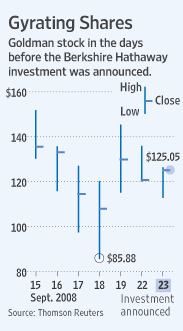
Anyone remember how Goldman reversed the steep sell-off the day before Buffett invested in Goldman? And how the financials reversed that day from their lows? Did anyone from Justice check out how Goldman traded in the SKF that day? How many shorts that they had laid out in that number?

And did Goldman, ramp and reverse the financials,  the day after the Government announced the shortseller rules, because they knew of Buffett’s investment?

After all, didn’t Byron Trott, Buffett’s broker at Goldman, who put the deal of Buffett’s investment into Goldman together–didn’t he at the end of March 2009, start his own firm?
And didn’t Goldman, change the rules on him alone, allowing Mr. Trott to sell his shares in Goldman, unlike the other executives who were handcuffed to the hip with their Goldman stock, because of Buffett’s investment?

The Sunday before Buffett’s announced investment, the Fed allowed Goldman to become a bank holding company. Then they blocked all short selling of the financials. Then Morgan Stanley announced their deal with the Japanese.

Buffett bought out Constellation Energy, to give confidence in the deal making arena, because that deal was on the ropes, and in the financials, names like State Street went from 30 to 64, Morgan Stanley, went from 12 to 34, and Goldman went from 86 to 144–all in ONE day–from 12:30 in the afternoon, to 8:00 am in the next day’s pre-market!

Is someone going to say that the stocks ramped all because you couldn’t lay out any more shorts, or those who were short, were instead tipped?

Here was the action in Goldman the day that Buffett’s tip to the rest of Wall Street was announced.

Why did you have, instead, the move in the financials, the days before?

How is it, that when a company on Wall Street, reports good numbers, and the stock sells off; that everyonne already knew that news.

Was the street so incestuous, that everyone else knew the news that Gupta had tipped?

How many people did Raj also tip? Who were also dying on the vine in September of 08?

And even with this massive, wonderful tip, Galleon was down 7.23% in September of 2008, and he was down another 5.23% in October. Even though he was getting tipped!

Is it any wonder why he was having crumpets and tea with Gupta, in his private office!

Away from the wires!

So now are we to believe, that it was just Raj, alone, who ramped the financials, or was a better explanation, that Goldman Sachs, decided to deploy their capital, into a massive short squeeze, in the shorted names, because they knew that the PPT, would be behind them, in their effort to prop up the markets, on the backs of the shortsellers, because Trott had already told Goldman that Buffett was in, and the Fed, had already told Goldman, that on Sunday night, they would be a bank holding company, and that, they would then have access to Ben’s billions?

And Ben, and Timmy, and Lloyd, will all suffer memory problems, because the sole rat, in this whole mess, was Raj, just like Goldman’s sole rat, in the Abacus, was a 27 year old kid called Fab!”