Elite Mouthpiece Taunts Ron Paul On Failure Of Fed Campaign

Added July 21, 2012:

How did I see the confrontation? I thought Paul did as well as anyone could in the time given. Except for a few word slips, he was pretty cogent and effective. Bernanke looked discomfited in the middle, when he was questioned about the transfer of authority from Congress to the Fed and when the issue of secrecy was brought up. Other than that, he was impassive and spoke little.  Paul wasn’t “subdued” at all. I don’t watch all his videos, but I’ve seen him a number of times in debate, and that was fairly straightforward Paul. If there was a white flag, I didn’t see it.

If he wasn’t as combative as some seem to think, it’s most likely because it’s his last such confrontation. He’s retiring, I’m told. Too bad.

I thought it was a fairly effective performance and a good wrap up of his major arguments. I think if you’d known nothing about the Fed until then, you would have got the salient points of the anti-Fed argument: he described Bretton Woods,  exchange-rate and interest-rate manipulation; big government financing through debt; transfer of wealth from the poor and middle-class to the wealthy; malinvestment; money supply expansion versus CPI inflation; the housing bubble; and the need for Congressional oversight.

I wouldn’t call it a knock-out, simply because Bernanke was so impassive through out.

That of course helps the media to reframe the confrontation anyway it suits them. Which is what Dana Milbank promptly did.

Paul Vs. Bernanke video

“Ron Paul Vs. Bernanke: final battle ends on surprising note,” David Grant, Christian Science Monitor, July 18, 2012

“Ron Paul Has The Final Say,” Bob Adelman, New American, July 19, 2012

ORIGINAL POST

Skull & Bones affiliated establishment journalist Dana Milbank taunts Ron Paul about the end of the “End the Fed” campaign in a piece entitled, “Ron Paul Fed Up With Trying To End The Fed” (Washington Post, July 18, 2012)

Well, I have plenty of problems with the whole Ron Paul movement these days (for a view from a Paul supporter see  this:), but the piece does more than criticize Paul.

What it does is gloat.

Here are some lines from it, with my parsing.:

“He didn’t even make a dent in it.”

[LR: The Fed is unassailable]

“…Paul raised the white flag.”

[LR: The Fed has won…]

“For the fiery Paul, it was a subdued surrender.”

[LR: So now you know how powerful we really are, old man.]

“….treating him with the cautious affection one might use to address a crazy uncle.”

[LR: You didn’t reach the point where we’d have to assassinate you, so we’ll just let people know that you and your supporters can’t be taken seriously.]

“But Paul faded away with surprising deference.”

[LR: Yes. He’s under our thumb. We call the shots. He knows what’s good for him, so he’s fading away.]

“The one substantial challenge to Bernanke — Paul’s “audit the Fed” bill, which the House is expected to approve next week before it dies in the Senate — was easily dispatched by the Fed chairman,”

[LR: Audit the Fed is croaking.]

“The Paul to Bernanke word ratio this time was 12 to 1.”

[LR: He’s just a rambling  old man. Real men don’t talk, they print.]

“There’s no constitutional reason why Congress couldn’t just take over monetary policy,” he said. “But I’m advising you that it wouldn’t be very good from an economic policy point of view.”

[LR: We’re the constitutionalists, not you. Audit the Fed is only about Congress taking over monetary policy, folks. Imagine! They can’t run a post office. How do you think they’re going to do with deep stuff like economics?]

“”At this point, the committee chairman cut him off. Paul’s time had expired.”

[LR: We’ve put up with you long enough, grandpa. Your time’s up. The game is over.]

The framing of the whole piece is quite masterful. There is not one substantial piece of analysis about the actual policies in question. We are not told what is involved in either “End the Fed” or “Audit the Fed.”

We are instead given information about procedure….rules regarding how bills go through the house, and how speakers get to speak. A contrast is set up between the grave, measured proceedings of the state and the law (the constitution) and the self-indulgent rambling of an aging politician.

The roles are reversed.

Paul becomes the political class. Bernanke becomes the embodiment of the constitution and of law.

From beginning to end we’re told how to think about what’s going on.

This is what we’re supposed to think:

Bernanke is sage, powerful and indulgent.

Paul is a crazy old man, who doesn’t know the elements of civility….or the constitution.

He’s an anti-government politician, but he’s for the government control of the money supply.

He cuts into other people’s time. He rambles on. He talks too much.

Paul is just a “supplicant” before the great Fed chairman. The final word is with the Fed.

So, even though he gets his fifteen minutes, it’s clear Paul doesn’t really understand the constitution or money.

And he’s for the government!

Notice how the piece distorts Paul’s position to make it look as if “Audit the Fed” (Paul’s fall-back position from “End the Fed”) is about putting arcane and complex professional matters into the hands of politicians.

Milbank turns Bernanke into the “private” expert and Paul into the bumbling government man.

That is sure to appeal to Americans of every political stripe. The average reader would immediately distrust anyone who intends to subject policies about the country’s money-supply to ignorant legislators driven by partisan bias.

What that does is clear.

It turns the  whole anti-government argument against anti-government activists.

It also turns  the pro-constitution argument against constitutionalists.

This is propaganda of the highest order.

Ron Paul Implosion: End The Fed To Technology Revolution…

The Pauls have lost all credibility with me.

Read their latest missive, blogged at EPJ

And reported here at Forbes: “Ron Paul Takes Up Internet Freedom with New Technology Revolution.”

They’ve abandoned the financial battle.

I guess the financial coup of 2008, completed in 2010, is now sealed and cordoned off from prosecution. Last month, as if to confirm that, the White Queen (the City)  took down the Black Knight (Gupta) that had infiltrated the highest ranks of her court, while the White Bishop (Lloyd Doing-God’s Work Blankfein) was witness for the prosecution.

“End the Fed,” which  Rand Paul converted to” Audit the Fed,” is over.

The Pauls have now skipped forward to their new, new project –  the  “Technology Revolution.”

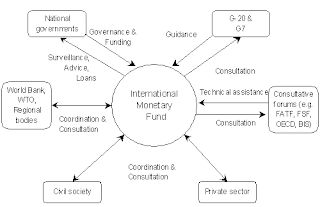
I  never thought that much of “End the Fed,” because, as I’ve blogged previously, the elites can manufacture money from other places besides the Fed, like the BIS and the reconstituted IMF.

But, apparently,  End the Fed doesn’t even work as a popular slogan any more.

So, what do I think about the new campaign?

I think it will be about as effective as their “End the Fed” campaign, which is to say, not effective at all.

See my comment at The Daily Bell in 2010:

Posted by Lila Rajiva on 11/23/10 11:55 AM
Daily Bell: “But by pursuing his strategy, he has made his opponents look like fools and perhaps altered the course of history.”

Lila: Let’s hope. Personally, I agree with Doug Casey on this:
“As a lone voice, his father was a breath of fresh, more principled air, but he didn’t change anything at all that I can see”

(Doug Casey on Presidents, LRC)

But it will be a great platform for the Pauls to sell books, promote ideas and launch political careers for their family members.

I only hope it won’t be done on the backs of idealistic young people. There were many who put change they could hardly spare in a tough economy into the Paul’s war chest.

The new campaign, which dubs itself  “The Internet Versus The Machine” is obviously a rebranding campaign to move young people away from what Forbes calls “the archaic” (they mean arcane) issues of finance.

Instead, the Pauls will focus on the hip world of the net.

Forbes:

“Young people have been a driving force in the Paul campaign, and the focus on internet freedom should only bolster that support.”

I’m going to call foul on that.

Their new “campaign” is in support of the Technology Revolution on the Internet?

Last I looked the tech revolution has been around for a while, getting on quite well without the Pauls.

One part of  the new project is going to be defending big business from attempts by consumers to scrutinize their data collection.

I kid you not. Here is Buzzfeed on the subject.

“The Pauls also take a stand for the growing industry known (and widely criticized) as “big data.”

They deride the notion that “private sector data collection practices must be scrutinized and tightly regulated in the name of ‘protecting consumers,’ at the same time as government’s warrantless surveillance and collection of private citizens’ Internet data has dramatically increased.”

So does this mean that Ron Paul is going to be fighting to prevent European governments or NGOs  like EFF or Asian governments from scrutinizing Google’s data collection practices?

Remember that I just blogged that Google’s CEO Larry Page should be arrested for privacy violations and espionage against foreign governments?

I was being satirical about US surveillance of foreign CEO’s and money-managers.

For instance, in the Galleon -Gupta cases, the government used wire-taps whose authorization was obtained pre-textually in violation of the defendants’ constitutional rights.

I don’t recall that the Pauls said a word about that, although the Galleon insider case has dominated the financial media for a couple of years now, and is directly tied via Rajaratnam’s funding of Tamil charities to  issues like terrorist money-laundering  with which Paul adviser Bruce Fein – once employed by an alleged front group for the Tamil Tigers –  is intimately connected.

A recent Washington Post article described how the military is outsourcing surveillance in Africa to private contractors (with little accountability, significant cost over-runs, and little to show for the expense).

Densely populated China and India are both locked in battles with the West for access to resources and agricultural lands.  Indian and Chinese companies compete with American and European countries on the African continent.  China and India have also complained about American corporate espionage.  American companies in turn complain about IP theft from the Indians and Chinese.  Meanwhile the US government itself is involved in IP theft through its pervasive global surveillance.  Where does data collection for corporations end and espionage for the state begin, anyway? Where does the government end and the private sector begin, when private companies are outsourced arms of the government and the government is the enforcement arm of the companies?

Ron Paul is not oblivious to the complexities of all this. He is far too shrewd.

Rajat Gupta’s conviction shows evidence in my opinion of being a  set up by the government, with some arm-twisting from Goldman Sachs. Likely it was an important blow in the  covert psy war against India, an ostensible US ally, about which I blogged here (“Coconut Imperialism”and here, “Educating the Gentoos In India”)

The obvious response from foreign governments (such as India) would be to treat American CEO’s the same way and wire-tap them.

So, is it just coincidental that the Pauls suddenly abandon their financial campaign (which never involved a word against Goldman Sachs), and suddenly rush to head off any animosity toward Google?

On their silence on G Sachs, here is a comment I made (one among many) below the same Daily Bell article:

Posted by Lila Rajiva on 11/23/10 11:40 AM

@Pisano.

Why would it distract him?
How hard is it to say, unequivocally, “Goldman Sachs and several other banks, are involved in corrupt actions and should be investigated and prosecuted.”

There. Back to “business.”

He certainly had no problem drawing a hard line over relatively trivial things like a monument to Rosa Parks. If he was really afraid of distraction, why would he make a fuss over something like that, and then on something crucial, suddenly go silent?

Why doesn’t he state clearly – “9-11 needs to be investigated. There is credible evidence that there was some kind of conspiracy involving intelligence agencies, US and foreign.”

I like Ron Paul and want to believe the best of him.

But this excuse doesn’t hold water for two seconds.”

This looks like more material to add to the mounting evidence (see  here) that Paul fronts for financial interests.

Perhaps he cannot avoid doing it, as I’ve said.

But there’s no need to be suckered into what could well be a counter-attack against foreign governments who defend themselves against espionage by Google/Facebook/Hotmail/Skype/TOR and the rest of the government-corporate spy sector, by couching the issue as a defense of the private sector.

That explanation also takes care of Paul’s pandering to the left.

The financial world (which controls the media) is left-leaning, in contrast to non-financial businesses.  Paul’s recent moves make quite a bit of sense when understood that way.  He acts to co-opt the brand of libertarianism appropriately called the Marxism of the right by deploying what seem to be ideologically inflexible positions in the service of  larger imperial goals.

So, I have to ask. Will the two Pauls now be collecting money from young people to defend multi-billion dollar multinationals like Google from scrutiny by the governments on which they spy?

I mean, if you phrased that in the appropriately anti-state way, there will be enough libertarian lemmings who’ll rush to defend Google, I’m sure.

This theory might explain why the financial media, usually so vocal in defense of insider-trading, when it’s done by Michael Milken or Ivan Boesky, is suddenly so quiet  about South Asian insider-trading not a tenth as bad.

Does it also explain why large parts of the alternative press  have had nothing but praise for Julian Assange, another front for western financial interests? And why the Pauls have promoted Assange?

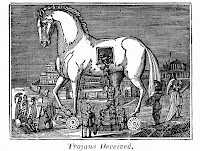
Talk about Trojan horses.

Big corporations cannot be analyzed separately from government.

When the state outsources its spying to corporations, for someone to argue that the state should not limit corporate surveillance because it’s engaged in surveillance itself is confused, at best, and downright misleading, at worst.

Especially when it comes from seasoned politicians like the Pauls.

Parts of the government are scrutinizing the private sector. Often they’re right to.

Other parts of government are much worse than the private sector when it comes to privacy violation.

Those parts of the government are often most incestuously allied with corporations. This is the corporate-state or intel-industrial complex that produces programs like Echelon.

So it’s quite bizarre for the Pauls to claim that Microsoft (or Google or Apple) are pure private-sector entities, when they gain market share directly because of concrete government actions on their behalf and because of endemic and pervasive state-created judicial/legal/financial corruption.

One more thing.  Microsoft wasn’t prescient at all about the net, as the Pauls claim in their new manifesto.

It was way behind. Gates himself admitted it.

There is, finally, another reason why the Pauls may have turned their attention to protecting Big Data,

It looks like Big Data is bankrolling him.

Here’s Reason’s Brian Doherty, making the point:

“With Peter Thiel, founder of the controversial “big data” company Panantir, having made a $2.6 million investment in the (somewhat feckless in the end) superPAC “Endorse Liberty” during campaign season, perhaps the Paul machine sees this as a cause that can energize both grassroots and big money.”

And that’s all  I want to say now about this turn of events until I learn a bit more what is really going on.

But, if you were waiting to see Ron Paul libertarianism implode, it happened this week.