Tamil Spring Color Revolution? Massive Protests Against Bull-Taming Ban

Related image

According to a legend, once Shiva asked his bull, Basava, to go to the earth and ask the mortals to have an oil massage and bath every day and to eat once a month. Inadvertently, Basava announced that everyone should eat daily and have an oil bath once a month. This mistake enraged Shiva who then cursed Basava, banishing him to live on the earth forever. He would have to plough the fields and help people produce more food. Thus the association of this day [Mattu Pongal] with cattle.” [Pongal Festival.org]

Update, January 22, 2017:

An ordinance has been passed that allows Jallikattu to proceed without interference in Tamil Nadu.

Note: My post, unlike my anti-demonetization posts, does not appear individually in a google search. I tried immediately after posting and after it a couple of times. No luck.  You can draw your own conclusions from that.

Meanwhile, please note that the massive demonstrations across TN were singularly well-coordinated and peaceful, and very well-prepared, with beautifully done masks of bulls, vinyl posters in Tamil and English (for foreign media), and well-spoken student leaders. Bull masks and black flags and outfits abounded. IT students and Face-book featured prominently, while several major media outlets captioned the whole thing repeatedly as “undirected,” “people power” (MakkalMovement)- a signalling of the kind common in intelligence operations.

All this in a country where bus-burning and hooliganism is the norm during protests. Here, by contrast, police and protestors cooperated like long-lost family members.  The (BJP) Center and the (AIADMK) State leaned over backwards to accommodate each other.

I suggest this is an exercise in consciousness-raising, using a cardinal symbol of Shiva, the bull; opposing the old globalist feminism and virulent rights talk (PETA) with the new, controlled opposition globalism of managed nationalism and the virile male (Putin, Trump).

Supporting that interpretation, around the time of this bull-celebrating New Year festival, comes the inauguration of US president Donald Trump, the bull in the globalists’ feminist china shop…a master of bull in his own right…a stud bull…


ORIGINAL POST

While any protest against demonetization  has been swiftly quelled by the Central Government and blacked out from media coverage, one wave of protests in Tamil Nadu has quickly become headline news:

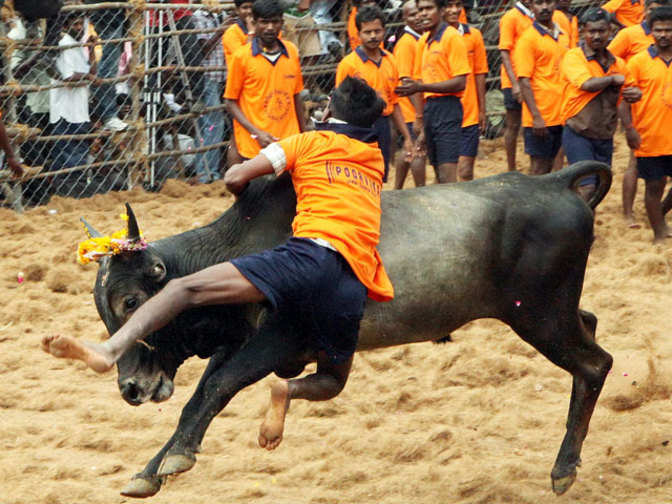
That’s the protest against a three-year ban on Jallikattu, a 3000+ year-old traditional Tamil sport characteristic of the Tamil Spring/Harvest Festival (Pongal) in which young men chase and wrestle down a fleeing bull to snatch money or gold tied to its horns:

In Tamil Nadu, Jallikattu is Veera Vilayattu or warrior sport, where a man matches wit and sinew with a raging bull and grabs a small bag of coins or Jalli, tied to its horns. The most daring among them twitches through the flaying horns and threshing hooves and hangs on to its hump as the animal completes a short lap of 50 metres. In the days gone, he would also win the daughter of the owner of the bull in marriage. It is about courage, masculinity, and above all, cultural ethos.”

Images of Jallikattu appear on Indus Valley seals, proving the ancient and indigenous nature of the tradition:

Indus Valley civilisation is known for being one of the most advanced and sophisticated amongs its contemporaries. The sport of Eru Thazhuvathal is celebrated so much that they decide to make a seal depicting the same.”

The Indian branch of PETA (People for the Ethical Treatment of Animals) and the Animal Welfare Board began their campaign to add Jallikattu to the list of activities banned under laws prohibiting cruelty to animals.

In 2014, a 2-member bench of the Supreme Court banned Jallikattu completely. 

A Bench of Justices K.S. Radhakrishnan and Pinaki Chandra Misra said, “Forcing a bull and keeping it in the waiting area for hours and subjecting it to the scorching sun is not for the animal’s well-being. Forcing and pulling the bull by a nose rope into the narrow, closed enclosure or ‘vadi vassal’ (entry point), subjecting it to all forms of torture, fear, pain and suffering by forcing it to go the arena and also over-powering it in the arena by bull tamers, are not for the well-being of the animal.”

But Tamil animal activists have joined bull-tamers and their aficionados to insist that the sport is not inherently cruel, despite occasional abuses.

They argue that the ban constitutes an intentional assault on Tamil culture by the Central Government.

What is clearly true is that the objective of Jallikattu is not harming or killing the bull, as it is in Spanish bull-fighting. People, not bulls, seem to be the main victims:

This is Jallikattu, an ancient and bizarre bull-wrestling sport that takes place in villages throughout Tamil Nadu every January to celebrate Pongal, a New Year’s festival that coincides with the ancient rice harvest. Though similar to and older than the Spanish running of the bulls, it’s bloodier. Instead of bulls getting killed, it’s the people. In previous years, as many as 20 young men have been fatally gored, and several hundred, including spectators, have been mauled, trampled or otherwise injure.”

Since the original impetus for the ban was the death in 2004 of a 14-year-old spectator, framing the issue as one of animal-rights versus human (read, masculine/patriarchal) cruelty is obviously misleading.

But that is how it has been framed, with the international animal-liberation movement taking a prominent role.

In January 2016, the head of PETA was detained by Indian police for blind-folding a statue of Gandhi in protest against Jallikattu.

Regarding the anti-Jallikattu activism, BJP gadfly and alleged Mossad mouth-piece Subramanian Swamy has charged that it is funded from abroad and is part of an Afro-Dravidian separatist movement intended to fragment India. He has insisted on a CBI investigation:

Bharatiya Janata Party leader Subramanian Swamy has alleged that protests organised against Jallikattu have been inspired from abroad and he intends to take the case to the Central Bureau of Investigation in terms of funding of the animal rights organisations.”

Far more germane to the issue than animal-rights is the question of indigenous farming technology.

Jallikattu is a tradition that ensures that certain skills (bull-taming without the use of a rope) are conserved among agriculturalists and certain traits (virility, strength, and speed) are conserved among indigenous breeds:

Male calves in other regions are sold and taken for slaughter in a few days. Only in regions where there are events like jallikattu are they kept. The owner of an imported cow will like it to deliver a female calf. If she does, it’s a windfall. If it’s a male calf then he will have no use for it and he has to feed it. It will go to the slaughter house for Rs. 500. A lot of mutton we eat is the meat of these under-one-week calves mixed with mutton. The same will happen to these native breeds if not for activities like jallikattu. With reduced availability of males, farmers will have to go in for artificial insemination, which is cost prohibitive and is directly in contravention of in-situ conservation. Unless there are bulls being bred and reared in the in-situ region, the genetic pool of the breed will not be healthy as no adaptation to changes in climate, local environment has been ingrained. We are messing with evolution when we abandon in-situ conservation with bulls and natural servicing/mating.

Native cows do not yield as much milk as the imported breeds. So they don’t have a supportive or sponsored breeding programme. Artificial means are not adopted for native breeds. So as a fall out of the banning of jallikattu, they will soon fade away and become extinct.”

Viewed against the back-drop of an incipient digital dictatorship inaugurated by the Modi demonetization fiasco, it becomes obvious that the ban on Jallikattu is not a distraction from, but a replication of, the ban on currency notes.

The cash ban, as I showed in an earlier blog-post,  was effectively a war on small and medium businesses and the indigenous financial sector.

That sector uses indigenous methods of financing (chit-funds, hawala, angadia payments, etc.), all of which depend on a combination of cash and promissory notes/back-dated checks.

Ban cash and you break the back of the native financial sector and the economy that depends on it.

Ban Jallikattu, likewise, and you break the back of native farming and cattle-breeding and the economy that depends on it.

This year, the Jallikattu issue has boiled up into open, state-wide protests around the Pongal season (the 4-day harvest festival in mid-January).

Pongal, by the way, means “boiling.”

State-wide Jallikattu protests, triggered by anti-Jallikattu activism and the arrest of thousands of pro-Jallikattu protestors – have become a stand-in for a spectrum of discontents –

*The unilateral imposition of demonetization on the country, causing untold hardship in drought-hit Tamil Nadu

*Income-tax raids that appear to target Tamil Nadu

*The suspicious but uninvestigated death of the charismatic and popular Tamil Chief Minister, Jayalalitha

*Apparent attempts by the BJP government to insert itself into  post-Jaya politics to gain a foot-hold in the important state

*The refusal of northern neighbor Karnataka to abide by a SC (Supreme Court) directive to share Cauvery River water with  drought-hit Tamil Nadu….

*The inadequate central government response to drought in Tamil Nadu

Despite these popular grievances, however,  there’s a lot more going on behind the scenes of what is being dubbed an undirected “people’s movement”.

ITEM

Tamil Nadu is the most industrialized of all Indian states along with Karnataka. Bangalore is the center of the software and outsourcing industry while there is a vast amount of foreign investment in TN’s Coimbatore and in Chennai, a manufacturing center.

Western intelligence agencies are active here, protecting the investments of the business class.

ITEM

Tamil politics has been the locus of foreign intervention ever since the British fostered the rise of Dravidian (south Indian) consciousness, by subsidizing the promotion of anti-Brahmin groups, out of which the DMK and the Anna DMK (to which Jaya belonged) developed.

A water-shed moment was reached during the Chief Ministership of famed film-star M.G.Ramachandran (MGR), who mentored Jayalalitha, reportedly his long-time mistress.

Under MGR, Tamil consciousness got a new, violent face, with the rise of the Tamil Tigers.  The Tigers, renowned as the world’s deadliest terrorists/freedom-fighters, began as a band of murderous roving bandits. Patronized by both the Mossad and Indira Gandhi, they eventually became a thorn in the side of the national government and one of their group murdered Mrs Gandhi’s own son, Rajiv, then the Indian PM.

The British also endorsed  a highly questionable racial narrative that pitted dark-skinned Tamils as the eternal victims of light-skinned Aryan and Vedic Hindus of the north, a narrative that is part of the Afro-Dravidian movement, which Rajiv Malhotra has identified as a Western strategy to create a Tamil secessionist state out of TN and NE Sri Lanka, home to a militant Tamil diaspora.

The Afro-Dravidian narrative in turn reinforced another fiction sponsored by imperialist ideologues – the Aryan invasion of India, a theory of the origins of classical Indian culture that has been discredited by genetic data and archeological records.

All this forces us to accept the following basic scientific fact: outside of Africa, South Asia contains the world’s oldest populations, and modern Europeans are themselves among the peoples descended from migrants from India, going back more than 40,000 years. This should be the starting point for studying history in the Holocene or the post Ice Age period.”

But, while PETA and other anti-Jallikattu animal rights groups are certainly funded from abroad,  there is evidence that the pro-Jallikattu groups are also well-funded, come mainly from Westernized student groups and IT professionals  savvy with social media in the well-known tradition of “undirected,” and “leaderless” people’s movements (Makkal Movement) that has become the new face of intelligence interventions.

Here’s more evidence of an intel connection:

1.  Both the PETA spokesman in India and anti-Jallikatu representatives have introduced the meme of “Arab Spring” into the public language around the protests. The Times of India, an elite media organ, was one of the earliest to insert the meme into Jallikattu discourse.

The Economic Times and a host of other major media outlets did so too.

2. The pro-J protests have been drawn from among relatively affluent, Westernized student groups in Chennai and appear well-funded.

3. The bull itself is the animal of Shiva and Shiva is identified by the world order as its presiding deity, using the popular but erroneous Christian identification of Shiva with Lucifer (which I have refuted on this blog).

On January 16, simultaneously with the Jallikattu uproar and the Pongal festival, in which the bull plays a prominent part, India became an associate member of CERN (the European Organization for Nuclear Research).

Outside CERN is a statue of Shiva in Nataraja pose (as a dancer, creating and destroying the worlds). The statue was recently depicted in a some kind of hoax video of human sacrifice to Shiva that was actually filmed within its precincts.

4. The protests have targeted the successors to Jayalalitha, CM Paneerselvam and Sasikala Natarajan, Jaya’s chosen Chief Secretary, for inadequate action on Jallikattu.

These are the same figures that the BJP itself has been interested in targeting, in an attempt to fracture the AIADMK and the DMK to secure control over the state.

5. The attacks against PETA were initiated by Subramanian Swamy, of the BJP, a known Mossad disinformation outlet.

6. The bull is identified with pre-Vedic Indian culture, supposedly presided over by a mother goddess,  associated with a snake and bull.  The mother goddess in the form of Shakti is the female counterpart of Shiva. The snake is identified with Saivite worship. For instance, the Naga (snake) sect in Tamil Nadu are Saivites.

Amma means mother in Tamil and was the name assigned to deceased former Tamil CM Jayalalitha. There is at least one important South Indian guru named Amma who is given great prominence in globalist initiatives like the fight against modern slavery and is featured by the UN.

Recently,  South Indian television networks have had a plethora of shows featuring snake-gods and humans who morph into snakes, including the popular serials, Mahamayi and Nagini.


Shiv Sena MP: Modi In Love With Self

A right-wing party attacks the PM for replacing the image of Gandhi with his own on calendars associated with Gandhi’s pet “Khadi” (home-spun) cottage industry:

“Speaking to reporters in Mumbai, Shiv Sena MP from south Mumbai and party spokesperson Arvind Sawant called the move as an insult to Gandhiji. “I saw the news in some newspapers that Mahatma Gandhi’s photo from Khadi Gramodyog calender has been removed and replaced with that of the PM Narendra Modiji. Gandhi is the father of the nation, he is one who sowed the seeds of promoting Khadi. Removing Gandhiji and replacing it with PMs is an not only an insult to the Father of the Nation and but also of the nation and this should be taken very seriously” said Sawant.

In a personal attack Sawant said, “This is a perfect example of what happens when a person falls in love with his own image.”

Corporate-Govt Scams Untouched By DeMo

At what looks like one of the many globalist “change agent” sites that offer controlled opposition to the corporate-globalist wing, a young writer deconstructs DeMo correctly as blind to corporate-govt corruption at the highest levels, but then concludes that the enormous inequality that RESULTS from this nexus is really its CAUSE.

That of course is an infamous globalist meme in its own right that inevitably leads to further  government intervention, in the form of subsidies and grants to the victims of the earlier round of pro-corporate subsidies….and so it goes.

And how do I know the site is controlled opposition?

The slickness of the design, the crowd-funding, the themes (opposition to the menstruation taboo and reiteration of the “99 percent and 1 percent” thesis).

In separate CBI raids in 2013 and 2014, on the two companies mentioned above, large quantities of hard cash and accounting documents were seized from the respective offices. The documents which were seized contained a detailed account of payments allegedly made to high-ranking political figures. Amongst these figures are politicians from both BJP and Congress – Shivraj Singh Chauhan (CM-Madhya Pradesh); Raman Singh (CM–Chhattisgarh); Shaina NC (treasurer of BJP in Maharashtra); Sheila Dikshit (former CM of Delhi).

The documents related to the Birla matter also contain the signature of the deputy director of the Income Tax (Investigation). Despite this seemingly incriminating information, the Income Tax Department did not push for a further enquiry with the CBI. According to Mr Prashant Bhushan’s allegations, KV Chowdary did not look into the matter when he was the head of the income tax department.

According to Mr Prashant Bhushan, in an interview with The Wire, Mr Chowdary has been associated with controversial issues in the past – Ponty Chaddha’s income tax assessment and the stock guru scam. Despite this, he was appointed as the chief of the Central Vigilance Commission, against which the citizen collective Common Cause filed a writ petition in 2015.

Supreme Court has asked for more evidence on the matter. Meanwhile, many representatives from the BJP have rubbished the allegations, while representatives from the Congress and other parties seek an investigation into the issue. Little can be said as to what these documents will amount to in the court of law, as the next hearing is set to happen in January.

However, these allegations form another link in a series of alleged big-business scams involving the government. It makes the writer wonder, that if big corporate scams are indeed the biggest culprits of money laundering and corruption, shouldn’t we be targeting them instead of ?500 and ?1000 notes? Do meagre bribes by the majority of the people in the country even compare to the amounts cited in big corporate scams? Let’s find out.

Black Money In Corporate Scams, Political Campaigns And Demonetisation

Scams, as big as the Coalgate scam, raise many important questions about how best to identify, as well as, deal with the central issues surrounding black money.

Recently, other alleged major scams by corporates as revealed in the Essar tapes – wherein investigation is under way concerning the alleged systematic bribing of senior political officials, and the Directorate of Revenue Intelligence’s (DRI) probe into over 40 of India’s biggest energy companies (including Adani and Reliance) for artificially inflating prices of imported coal.

The amounts in these scams are believed to be massive. Thousands of crores of rupees. It is no secret that large amounts are laundered offshore to tax haven countries like Switzerland, Mauritius, etc.

There are many estimates of India’s foreign black money. According to economists Pellegrini, Sanelli and Tosti in an interview with Times of India, the amount invested in shares, debt securities and bank deposits in tax havens alone may add up to $181 Billion or ?10.5 Lakh Crore. One of the higher figures was perhaps given by Prof. R Vaidyanathan of IIM, who estimated that there was more than ?70 Lakh Crore in 2007-08, stashed away in more than 70 tax havens in the world!

Whether it is  ?10 lakh crore or ?70 lakh crore, the amount of money laundered offshore is a significant proportion of the GDP.

To add to this, let us consider probable circulation of black money through political parties, which get special exemptions and are not even subject to RTI. It is alleged in India that illegal funds are used by political parties for campaigns, which often come as unaccounted cash from unknown donors.

The 2014 elections were the second most expensive elections in world history, estimated to be $4.9 Billion (More than ?3 lakh Crore) having been spent on campaigning for seats. Fourteen of India’s biggest industrial houses set up electoral trusts to give money to their favoured parties.

The amount of money involved in the slew of corporate scams and party politics goes into thousands and lakhs of crores. To put it in perspective, India’s GDP for FY16 was ?135.7 lakh crores. In 2007, the World Bank had estimated the size of the black economy to be 23.2% of the GDP in 2007.  According to India Ratings, the withdrawal of high denomination notes is likely to destroy  ?4 lakh crore – about 12% of the total black economy. To do this, about 86% of all the cash in circulation was withdrawn in the form of ?500 and ?1000 denomination notes.

These figures should make everyone ask one question. Has demonetisation of high-value notes really struck at the heart of the black money economy? The writer is no economist. However, it doesn’t take an economist to see that the amounts of money involved in corporate scams and party politics constitute of a major chunk of the black economy. Moreover, the mechanisms of money laundering in these two cases rarely rely on the liquid cash economy and are even safeguarded by colloquial electoral and political practices.”

House Panel Castrates Itself For Modi

From India Today, comes news that the Public Accounts Committee (PAC) Panel has contradicted the statement of its chairman that Modi can be called before it to explain demonetization.

The contradiction comes following a strong protest lodged by a BJP member of the PAC with the Lok Sabha (Lower House) speaker:
“The PAC statement says that under the rules, “officials may be called to give evidence in connection with the examination of the estimates and accounts in a particular Ministry, Ministers shall not be called before the Committee either to give evidence or consultation:

QUOTE

  1. The PAC statement, however, further reads that the chairperson of the committee “may have an informal interaction with the Minister”.
  2. The PAC statement in interesting in the view of chairman K V Thomas’s stand that PM Modi Modi could be summoned if the panel is not satisfied with the responses of RBI governor Urjit Patel and finance ministry officials on demonetisation.
  3. Earlier, a BJP member of the PAC registered protest with the Lok Sabha speaker against the statement made by Thomas.
  4. On his part, Thomas cited precedents of PAC summoning union ministers during the chairmanship of senior BJP leader Murli Manohar Joshi, who wanted the then PM Manmohan Singh to appear before the parliamentary panel in connection with 2G and coal scams.
  5. Thomas also cited a 1996-example when the then agriculture minister C Subramaniam appeared before the committee over a CAG report.
  6. In 1992, the then finance minister Manmohan Singh faced PAC over Harshad Mehta stock exchange scandal.
  7. RBI Governor Urjit Patel is slated to appear before the PAC over demonetisation on January 20.

    END QUOTE

Note Ban Targets Informal Finance, Small Biz, Small Farmers

NOTE BAN FALL-OUT:

(In Progress)

1.  Silk-weaving:

(Varanasi, Uttar Pradesh, Dec. 24, 2016)

50% drop in demand and in production among bigger weavers. Sale of previous inventory at much lower prices. Smaller weavers even worse hit. Half of the 30,000 daily wage workers,  or 15,000 people, put out of work. No money to pay workers or suppliers.

2. Timber:

(Haryana, Uttar Pradesh, Uttarkhand, Punjab, Kashmir, Jan 12, 2017)

At least 500,000 workers out of work. Total loss to the industry of at least Rs. 180 crores or Rs. 18,00,000,000 (1.8 billion).

The entire timber industry shut down within one week of demonetization. The losses are from the 30-day shut down.

3. Chit funds:

(December 28, 2016)

55% of the chit fund industry’s cash flow has been lost. In urban areas the monthly flow is Rs. 3-5 crores (300-500,000) Rural chit funds have been hit even worse, because of smaller cash flows. Chit funds are a unique savings and borrowing for lower and middle-income families, but they cannot tap in bank loans like other non-bank financial institutions to tide over the crisis.

Indeed, the entire informal financial sector (chit funds, nidhis, hundis) – some 26% of GDP and 40% of formal bank lending –  has been permanently damaged.

Informal finance is one of the two primary targets of DeMo, fronted by Modi, but pushed by the globalist financial cabal.

4.  Ceramics:

(Surat, Gujarat, December 14, 2016)

25% of ceramic units in Morbi, hub of Gujarat’s  ceramics industry shut down (responsible for 4,200 crores exports).  Another article dated December 5 (see below) says 60% of the ceramics business was likely to be shuttered. 200 out of 650 large ceramics factories in Surat were closed as of November 26th. Business down from 65-70 crores/day to 25. Over 2000 auxiliary industries affected.

5. Diamonds:

(December 5, 2016)

The Surat (Gujarat) diamond industry, worth 95,000 crores (a crore is Rs. 10 million) has seen a decline of 25%.  The business traditionally relied on the angadia cash payments  (a local hawala system using couriers). This was banned in 2002 but still accounts for 30% of the business. It has ground to a halt.  200 factories shut down in the first week of December.

6 Farming:

(Maharashtra, Dec. 16, 2016)

Farm auctions could not be held for 10 days because there was no cash, so red onions that could not be stored sold at half price, putting many marginal small farmers out of business permanently. The same situation plays out in elsewhere in the country.

In Delhi, by Nov. 11, perishable horticultural produce has been badly hit. Onion and potato prices have halved.Rabi or winter crop sowing in farming areas across the country have been affected because of lack of money to buy inputs.

7. Fish markets

(Bengal, November 13, 2016)

Malancha the gigantic fish market 100 km south of Kolkata is 40-50% dry. The largest of some 12 mega fish markets in south Bengal, it normally sells 15000 kg of fish every day. Azibor Rehman, the owner of the biggest fish depot there, says it is the biggest depression he has seen in 50 years. Small farmers who keep notes at home and have no bank accounts are being fleeced by 20% rates to change their notes.

In Goa, fish vendors throw away fish and lose business, as customers prefer to pay for fish with cash.

8. Tourism:

(Goa, Dec. 23, 2016)

90% of tourists at Anjuna have left. Restaurants have shut down and workers are out of jobs. Tourism in India employs 50 million people, 10% of the Indian work-force (more than the population of Colombo) and they are all affected by the note ban. Foreigners can only exchange 2.5% ( Rs. 5000) of what they could before the ban, which was about Rs. 200,000/week or $3000.

9.  Bicycle manufacturing

(Ludhiana, Punjab, November 26, 2016)

Production is down by 50%, there are no fresh orders, and parts cannot be ordered. Ludhiana is the hub of India’s bicycle manufacturing industry. It produces 1.4 crore bicycles at a value of 7000 crores or Rs. 70,000,000000 or $70 billion. 1/3 of migrant workers in the industry have lost their job and gone home to Bihar and Orissa. The bicycle ancillary industry, which employs 300,000 people, have reduced hours by a third.

10.  Small and medium enterprises

(Delhi, Dec. 11, 2016)

A death knell for India’s small and medium enterprises, says the chief executive of Ambit Capital.  Indian  regulations deliberately favor small and medium enterprises over big businesses.  The cash crunch delivered a death blow to them, leaving the market open for big business. Entering the “white” world, would force these businesses to pay taxes, legal minimal wage, and regulatory fees, making their margins too small for them to continue. 30 million Indians work in manufacturing, with 10 million working as self-employed,  with no hired hands outside the family. Those with hired labor on average have 7 or fewer employees.

Here were see another primary target of the globalists’ plan for India.


RBI: DeMo Disclosure Endangers Life, National Security

From Gulf-News:

India’s central bank refused to share specific details of Prime Minister Narendra Modi’s ban on high-value banknotes citing danger to life and national security, as the mystery deepens over who took the unprecedented decision.
The Reserve Bank of India recommended the move, which was accepted by the cabinet and announced by Modi on November 8, Power Minister Piyush Goyal told parliament in November. The RBI board approved the ban three hours before Modi’s speech and hadn’t discussed the matter before, a slew of responses to Bloomberg News’s Right to Information requests show.
However, the RBI told a lawmakers’ panel this week that the government had “advised” the monetary authority to “consider” the ban a day before the RBI board made its recommendation. The government then “considered the recommendations” and decided to withdraw the notes, culminating in Modi’s address that blindsided the nation.
The cloak of secrecy that has shrouded the currency ban decision is likely to bolster the view that authorities, both on Mint Street and in New Delhi, were not prepared for such a decision and the way it was announced. It risks undermining perceptions of the central bank’s independence and raises questions about Modi’s decision-making style and his communication with the RBI.
More clarity may emerge when RBI governor Urjit Patel deposes before a parliamentary committee on January 20. Details are essential to help assess the success of the shock move as well as gauge the impact of the decision on Asia’s No 3 economy.
“It is very perplexing that the RBI doesn’t answer questions about how the decision was arrived at,” said Shilan Shah, Singapore-based India Economist at Capital Economics. “There are concerns that in the whole process the RBI has been sidelined by the government and that raises questions about its independence,” he said, adding that authorities have not been transparent. Bloomberg News asked the RBI 14 questions between December 8 and January 2. The central bank as of January 11 had answered five, disclosing the date and time of the RBI’s board meeting and the fact that the board had never discussed demonetisation before November 8. It said it doesn’t have information to answer one question, on how many of the worthless notes have been deposited at commercial banks. It transferred two questions on printing of new notes to organisations that manage the presses. The RBI said that a question asking “what prompted the board to discuss and approve the withdrawal of notes” doesn’t come under the definition of “information” under the RTI Act. It provided different answers to a question asked three times, seeking details on board members who opposed the move. In two replies the RBI said “it is a matter of fact that the decision was unanimous.” In a separate response, it said “this information is not available on record.” To a question seeking details on the number of demonetised notes already at banks on the evening of Modi’s speech, the RBI claimed an exemption, citing danger to the life or physical safety of anyone who disclosed this information to the public. The RBI also claimed exemptions on two questions seeking detail on its preparations for the demonetisation and studies it used to forecast the impact of the move. Sharing these “sensitive matters” would endanger India’s sovereignty, integrity and security, according to the RBI.
The use of those specific exemptions are “perplexing,” Capital Economics’s Shah said. Shailesh Gandhi, a former bureaucrat with the Central Information Commission, told the FirstPost website on December 31 that the RBI’s attitude of stonewalling smacked of “sheer arrogance.”
“What the RBI is doing by refusing to answer queries under RTI is denying citizens their fundamental rights,” Gandhi said. Lawmakers are also seeking answers. Parliament was gridlocked as the opposition demanded discussions and voting on the measures, the Supreme Court is hearing petitions against the legality of the steps, and two lawmaker panels have sought explanations from the RBI.
The decision to demonetise was taken only when the stock of new currency notes was reaching a “critical minimum,” enough to meet a significant part of demand, the RBI told a panel in a note accessed by Bloomberg News. However, the currency swap was riddled with rule changes and data that analysts have questioned. Patel will depose before another lawmaker panel on January 20, which is expected to seek his view on the impact of the demonetisation on India’s economy.”

Alleged Trump Sex Video: From 9-11, Grosvenor Gardens

An interesting factoid:

The infamous alleged fetish video involving Donald Trump and a Russian hotel bed in which the Obamas slept (details delicately withheld on our chaste blog) turns out to have been given to US intelligence officials by none other than Senator John McCain, whose own record is so dodgy it muddies the story even more.

We think the much bigger question than Obama’s bed is Trump’s. Who’s in it? How much in hock is he to Russia?

McCain, an alleged war-hero but documented fink,  was once a POW in Vietnam and, since I just watched “The Manchurian Candidate,” that raises all sorts of questions for me about his own motivations and agenda.

Second, the file on Trump was compiled by a 20 year veteran of MI6 (the British foreign intelligence service), Christopher Steele, who from 1990 until 2009 was also a spy in Russia.

2009 was the year a lot of intel operations, including that of Wikileaks, began operating.

So what did Mr. Steele do in 2009? He opened Orbis Business Intelligence, which compiled the video. Apparently, he was funded by Republican anti-Trump operatives.

Where is Orbis located?

At the commercial site of 9-11 Grosvenor Gardens in London.

Is this another Rothschild/NWO wink or merely coincidence?

If the former,  into which realm of reality, falsity, or some mixture of both, do we consign the video?

And who is  behind it?

Insane McCain, Trump himself, his handlers, the Russians, the financial cabal, the CIA, Mossad, the FSB? Or some combination of these?

And if this is an X-rated rerun of the Manchurian Candidate, with McCain as the brain-washed trigger-man, is it Mike Pence or Hillary Clinton, who is the intended beneficiary?

My bet is the latter.


Breast Cancer Report Suggests Khazarian Link To Ashkenazim?

Michael Hoffman:

Proceeding from early findings in books such as Arthur Koesltler’s The Thirteenth Tribe and Paul Wexler’s The Ashkenazic Jews: A Slavo-Turkic People in Search of a Jewish Identity, scientists like Dr. Elhaik have traced the origins of most “Jews” in the West to a Turkic people who converted to Judaism in the eighth century, lived in the Eurasian state of Khazaria, and then migrated to Eastern Europe in the 12th and 13th centuries where gullible churchmen accepted them as the Jews, God’s wayward but chosen people.

In Khazaria the word “Kagan” (also spelled Khagan) denoted ruler or emperor. Observe some of the fake “Jews” who rule over us and who have that moniker or prefix: Robert Kagan, neocon architect of the Iraq war (co-founder of the Project for the New American Century with William Kristol); Elena Kagan, Associate Justice of the U.S. Supreme Court; Lazar Kaganovich, Bolshevik Commissar of the propaganda department of the Red Army, destroyer of the Cathedral of Christ the Savior and Secretary of the Moscow Branch of the Communist Party under Stalin; Rabbi Meir Kagan, Polish-born author of the Talmud-derived law book Mishnah Berurah that rules the lives of hundreds of thousands of Khazar adherents of Orthodox Judaism.

The Zionist-dominated American media typically surround pioneering scientific data like that of Dr. Elhaik with a plethora of extreme skepticism, conflicting reports and disputation from contrary sources, so as to sow doubts among those who might otherwise be willing to accept the data as credible. Such acceptance would completely undermine the Israeli justification for appropriating Palestinian land and extruding the indigenous population. It would also expose the diabolic bankruptcy of the doctrine of recent popes and Protestant Fundamentalists, which insinuate that having rejected Christ, Israelis will nevertheless be granted eternal life as a result of an “irrevocable covenant” based on their alleged carnal descent from the Biblical patriarchs.

In the case of the following New York Times article of Nov. 27, 2013, the propaganda mechanisms usually in place are absent. This is an unguarded study of hereditary breast cancer genes occurring among Khazar women who are identified as “Ashkenazi” (of course we sympathize with the Khazar ladies —and all women afflicted with breast cancer  — and we advise that all married women have many children and breast feed them, because statistically, mothers of large, breast-fed families often have significantly lower rates of breast cancer).

No attempt has been made in this Times report on Ashkenazi breast cancer to explain how millions of so-called Jews occupying Palestinian land are shown in scientific and medical literature to have an east European rather than a Middle Eastern origin.

Substitute the word “Khazar” for “Ashkenazi” in the Times report: “In Israel, a Push to Screen for Cancer Gene Leaves Many Conflicted,” and you’ll have the true racial identity of half the population of “Jews” in counterfeit “Israel,” and most of the population of “Jews” in the USA, Canada, Australia and Europe.

It is for this reason that we never call these people Jews. Instead we have coined the term “Judaics” to describe them, based on their religious/nationalist affiliation with or nostalgia for Talmudic Judaism and/or the folk culture of Yiddishkeit, the medieval ghetto, and the accompanying legends of tribal solidarity during persecution. An equally or even more appropriate term would simply be Khazar, but this word remains at present too opaque to be widely recognized as a synonym for those who say they are Jews and are not, although hopefully that will change in the near future.”

Chinese Flags In Kashmir: Turko-Mongolic Face Of NWO

The appearance of Chinese flags among Muslim separatists in Kashmir show the rank hypocrisy of Islamicist groups there, given that the Uighur Muslims of China suffer an oppression far greater than that imposed on any Indian Muslim:

The presence of Chinese flags in Kashmir is clear indication that a dark movement, to destabilise the region, backed by Pakistan, who in turn is backed by China, is going on in the Valley. India doesn’t have much choice under the circumstances but to crush any such movement before it gets too big to handle.”

I’ve said before that the globalist order is fronted by an ethnically coherent group of Turko-Mongolic lineage, misleadingly called Jewish in common parlance.

In reality, the term Jew is itself a recent coinage. The people of the Old Testament are properly called Hebrews and those with whom the divine Mosaic covenant was made are properly called Israelite.

The term Jew can only be applied to those who lived in the Biblical region of Judea or to the blood descendants of the patriarch Judah.

Modern “Jews,”  being almost entirely neither of these, are better described as a mixture of European and Middle-Eastern and other blood, who, in origin, are a Turko-Mongolic people.

So, it makes sense that the global Sanhedrin would operate through its networks in Turkey and in China.

In the latter, the Sanhedrin operates through the disaffected Uighur Muslims, who call their homeland not by its Mandarin name Xianjiang, but as East Turkestan, betraying that same ancient connection.

In that light, Modi’s elevation of Hindi and Delhi (but not Hinduism as such) becomes notable, because Delhi was the center of the Turkish empires in North India – from the Mameluke and the Khilji in the 13th century AD to the Tughlaq in the 15th century.