Pro-Jallikattu Protest Hijacked By Violent Groups

This Hindustan Times report confirms some of the theories I’ve floated about the “Tamil Spring” Jallikattu protests.

It turns out they were well-organized; they did spring from deeper discontents than Jallikattu alone; there were secessionist, communal, and anti-national groups intent on sabotaging them; there is friction between the Tamil identity parties themselves:

One group of protesters ran inside the Parthasarathy Temple close to the beach and rolled a Sintex water tank towards the police. A car was set on fire. Mob frenzy was at its peak as protesters set fire to vehicles at will.Unverified videos of policemen damaging vehicles and setting fire to an auto rickshaw too began doing the rounds on social media. The city commissioner of police, S George, denied any use of force, saying those videos were morphed, at a press meet on January 23.

Around midnight, police had to fire blanks in the air in the heart of the city to disperse rowdy elements. According to the Chennai police, over 50 people were injured, 40 police personnel wounded and 400 police vehicles and a police station torched.

……..By 20th January, senior police officials had begun murmuring about “anti-social elements” and “fringe groups”.

“This is too organised,” said one senior police official at the time. “There are people making arrangements for food and water in a very systematic manner. In the beginning, there were only a small group of people belonging to fundamentalist Islamic groups. I saw them on the first day. There are students here now, but there is a group of people working quietly behind the scenes, and this includes extreme Left wing groups and the pro-Tamil groups,” he said.

These suspicions were further confirmed by January 21. Speaking to Hindustan Times, one of the key protesters for Jallikattu, Tirupur-based Karthikeyan Sivasenapathy, managing trustee of the Senapathy Kangeyam Cattle Research Foundation, said that genuine student protests had been hijacked by fringe elements. “By the evening of 22nd January, most of the students had left,” claimed Sivasenapathy.

“Most villagers and students in Madurai left for home by the morning of 23rd January,” said another senior police officer. “What followed was a crackdown on the combined strength of members of extreme Left-wing outfits, communal outfits, members of some political parties and pro-Tamil outfits. In fact, we have only recently received intelligence that many of these groups met in Coimbatore at least three months ago to plan a situation like this,” he said. Three police officers confirmed this separately to this reporter…….

Sources within the bureaucracy also say that these intelligence inputs did not reach the chief minister. Due to a deepening power struggle between AIADMK general secretary VK Sasikala and CM OPS, the intelligence inputs are reportedly going to Sasikala, bypassing Panneerselvam. Chennai, as a result, witnessed violence like never before.Hijacking a protest?

…..By January 2016, the movement demanding Jallikattu had garnered a lot of attention, especially through social media. By June 2016, a music video composed and released by Adhi, linking Jallikattu with Tamil pride went viral, with over six million views on YouTube.

“Adhi’s music video was not just about Tamil pride but also about organic farming and native breeds,” said Sivasenapathy. “All political parties in Tamil Nadu failed to see the huge resentment among the people, and Jallikattu caught their imagination. People are fed up with the system and the leaders,” he said.

With the Supreme Court upholding the ban on the sport in November 2016 and again refusing to announce its verdict before Pongal (usually on 14th January), tempers flared.

As protests continued, the team of three who appeared to be the “leaders” of the movement were called by the state and Centre for talks on how to resolve the situation. Sivasenapathy, Rajasekar and Adhi were flown to Delhi where they met with the Prime Minister Narendra Modi, home minister Rajnath Singh and other officials on January 20. A draft ordinance was quickly prepared and the Centre, the President and the Tamil Nadu governor approved and signed it by January 21. The decks were cleared for Jallikattu, at least for this year.

A change in mood

Sivasenapathy claims that when he returned to Marina Beach on January 21 to deliver the good news to protesters that they had won the battle, the mood was palpably different…

Thirumurugan Gandhi of the May 17 movement, a small organisation championing a separate Tamil Eelam in Sri Lanka, now addressed the crowd. “This protest is not just for the single demand for Jallikattu, but about the excesses of the state and Central governments. No one was able to do anything about it all this while. Students are joining this protest to express their opposition to such authoritarian actions.” Gandhi was not available for comment despite multiple attempts to reach him.

Gandhi went on to attack the NDA, and the AIADMK (All India Anna Dravida Munnetra Kazhagam) government in the state. “The state and Centre are working together to bring in anti-people schemes like the Neutrino project and the methane gas scheme in the Delta areas. If Neutrino project is implemented, the final sufferers will be the people and the farmers. They will commit suicide. Students must give voice for all this too,” he urged students to continue their protests.

An alarmed Sivasenapathy and Adhi then held a press conference on January 22, distancing themselves from the protests, alleging that “vested interests” had entered what was a movement by students. “The victory belongs to students alone,” said Adhi. “There are some other organisations that have wormed their way into these protests. Traffic is being regulated by youngsters, garbage is being collected by youngsters and food is being provided by them. But small gangs of people from outside are coming in vehicles — one group is saying Muslims are being targeted, another group says Hindus are being targeted and then they clash. One gang is raising the national flag, another gang is saying ban Pepsi and Coke and pouring it on the ground…..Another senior police official who did not want to be named said that anti-Modi slogans and anti-PETA slogans were being injected into the protests by these groups.

Take for instance the Social Democratic Party of India (SDPI), the political front for the Popular Front of India (PFI), an organisation with its roots in Kerala that has taken extremist and communal turns on various social issues. SDPI cadre was part of the protests from the very first day, ensuring that food supply continued throughout the week-long action. “The Centre has full rights and powers to ensure that Jallikattu happens,” said Syed Ibrahim Gani of the SDPI in Chennai. “The BJP leaders here and at the national level all speak different things. What is their stand?” Gani also said that blankets, clothes and food were provided by the organisation and its affiliates. “All Islamic organisations supplied food. It is part of our religion and concept,” he said.

When asked for his reaction about the police’s allegations that fringe elements had hijacked the students’ protests, Gani preferred to remain silent.”

Subramanian Swamy, an alleged Mossad disinformation outlet, has suggested that ISI (Pakistan’s spy agency) might be behind the provocateurs at the pro-Jallikattu protests:

“President’s Rule necessary. CRPF, BSF and Army must be mobilised for strike. It is now or never to recover TN from Naxals & Jehadis & Porkis,” Sawmy wrote in Twitter. In this tweet, he contradicted his earlier position where he asked for Sasikala Natarajan to be made the Chief Minister of the state in place of incumbent O. Panneerselvam. “Sasikala should take over. NRH Natarajan be kept far away from power. Panneer (O. Panneerselvam) is a good man but the road to hell is paved with good intentions,” Swamy, a Tamil himself, had tweeted earlier. Later, speaking with India Today, Swamy said that the sudden violence in Chennai was actually triggered by Pakistan’s intelligence agency ISI. “Genuine agitators have dispersed. The main organiser said he is leaving Marina. Today there are people with Prabhakaran’s and Hafiz Sayeed’s posters. This is now an ISI-financed agitation,” Swamy said.

Read more at: http://www.sify.com/news/isi-behind-jallikattu-violence-need-president-rule-in-tn-swamy-news-national-rbxxEdegbaged.html
Anti-Trumpers Lose Their Minds..And It’s A Good Thing

I didn’t vote for Trump. I thought he was some kind Trojan Horse.  I didn’t vote for Hillary. I know she’s Chairman Mao in a pantsuit.

I didn’t vote. I had it with everything about voting a long time ago.

But I must say I now see the point of voting for Trump. Anyone who gets the opposition this lathered up cannot be all bad. I still think his foreign policy is going to be all bad, but on the domestic front, there’s at least one good thing to cheer about. He’s driven the opposition crazy.

Gary North at LRC:

I did not vote for Donald Trump. I voted for Gary Johnson. Johnson vetoed 739 bills when he was governor of New Mexico. No governor of New Mexico had ever vetoed that many bills and most of them were sustained. His opponents in the legislature could not get enough votes to override his vetoes. He really made them squirm. That had impressed me for many years, and I figured I might as well say thank you in the only way that matters for a politician: my vote. Also, when asked his opinions on Aleppo, he answered: “What is Aleppo?” Somebody who had never heard of Aleppo probably would not get the United States involved more deeply than it already is in Syria. America would be a lot better off if Barack Obama had never heard of Aleppo.

Anyway, back to Trump. He is the victim of the most systematic campaign of media vitriol that I have ever seen. They didn’t like Barry Goldwater, but they did nothing like this. They didn’t like Ronald Reagan, but they did nothing like this. They will not give Trump any slack at all.

He is being tried by a court that has the guilty verdict in its pocket. Even more delightfully, this court has proven itself to be politically impotent. And in the outlook of this court, there is nothing worse than political impotence. Political impotence means being cast into the outer darkness. As Trump’s parade begins, they sit on the sidelines shouting, “This just isn’t fair.” Yes, it is. It is also delightful.

I call your attention to the most vicious piece of slander against Trump that I have seen so far. It was written by somebody in Australia. Now, the fact that anybody in Australia gives a rat’s patootie about Donald Trump is amazing. But to write something like this is really astounding. I’m not going to quote from it. I want you to read it. As you read it, think this: this bonehead Aussie has no political skin in the game. This is in his country. It is in his political system. He is down under. But he is utterly apoplectic about Donald Trump. You can read his screed here. It appeared in the most internationally influential of Australia’s newspapers, the Sydney Morning News.

What impressed me most about his article is its tone. It is not moral outrage. It is whining. This is crybaby journalism. We do not see it often because they win so often. Snide comments, yes. Contempt, yes. But not whining. When you see a journalist whine, you know he is beaten. He is not rallying the troops for one last stand at the barricades. He is like a three-year-old lying on his back, kicking his legs wildly, and screaming: “I want it! I want it! I want it!” Someone ought to dump a glass of ice water on the guy.

This is happening all over the West. The columnists really have lost their minds. They have lost all sense of perspective.

Republicans were upset twice when Obama defeated Republican candidates for President. But before he came to power in 2009, they pretty much held their peace. I’m not talking about screwballs on the fringe. I’m talking about conservatives in newspapers, magazines, and on websites that had Alexa ratings higher than 500,000. I am talking about the equivalent of the Sydney Morning News.

Trump has really gotten under their skins. I am grudgingly becoming a fan of Trump’s. Anyone who can cause this much pain among the liberal establishment, including the liberal Republican establishment, can’t be all bad.

We are told that he has low public opinion ratings. First, this is not true. Over half the public is favorable. Second, he ran against a woman who had the lowest public opinion ratings of any Democratic candidate for President over the last century. Never has a Democratic candidate for President been so widely regarded as untrustworthy. Now, let me say that I don’t think there’s anything wrong with electing somebody to office who you think is untrustworthy. If you elect anyone to office, and you don’t assume that this person is untrustworthy, you are living in a fantasy world. But Hillary Clinton set the record for public skepticism. Yet the liberal media had a lovefest with her. They seemed astounded when this nagging, shrill, legendary thrower of plates lost the election. Hillary Clinton was the Bobby Knight of American politics. Her loss is not the end of the liberals’ world. But liberals think it may be. Liberals who think this are dumb.

THE MEDIA

The media have not been able to come to grips with his victory. They think the voters in Midwestern states have betrayed American democracy. They think that what’s good for California and New York is good for the nation. A lot of us don’t think so. I moved out of both of those states a long time ago. I have never longingly looked back at either of them. I paid my unfair share of confiscatory state taxes in both of them. That was 40 years ago before they both went even more politically insane than they were then. New York is a state represented in this century in the Senate by Chuck Schumer and Hillary Clinton. California elected Diane Feinstein and Barbara Boxer. Need I say more?

The media will be in continual apoplexy for at least the next four years. And in each of these years, the media will lose market share. In each of these years, newspaper reporters will be fired unceremoniously. These people are typing furiously on the Titanic. The public is paying less and less attention to them, as Trump proved on November 8. One of my favorite websites is www.NewspaperDeathWatch.com. The latest report on falling ad revenue for the print version of The New York Times is here. I also enjoyed learning of the rout at Reuters.

Also, in each of these years, employees in network television, as well as MSNBC and CNN, will get their well-deserved pink slips.

The more the media grouse about every aspect of Trump’s administration, the more that Trump’s voters will conclude that they did the right thing on November 8.

By the way, where’s Hillary? Talk about a disappearing act! She went from the queen of the media to Greta Garbo in 48 hours. “I want to be alone!”

It is going to be business as usual in Washington. It was business as usual for eight years under Obama. Actually, it was a much-reduced business in Washington. Obama got less legislation through Congress than any modern President of the United States. He was heavy on agenda but light on implementation. Fortunately.

I think Trump’s great contribution has already been made. He utterly humiliated the liberal media. He humiliated the entire bipartisan establishment. He trounced his Republican opponents, and then he beat Hillary Clinton when it counted. He is the only person in American political history with zero backgrounds in any area of government who has been elected President. That is going to get him into the history textbooks.”

Coke, Reliance Enter Indian Dairy Drink Market

“Jallikattu” or bull-taming, is an agricultural tradition intended to conserve and improve native cattle species, now under an existential threat from imported breeds and big corporations.

From the New Indian Express:

Natives that are not grown for pride are sent for slaughter causing drastic decline in sex ratio. Jallikattu enthusiasts claim the sport help to sustain bulls for longer.

“The bulls that don’t win the game are not used for pure-breed next generation natives. Each of the strong, pure natives are used for inseminating 10-15 cows. Let’s say half the bulls win human beings. Each of these will give rise to 15 more pure natives,” says a professor of Dairy Technology at TANUVAS. Going by Rajasekaran’s number, more than a lakh-and-a-half pure natives are produced by every batch of Jallikattu bulls.

Native species do not produce as much milk as some imported species and without impregnation by the best studs, partly conserved through Jallikattu, their existence would be in doubt.

India’s largest milk producer, Amul, in Gujarat, uses Jersey cows, imported from Holland.

Meanwhile,  beverage giant, Coca-Cola, is teaming up with India’s Reliance to enter the dairy drinks market in India, this year.

With demand rising powerfully, milk will soon have to be imported along with exotic semen and other inputs needed to continue cross-breeding the native and the foreign species. More imports means higher prices making milk unaffordable to the poor; it means higher costs, making farming impossible to the marginal farmer; it means reliance on European and hybrid breeds that demand more water and are less hardy; it means foreign species’ milk that causes schizophrenia, autism and type-1 diabetes.

That’s the context needed to understand the anger at the PETA-inspired ban of Jallikattu, already heavily regulated under India’s animal protection laws.


Meet The People Behind Tamil “People-Power”

Read Previous Post:

Tamil Spring Color Revolution? Massive Protests Against Bull-Taming Ban”

In my earlier post on the subject, I mentioned that the Jallikattu protests (like the Jallikattu ban itself) seemed to be a well-organized effort, not a spontaneous outpouring.

In the first place, the constant signalling by the major media that it was “MakkalMovement,” (Makkal means people in Tamil), people-power, undirected, and spontaneous, sounded like propaganda.

Second, the epicenter of the protest was at Marina Beach in Chennai, the site of earlier Dravidian and Tamil identity protests, showing that this was a choreographed event, not happenstance.

The black outfits and flags deliberately hearkened back to the black-shirts of  early Dravida politics.

Third, the Jallikattu protest was led from the start by the urban, the young, the and sophisticated, whereas Jallikattu itself is a rural and traditional sport.

The spokesmen have been tech-savvy relatively affluent student groups, hardly representative of an uprising of rural cattle farmers.

The J-movement in fact sounds and feels like a well-funded and organized political movement.

And so it is.

From the Hindustan Times, comes a report naming the leaders of the Jallikattu uprising, which, contrary to the media, was first planned more than 3 years ago in 2013.

The starting point was a Chennai professional and bull owner with rural roots – Himakiran Alagula.

In 2013, Alagula contacted P. Rajasekharan of the Tamil Nadu Jallikattu Federation, who had been fighting for the practice for a decade.

Karthikeya Sivasenaapathy, the managing trustee of the Senaapathy Kangayam Cattle Research Foundation near Tirupur joined the team.

The founder of that institution, Kuttapalyam K. N. Saminathan was chairman of the livestock development committee of the TN government for over a decade, an MLA (Member of the Legislative Assembly or lower house of the state government), and an appointee of former TN Chief Minister and founder of the Dravidian identity movement in its current form, C. N. Annadurai.

Once a protege of Annadurai, the charismatic Lankan-born Tamil actor, M.G. Ramachandran used his enormous popularity with the masses to split the Tamil identity party – the DMK (Dravida Munnetra Kazhagam or Society for the Advancement of  Dravidians)  and create the Anna DMK, using Anna’s name to propel the movement into a personality cult with a humane face.

It was also under MGR rule, a band of criminals was transformed into a Tamil liberation army (Tamil Tigers), with the assistance of Mossad.

Also under MGR, Tamil Nadu devolved into a corrupt police-state.

This transformation speeded up with MGR’s mistress and former co-star, Jayalalitha, who by the time of her death was regarded as a mother goddess- Amma.

Amma, as I pointed out earlier, is a form of Shakti, the consort of Shiva and Shiva, misconstrued as Lucifer is the presiding “deity” of the New World Order.

Thus, the original atheistic,  iconoclastic, rationalistic, anti-Brahmin Tamil movement of E.V. Ramaswamy, whom the British empire originally cultivated to break up the unity of the nascent Indian state through a false opposition of Aryan and Dravidian concocted by imperial apologists, was transformed in a few decades into a popular, religious and semi-mystical cult headed by a Karnataka-born and English convent school-bred Brahmin grand-daughter of a physician to Mysore royalty.

Jayalalitha, moreover, was brought up when young by her maternal grandparents, one of whom worked for Hindustan Aeronautics, an Indian government-owned aerospace corporation with a long history of collaboration with US defense contractors like Boeing and Lockheed Martin, which have extensively documented ties with the  intelligence agencies.

Even Annadurai, the recipient of a Yale Chubb fellowship, was hosted by the US state department,  which suggests that globalist attempts to erode Indian sovereignty through the southern state, have been continuous and long-standing.

Thus, to read that behind the “leaderless” Jallikattu protests is a protege of one of the pillars of Dravidian identity politics is to realize that the current Jallikattu protests very likely mask another face of globalist intervention in India.

The purported MakkalMovement was also joined by someone described in the Hindustan Times article as a “businessman” from Coimbatore, Balakumar Somu.

Somu shows up on the pages of the Vijayvaani website which styles itself an “internet based public opinions forum” giving a niche for independent journalism. The site is copyrighted from 2008-2013 and has a registered office at 300 Gulmohar Enclave, New Delhi. There are articles by left-wing dissident journalists like James Petras and libertarian right dissidents like Paul Craig Roberts. Both just fit into the spectrum of allowed dissent in the West and are prominent voices therein, again providing another Western link.

Somu describes himself as follows:

The author is an IT professional, animal rights activist, freelance photographer and active blogger. He is pro-active in defence of Jallikattu, a sport with over 4000 years of recorded history.”

On  Jallikattu.in, which he appears to have founded, Somu is described as an “IT professional” with “wide ranging experience in India and abroad.”

This constitutes another foreign angle to the story.

The pro-J group went on to get the backing of something called the Biodiversity Conservation Council of India, which calls itself a non-profit public charitable trust and describes its mission as bringing about the goals of the United Nations, one of the premier tools of the globalist elites:

BiCCI seeks to legally revive and promote events of bio-cultural significance like Jallikattu, Rekla Race, traditional cattle/livestock shandys, Kambala, Bailgada and conduct bio cultural events under the aegis of United Nations Convention on Biological Diversity NCBD. BiCCI strives to support rural folk including women, women’s self-help groups, tribals, who rear native breeds of cattle, train them to produce cattle by-products and provide marketing support to them.

BiCCI intends to work with the Convention on United Nations convention on biological diversity, bringing together various organisations working for the conservation of native cattle of India and “to promote the “National biodiversity act 2002”.

The team at Biodiversity Conservation Council of India includes the following individuals:

  1. Srinivas Ratnasami, a prominent Madras High Court lawyer and dog-breeder who advises the Kennel Club of India.
  2. Karthikeya Sivasenapathy, Board of Managers at TN Agricultural University at Coimbatore and managing trustee at Senapathy Kangayam Cattle Research  Foundation
  3.  Balakumar Somu, a former IT consultant from Singapore, now resident in Coimbatore, and founder of Activists for Righteous Harmony of Animals Movement (AHRAM), a blogger, and photographer.
  4. Himakiran Anugula, an entrepreneur and advocate of sustainable, organic and local practices.
  5. Saravana Kumar, an engineer who owns a construction company and several farms, resident in Madurai.
  6. Raja Marthandan, a serial entrepreneur and aficionado of organic farming and native cattle species.
  7. Sundar Ganesan, Director/Trustee at Roja Muthiah Research Library, with an interest in archival work and the preservation of heritage. The Roja Muthiah Research Library, one of the best private collections of Tamil publications has been preserved at Chennai with the help of grants  from the U.S. Department of Education, the National Endowment for the Humanities, and the Ford Foundation along with collaboration from the Wellcome Institute for the History of Medicine

The website is dated 2017 and 4/7 of the members seem to be the same people behind the pro-Jallikattu movement, so one wonders if the BiCCI has a substantial presence outside this particular web-page and this particular issue.

Under the tab CAMPAIGNS, one finds a few tweets about Jallikattu and nothing more, which suggests that BiCCI is simply a PR effort intended to create the impression of a substantial Indian body behind pro-Jallikattu activism.

I could be wrong, but the evidence so far suggests that a very worthy cause (the viability of Indian cattle breeds) is being used as a vehicle for Tamil identity politics intended either to revive the fortunes of the Tamil parties…..or to co-opt it for some other purpose…

Perhaps that purpose is a diversion from the dire consequences of demonetization on the informal sector.

Or it could be that the protests and ensuing commotion enable some other infiltration, or will justify intervention from the Center.

In any case, things are not as they seem.


Government Widens Financial Reporting Requirements

The government is widening the number of transactions that will be directly reported by financial institutions to the income tax division:

Reiterating its November 2016 instruction, the Central Board of Direct Taxes (CBDT) in a notification dated January 17, has also asked banks to report all cash deposits of Rs 2.5 lakh or more made in one or more accounts of a person during November 9 to December 30, 2016, the 50-day window for deposits that was provided by the government following its decision to scrap high-denomination currency notes of Rs 500 and Rs 1,000.

“Cash deposits during the period November 9, 2016, to December 30, 2016, aggregating to Rs 12.50 lakh or more in one or more current account of a person (and) Rs 2.5 lakh or more in one or more account (other than a current account) of a person will have to be reported to tax authorities,” it said. Also, cash deposits during April 1, 2016, to November 9, 2016, in any account that are reportable should also be intimated to the tax authorities by January 31, 2017, the notification said.

It made it mandatory for a banking company or a cooperative bank to report cash deposits aggregating to Rs 10 lakh or more in a financial year, in one or more accounts (other than a current account and time deposit) of a person.

The tax department has also made it mandatory for a company or institution issuing bonds or debentures to report receipts from any person an amount aggregating to Rs 10 lakh or more in a financial year for acquiring bonds or debentures. A similar limit has been set for reporting purchase of shares and mutual funds.

“Buy back of shares from any person (other than the shares bought in the open market) for an amount or value aggregating to Rs 10 lakh or more in a financial year will need to be reported by a listed company,” the notification said. Purchase of foreign exchange including travellers cheque and a forex card aggregating to Rs 10 lakh would have to be reported to tax authorities.

Property registrar will have to report to tax authorities purchase or sale by any person of immovable property for an amount of Rs 30 lakh or more. Also, cash payment exceeding Rs 2 lakh for sale of goods or services of any nature will have to be reported, the CBDT’s notification said.

Banks will also have to report one or more time deposits, other than a time deposit made through renewal of another time deposit, of a person aggregating to Rs 10 lakh or more in a financial year, the CBDT said.

Payment made in cash for purchase of bank drafts or pay orders or banker’s cheque of an amount aggregating Rs 10 lakh or more in a financial year as well as payments made in cash aggregating Rs 10 lakh or more during a year for purchase of prepaid instruments issued by RBI need to be reported.

A banking company or a cooperative bank would also have to report cash deposits or cash withdrawals (including via bearer’s cheque) aggregating Rs 50 lakh or more in a financial year, in or from one or more current account of a person.”


Tamil Spring Color Revolution? Massive Protests Against Bull-Taming Ban

Related image

According to a legend, once Shiva asked his bull, Basava, to go to the earth and ask the mortals to have an oil massage and bath every day and to eat once a month. Inadvertently, Basava announced that everyone should eat daily and have an oil bath once a month. This mistake enraged Shiva who then cursed Basava, banishing him to live on the earth forever. He would have to plough the fields and help people produce more food. Thus the association of this day [Mattu Pongal] with cattle.” [Pongal Festival.org]

Update, January 22, 2017:

An ordinance has been passed that allows Jallikattu to proceed without interference in Tamil Nadu.

Note: My post, unlike my anti-demonetization posts, does not appear individually in a google search. I tried immediately after posting and after it a couple of times. No luck.  You can draw your own conclusions from that.

Meanwhile, please note that the massive demonstrations across TN were singularly well-coordinated and peaceful, and very well-prepared, with beautifully done masks of bulls, vinyl posters in Tamil and English (for foreign media), and well-spoken student leaders. Bull masks and black flags and outfits abounded. IT students and Face-book featured prominently, while several major media outlets captioned the whole thing repeatedly as “undirected,” “people power” (MakkalMovement)- a signalling of the kind common in intelligence operations.

All this in a country where bus-burning and hooliganism is the norm during protests. Here, by contrast, police and protestors cooperated like long-lost family members.  The (BJP) Center and the (AIADMK) State leaned over backwards to accommodate each other.

I suggest this is an exercise in consciousness-raising, using a cardinal symbol of Shiva, the bull; opposing the old globalist feminism and virulent rights talk (PETA) with the new, controlled opposition globalism of managed nationalism and the virile male (Putin, Trump).

Supporting that interpretation, around the time of this bull-celebrating New Year festival, comes the inauguration of US president Donald Trump, the bull in the globalists’ feminist china shop…a master of bull in his own right…a stud bull…


ORIGINAL POST

While any protest against demonetization  has been swiftly quelled by the Central Government and blacked out from media coverage, one wave of protests in Tamil Nadu has quickly become headline news:

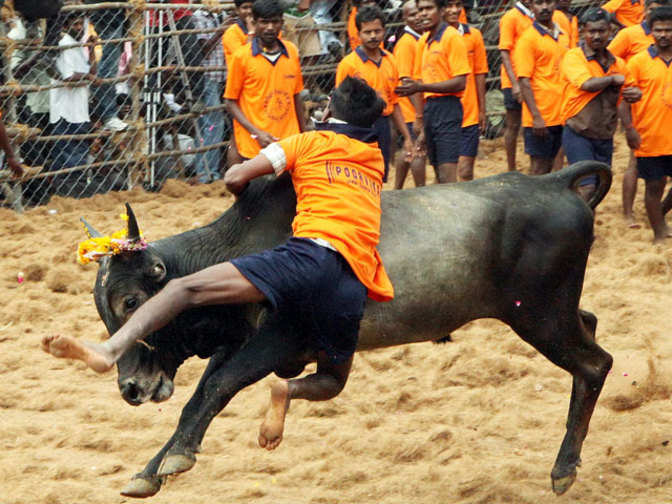
That’s the protest against a three-year ban on Jallikattu, a 3000+ year-old traditional Tamil sport characteristic of the Tamil Spring/Harvest Festival (Pongal) in which young men chase and wrestle down a fleeing bull to snatch money or gold tied to its horns:

In Tamil Nadu, Jallikattu is Veera Vilayattu or warrior sport, where a man matches wit and sinew with a raging bull and grabs a small bag of coins or Jalli, tied to its horns. The most daring among them twitches through the flaying horns and threshing hooves and hangs on to its hump as the animal completes a short lap of 50 metres. In the days gone, he would also win the daughter of the owner of the bull in marriage. It is about courage, masculinity, and above all, cultural ethos.”

Images of Jallikattu appear on Indus Valley seals, proving the ancient and indigenous nature of the tradition:

Indus Valley civilisation is known for being one of the most advanced and sophisticated amongs its contemporaries. The sport of Eru Thazhuvathal is celebrated so much that they decide to make a seal depicting the same.”

The Indian branch of PETA (People for the Ethical Treatment of Animals) and the Animal Welfare Board began their campaign to add Jallikattu to the list of activities banned under laws prohibiting cruelty to animals.

In 2014, a 2-member bench of the Supreme Court banned Jallikattu completely. 

A Bench of Justices K.S. Radhakrishnan and Pinaki Chandra Misra said, “Forcing a bull and keeping it in the waiting area for hours and subjecting it to the scorching sun is not for the animal’s well-being. Forcing and pulling the bull by a nose rope into the narrow, closed enclosure or ‘vadi vassal’ (entry point), subjecting it to all forms of torture, fear, pain and suffering by forcing it to go the arena and also over-powering it in the arena by bull tamers, are not for the well-being of the animal.”

But Tamil animal activists have joined bull-tamers and their aficionados to insist that the sport is not inherently cruel, despite occasional abuses.

They argue that the ban constitutes an intentional assault on Tamil culture by the Central Government.

What is clearly true is that the objective of Jallikattu is not harming or killing the bull, as it is in Spanish bull-fighting. People, not bulls, seem to be the main victims:

This is Jallikattu, an ancient and bizarre bull-wrestling sport that takes place in villages throughout Tamil Nadu every January to celebrate Pongal, a New Year’s festival that coincides with the ancient rice harvest. Though similar to and older than the Spanish running of the bulls, it’s bloodier. Instead of bulls getting killed, it’s the people. In previous years, as many as 20 young men have been fatally gored, and several hundred, including spectators, have been mauled, trampled or otherwise injure.”

Since the original impetus for the ban was the death in 2004 of a 14-year-old spectator, framing the issue as one of animal-rights versus human (read, masculine/patriarchal) cruelty is obviously misleading.

But that is how it has been framed, with the international animal-liberation movement taking a prominent role.

In January 2016, the head of PETA was detained by Indian police for blind-folding a statue of Gandhi in protest against Jallikattu.

Regarding the anti-Jallikattu activism, BJP gadfly and alleged Mossad mouth-piece Subramanian Swamy has charged that it is funded from abroad and is part of an Afro-Dravidian separatist movement intended to fragment India. He has insisted on a CBI investigation:

Bharatiya Janata Party leader Subramanian Swamy has alleged that protests organised against Jallikattu have been inspired from abroad and he intends to take the case to the Central Bureau of Investigation in terms of funding of the animal rights organisations.”

Far more germane to the issue than animal-rights is the question of indigenous farming technology.

Jallikattu is a tradition that ensures that certain skills (bull-taming without the use of a rope) are conserved among agriculturalists and certain traits (virility, strength, and speed) are conserved among indigenous breeds:

Male calves in other regions are sold and taken for slaughter in a few days. Only in regions where there are events like jallikattu are they kept. The owner of an imported cow will like it to deliver a female calf. If she does, it’s a windfall. If it’s a male calf then he will have no use for it and he has to feed it. It will go to the slaughter house for Rs. 500. A lot of mutton we eat is the meat of these under-one-week calves mixed with mutton. The same will happen to these native breeds if not for activities like jallikattu. With reduced availability of males, farmers will have to go in for artificial insemination, which is cost prohibitive and is directly in contravention of in-situ conservation. Unless there are bulls being bred and reared in the in-situ region, the genetic pool of the breed will not be healthy as no adaptation to changes in climate, local environment has been ingrained. We are messing with evolution when we abandon in-situ conservation with bulls and natural servicing/mating.

Native cows do not yield as much milk as the imported breeds. So they don’t have a supportive or sponsored breeding programme. Artificial means are not adopted for native breeds. So as a fall out of the banning of jallikattu, they will soon fade away and become extinct.”

Viewed against the back-drop of an incipient digital dictatorship inaugurated by the Modi demonetization fiasco, it becomes obvious that the ban on Jallikattu is not a distraction from, but a replication of, the ban on currency notes.

The cash ban, as I showed in an earlier blog-post,  was effectively a war on small and medium businesses and the indigenous financial sector.

That sector uses indigenous methods of financing (chit-funds, hawala, angadia payments, etc.), all of which depend on a combination of cash and promissory notes/back-dated checks.

Ban cash and you break the back of the native financial sector and the economy that depends on it.

Ban Jallikattu, likewise, and you break the back of native farming and cattle-breeding and the economy that depends on it.

This year, the Jallikattu issue has boiled up into open, state-wide protests around the Pongal season (the 4-day harvest festival in mid-January).

Pongal, by the way, means “boiling.”

State-wide Jallikattu protests, triggered by anti-Jallikattu activism and the arrest of thousands of pro-Jallikattu protestors – have become a stand-in for a spectrum of discontents –

*The unilateral imposition of demonetization on the country, causing untold hardship in drought-hit Tamil Nadu

*Income-tax raids that appear to target Tamil Nadu

*The suspicious but uninvestigated death of the charismatic and popular Tamil Chief Minister, Jayalalitha

*Apparent attempts by the BJP government to insert itself into  post-Jaya politics to gain a foot-hold in the important state

*The refusal of northern neighbor Karnataka to abide by a SC (Supreme Court) directive to share Cauvery River water with  drought-hit Tamil Nadu….

*The inadequate central government response to drought in Tamil Nadu

Despite these popular grievances, however,  there’s a lot more going on behind the scenes of what is being dubbed an undirected “people’s movement”.

ITEM

Tamil Nadu is the most industrialized of all Indian states along with Karnataka. Bangalore is the center of the software and outsourcing industry while there is a vast amount of foreign investment in TN’s Coimbatore and in Chennai, a manufacturing center.

Western intelligence agencies are active here, protecting the investments of the business class.

ITEM

Tamil politics has been the locus of foreign intervention ever since the British fostered the rise of Dravidian (south Indian) consciousness, by subsidizing the promotion of anti-Brahmin groups, out of which the DMK and the Anna DMK (to which Jaya belonged) developed.

A water-shed moment was reached during the Chief Ministership of famed film-star M.G.Ramachandran (MGR), who mentored Jayalalitha, reportedly his long-time mistress.

Under MGR, Tamil consciousness got a new, violent face, with the rise of the Tamil Tigers.  The Tigers, renowned as the world’s deadliest terrorists/freedom-fighters, began as a band of murderous roving bandits. Patronized by both the Mossad and Indira Gandhi, they eventually became a thorn in the side of the national government and one of their group murdered Mrs Gandhi’s own son, Rajiv, then the Indian PM.

The British also endorsed  a highly questionable racial narrative that pitted dark-skinned Tamils as the eternal victims of light-skinned Aryan and Vedic Hindus of the north, a narrative that is part of the Afro-Dravidian movement, which Rajiv Malhotra has identified as a Western strategy to create a Tamil secessionist state out of TN and NE Sri Lanka, home to a militant Tamil diaspora.

The Afro-Dravidian narrative in turn reinforced another fiction sponsored by imperialist ideologues – the Aryan invasion of India, a theory of the origins of classical Indian culture that has been discredited by genetic data and archeological records.

All this forces us to accept the following basic scientific fact: outside of Africa, South Asia contains the world’s oldest populations, and modern Europeans are themselves among the peoples descended from migrants from India, going back more than 40,000 years. This should be the starting point for studying history in the Holocene or the post Ice Age period.”

But, while PETA and other anti-Jallikattu animal rights groups are certainly funded from abroad,  there is evidence that the pro-Jallikattu groups are also well-funded, come mainly from Westernized student groups and IT professionals  savvy with social media in the well-known tradition of “undirected,” and “leaderless” people’s movements (Makkal Movement) that has become the new face of intelligence interventions.

Here’s more evidence of an intel connection:

1.  Both the PETA spokesman in India and anti-Jallikatu representatives have introduced the meme of “Arab Spring” into the public language around the protests. The Times of India, an elite media organ, was one of the earliest to insert the meme into Jallikattu discourse.

The Economic Times and a host of other major media outlets did so too.

2. The pro-J protests have been drawn from among relatively affluent, Westernized student groups in Chennai and appear well-funded.

3. The bull itself is the animal of Shiva and Shiva is identified by the world order as its presiding deity, using the popular but erroneous Christian identification of Shiva with Lucifer (which I have refuted on this blog).

On January 16, simultaneously with the Jallikattu uproar and the Pongal festival, in which the bull plays a prominent part, India became an associate member of CERN (the European Organization for Nuclear Research).

Outside CERN is a statue of Shiva in Nataraja pose (as a dancer, creating and destroying the worlds). The statue was recently depicted in a some kind of hoax video of human sacrifice to Shiva that was actually filmed within its precincts.

4. The protests have targeted the successors to Jayalalitha, CM Paneerselvam and Sasikala Natarajan, Jaya’s chosen Chief Secretary, for inadequate action on Jallikattu.

These are the same figures that the BJP itself has been interested in targeting, in an attempt to fracture the AIADMK and the DMK to secure control over the state.

5. The attacks against PETA were initiated by Subramanian Swamy, of the BJP, a known Mossad disinformation outlet.

6. The bull is identified with pre-Vedic Indian culture, supposedly presided over by a mother goddess,  associated with a snake and bull.  The mother goddess in the form of Shakti is the female counterpart of Shiva. The snake is identified with Saivite worship. For instance, the Naga (snake) sect in Tamil Nadu are Saivites.

Amma means mother in Tamil and was the name assigned to deceased former Tamil CM Jayalalitha. There is at least one important South Indian guru named Amma who is given great prominence in globalist initiatives like the fight against modern slavery and is featured by the UN.

Recently,  South Indian television networks have had a plethora of shows featuring snake-gods and humans who morph into snakes, including the popular serials, Mahamayi and Nagini.


RBI: DeMo Disclosure Endangers Life, National Security

From Gulf-News:

India’s central bank refused to share specific details of Prime Minister Narendra Modi’s ban on high-value banknotes citing danger to life and national security, as the mystery deepens over who took the unprecedented decision.
The Reserve Bank of India recommended the move, which was accepted by the cabinet and announced by Modi on November 8, Power Minister Piyush Goyal told parliament in November. The RBI board approved the ban three hours before Modi’s speech and hadn’t discussed the matter before, a slew of responses to Bloomberg News’s Right to Information requests show.
However, the RBI told a lawmakers’ panel this week that the government had “advised” the monetary authority to “consider” the ban a day before the RBI board made its recommendation. The government then “considered the recommendations” and decided to withdraw the notes, culminating in Modi’s address that blindsided the nation.
The cloak of secrecy that has shrouded the currency ban decision is likely to bolster the view that authorities, both on Mint Street and in New Delhi, were not prepared for such a decision and the way it was announced. It risks undermining perceptions of the central bank’s independence and raises questions about Modi’s decision-making style and his communication with the RBI.
More clarity may emerge when RBI governor Urjit Patel deposes before a parliamentary committee on January 20. Details are essential to help assess the success of the shock move as well as gauge the impact of the decision on Asia’s No 3 economy.
“It is very perplexing that the RBI doesn’t answer questions about how the decision was arrived at,” said Shilan Shah, Singapore-based India Economist at Capital Economics. “There are concerns that in the whole process the RBI has been sidelined by the government and that raises questions about its independence,” he said, adding that authorities have not been transparent. Bloomberg News asked the RBI 14 questions between December 8 and January 2. The central bank as of January 11 had answered five, disclosing the date and time of the RBI’s board meeting and the fact that the board had never discussed demonetisation before November 8. It said it doesn’t have information to answer one question, on how many of the worthless notes have been deposited at commercial banks. It transferred two questions on printing of new notes to organisations that manage the presses. The RBI said that a question asking “what prompted the board to discuss and approve the withdrawal of notes” doesn’t come under the definition of “information” under the RTI Act. It provided different answers to a question asked three times, seeking details on board members who opposed the move. In two replies the RBI said “it is a matter of fact that the decision was unanimous.” In a separate response, it said “this information is not available on record.” To a question seeking details on the number of demonetised notes already at banks on the evening of Modi’s speech, the RBI claimed an exemption, citing danger to the life or physical safety of anyone who disclosed this information to the public. The RBI also claimed exemptions on two questions seeking detail on its preparations for the demonetisation and studies it used to forecast the impact of the move. Sharing these “sensitive matters” would endanger India’s sovereignty, integrity and security, according to the RBI.
The use of those specific exemptions are “perplexing,” Capital Economics’s Shah said. Shailesh Gandhi, a former bureaucrat with the Central Information Commission, told the FirstPost website on December 31 that the RBI’s attitude of stonewalling smacked of “sheer arrogance.”
“What the RBI is doing by refusing to answer queries under RTI is denying citizens their fundamental rights,” Gandhi said. Lawmakers are also seeking answers. Parliament was gridlocked as the opposition demanded discussions and voting on the measures, the Supreme Court is hearing petitions against the legality of the steps, and two lawmaker panels have sought explanations from the RBI.
The decision to demonetise was taken only when the stock of new currency notes was reaching a “critical minimum,” enough to meet a significant part of demand, the RBI told a panel in a note accessed by Bloomberg News. However, the currency swap was riddled with rule changes and data that analysts have questioned. Patel will depose before another lawmaker panel on January 20, which is expected to seek his view on the impact of the demonetisation on India’s economy.”

Modi’s New Year Speech: More Black Money Lies

There were some big whoppers in Modi’s propaganda blast on New Year’s Eve, which I sat through so that you, dear reader,  would not have to subject yourself to the tedium:

MODI-SPIN:

$500 and $1000 rupees notes (the old notes that were banned) were mainstays of the black economy.

FACT:

That would make the vegetable vendor, fish-monger, housewife, pensioner, and local shop-keeper all “black,” according to monetary moron Modi.

Of course, they are not. What with inflation, those notes are practically staples of normal day-to-day cash transactions: payment of daily wage workers, repairmen, and vendors.

The TV repairman takes Rs. 750 for an hour of repair on the antenna.  It would be normal to use a 500 and a couple of 100s for him. TV’s are not signs of great wealth, but widely owned by lower-middle-class  and even working-class people. A visit to the hospital, shopping at the vegetable or fish market, repairing a leaky ceiling – all of these would routinely be done with the banned notes.

MODI-MYTH

Demonetization has helped the Income Tax Department uncover more tax-evasion and money-laundering rings.

FACT

The Income Tax Department does not need demonetization to conduct raids on suspected tax-evaders. They do that in the course of their normal routine. In fact, demonetization has added NEW  rings of money-laundering and enabled corrupt bank officials to make a buck changing black to white. That explains the huge stashes (hundreds of thousands to millions)  of the new Rs. 2000 notes being busted all over the country.

MODI-MYTH:

The hard part is over. Corruption, drugs, trafficking, porn, and all other evils are based on black money held in cash and they have all suffered a permanent blow. Ramrajya is here.

FACT:

The largest part of black-money is digitally circulated in and out of India through market avenues such as round-tripping and participatory notes, neither of which was even mentioned in the Modi speech.  Black money is parked mostly in foreign bank accounts, in real estate, and in gold and diamonds. Far from helping eradicate corruption, cash bans and digitilization make it much easier for large players (like the government, large corporate entities and criminals) to manipulate and steal money from the ordinary man.

The aam admi’s troubles have only begun. He is being ruthlessly herded, through bribes and threats, into digital platforms for which he and the Indian infrastructure are ill-prepared.

MODI-MYTH:

More cash deposited at the banks will bring down inflation.

FACT:

One of the biggest problems with targeting black-money, is the inflationary consequences of sucking money out of hard assets and foreign accounts. Once in the country, they are bound to increase the supply of money in the country and pump up inflation.

Demonetization just changes the part of the economy where cash circulates.

It moves cash from the informal sector and small businesses to the formal economy and big businesses and government (banks lending to developers and companies).

It penalizes the winners in the free markets (the small businesses) and rewards the  losers (developers-government-banks-large corporations) .

It reverses the decision of the market and replaces it with a mandate from the center.

More deposits in banks means more money available against which banks can make loans.

Indeed, recapitalization of  banks with huge non-performing assets (bad loans to big industrialists and developers) is one of the real reasons for demonetization, not eradicating corruption – a story put out to hoodwink the public.

One example. Is Modi going after Vijay Mallya of Kingfisher for non-payment of loans? Why, on the other hand, is he unable to waive loans that hard-working farmers have been unable to repay for reasons they cannot control – like the failure of rains?

And why is only Vijay Mallya mentioned in Indian media reports? Mallya is only a front for Rothschild interests….

in the same way that Khodorkovsky was a front for Rothschild interests.

What about the vast public sector loans made to the scion of the Tata drug-running fortune, Ratan Tata, a Rothschild cohort, to purchase   over-priced Corus steel (at $12.1 billion) on the advice of N. M. Rothschild, the merchant banker?

The purchase was made at the height of the commodity boom, only 6 years after Corus was a penny-stock.

Tata is another friend of the Rothschilds, getting low-priced loans from Indian public sector banks to help out Corus, and selling his cars in India at twice the price they fetch in the international market.

Corus, originally British steel, foundered on the demands of highly paid unionized British workers, with their plush pensions.

MODI-MYTH:

The main problem in India is corruption and dishonesty, a problem of culture, to be addressed forcibly by the government.

FACT:

Corruption or graft in India, as elsewhere, is a symptom, not a cause of India’s woes.

Behind the symptom is the real cause, which is is not cultural, but political: the replacement of a healthily functioning economy by a system of political patronage run from the center.

In a patronage system, WHO  you are and WHOM you know are more important that WHAT you do.

Instead of competing honestly for money, through providing better services, businesses are forced to compete for favor from the political class.

This necessity has dribbled down into the lowest-class from the highest.

Call it trickle-down graft.

Why is the center so influential?

Ultimately, it’s because of the life-blood of the economy – money – is controlled from the bank at the center – the RBI.

Furthermore, behind the RBI is a more remote but far more powerful center – the BIS.

Behind the BIS stands the great central controller, the globalist Rothschild cabal.

The prevalence of corruption in a society thus has little to do with the innate honesty or lack of honesty among people.

In a famous 2013 survey of major cities all over the world, the Reader’s Digest ((not known to be unfriendly to the West) actually found that when money-laden wallets were dropped on the road, the two cities where they were most often returned with the money intact and the reward refused, were Helsinki and Mumbai.

Notably, Helsinki is in Finland, which is ranked at the top of corruption-indices. Mumbai is in India, which is ranked toward the lower end of most corruption indices.

That says a great deal about such indices. It says even more about the divergence between the POLITICAL category of “corruption” and the MORAL category of honesty.

By deliberately confusing the two, practiced RSS propagandist Modi has dressed up  a thoroughly political project, a black operation hatched by the Anglo-Zionists,  in the swadeshi  (home-made) and swachha (white) robes of national health and morality.


Modi Revives Iconography Of Delhi/Hindi Empire

A fascinating and insightful look at the imagery and numerals on the new currency notes:

Reserve Bank of India has put up the designs of the new 500 and 2000 notes on its website. They confirm what many feared – that this design overhaul will be used to push certain iconographies that suit the incumbent BJP government. The difference between the old design and the new seem to be centered on three things: Hindi, Delhi and Narendra Modi.

The new currency notes introduce numerals in Devanagri script, the present script of Hindi. This was not the case in earlier version of the currency notes. Is it the case that the government thinks that only Hindi people should be able to read the numerals in a script they are familiar with while the rest of us, the non-Hindi majority, would not need to read numerals in our languages? Was there any complaint from any quarter than the stand-alone Arabic (or Hindu-Arabic as it is sometimes called) numerals in English script were not being able to do the job? Why was there no Hindi-Devanagri numeral before this? May be because it is actually unconstitutional and in contravention of a Presidential order. Article 343 of the Constitution of the Indian union states in no uncertain terms that, ““[t]he form of numerals to be used for the official purposes of the union shall be the international form of Indian numerals”. The only modification to this comes in the form of the 1960 Presidential order, which allows for “the use of Devanagari numerals, in addition to the international numerals, in the Hindi publications of the Central Ministries depending upon the public intended to be addressed and the subject-matter of the publication. For scientific, technical and statistical publications… the international numerals should be adopted uniformly in all publications”.

×


The present Government of India and the Reserve Bank of India should explain how all-India currency bank-notes fall within the category of “Hindi publications of the Central Ministries” and how does the choice of Devanagari satisfy the clause of “depending upon the public intended to be addressed”. Does the Government of India, and RBI exist to serve only Hindi speakers? They might believe so. But non-Hindi linguistic groups are bound to Hindi people and to each other, only by the compact of the constitution and not by the Hindi imperialist whims or ideologies of the union government and its agencies. …..

A proportion of the currency notes could have had numerals in Devanagari, a proportion could have had Bangla, a proportion could have had Tamil and so on, based on population proportion of citizens using those languages. This is the model of the Euro, where it is a single currency, but there are specific variants to accommodate the diverse stake-holders. But doing that or even the present usage of Devanagari would need a constitutional amendment. The BJP, in its efforts to impose Hindi, is reopening the wounds of 1965 anti-Hindi imposition struggles that have not been forgotten by non-Hindi peoples. In this regard, the British had done a much better job, where numerals all many South Asian languages were given equal footing in font size, vis-à-vis English. Thus English, Hindi, Urdu, Bangla, Tamil, Telugu, Kannada, etc all had same font size numerals on bank notes as evidenced in the 10-rupee currency note of 1910.

The new notes also have the new Indian currency sign. That sign, derived from the “R” letter in Devanagari, was not chosen with the consent of the people. In my language Bangla and also in Assamese, the word for the currency unit is Taka or Toka. That starts with “T”. How can then the “R” sound be a general stand-in for all of us? And how did this get into the new currency note? How would have “R” people felt if a symbol for “T” sound were used instead? How is the sound of the currency name for Hindi people more important than the sound for Bengali or Assamese people? One might argue that it is called Rupees in English and that has R. That too is without consent of non-Hindi people and is a term handed down by the British. In Bengal, almost everyone grows up calling their currency as Taka, same as what they call it in Bangladesh.

GOI 1

Such words are not categories of nationalism but words of everyday use. By downplaying them, a whole people are classified as second class. While English is a foreign language for all, Hindi is also a foreign language for all non-Hindi people……. In a diverse, federal Union of States, like the Indian Union, the legendary Tamil Nadu leader and Chief Minister had laid down a principle that every citizen must share advantages and disadvantages equally. The usage of Hindi/Devanagari violates this fundamental principle of peaceful coexistence and cooperation as it is not equidistant from all stake-holders and give undue advantage to those for whom this is the mother-tongue and standard script. English provides that equal distance. The Indian union itself is the product of coordination and cross-linking of disparate ethno-linguistic nationalities mediated by English knowing elites of their respective groups. Most trans-linguistic discussions on political issues in the Indian union happen in English.

Thirdly, the actual proportion of area or real-estate on the currency note that is given to Devanagari vis-à-vis other language scripts has gone up. This is a very serious affair. The relative space and size of Devanagari-Hindi things vis-a-vis our non-Hindi mother tongues reflects exactly what New Delhi thinks of the rest of us vis-a-vis Hindi. And there is a temporal pattern to it that has gone from equality to inequality…… This marginalisation of non-Hindi languages has continued unabashed. The equal proportion to all South Asian languages in the 1917 bank note as well as the 1940 bank note was replaced by a currency series that continued for the longest time after the 1947 transfer of power that privileged Hindi over everything else. 1947 sadly marks the watershed year for the loss of status for non-Hindi languages. … The pace of that has visibly quickened with a militant edge under the present BJP regime in New Delhi.

GOI2

Thus, in RBI issued currency notes, Hindi-Devanagari words are big and are supposed to carry information. Non-Hindi language scripts are progressively smaller and are basically decoration with no practical use except for non-Hindi citizens to console themselves that “diversity” is alive, though certainly not kicking. …..Hindi mother tongue people form about 25 percent of the Indian population – that number too is arrived at after counting various linguistically non-Hindi languages as Hindi, because New Delhi orders so according to its political agenda.

Fourthly, the new currency notes do not have all the scripts of all the languages recognised in the VIII Schedule of the Constitution. Santhali is an example of an VIII Schedule language with its own Olchiki script that remains unrepresented in the currency note. Sanskrit with less than 20000 self-reported speakers is represented while Santhali with nearly 70 lakh speakers is not. The same goes for Meiteilon (Manipuri), which is an VIII Schedule language with its own script. The new currency note was an opportunity to include Santhali and Meiteilon but clearly Hindi and its expansion is the only driving force in the linguistic changes. People should know that the Indian union government considers languages to be a security issue! Which is why language groups and their scripts have to have their official stamp of recognition and approval from the Union Home Ministry.

…..As we speak, the union government is forcing small linguistic groups to adopt Devanagari as their official script and withholding recognition if they don’t agree. Thus, we find the absurd situation where speakers of Bodo, whose territorial homelands are not connected to any Hindi region, have been forced to adopt Devanagari. Thus, Hindi majority bureaucrats in the union government are killing the autonomous choice of a linguistic group in deciding their own future. And the government is shameless enough to celebrate International Mother Language Day.

The old currency notes tried to avoid location-based political symbolism except for the Parliament House in the denomination of 50 that arguably is for all. However, the Red Fort of Delhi in the new 500 denomination touches a raw nerve for many. The Red Fort was the political headquarters of the Mughal Empire for a long time.

[Lila: To me, this is more proof that Modi is actually posturing when he engages in sabre-rattling about Islam. One notices that he is quite obsequious to the Saudi ruling class…..the NWO uses Islam as a proxy for its own goals, witness the use of Islamic migrants to spearhead a movement to deconstruct European culture.]

Indian union came into existence in 1947. It is not a successor state to the Mughal Empire. The Red Fort is a sign of pre-British Delhi-based imperialism, signifying the power of imperial invaders who attacked the countries of Bengalis, Marathis, Axomiya, Odiyas and many others. Our ancestors resisted such invasions but Delhi won by brute power. Imperial Delhi ruled by posting mostly Hindi/Urdu speaking military people in our homelands…….

The use of the “Swachh Bharat Abhiyan” (Clean India expedition) logo accompanied byits Hindi slogan in Devanagari script crosses all limits of propriety. Never before has a government put one of its own schemes on something as non-partisan and common as a currency note. This mischief would basically result in an advertisement of the present government for all times to come, till these currency notes are withdrawn. This is certainly not illegal but not all shameless things aren’t illegal. This starts a very unhealthy precedent. Now, nothing stops any later day union government to use currency notes as their pet scheme advertising billboards. The abuse started earlier during the Congress regime with the use of the face of MK Gandhi, who was associated with a particular party that is still in business and were opposed by other parties who are also still in business.

Narendra Modi announced the new currency notes after the 500-1000 demonetisation announcement. His address was in Hindi, without any subtitles and then in English, with Hindi subtitles. So, the union government does care whether Hindi speakers comprehend the English speech but doesn’t care whether the majority of the citizens, that is, non-Hindi-English speakers understand anything at all. This imperial attitude, that treats a majority of the citizens as second class, was furthered by all PSU (that is New Delhi controlled) banks that mostly did not care to print any information for the public in their mother tongues. Last heard, the new currency notes do not match the structural specifications of the ATM machines all over. Since the top-down imposition of currency notes by New Delhi is sacred, all the ATM machines have to be structurally changed to match and fit what New Delhi has produced. “

Defects In New Notes Enable Counterfeiting

The new $500 rupee notes are reportedly defective:

In its hurry to meet the demand for new notes, the Reserve Bank of India has made major errors which can have serious consequences for the demonetisation exercise. The gaffe — RBI has printed two variants of the new Rs 500 notes.

According to a report in The Times of India, the newspaper has seen at least three case studies where the new Rs 500 note varied from each other. According to one customer quoted in the report, Gandhi’s face has a more than visible shadow. Apart from this, he has pointed to alignment issues with the national emblem and also serial numbers.

×

Reuters

Representational image. Reuters

Another Mumbai resident has told the newspaper that the colours of the notes he got were different. The report has cited one more such instance of variation.

Meanwhile, a RBI spokesperson has termed them as “printing defects” that have propped up because of “the current rush”. She has also said people can still freely use it for transactions or even return it to the central bank.

One thing is for sure: the same note with different features would mean confusion for the common man. It will be easy for the ‘experts’ in counterfeiting to cash in on this confusion.

How is the common man to know whether the Rs 500 note he has is indeed original or fake? It has to be remembered that the fake note circulation has been rampant in India despite the RBI’s frequent notifications on how to detect such notes.

Clearly, the awareness level among the general public about the security features of currency notes is very low. Notes with slight variations in features will only add to the confusion about the features.

Announcing the decision to withdraw Rs 500 and Rs 1,000 notes and issue new ones on 8 November, the prime minister had said that the move was aimed at destroying the counterfeit racket, ending terror funding and also stop black money generation.

If the haste has resulted in errors that will only facilitate counterfeiting, then it will kill the very objective of the demonetisation exercise.

[Lila: I beg to differ. It is very clear to me that the objective of demonetization was to attack and destroy the cash economy and facilitate further such attacks, requiring more and more digitalization and police state measures.]

Interestingly, the RBI had published on its site the security features of the new Rs 500 notes before the notes came into circulation.

It will be better for the RBI to find some practical solution to the problem before any damage is done.”

The defects in the news notes, added to the introduction of Rs 2000 note, as well as reports of new types of black markets emerging in relation to the note-ban, substantiate my theory that note-bandhi is a weapon OF the counterfeiters and of the black money of the global cabal.

It is intended to be used against economic and political opponents SELECTIVELY.

Thus, income tax raids have become a tool to crush selective mafias.

Most fascinatingly, THE ENEMY IS THE HINDU. 

This underscores once again that the elevation of Hindi and Delhi is an elevation (by the global corporatists behind Modi) of language and location, but not of Hindu religion and culture.

It is an elevation of the middle-class Hindi- speaking constituency of the BJP , not of Hinduism.

The ban on notes was intended to crush the black money channels of the political and economic competitors of the globalists.

But, it was also intended, it seems, to facilitate money-laundering and counterfeiting by the current government and its friends, hence the repeated back-tracking and confusion; the defective counterfeit detection machinery; the pressure placed on the banking system.

We saw the same sort of selectivity during the 2008 economic collapse in the US.

At the time, what the major media termed a bail-out and transfer of toxic assets turned out to be a form of inter-bank cannibalism, with the tax-payer footing the bill.

Something similar is at work here.

I firmly believe that the notes being inserted now will be counterfeited and that will compound the confusion about numbers coming from the RBI.

The chaos will make the insertion of excess notes very easy.

We could then have massive inflation, despite inflation-targeting policies on paper.

This will be more economic and financial war…terror…brought to the aam admi in India.