Did This 14 Year Old Invent Email?

V.A. Shiva Ayyadurai's Personal Statement on Invention of Email

Shiva Ayyadurai, a 14 year old, holds the patent for the computer program we know as EMAIL. But the story doesn’t end there. Many disputed his claim.  Professors, organizations, research outfits all tarred him as an exaggerator and liar. They claimed email existed before Shiva. But did it? Or was an industry threatened by the fact that invention can take place by anyone anywhere….

InventorofEmail.com:

“In 1978, a 14-year-old named V.A. Shiva Ayyadurai developed a computer program, which replicated the features of the interoffice, inter-organizational paper mail system. He named his program “EMAIL”. Shiva filed an application for copyright in his program and in 1982 the United States Copyright Office issued a Certificate of Registration, No. TXu-111-775, to him on the program. As required by the Regulations of the Copyright Office, he deposited portions of the original source code with the program. Prominent in the code is the name “EMAIL” that he gave to the program. He received a second Certificate of Registration, No. TXu-108-715, for the “EMAIL User’s Manual” he had prepared to accompany the program and that taught unsophisticated user’s how to use EMAIL’s features.

Recently however, a substantial controversy has arisen as to who invented email. This controversy has resulted in an unfortunate series of attacks on Shiva. Part of the problem is that different people use to the term to mean somewhat different things.

In the summer of 1978, Shiva had been recruited for programming assignments at the University of Medicine and Dentistry of New Jersey (UMDNJ) in Newark, New Jersey. One of his supervisors, Dr. Leslie P. Michelson, recognized his abilities and challenged him to translate the conventional paper-based interoffice and inter-organizational communication system (i.e., paper-based mail and memoranda) to an electronic communication system.

 Systems for communications among widely dispersed computers were in existence at the time, but they were primitive and their usage was largely confined to computer scientists and specialists. Shiva envisioned something simpler, something that everyone, from secretary to CEO, could use to quickly and reliably send and receive digital messages.

 Shiva embraced the project and began by performing a thorough evaluation of UMDNJ’s paper-based mail system, the same as that used in offices and organizations around the world. He determined that the essential features of these systems included functions corresponding to “Inbox”, “Outbox”, “Drafts”, “Memo” (“To:”, “From:”, “Date:”, “Subject:”, “Body:”, “Cc:”, “Bcc:”), “Attachments”, “Folders”, “Compose”, “Forward”, “Reply”, “Address Book”, “Groups”, “Return Receipt”, “Sorting”. These capabilities were all to be provided in a software program having a sufficiently simple interface that needed no expertise in computer systems to use efficiently to “Send” and “Receive” mail electronically. It is these features that make his program “email” and that distinguish “email” from prior electronic communications.

 Shiva went on to be recognized by the Westinghouse Science Talent Search Honors Group for his invention. The Massachusetts Institute of Technology highlighted his invention as one among four, in the incoming Freshman class of 1,040 students. His papers, documenting the invention of EMAIL were accepted by Smithsonian Institution. These are facts based on legal, governmental and institutional recognition and substantiation, and there is no disputing it.

 Standard histories of the Internet, however, are full of claims that certain individuals (and teams) in the ARPAnet environment and other large companies in the 1970s and 1980s “invented email.” For example, the familiar “@” sign, early programs for sending and receiving messages, and technical specifications known as RFCs, are examples of such false claims to “email”. But as some claimants have admitted, even as late as December 1977, none of these innovations were intended to emulate the paper-based mail system – Inbox, Memo, Outbox, Folders, Address Book, etc.

 Sending text messages electronically could be said to date back to the Morse code telegraph of the mid 1800s; or the 1939 World’s Fair where IBM sent a message of congratulations from San Francisco to New York on an IBM radio-type, calling it a “high-speed substitute for mail service in the world of tomorrow.” The original text message, electronic transfer of content or images, ARPANET messaging, and even the “@” sign were used in primitive electronic communication systems. While the technology pioneers who created these systems should be heralded for their efforts, and given credit for their specific accomplishments and contributions, these early computer programs were clearly not email.

 Based on false claims, over the past year (since the acceptance of Shiva’s documents into the Smithsonian), industry insiders have chosen to launch an irrational denial of the invention. There is no direct dispute of the invention Copyright, but rather inaccurate claims, false statements, and personal attacks waged against Shiva. Attackers are attempting to discredit him, andhis life’s work. He has received threatening phone calls, unfair online comments, and his name and work has been maligned. It is but a sad commentary that a vocal minority have elected to hijack his accomplishment, apparently not satisfied with the recognition they have already received for their contributions to the field of text messaging. Following the Smithsonian news, they went into action. They began historical revisionism on their own “History of Electronic Mail” to hide the facts. They enlisted “historians” who started discussions among themselves to redefine the term “email” so as to credit their own work done prior to 1978, as “email”.

[Lila: This was my own experience with the couple of stories I came up with that got hijacked by the national media….it’s why I tend to sympathize with Shiva – although I’ve not researched the story enough to know the details. 

More blatantly, they registered the InternetHallofFame.Org web site, seven (7) days after the Smithsonian news and issued a new award to one of their own as “inventor of email”. Through the PR machine of BBN (a multi-billion dollar company), they were proclaimed as the “king of email”, and “godfather of email”. These actions were taken to protect their false branding and diminish the accolades and just recognition Shiva was beginning to receive.

Shiva’s news likely threatens BBN’s entire brand, which has deliberately juxtaposed “innovation”, with the “@” logo, along with the face of their mascot, the self-proclaimed “inventor of email”. They have removed damaging references to eminent Internet pioneers of the time such as MA Padlipsky who exposed their lies, and showed that BBN’s mascot, was not the “inventor of email”.

 Some industry insiders have even gone to the extent, in the midst of the overwhelming facts, to now attempt to confuse the public that “EMAIL” is not “email”. It is a fact that the term “email”, the juxtaposition of those five characters “e”, “m”, “a”, “i” and “l”, did not exist prior to 1978. The naming of the software program EMAIL in all capitals was because at UMDNJ, the names of software programs, subroutines and variables written in FORTRAN IV used the upper-case naming convention. Moreover, at that time, the use of upper case for the naming of programs, subroutine and variable names, was also a carry over from the days of writing software programs using punch cards. The fact is EMAIL is email, upper case, lower case, any case.

 Sadly, some of these individuals have even gone further, deciding that false allegations are insufficient to make their case and have resorted to character assassination of the most debased nature including removal and destruction of facts on Wikipedia to discredit Shiva as an inventor of any kind. Threatening and racist emails telling him “to hang himself by his dhothi”, blogs referring to him as a “flagrant fraud”, and comments that EMAIL was “not an invention” are beyond disbelief, and reflect a parochial attitude that innovation can only take place in large universities, big companies, and the military. As MIT’s Institute Professor Noam Chomsky reflected:

“The efforts to belittle the innovation of a 14-year-old child should lead to reflection on the larger story of how power is gained, maintained, and expanded, and the need to encourage, not undermine, the capacities for creative inquiry that are widely shared and could flourish, if recognized and given the support they deserve.“

Of course a claim such as “I invented email” will leave anyone open to criticism and doubt, and as some suggest “hatred”. In this case, the victim has not made a “claim”, but rather been recognized by the government and top educational institutions in the world as an inventor. Regardless of the vitriol, animosity and bigotry by a vocal minority, a simple truth stands: email was invented by a 14-year-old working in Newark, NJ in 1978.

This is a fact. Innovation can occur, any place, any time, by anybody.”

As much as I’ve criticized Noam Chomsky for certain aspects of his work and although I tend to believe Dr. Coleman’s view that Chomsky is affiliated in some way with intelligence, I give the man great credit for always standing up for the individual against the establishment.

I’d love to know more about this whole story. To me Shiva’s contention sounds entirely credible, and he has the documentation and the patent to prove it.

From my own experience of  media revisionism, this is one of the many ways in which the establishment “writes out” anyone they don’t want to credit, especially, let me be frank, anything created by  non-whites. 

Even accounts of the history of the internet insist on seeing it as solely the creation of the US defense department, whereas the facts show it to be a complex development involving people from many countries (Belgium and France among them),  and involving private organizations and  lone individuals just as much as the government.

What is the importance of this history and how it is written?

Simply this. By constantly revising the real history of invention, the government, especially the US government, props up a false, supremacist narrative of the world that allows it to claim the net as its special domain, and any freedom on it as only a  grant generously given to the world that can be rescinded at any time. The implication is clear.

If the world doesn’t pay obeisance, the government has a right to clamp down on the net, because it created it.

Blogging Skirmishes, Donkeys, and Chomsky’s Taxes..

Some weird things have been happening to my blog….minor, but worth recounting.

First. A week or two ago, my blog was suspended because of a huge amount of spam that got sent my way.  That happened just after my first posts questioning the Gupta trial verdict. Not to worry, I told myself, can happen to any blog. Of course, in five years, it’s never before happened to my blog….

Second.  A video that I had posted on my blog was deleted….I didn’t delete it. Then that video shows up posted on a friend’s blog. The exact same thing happened last year, with another video that I didn’t delete either, which someone deleted from my blog.

OK. Petty harassment.

Third.  I opened my admin panel and found someone else added as a user. I didn’t add the person’s email.  So I deleted it. Next day, another user was added. I deleted it again.

Fourth,  I make a habit of searching my name to check blog comments or follow ups.  When I click the tab BLOGS on the side of the search, the top link these days  is to Veterans Today, where an error notice pops up saying an article apparently written by me has been taken down.  I’ve not written anything for VT since February 2011 and only wrote a few pieces for them, anyway. I asked them whether there was anything with my name on it on their site these days, they said no. So this is a google cache that someone is sending to the top of blog comments, for some reason.

Fifth. My blog posts show up in searches of Rajat Gupta, usually in the first two pages, sometimes quite high up.  In the last few days when I clicked on them, I found they were all set to private. I haven’t set any of those posts to private.

It’s possible that when updating the entire blog might have gone to private a few times, but why would individual posts change to private without my doing anything?

The posts that changed to private were all controversial ones:

One about Chomsky being for taxes for other people, but not for himself.

One about gold holdings by different countries, showing that India and China have much less than the developed countries and suggesting neo-colonial motives in manipulation of gold and currencies.

One about Goldman knowing all about Galleon and Gupta being a patsy ( a recent one)

Since I blogged, they’ve all been changed back. But I took screen shots,  so it’s not imagination or paranoia.

And a few other things.

I noticed at least one mainstream paper in India responding almost point for point to concerns about the trial I’d raised in my blog.

And then there was the Tahrir Square video on Gurcharan Das’s blog, which, as I said, was on the home page when I blogged it, and then the next day was hidden.

The internet, friends, is not an unalloyed force for good.

No more than TV was.  It is not instant liberation, as naive people like to say it is.

Heartwarming to say things like that. Not terribly true.

Something is good only in proportion to the motives with which it used.

The many well-intended people who use the internet do  make it a force for good.

Unfortunately, the net is also teeming with intelligence operatives, criminals, sting-operations, fakes, frauds,  and  police-state busybodies, who do not ever let really spontaneous interchange take place. They must have a thumb on the scales and rig the deal. They must manage the outcome so it goes in their favor….

Or supports their agenda.

Part of which is to lull people into a false sense of power and security on the net, so they put all their information out there. This is do-it-yourself surveillance. 24/7 and updated by the second.

Radical transparency is the carrot.  The internet kill-switch is the stick.

Either way, the donkey moves forward.

And when one donkey moves forward, so do all the others.

The net appeals to the herd in us.

Internet herds are no less herds because they are electronic. Think about the electronic trading that stampedes the market this way and that.

The internet may liberate us.

Equally, it may enslave us.

Right now it’s 50-50.

These days  I’d say  all bets are off.

Globalist Power In America

Jeff Thomas in LRC:

The Patriot Act (Passed in 2001 and extended in in 2011 with additional controls) expands law enforcement powers and removes civil liberties and constitutionally guaranteed rights. www.renewamerica.com/columns/webster/090419

The National Defense Authorization Act, passed on 31st December, 2011, allows the indefinite imprisonment by the military of any “suspects” (including American citizens on American soil) without allowing due process of law. www.en.wikipedia.org/nationaldefenseauthorisationact

The MAP-21 Bill, which allows the Internal Revenue Service to suspend the passport rights of Americans, based on the premise that their tax obligations may be unfulfilled. www.losangeles.cbslocal.com/2012/IRSbill

The National Defense Resources Preparedness order, created in March, 2012, allows the President to take over control of all food, water, labour and industry in the US, “to promote national defense.” www.naturalnews.com/035301/Obamaexecutiveorders 30,000

Drones to fly over the US allowed by executive order, February, 2012, providing the government with an Orwellian surveillance ability and a killing capacity ranging from selected individuals to entire communities. www.wsws.org/articles/2012/jun2012/pers-j21.shtml

FEMA Interment Camps, to be constructed in every state, with 3 – 15 in each state, for an undisclosed purpose. www.americanthinker.com

Compounds to store “disposable coffins,” each with hundreds of thousands of 4-5 person coffins stored near city centres around the country. www.youtube.com/watch?v=ERaw6AW7Zec

450 million hollow point bullets ordered by the Department of Homeland Security To be used domestically. (The DHS is not responsible for addressing national invasions or overseas wars; it exists solely for the control of internal disorder. Hollow point bullets are not intended for sharpshooting – they are designed specifically to maximize tissue damage.) www.articles.businessinsider.com

Comment:

If this doesn’t wake up people, I don’t know what will.

Print it out. Plaster it everywhere you can. Pass it to people who don’t read the papers, or people who only listen to Mark Levin (grrr-rrr).

I am emailing it to friends in India, who think of me with amused benevolence as some kind of  harmless loco, like one of those rural preachers scaring their flock about the second coming.

If it’s so bad, they tell me, why does everyone want to go to America? Why are people falling over themselves for a green card?

[In the last decade of liberalization, India has become one of the most pro-American countries in the world.  Pro-capitalist too, from the soaring  sales of Ayn Rand’s books there.]

So this is for all of you ammas and appas, thaathas and  paatis, annas, thambis, thangachisbhaiyyas who are always saying things like –

“Why do you want to blog about such things?”

“Arrey, you’re asking for  big trouble.”

“They are not going to like some foreigner writing about their government. Just stop it.”

“Probably there’s a reason if the government is doing it.”

Here’s my answer to all of you:

Green cards are not everything.  Yes, the Indian passport is one of the most restrictive in the world. Yes, the rupee has fallen recently like no other currency. Yes, there are  current cuts for hours,  continual carnage on the roads,   filth on the streets,  bureaucratic muddles that put Kafka to shame, and whole-sale corruption.  But poverty and inefficiency has its uses. The Indian government hasn’t got the resources to police the entire country as they do here. The black economy there is too powerful to be destroyed. The criminals out of power keep the criminals in power in check.  It is a murky compromise. But it is a compromise.

Here, there is no compromise.

Here, there is only the razor-edge uncompromising division between us and them,  true and false, good and evil.

Here, we cannot compromise with evil, because we cannot find it within us, only outside, out there, in the other fellow.

And so we have given evil a name and a place, and we have made an appointment to meet it. We have loaded the bullets and sharpened the knives.

We have dug the grave in which we will bury it.

Now nothing will stop us from keeping our appointment.

Even though that grave may  become our own.

Obamacare: Bad From Every Angle

David Lindorff at Oped News points out that people on the left should also  be upset by the Supreme Court ruling on Obama care, equating a penalty with a tax. I guess if  the government decides to make  people tattoo 666 on their foreheads, as some maybe not-so-batty-after-all people fear it might, that could be constitutional too.

Not since the commerce clause has there been a  semantic theory so convenient for overreaching executives.

“On the downside for Obama, he goes into the final four months of the election campaign saddled with a decision that says he has raised taxes on some of the nation’s poorest people –– for that is what the court said will be happening, 18 months from now, when the health insurance mandate part of the new Act takes effect, and people who have no employer-provided health plan, and no other kind of coverage, fail to buy a policy for themselves and their families.  They will be socked with a bill by the IRS, and while the Obama administration and supporters of the act in Congress were at pains to say that the payment such people would be hit with would be a fine, the Justices in the majority were adamant that it would be a tax………

..The real losers in the latest Supreme Court decision, however, are the people of the United States. Not those who will be required to go out and buy some over-priced, minimal coverage, rip-off insurance plan offered by the private insurance industry, or to pay a “tax” to the IRS for not doing so, but everyone…”

Comment:

This is just a gift to the insurance industry, probably the industry most responsible for soaring costs in every field.

And it’s a blow to young people, who can often get by with just catastrophic coverage. It also hits people who are fine with self-medicating or using cheaper alternative resources.

Finally, it’s a huge blow to small businesses, the engine of job-growth.

With the economy struggling, you’d think that would be a consideration. But it wasn’t.

People are going to think twice about hiring now.

That means fewer young people are going to find jobs…..

If I were young,  this has  to be the point where I pack my bags, get my passport stamped, and hop onto the first cheap flight out of the country.

Rajat Gupta: Harassed After Objecting To Rakoff Rulings

I’ve copy-pasted the following posts from the blog of Benula Bensam, the 24 year old Indian-born American and law student, who sent Judge Rakoff letters discussing the basis for his rulings on the evidence in the Gupta case. Rakoff reprimanded her and told her to stop.  When Goldman CEO Lloyd Blankfein showed up in court to testify for the prosecution, she was asked to leave and her cell phone was confiscated by federal marshalls. Apparently, she was also photographed by the marshalls.  Rakoff says he didn’t know about the intimidation by the court officers.

She stopped blogging and took down her old posts, but the three letters she sent to Rakoff still remain up. Here they are:

[I can’t use the insert links function on my blog, so I am forced to just copy-paste the material without editing]


  1.                 Although the daily posts of the Gupta trial have been discontinued and old posts removed, I will be silently steadfast against the U.S. Marshalls’ tactics of intimidation by continuing to attend the hearings.
     
                    To have an open debate about the three letters addressed to Judge Rakoff which precipitated the involvement of the U.S. Marshalls, I have posted them here. The first was delivered typed but the last two were transcribed to hand print because of problems with my home printer so there may have been slight changes made to choice of words in the process of that transcription. 
     
    June 7, 2012

    Note on timestamp:
    The timestamp on this site was incorrect when these posts were published.
    Note on press coverage:
    There were varying degrees of accuracy in the reporting of the statements I made to the press. There were favorable articles of me in reputable papers that did not accurately state or quote what I said. There were rather critical articles from less reputable papers that nevertheless accurately stated what I said.
    June 9, 2012

    Posted 3 weeks ago by
     
  2. To: Judge Rakoff
    Date: June 4, 2012
    Re: Expectation of a benefit


                In Friday’s finding that the expectation of some monetary return for supplying insider information is sufficient to meet the “benefit” element of an insider trading crime, I wondered if it was relevant only for the conspiracy to commit the crime or for the actual crime as well. Perhaps the disparate results of two similarly situated Defendants where one profited from the insider information and the other did not for extraneous reasons such as other market forces or trader skill, would influence such a decision.


    Sincerely,
     
    Benula Bensam
    Posted 3 weeks ago by
     
  3. To: Judge Rakoff
    Date: May 29, 2012
    Re: Co-conspirator theory
     
     
    Phone calls from the McKinsey office and a call from Switzerland were used to find a conspiracy of insider trading but the evidence may only have established the identity of the caller to be Gupta (out of all other possible tippers to which Rajaratnam had access) without establishing an intent. Rather, intent was assumed in this admissibility hearing. The fact that Gupta may have been close friends with Rajaratnam does not allow for a direct line of reasoning between identity and intent (although the Defense’s central argument is that the two did not have a close relationship) or where the contents of the conversations are unknown (perhaps the FBI did not have many “pertinent” calls between Gupta and Rajaratnam not because they did not frequently speak but because their conversations were personal and benign; the tape played regarding Goldman’s consideration of an AIG option may only show Gupta’s mistaken belief that strategies not pursued or rejected are confidential no longer). Unlike the sinking of a ship off the coast of the European continent to collect insurance payoffs (DeGeorge case- prior criminal acts used to prove identity alone; analogous to the Swiss call to augment the admissibility of the McKinsey call), the act can not be directly linked to the consciousness of wrongdoing.


    Sincerely,
     
    Benula Bensam
    Posted 3 weeks ago by
     
  4. To: Judge Rakoff
    Date: May 24, 2012
    Re: William W. George and “Confidential” information
     
    Although you admitted it was a bad example, an analogy was made to narcotics crimes where some third person may testify to their understanding of “sugar” in order to prove that a defendant would also have known of the cocaine. While the meaning of “sugar” to those in the narcotics trade has a definite meaning because it refers to some physical, tangible object, the meaning of “confidential” information does not have any definite form. So, there may be an understanding of what “confidential” means to people at Goldman Sachs but this meaning may or may not be the same as the meaning of the word in the criminal statute defining insider information. One may assume that Goldman’s Code on confidentiality may be more stringent than the statute and thus any violation of Goldman’s Code would be a violation of the statute, but this assumption can not be automatically made and perhaps should be left for the jury to determine. Another problem is that even the understanding of what “confidential” information means in the context of Goldman’s Code may be varied amongst those at Goldman Sachs. There was for example, no printed disclaimer at the beginning of the Goldman Sachs Board meeting in Russia that all is “confidential” (and even if there were such a disclaimer, it would only present a rebuttable assumption of confidentiality).
     
     Perhaps the best solution would be to allow the prosecution to ask William W. George,
     1. Did he speak about the any part of the communications made in the Board meeting with anyone who   
         was not at the meeting?
    2. If not, did he feel that he was at liberty to do so if he wished?
     3. Did he hear at anytime any others present at that Board meeting discuss the information presented
        at that meeting with anyone not in attendance? (This last question may be modified to
        avoid hearsay problems).
     
     This would allow the jury to decide whether or not to draw the inference that if another member of the Goldman Sachs Board felt the information related to have been confidential, Gupta would also have taken this view (Is there a possibility that the witness may plead the 5th?).
     
    The words ‘“confidential” information’ should NOT be categorized as industry jargon; it is not precise enough (as “sugar” or “FINS” or “tape” or even “LOL”) to constitute industry jargon.  This is especially important where in the context of this case, “confidential” is a legal term, a term in common use, and a term in a company’s Corporate documents.
     
    Sincerely,
     
    Benula Bensam
    Posted 3 weeks ago by
     
  5. I was sent out of the courtroom today by U.S. Marshalls. They refused to return my cell phone and took a picture of me using their camera phone over my objections.

    Should I protest outside of the Courthouse? Tomorrow?

    Posted 4 weeks

BREAKING NEWS: Google CEO Charged With Criminal Conspiracy

Breaking News:

The Central Bureau of Investigation (CBI) in India has announced that following on secret multi-year wire-tapping of American-born CEOs with companies operating in India, Larry Page has been charged with multiple felonies, including criminal conspiracy, conspiracy to defraud, racketeering, invasion of privacy, espionage, theft of intellectual property, and copyright violations. Mr. Page has surrendered at his house to Interpol..

A spokesman for Google said that the charges were related solely to Mr. Page and had nothing to do with the company, which is cooperating with the Indian government.

Mr, Page was alleged to have used subordinates to alter and delete posts, engineer google results, and other wise harass bloggers, such as Daniel Brandt,  critical of the power elite.  Unfortunately for him, the bloggers kept a file on him worthy of the CIA itself, and he is now looking at a class-action suit in the millions.

I guess he should have followed his own advice – don’t be evil….

[This is satire intended to mock the “justice” administered to Rajat Gupta by the  kapos of the ruling mafia.  On the other hand, it’s perfectly true that Google does engineer its results,  has harassed and shut down Mr. Brandt’s “Scroogle” site,  has invaded the privacy of millions of people through Google Streetview, and many of its other applications, has been credibly alleged to be involved in espionage for the state,  and does violate copyright continuously.  We urge Mr. Page to reform his company and think a bit about how he and his family would like it if the kind of  harassment his Frankenstein monster enables were turned on him, just for a moment.] 

Rajat Gupta: Goldman In On Galleon Trading

WallStreetManna, a seasoned observer of the ongoing crime scene that is Wall Street, points out that pretending that Gupta was the only one at Goldman in a chummy relationship with Galleon is eye-wash. Galleon, like Madoff, was turning in returns too good to be true. Everyone had to have known.

Unlike Madoff, of course, Rajaratnam didn’t bilk his investors. They got all their money back, plus profits.

But the point still holds.

Galleon was just one of a number of  “under the table” relationships Goldman cultivated with hedge-funds and other favored operators, like…

…well, like the mysterious “self-made billionaire” Jeffrey Picower,  who died of a heart-attack just as the Madoff ponzi unraveled and just as he went from being a self-proclaimed victim to a suspected accomplice, if not master-mind, whose billions sat in an account managed by none other than Goldman Sachs.

“Now I compared Galleon’s returns to Madoff’s. What did the beneficiary of Madoff, to the tune of $7 billion, Jeffry Picower do, the minute he “found out” Madoff was a fraud?

He closed the Picower Foundation. Even though he could have easily kept it open. After all, didn’t he make $7 billion, that we found out later? He must have wanted it closed!

What did Raj do immediately after he was accused by prosecutors? Isn’t he closing the fund?

Why did Goldman think Madoff’s returns were inconceivable, but Galleon’s weren’t?

And why did Raj pay Goldman so much damn money?

Ask Raj. Or ask Anil.

But don’t ask Goldman. Or the SEC. They just hired a former Goldman cronie [sic] as their new COO before Raj got busted.
[Lila: That would be Adam Storch]

You’ll just get “no comment.”
———

Now how about the Buffett tip?
————————–
Goldman directors even tipped the Buffett deal.

Anyone remember how Goldman reversed the steep sell-off the day before Buffett invested in Goldman? And how the financials reversed that day from their lows? Did anyone from Justice check out how Goldman traded in the SKF that day? How many shorts that they had laid out in that number?

And did Goldman, ramp and reverse the financials,  the day after the Government announced the shortseller rules, because they knew of Buffett’s investment?

After all, didn’t Byron Trott, Buffett’s broker at Goldman, who put the deal of Buffett’s investment into Goldman together–didn’t he at the end of March 2009, start his own firm?
And didn’t Goldman, change the rules on him alone, allowing Mr. Trott to sell his shares in Goldman, unlike the other executives who were handcuffed to the hip with their Goldman stock, because of Buffett’s investment?

The Sunday before Buffett’s announced investment, the Fed allowed Goldman to become a bank holding company. Then they blocked all short selling of the financials. Then Morgan Stanley announced their deal with the Japanese.

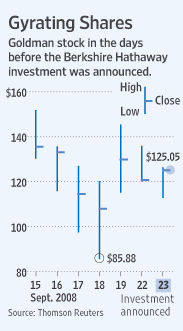
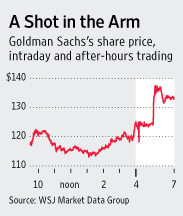
Buffett bought out Constellation Energy, to give confidence in the deal making arena, because that deal was on the ropes, and in the financials, names like State Street went from 30 to 64, Morgan Stanley, went from 12 to 34, and Goldman went from 86 to 144–all in ONE day–from 12:30 in the afternoon, to 8:00 am in the next day’s pre-market!

Is someone going to say that the stocks ramped all because you couldn’t lay out any more shorts, or those who were short, were instead tipped?

Here was the action in Goldman the day that Buffett’s tip to the rest of Wall Street was announced.

Why did you have, instead, the move in the financials, the days before?

How is it, that when a company on Wall Street, reports good numbers, and the stock sells off; that everyonne already knew that news.

Was the street so incestuous, that everyone else knew the news that Gupta had tipped?

How many people did Raj also tip? Who were also dying on the vine in September of 08?

And even with this massive, wonderful tip, Galleon was down 7.23% in September of 2008, and he was down another 5.23% in October. Even though he was getting tipped!

Is it any wonder why he was having crumpets and tea with Gupta, in his private office!

Away from the wires!

So now are we to believe, that it was just Raj, alone, who ramped the financials, or was a better explanation, that Goldman Sachs, decided to deploy their capital, into a massive short squeeze, in the shorted names, because they knew that the PPT, would be behind them, in their effort to prop up the markets, on the backs of the shortsellers, because Trott had already told Goldman that Buffett was in, and the Fed, had already told Goldman, that on Sunday night, they would be a bank holding company, and that, they would then have access to Ben’s billions?

And Ben, and Timmy, and Lloyd, will all suffer memory problems, because the sole rat, in this whole mess, was Raj, just like Goldman’s sole rat, in the Abacus, was a 27 year old kid called Fab!”

Rajat Gupta: Raj’s Other Buddies At Goldman

Forbes’ Walter Pavlo (May 23, 2012) noted that there were many other people at Goldman who socialized with Rajaratnam and could have been tipping him:

“Eisenberg testified that Gupta was on Raj’s list of names of “important” people that had immediate access to the Galleon co-founder and it was given to her by her predecessor.  Being on that list meant that Raj was to be told immediately and the list includes the names of Rajiv Goel, Anil Kumar and Danielle Chiesi …. all of whom have pled guilty to charges related to insider trading.  This strategy is meant to portray Gupta as being in some ring of co-conspirators when in fact this may not be the case.  Also on the list was Parag Saxena and Stanley Druckenmiller, neither are accused of any crime.  Druckenmiller was one of the top people of billionaire George Soros and headed his own hedge fund, Duquesne Capital Management (closed in 2010).  Saxena is a founding partner and CEO of New Silk Route Partners and, like Raj, graduated from the Wharton School (U Penn).

While Gupta was on Raj’s short list, I am certain he was also on other short lists.  I am confident that executive assistants at a number of firms were told to escalate a call from Rajat Gupta.  Lloyd Blankfein, CEO of Goldman might put someone like Gupta on his “short list” since Gupta was on the firms’ Board of Directors.  Billionaire Bill Gates may have Gupta on his list since he was on the board of the Bill & Melinda Gates Foundation.  But being on those lists do not help the government’s case.

Then there was that phone call Eisenberg testified about, the one from “Gupta’s phone number” that was placed to Rajaratnam moments before the close of trading on September 23, 2008, the day of the announcement of Berkshire Hathaway’s $5 billion investment into Goldman Sachs.   “Raj closed the door,” she testified, after she passed the call to Rajaratnam.  Then what?  Look, it doesn’t look good, but it is not supposed to look good …. but there are two different views of the same event.  There is no tape of that conversation, nor is there anyone that is going to testify about what they heard on that phone call…but there was testimony from a Galleon trader, Ananth Muniyappa, that said he was instructed to purchase 267,000 shares of Goldman stock after that phone call … a phone call which ended, according to Eisenberg, with a big smile from Raj.

Raj knew other people at Goldman Sachs beside Gupta, and this would also cast doubt as to who, if anyone, was providing inside information to Raj on Goldman. Goldman’s president, Gary Cohn, was known to socialize occasionally with Raj….so was David Loeb, head of of Goldman’s Asia equity sales…so was David Heller, co-head of Goldman’s security division … so was Michael Daffey, another Goldman executive.  Those guys have not been accused anything illegal, but oh the trouble that a well-timed call and a smile can get one into these days on Wall Street.”

Rajat Gupta: Due Process Problems With Insider Trading Trials

Nathaniel Burney (Burney Law Firm) argues that the grey areas in the jurisprudence of insider trading leave the area wide open for due process violations when alleged crimes are being investigated and tried.

“On Feb. 3, an SEC press release about yet another expert network case said that “it’s legal to obtain expert advice and analysis through expert networking arrangement.”  So far so good.  But right before that, it said this case was part of “the SEC’s ongoing investigation into the activities of expert networks that purport to provide professional investment research to their clients.”  (Emphasis added.)  That’s a loaded sentence, and reveals a predisposition to think that expert networks are bad.  All this does is increase the fear that the feds are going to see insider trading where none occurred.

Similarly, in a Feb. 8 press conference for the latest roundup of insider trading charges, the SDNY U.S. Attorney Preet Bharara made a prepared statement that expert networks are not “inherently wrong or bad.”  It’s just that these particular defendants had a business practice that was inherently wrong.  But he opted not to discuss what is wrong or right about a situation where an expert network uses an employee of company X, even with company X’s permission.  He acknowledged that it’s still a “gray area.”

So Robert Khuzami spoke up.  Khuzami, the head of enforcement for the SEC, sent a warning that hedge funds dealing with expert networks had better do some serious due diligence, to find out whether the expert network uses employees of company X.  And if so, to make sure no material nonpublic information gets received.

In other words, there’s an affirmative burden to make sure the information you receive is not private.  Which is bizarre when there is no way to know that, in many cases, unless you’re privy to inside information. It’s a Catch-22.

-=-=-=-=-

So there’s a huge “gray area” as to whether expert networks are kosher or criminal, as they currently exist and have existed for the past decade or so.  In theory, they’re lawful, but in practice the government sees them as only “purportedly” lawful.  And if you happen to use them, and you get inside information — info you couldn’t have known was secret if you weren’t an insider — too bad, so sad.  You had a duty to know the unknowable.  Maybe.

There are far too many unknowables here.

Isn’t this a classic due process violation? For the government to be allowed to use its might to deprive individuals of their liberty, property and livelihood, the public had better damn well be on notice that the conduct is something that’s going to get punished. If the public could not have known that certain conduct was unlawful, the government cannot be allowed to punish it.

And if the government itself doesn’t know where to draw the line…?”

Preet Bharara – Overhyped and Toothless

Gary Weiss in Salon

“Yet nowhere in Gabriel Sherman’s well-researched piece in New York is there even one mention of Preet Bharara.

There’s a simple reason for that:  Preet Bharara is not busting Wall Street. He’s not collaring the masters of the meltdown. He’s done nothing to even slightly discomfit Wall Street’s still-ferocious money machine, or has yet to bring to justice the architects, enablers and continuers of the 2008 financial crisis — the bankers who got us into that mess, and the ones who are continuing to extract pain from foreclosed homeowners, in the New York area and beyond.

As a matter of fact, his over-hyped insider-trading prosecutions, the main focus of the Time piece, are doing the Street a favor, by targeting people who actually ripped off Wall Street — individuals like hedge fund managers Raj Rajaratnam and Danielle Chiesi, who functioned a bit like the goons who used to dope race horses in the old days.

Bharara’s insider trading targets rigged the game for their own profit by illegally misappropriating information, in effect stealing from their employers and other investors, just as the horse-dopers cheated racetracks and other betters. Another analogy, also from the racetracks of old, would be to the scam artists who used to “past-post”: bet on races after they knew the outcome.

That’s how insider trading works. It’s a form of theft and cheating. It’s bad. Bharara was right to prosecute them, just as he has aggressively pursued drug gangs in the outer boroughs. But let’s be clear on something: The big players, the Goldman Sachses, Merrill Lynches, Banks of America and so on, don’t like insider trading any more than Preet Bharara does.

And none of his criminal prosecutions to date — including his recent bust of three high-ranking former Credit Suisse execs, accused of rigging the value of mortgage bonds they held in 2008 — had any connection to the pain being felt by Americans today, which can be directly traced to the misconduct of mortgage bankers and derivatives traders in the run-up to the financial crisis.

The real perps of the financial crisis haven’t been in Bharara’s — or the Justice Department’s — cross hairs for a single moment since Barack Obama took office three years ago. It’s one of the most troublesome failings of his administration.”