The Empire Strikes Back: Banks Cut Off Trump

The unprecedented social media black-out of the President of the US has been accompanied by businesses of all kinds, from hotels to soft drinks, stopping political contributions not only to Trump but to any Republican who objected to the electoral college certification.

Now comes news that banks, including Deutsche Bank, favored by the Trumps, will be dumping the President.

From the MI6/Rothschild mouth-piece, The Guardian:

“Several of the biggest banks in the US have said they too will suspend donations from their political action committees. They include JPMorgan Chase, Goldman Sachs, Citigroup and Morgan Stanley. According to Reuters, Deutsche had been looking to end its links with Trump since November, having grown tired of negative publicity.”

Preet Bharara fixes HSBC; jail for Gupta, Martoma

Credit: blogs.marketwatch.com

Manhattan prosecutor Preet Bharara shows his true colors as a servant of the money-power.

In the case of mega British bank  HSBC, Bharara is willing to settle for peanuts civil charges over HSBC’s defrauding of the US government to the tune of  millions of dollars:

Federal prosecutors in Manhattan on Tuesday announced a $10 million settlement with the British bank HSBC, accusing it of fraud over the way it submitted fees to the government when foreclosing on homeowners.

HSBC, prosecutors said, lacked the internal controls to review fees it incurred in the process of foreclosing — expenses that the bank ultimately passed on to the government for reimbursement. The bank, which admitted committing the misconduct as part of the civil settlement, cost the government millions of dollars in losses.

Civil actions like these serve as an important tool that our office can and will continue to use in holding financial institutions responsible for misconduct,” Preet Bharara, the United States attorney in Manhattan, said in a statement.

In a separate statement, a spokesman for the bank said, “We are pleased to have settled this matter,” additng that the bank had “taken steps to enhance oversight” of the billing process.”

HSBC  Holdings, the company that owns the bank, has a market capitalization of $192.57 billions. That is billion with a ‘b.’

The fine on HSBC was ten million.

There are a thousand millions to a billion.

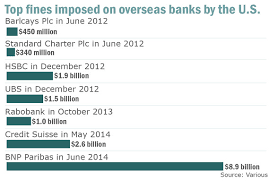
In 2012, the bank settled criminal charges over money-laundering for $1.92 billion.

HSBC was the bank of choice for the Mexican drug cartels.

In Forbes’ global 2000 list of the world’s largest companies, HSBC came in at 14.

It ranked #3 among all companies in the world in  total assets.

HSBC’s billion-dollar-plus fine was the third it had earned in a decade, says a Reuters piece from 2012, which also lists the fines paid by HSBC’s mega-bank colleagues:

Standard Charter PLC:  $327 million (violating sanctions)

ING, NV:  $619 million (violating sanctions against Cuba and Iran)

Meanwhile, for not making any money on an alleged insider tip about consummate insider Warren Buffet’s insider-deal involving insider-bank Goldman Sachs (to which at least half-a-dozen insiders were privy and which any one of them could have leaked);

for not costing the government a dime,

Rajat Gupta became the highest-placed manager ever to be convicted criminally and the first to ever have been subjected to federal wire-tapping…and pre-textually, at that.

Wire-tapping is usually reserved for the mafia.

In this case, the blue-chip manager got the wire, the strip-down and jail…and the mafia (SAC Capital) got off with fines.

Gupta is now starting two years in jail, having got a “break” because of his philanthropic work.

The Occupy Wall Street left  would have liked him to do ten years.

Matthew Martoma, a significantly smaller fry than Gupta, is now facing eight years in prison, as  Bharara throws the book at him.

Martoma elicited information about drug-trials from a couple of doctors before the results were public and earned millions in bonuses.

It isn’t clear how Martoma’s conduct was any more corrupt than that of the big banks….and that of many fraudulent lenders and borrowers all through the financial crisis, not to mention corrupt bureaucrats, courts, lawyers, doctors, journalists and general public.

Martoma’s boss, the alleged mafia-man and Sith Lord of Wall Street, Steven Cohen, has not been touched criminally.

Actually, no manager or CEO of any of the largest banks has faced any criminal proceeding.

Some Sheriff of Wall Street, this Preet  Bharara.

Interestingly, the author of the piece I just linked,  Judge Jed Rakoff, is as much an enabler of corruption as any figure in the court-system.

Which makes the piece, while true, the usual hypocritical tosh, wherein the very folks who scammed us get to change their jaddis, put on new togs and and bloviate about the integrity of the markets.

(For non-desis, jaddi = underwear)

Just remember it was the same Jed Rakoff  who handled the Madoff fraud and reportedly made it harder for the victims to collect.

And it was again Jed Rakoff who prevented crucial evidence from being heard in the Gupta case.

Evidence that would have helped the defense and thwarted Bharara.

Now, between Bharara and Rakoff, the fix is in.


Jamie Dimon Weighs In On “Too Hot” Former Citi Employee?

Update:

The case gets stranger. Lorenzana was on a 2003 TV serial, giggling about breast implant surgery she’d had. Knowing that, would any lawyer have framed her case the way it was? Of course, this doesn’t mean she wasn’t the target of harassment. The surgery itself says nothing. It’s commonplace. Do men who take viagra or steroids lose their civil rights? No. And a competent corporate lawyer would, of course, make it the first order of business to establish that the plaintiff in a harassment suit was a slut and “asking for it.” That’s quite usual. But I remain suspicious why this story, like the Helen Thomas story, has suddenly become so prominent….Maybe to create a little sympathy for the banks? Take the focus off the Gaza flotilla? Continue reading

Kleptocrat Megabanks, Municipalities In $2.8 Trillion Bid-Rigging Fraud

Bloomberg reports on the nation-wide bid-rigging fraud in the municipal bond-market that accompanied the credit crisis:

“A telephone call between a financial adviser in Beverly Hills and a trader in New York was all it took to fleece taxpayers on a water-and-sewer financing deal in West Virginia. The secret conversation was part of a conspiracy stretching across the U.S. by Wall Street banks in the $2.8 trillion municipal bond market.

The call came less than two hours before bids were due for contracts to manage $90 million raised with the sale of West Virginia bonds. On one end of the line was Steven Goldberg, a trader with Financial Security Assurance Holdings Ltd. On the other was Zevi Wolmark, of advisory firm CDR Financial Products Inc. Goldberg arranged to pay a kickback to CDR to land the deal, according to government records filed in connection with a U.S. Justice Department indictment of CDR and Wolmark.

West Virginia was just one stop in a nationwide conspiracy in which financial advisers to municipalities colluded with Bank of America Corp., Citigroup Inc., JPMorgan Chase & Co., Lehman Brothers Holdings Inc., Wachovia Corp. and 11 other banks. Continue reading

Massachusetts Moves Millions Out Of Big Banks

The Washington Post reports:

“Massachusetts officials on Wednesday announced plans to move millions of dollars in state investments out of some of the nation’s biggest banks to protest credit card interest rates.

State Treasurer Timothy Cahill said the state has removed Bank of America, Citi and Wells Fargo from a list of institutions approved for new state investments. Massachusetts, which is the only state to make such a move, is also beginning to divest $243 million in funds held at those banks, though the process could take up to six months.

“We want to bring some fairness into the issue,” said Cahill, who is running for governor. “I don’t think what we’re asking is . . . out of line.”

Scoundrel Time…

Scoundrel time in the UK

“Experts have analysed the pensions of a number of former directors of British banks, many of which were only saved from collapse by state bailouts. The biggest beneficiary is former Royal Bank of Scotland director Larry Fish, who has a pension pot of £18m, paying out £1.5m a year. Unlike the former RBS chief executive Sir Fred Goodwin, he has managed to maintain a low profile up to now, as he used to run the bank’s American operations.

Other bankers with pension pots of more than £1m include: Richard Banks, Richard Pym and Chris Rhodes (Alliance & Leicester); Steve Crawshaw and Chris Rodrigues (Bradford & Bingley); Peter Cummings, Colin Matthew and Phil Hodkinson (HBOS); David Baker, Robert Bennett, Keith Currie, David Jones and Andy Kuipers (Northern Rock); and Johnny Cameron and Mark Fisher (RBS).

The analysis also established that the true value of Sir Fred Goodwin’s pension pot could be, in fact, almost double the previously stated figure of £16m. According to pensions expert John Ralfe: “The official numbers that Royal Bank of Scotland has come out with is that his total pension pot from the age of 51 to the expected death is about £16.9m. I think that is a gross understatement. If I wanted to go along to a third-party pension provider and get the sort of pension that Fred Goodwin is on – £700,000 and that goes up in line with inflation, of course, each year – I would have to pay something in the order of £28m.”

The contrast with the pensions given to rank-and-file banking staff could not be greater. Dennis Grainger, who worked at Northern Rock for a decade, is entitled to only £700 a year. “I’m so disgusted with this I’ve turned it down,” said Mr Grainger.

Vince Cable, the Liberal Democrat Treasury spokesman, has attacked the scale of the rewards: “What makes people really, really angry is that these people were exceptionally well paid, got enormous pension pots and other payments, despite the fact that they have failed and they have failed their shareholders, failed their employees and failed the taxpayer, and they are walking away with their millions.”

The large payments are not limited to pensions. Bank bosses have seen their average salaries rise from £800,000 in 2006 to more than £1m in 2008 – 20 per cent more than the average pay packet of chief executives in other sectors. They now earn £255,000 a year more than their FTSE-100 counterparts. Fees paid to non-executive directors of banks have also risen. In the case of the RBS, non-executive directors have seen their fees almost treble in less than a decade, from £25,000 a year in 2000 to £73,000 a year in 2008.

Mr Cable has denounced bankers’ pay and perks as “the kind of things you would associate with absolute monarchies in the days of the Bourbons in France”.

Sir Fred Goodwin

Even after cashing in £2.7m of his pension, he gets £550,000

Sir James Crosby

Will start reaping rewards of £10.4m pension pot in 2011 £572,000

Lawrence Fish

£18m pension fund yields over a million every year £1.5m

Adam Applegarth

In 2022 he will be able to claim his full yearly pension £305,000

Andy Hornby

The former HBOS chief can take his pension at 50 £240,000

Michael Fairey

Opted to take his entire £7m pension pot as a lump sum £280,000″

Soros To Buy Stake In Bombay Stock Exchange, Goldman Seeks Commercial Banking License in India

Palak Shah at the Business Standard :

“US micro hedge fund legend George Soros and the world’s third biggest philanthropist George Kaiser are in the race to acquire close to 4 per cent in the Bombay Stock Exchange (BSE), Asia’s oldest stock exchange.

Soros has bid for the BSE stake, held by the embattled Dubai Financial Group LLC, through Soros Fund Management LLC, and Kaiser has done so through private equity fund, Argonaut.

Other investors who have bid for BSE stake include New York-based private equity majors J C Flowers and Caldwell Investment, promoted by Toronto investment broker Thomas Caldwell. Caldwell is a specialist investor in stock exchanges and bought 4.3 million shares of the New York Stock Exchange in 2006. Sources added that a private equity fund has bid Rs 370 for each share, valuing BSE at over Rs 3,800 crore. Avendus Capital is advisor to the deal.

Dubai Financial, part of sovereign fund Dubai Holding, holds 3.92 per cent stake in BSE, which it bought when the exchange was demutualised in 2007. BSE was then valued at Rs 3,780 crore. While BSE and Avendus could not be reached for comment, sources familiar with the developments said Dubai Financial felt the exchange deserved a higher valuation in the current situation.

In the recent past, the valuation of the exchange saw a sudden spurt after a new management team took over in 2009.

While some stock brokers sold BSE shares at around Rs 180 a piece some six months ago, a bank auctioned 0.27 million shares at Rs 320 a couple of months ago.

Under the new management, BSE changed its derivative trading cycle to compete with the National Stock Exchange, launched a mutual fund trading platform and is upgrading its technology platform. BSE currently has a near 28 per cent share of the equity spot market in the country and has been making efforts to develop its derivative trading segment, where National Stock Exchange is a monopoly player. BSE will launch currency derivatives in May and is also in the process of increasing its stake in Central Depository Services Ltd to 51 per cent.

Currently, six foreign investors hold 25.65 per cent of BSE and five Indian institutions hold 12 per cent.

A little under 62 per cent of BSE’s shares are widely held. Among the key Indian shareholders are firms such as Bajaj Holdings and Investment, which owns 2.94 per cent, Infosys Technologies CEO and MD S. Gopalakrishnan, who owns 1.04 per cent and media major Bennett, Coleman and Co, which owns 1.04 per cent.

BSE recently announced 12 bonus shares for every share held and the exchange currently has around Rs 2,000 crore of cash reserves, which translates into cash per share of at least Rs 190.

BSE posted a net profit of Rs 55.42 crore on revenue of Rs119.21 crore for the quarter ended December 2009.”

The launching of the mutual fund platform and the upgrading of the technology and expansion of derivative trading is exactly what Goldman Sachs introduced into the New York Stock Exchange in the 1990s. And we saw what happened in the 15 years following. And Goldman is in India, currently seeking a commercial banking license to operate there.

With the same players around (Soros, Goldman Sachs etc. ), there’s no reason to believe that what’s coming up for the Bombay Stock Exchange won’t take the same direction. Before the financial crisis, the Indians had little exposure to the highly levered derivatives and toxic debt that blew up the system elsewhere. Let’s see whether this upcoming round they’ll be as lucky. With economies stagnant elsewhere, Asia and some select African countries are the only places where there’s actual economic growth occurring.

I’m afraid the same handful of corrupt players will game the system there…

More here at The Economic Times:

“His hedge fund Quantum, which was reported to have posted earnings of over 30% last year, went on a buying- spree at a time, when most funds were dumping stocks in a sliding market. On July 4, Quantum Fund bought a 3.8% equity in Jain Irrigation Systems, and close to 1% of the holding of Jai Corp for a value consideration of Rs 167 crore. Since February, the fund has made investments valued at close to Rs 600 crore, or $ 140 million, in various companies, including Indiabulls Financial Services, Indiabulls Real Estate and Kalindee Rail Nirman. Quantum’s selective stock picking comes at a time, when institutional investors have been pulling out a large chunk of money amid concerns over a combination of factors such as weak global markets, soaring global oil prices and spiraling inflation in India. “Hedge funds normally are active, when there is some momentum in the market. Quantum may be trying to do some value-buying, but one has to see how long the fund stays invested, given the prevailing uncertain market conditions,” said a stock-broker..”

Remember Formula K (or, the First Law of Kleptocracy) :

s(B) + s(G) + s(S) v. EE where ‘s’ is always a positive integer

Some (s) of the big banks (B – eg. JP Morgan, Goldman Sachs, Citi etc.)

+

Some parts of government (G – eg. parts of the SEC/Treasury/Fed Reserve Chairman, IMF, World Bank etc.)

+

Some hedge-funds and speculators (S – eg. Soros, Paulson (?), Loeb, Cohen and others reportedly involved in manipulation and collusion with government)

Versus

Every one else (EE)

JP Morgan Gets $3.4 Billion For Buying Wa-Mu; Shareholders Get Zip

At Seeking Alpha, Troy Racki writes about the second rape of Washington Mutual stock-holders and US tax-payers by JP Morgan:

“In the settlement offer WaMu will relinquish all claims against JP Morgan and the FDIC. In return WaMu will be allowed to keep a $3.9 billion dollar deposit it held in its own bank. Most of the $3.9 billion deposit was generated from the sale of preferred securities in 2006 and 2007. Additionally WaMu will be allowed to keep $1.8 to $2.0 billion of its own tax return created from huge losses in 2008. The rest of the projected $5.6 billion return will be split between the FDIC and JP Morgan.

According to the settlement terms JP Morgan will receive $5 billion in HELOC backed securities valued on the open market at 60% of par, $193 million in Visa class B securities, $2.1 billion in cash, and a $20 million wind farm, all from WaMu. Given the initial purchase price of WaMu for $1.9 billion in 2008, these additional assets received means that JP Morgan will pay a negative $3.4 billion for their purchase of the bank.

The loss of these assets will heavily impact WaMu’s balance sheet which now stands to make only the bondholders whole, according to the settlement’s disclosure statement. Currently senior WaMu holding company debt trades at 106 cents on the dollar.

Under the terms of the settlement WaMu shareholders will receive nothing.

In the disclosure statement WaMu’s attorneys stated that the proposed settlement will net the most for all creditors and that further legal dispute would only financially harm the estate. This comes in stark contrast to prior statements by WaMu’s equity counsel that a protracted legal battle with JP Morgan and the FDIC may have returned up to $20 billion to the estate.

Currently the settlement is awaiting the approval of the FDIC, Washington Mutual bank bondholders, WaMu unsecured creditors, WaMu preferred shareholders, and the bankruptcy judge. An incomplete plan of reorganization was also filed on Friday along with the disclosure statement. The incomplete POR lacks a balance sheet meaning that WaMu’s unsecured creditors are left only to guess at what they may eventually recover, if anything.

Despite the negative purchase price, Jamie Dimon, CEO of JP Morgan has indicated that the purchase of WaMu could have been closed for less, much less. In July 2009 he stated that JP Morgan “could have bought WaMu for a dollar” because of the projected losses that would have been taken on the deal.

The losses never materialized. In May 2009, JP Morgan wrote up its WaMu loan portfolio by $25 billion.

Had the $1 purchase price gone through JP Morgan would have eventually been paid $5.1 billion by WaMu and the FDIC to assume the bank.

While the deal may be good for JP Morgan, former WaMu customers are not so fortunate. Nationally many WaMu Providian credit card customers have since experienced dramatic rate increases. In Oregon, WaMu checking clients report that deposits are being held for fourteen days prior to being accredited to accounts. This abnormally long waiting period means that many checking customers are now being hit by multiple $35-a-peice overdraft charges for having insufficient funds. In northern California, out-the-door waiting lines for teller service at one branch sparked verbal outrage and multiple client threats to move deposits to a community bank branch. The branch responded after twenty minutes by temporarily adding a teller.

Meanwhile FDIC chairwoman Sheila Bair is continuing to push for additional powers that would allow the FDIC to not only shutter banks but their holding companies. This authority would allow for the FDIC to avoid future conflicts when it closes a bank but is unable to force a holding company to capitulate, as is in the case with WaMu. It has come under scrutiny after internal JP Morgan e-mails and PowerPoint presentations revealed that as early as March 2008 regulators were in negotiations with JP Morgan on the closure of Washington Mutual, termed “Project West”, six months prior to the bank’s seizure.”

More later…

During Boom, Regulators Gave Themselves Bonuses For Superior Work

The Associated Press reports that the banks weren’t the only ones handing out bonuses:

“Banks weren’t the only ones giving big bonuses in the boom years before the worst financial crisis in generations. The government also was handing out millions of dollars to bank regulators, rewarding “superior” work even as an avalanche of risky mortgages helped create the meltdown.

The payments, detailed in payroll data released to The Associated Press under the Freedom of Information Act, are the latest evidence of the government’s false sense of security during the go-go days of the financial boom. Just as bank executives got bonuses despite taking on dangerous amounts of risk, regulators got taxpayer-funded bonuses despite missing or ignoring signs that the system was on the verge of a meltdown.

The bonuses were part of a reward program little known outside the government. Some government regulators got tens of thousands of dollars in perks, boosting their salaries by almost 25 percent. Often, though, rewards amounted to just a few hundred dollars for employees who came up with good ideas.

During the 2003-06 boom, the three agencies that supervise most U.S. banks — the Federal Deposit Insurance Corp., the Office of Thrift Supervision and the Office of the Comptroller of the Currency — gave out at least $19 million in bonuses, records show.

Nearly all that money was spent recognizing “superior” performance. The largest share, more than $8.4 million, went to financial examiners, those employees and managers who scrutinize internal bank documents and sound the first alarms. Analysts, auditors, economists and criminal investigators also got awards.

After the meltdown, the government’s internal investigators surveyed the wreckage of nearly 200 failed banks and repeatedly found that those regulators had not done enough…”

My Comment

How to react to this? Weep….tear your hair out?…..roll on the floor laughing….throw up?

A bit of all.

The salient points:

1. Giving bonuses/incentives for “superior performance” doesn’t work, either in the public or so-called private sector (pseudo-private). The next time anyone makes that argument, rub this article in their nose.

2. Sacking is the key. Every regulator who didn’t sound the alarm over the last decade needs to be demoted and/or sacked. At the very least, the department gets a 25% cut. Or better yet, throw out all the “financial examiners.” Obviously, the job means zip. Hire a team of snake-charmers, dancing bears, or g-stringed pole-dancers……you’d at least get a laugh for your money.

3. The only way to get any real information out of the government is through a Freedom of Information Act request.

4. “Regulatory capture” – the corruption of the government by the people it’s supposed to be regulating – is clearly only one part of the problem. The more intractable problem is bureaucratic empire-building. You don’t need other people to corrupt government officials. They carry the germ themselves, because they aren’t accountable to the market for excesses and mistakes.

5. The underlying problem is the artificial boom. It pushed prices of everything sky high and gave everyone a false sense of prosperity. Naturally, the idiots broke out the champagne and started pinning gold medals for genius on their chests.

6. The mob likes flattery. The boom flattered everyone…

Financial Crisis Inquiry Commission Chair Berates Lloyd Blankfein

“It sounds like selling a car with faulty brakes and then buying an insurance policy” on the driver,”

—   Financial Crisis Inquiry Commission Chairman Phil Angelides (D) to Goldman Sachs CEO Lloyd Blankfein.

Well, well, well,

Doesn’t sound too different from what we said in September 2008, does it? Continue reading