Carnage Of Russia’s Christians Under Bolsheviks

Srdja Trifkovic  writes about the 20th century as the worst century for Christian martyrdom (45 million).

This carnage dwarfs any of the crimes of the Inquisition or of the conquest of the Americas and dwarfs in absolute terms any previous Christian martyrdom, even under the Romans:

According to the respected and reliable OUP World Christian Encyclopedia (2001), there have been many more Christian martyrs in the 20th century–over 45 million–than in all of the preceding 19 centuries of Christianity. Of that number, some 32 million were killed by “atheists” and over 9 million by Muslims. The “atheists” denote, overwhelmingly, Soviets and their Communist cohorts and satellites, but also include Nazis and their allies. The Spanish Republic was an especially efficient Christian-killing machine. In terms of the size of the targeted population and the timespan of only two and a half years, the Compañeros did almost as well as the Tovarishchi.

It may be argued that among the Bolsheviks’ victims many were slaughtered not because they were Christians-as-such, but because they were “objectively” real or potential enemies of the state, i.e., Tsarist army officers and aristocrats, peasant farmers (“kulaks”), artists, academics, or middle class professionals. But while it would be admittedly erroneous to count every Christian, however nominal, who died under Communist persecution as a “New Martyr,” there is no doubt:

  1. that Christians were targeted with particular ferocity for the very reason of their faith;
  2. that the Russian Orthodox Church and other Christian confessions–notably Eastern Rite Cattholics–were subjected to systematic destruction on a titanic scale; and
  3. that the majority of victims targeted for supposedly “secular” reasons of class, profession, or political beliefs, were also Christian believers whose faith was inseparable from other traits of their personality.

We’ll never know how many of those countless victims were “in a situation of witness for the Faith” at the moment of death, which is the convential definition of martyrdom. Of the mental state of the killers, however, and specifically of their intention to eradicate Christianity by whatever means, there is no doubt at all. In 20 years (1918-1938) the number of churches that remained open in Russia was reduced from 54,000 to under 500–to less than one percent, that is, of the pre-Bolshevik total. In all some 600 bishops, 40,000 priests, 120,000 monks and nuns, and millions of laypeople were martyred for the Orthodox Faith in Russia in the five decades after 1918. The survivors were also confessors: they survived, but theirs was a living martyrdom…….
…Attempts at “killing the soul” started only months after the Revolution of 1917. Irina Skariatina remembered the desecration of her church while Metropolitan Benjamin was serving an all-night vigil in Petrograd in 1918 when the church was surrounded by hundreds of soldiers who subsequently broke in, talking, laughing, swearing, smoking, spitting loudly:

They came up the aisle to the altar where the Metropolitan and twelve assisting bishops and archimandrites were officiating and, pushing them aside, prodded the golden coverings of the altar with their bayonets (“to see if any firearms were concealed,” they explained), then threw cigarette ashes into the Chalice and finally spat into it, throwing it on the ground as they left the altar on their way out. The congregation, paralyzed with horror, did not move at first. Then suddenly it broke loose, a multitude of people maddened by the outrage, all acting under the same impulse of boundless indignation. In a second the soldiers were stopped, surrounded, and would probably have been torn to pieces alive (despite the fact that they were armed and the congregation was not), had not the Metropolitan come forward and called out in a loud voice the words of Christ: “Forgive them, for they know not what they do,” adding, “Let them go in peace and do not leave your places for we shall proceed with the service.” He was obeyed, of course …

Such fortitude did not save him from the firing squad in 1922. Patriarch Tikhon, amidst the rising ocean of blood, called on his flock to share the cup of martyrdom: “If it becomes necessary to suffer for the sake of Christ, we call upon you, beloved sons and daughters of the Church, we call upon you to suffer to-gether with us. If a redeeming sacrifice is required, the death of the innocent sheep of Christ’s flock, I bless the faithful servants of the Lord Jesus Christ to pain and death for His sake.”

By that time the mind-boggling scale of the Soviet killing machine made obvious a fundamental difference between anti-Christian pogroms carried out by Muslims in the previous 13 centuries and those perpetrated by 20th century totalitarians.”

Trifkovich, sadly, fails to notice the million or more Muslims killed in Iraq and other countries by Zionist Christians or their allies, the blow-back from which drives Islamic violence. He fails to reveal that Islamicist violence is often manufactured or instigated. He fails to analyze both Muslims and Socialists as tools of a more subtle and calculating power.

Even so, he is right to warn Western Christians that they too face a future of persecution:

The New Martyrs’ example and their legacy is precious, because in this, 21st century, it will be the turn of Western Christians to experience martyrdom. In Western Europe they will be persecuted by the unholy alliance between the postmodern, Christophobic velvet totalitarianism of the therapeutic hyper-state, and a resurgent Islam which already accounts for a quarter of all newborns in France. In the United States they will be persecuted for refusing to accept the destruction of the moral foundation of the society, currently epitomized by abortion, by “gay marriage,” and by the ever-expanding speech and thought codes. Instead of being thrown to the lions or sent to Siberia, the resisters will be subjected–by some monstrous mechanism devised by an ever more activist judiciary–to the mandatory “sexual diversity orientation sessions,” or feminist-led pro-abortionist “right-to-choose education workshops,” or “immigrant rights sensitivity training,” after which the continuing refusal to recant will lead to compulsory “therapy” and forced medication. This scenario is not farfetched on either side of the Atlantic. Western Christians should be prepared for martyrdom.”

Roots, Not Symptoms, Mr. Raspail

Michael Hoffman, whose  other views I don’t necessarily endorse, sees through Jean Raspail’s race-war propaganda classic, “The Camp of the Saints”:

How strange – not one word from Jean Raspail about who is really at fault for the invasion of France–the French themselves! Who were (and are) too hedonistic and selfish to average three or more French children per couple. Into this vacuum quite naturally (i.e. by the iron law of biology) rush those people who have enough sense to reproduce themselves (the Muslims) and who need lebensraum. Raspail deals, as do so many others, with symptoms and scapegoating: “those politicians” and that “sepulchral media” who vex “the still healthy body of the French nation.”

I assure Monsieur Raspail that the French people are desperately sick, not healthy, and that the “sepulchre” was built by the French themselves and the bones one finds there are of the aborted children who would have obstructed the multiple vacations, the second house, the third car. This sepulchre is also peopled by the spectre of millions of French children who were never conceived, for the same reasons.

Those white nations which do not have sufficient spark of life to reproduce themselves are indeed doomed, but this is no “conspiracy.” These are the inevitable wages of the Masonic, “secular Republic” that is France. The same is true for Italy, where the Catholic Church has auto-destructed and Germany, Spain, Sweden...all secular, all playboys and playgirls.

One cannot merely pay lip service to Christianity, tossing a bone to a mere nostalgia. The French, or for that matter the American intellectuals, even on the Right, dare not look to see what culture and religion prevailed when Charles Martel marched to Poitiers in 732, when Isabella reconquered Granada in 1492, when Pius V was victorious at Lepanto in 1571 and Nicholas, Graf von Salm in Vienna in 1529 and John Sobieski in that same city in 1683.

The West today, ruled ideologically by the spirits of Jean Jacques Rousseau, Charles Darwin, Albert Pike, Sigmund Freud and Menachem Mendel Schneerson cannot conquer, except from the cockpit of a glorified airborne video game attached to missiles.

Who is to blame for the demise of Europe– the healthy, fertile Muslims or the anemic, self-extinguishing denizens of the House of Usher? If lebensraum was a virtue for the Germans is it a vice for the Muslims? The most primitive pagan in the jungle knows what the “advanced” Europeans do not know, that sex without children is death!

And the current “Crusade”? It was only forty years ago that Jacqueline Kennedy wore a black veil at the funeral of her assassinated husband, and Christian women throughout Europe and America–sophisticated women of the middle and upper classes–wore head coverings in church. Now crusader George W. Bush is on a campaign to “free Muslim women” from standards of propriety and modesty not so different–at least in spirit– from what prevailed universally in the West as recently as four decades ago.

France has banned girls from wearing head scarves in its public schools, lest the girls appear too modest, and this in a France where rectums and genitals are on display on every street-corner kiosk, yet there is a morbid fear of the least display of chastity.

The Muslims rightly despise us because we have lost all self-respect; because we are not the people of the West any longer, but the people of the alchemical crucible of constant, ruinous transvaluation.

The West cannot turn its back on God and retain any territory anywhere, and when I say God I am not speaking of the god of the rabbis.

Roots, not symptoms, Monsieur Raspail.”

The Declining Value of Elite Credentials

Of Two Minds.com:

“Economist Michael Spence developed the job market signaling model of valuing employees based on their credentials in the 1970s. The basic idea is that signaling overcomes the inherent asymmetry of information between employer and potential employee, i.e. what skills the employer needs and what skills the employee actually has is a mystery to the other party.

Credentials (diplomas, certificates, grad point averages, test scores, etc.) send a signal that transfers information to the employer about the opportunity cost the potential employee sacrificed for the credential.

It is important to note that the credential doesn’t necessarily signal the employee’s actual skills or knowledge– it only signals the amount of human and financial capital the employee and his family invested in obtaining the credential.

Signaling boils down to something like this: if Potential Employee A graduated from a prestigious Ivy League university, and Potential Employee B graduated from a lower-ranked state university, this doesn’t signal that Candidate A is necessarily more intelligent than Candidate B; it does signal, however, that Candidate A probably worked harder to get into and graduate from the prestigious school.

The signal is: Candidate A will work harder for the employer than Candidate B, all other qualifications being equal.

The Signal Value of credentials is the entire foundation of higher education. The higher education system does not actually test or credential the body of knowledge or working skills of graduates; it simply accredits that the graduate sat through a semi-random selection of courses and managed to pass the minimal standards–or alternatively, that the graduate gamed/cheated the system to gain credit without actually doing any real learning.

The reason tens of thousands of parents are sweating blood to get their child into an Ivy League university is the signaling power of that degree is widely viewed as having the near-magical ability to guarantee lifelong highly compensated employment.

But the power of higher education credentials is eroding for systemic reasons.

1. Credentials of all sorts are in over-supply: there are more people holding credentials than there are jobs that require those credentials.

2. Higher education does not prepare graduates for the real world of work in the emerging economy, so the signaling value of a diploma has been lost.

3. The opportunity cost paid by those graduating from college is now more noise than signal.

4. The intrinsically ambiguous signal value of a credential cannot be substituted for real-world accreditation of real skills and working knowledge.

In essence, the failure of signaling to accredit actual skills and knowledge bases is being acknowledged by employers. This accreditation is precisely what diplomas fail to do. Specialty programs (nursing, medicine) accredit the skills and knowledge of the graduates, but this is not true of the vast majority of diplomas and credentials.

The job-market value of a college degree was relatively high in the 1970s when Spence developed the Signal Model because the number of workers with college diplomas was still relatively modest (around 15% of the workforce). The most basic function of the market–supply and demand–worked in favor of what was relatively scarce–a college diploma. As a result, the assumption that the applicant had worked hard to obtain the degree was more signal than noise.

Nowadays, conventional credentials such as college degrees are in over-supply: around 40% of the work force has a college diploma of some sort, and an increasing number of college graduates are taking jobs that do not require a college education.

This is reflected in the declining wages of college graduates: Even the Most Educated Workers Have Declining Wages.

While the cost of higher education has skyrocketed (tuition is up 1,100% since 1980), the educational yield of higher education has declined. The national study Academically Adrift: Limited Learning on College Campuses, found that over one third of college students “did not demonstrate any significant improvements in learning critical thinking and other skills central to success in the new economy” and concluded that “American higher education is characterized by limited or no learning for a large proportion of students.”.

From this dismal record, we can extrapolate that another third gained marginal utility from their investment of tens of thousands of dollars and four years of study.

Google is widely viewed as a bellwether of the new economy. It is noteworthy, then, that Google has found that academic success has little correlation with being productive in the workplace. Lazlo Bock, Senior Vice President of People Operations at Google, made the following comments in an interview published by the New York Times in June 2013:

One of the things we’ve seen from all our data crunching is that G.P.A.s (grade point averages) are worthless as a criteria for hiring, and test scores are worthless. Google famously used to ask everyone for a transcript and G.P.A.s and test scores, but we don’t anymore. We found that they don’t predict anything.What’s interesting is the proportion of people without any college education at Google has increased over time as well. So we have teams where you have 14 percent of the team made up of people who’ve never gone to college.

Signaling an ability to grind though four or five years of institutional coursework is no longer enough; the signaling needed to indicate an ability to create value must be much richer in information density and more persuasive than a factory model diploma.”


Do I contradict myself?

A reader writes querulously that he can’t understand why I link so-and-so (a Hindu right-winger), even though I am a believing Christian…..and why I deconstruct the Tamil Tigers, but say nothing about Sri Lankan racism.

He put it a lot more intemperately than that, but that was the substance of it, once the personal attacks are left out.

Another tells me that if I critique neo-conservatives, I must equally criticize Islamicists.

In other words, I have a point of view that is not neutral, according to my readers.

Well, guilty as charged.

I am not neutral, nor would I want to be.  I cordially detest the ideology and objectives of the global centralizers. I might call them Zionists or Elites or Power-Elite or any other term, but it’s clear whom I mean, and if it’s not,  please search Kleptocracy or New World Order or Zionism on my blog.

Given that,  this blog is my small attempt at deconstructing the unceasing propaganda put out by the Controllers,  propaganda that extends to every branch of human inquiry, from science to theology, from politics to academics.

One reader wants me to begin every critique of the Tamil Tigers with a “fair and balanced”  criticism of Sri Lanka. But why? Are the  Tigers, with the backing of Western intelligence groups, with a well-heeled Tamil diaspora and Western (left-wing) church groups behind them,  lacking in voice?

Sri Lankan racism is beside the point. If armed insurrection, assassinations, and terrorism against civilians is the proper response to racial chauvinism,  God help us all.

The facts show that the Lankan Tigers were manipulated and used by both a part of the Indian intelligence service (RAW) and the Israeli (Mossad). That is what is important.

If the Tigers were concerned about Tamils, they would not have killed them in such numbers. Until the civil war, they assassinated more Tamils than their enemies did.

I am sure Sri Lankans can be racist. Who doubts it? That goes with the human condition.

But my  primary interest on this blog is to show how the Controllers use such inter-ethnic frictions to push their own agenda, using the various players as tools in their larger game. And how that agenda itself drives the friction.

Explaining why some particular tool really had some cause against that other tool isn’t germane to my objective.  I am interested in the ones who use the tools. And my sole objective is to neutralize the propaganda.

I am fair, but unbalanced.

I could, of course, flame the fans of race or culture-war in the US, as some do.

And some people might consider some of my posts as tending in that direction. But I’m not interested in culture-wars, except as they are war-gamed by the elites.

I deconstruct homosexual propaganda, only because sexual “liberation” has long been the front behind which the global order brainwashes the young to turn against the very traditions that would protect them from the pathology of that order. For the rest, my beliefs  do not require anyone else to subscribe to them.

As for consistency, my political positions on war, the police state, and the government have stayed the same, but in the course of writing and reading, I’ve changed from staunchly pro-choice to strongly pro-life. I’ve gone from being a Christian skeptic to a believing Christian.  I’ve gone from being an ardent Ron Paul/Lew Rockwell anarcho-capitalist to a traditionalist conservative, but an antiwar, small government conservative. I have become sympathetic to the men’s rights movement (the part that the elites haven’t co-opted).

That is the nature of the intellectual life.  One learns. One grows; sometimes, down, but hopefully, up.

My old posts are up there for everyone to see, revisions, corrections and all. The things I got right, the things I got wrong (pro-choice,).

I link the Hindu right-wing when I think they are right. When they are wrong, I don’t link them.  I link others. Is that hard to understand?

Not if you think that truth is more important than ideology.

And that truth, in the realm of politics, doesn’t exist outside a context or a history.  And  what one takes to be context or where one starts one’s history is not just personal preference but judgment, which is objective and true, but not in an ideological sense. In fact, it requires the abandonment of ideology.

More on the “Two Rocks” Critique of Papal Primacy

A Catholic website refutes the two-rock argument against the primacy of the Roman Catholic church (derived from the primacy of the apostle Peter),  the subject of my previous post.

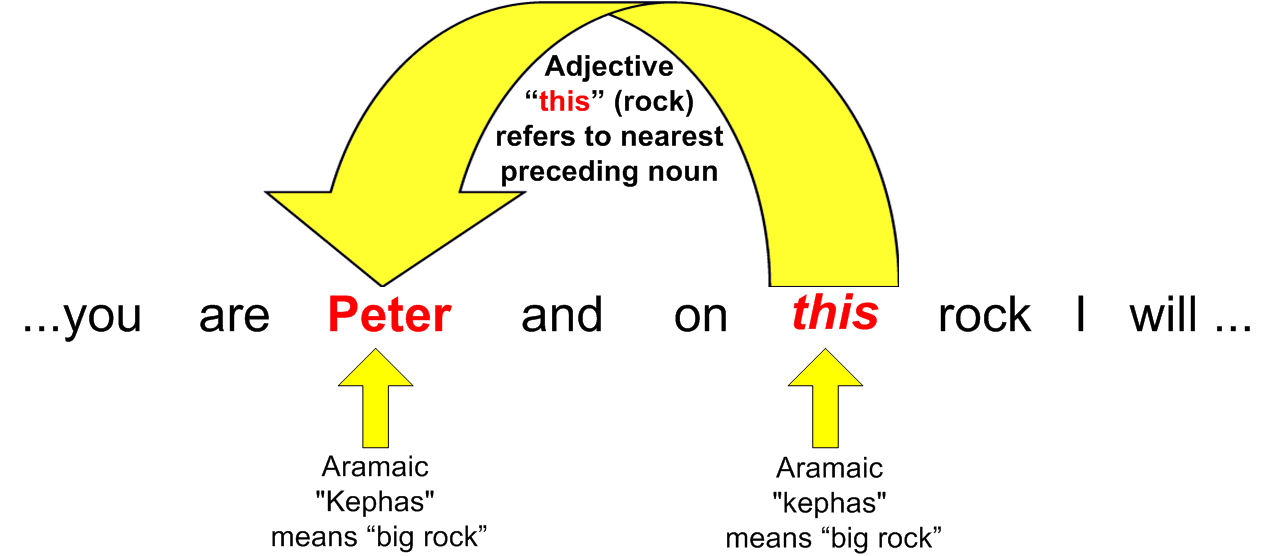
Let’s call this the “little rock, big rock” theory. It claims that Peter is a little rock and his declaration (Jesus is the Christ) is the foundation of the Church. The Greek text of the passage says “You are Peter (Petros) and upon this rock (petra) I will build my Church.”(Mat 16:18-20). In modern Greek, the name Peter Petros means “small stone” and Petra means “stone.” The theory proposes that Peter was only a little pebble and unimportant, while the big rock was the “declaration” of several verses earlier, that Jesus was the Christ.

OK, I’m going to get a little “heady” here by talking about Aramaic, and ancient Greek. The Greek text is a translation of Jesus’ words, which were actually spoken in Aramaic. Aramaic only had one word for rock, kephas (which is why Peter is often called Cephas in the Bible). The word Kephas in Aramaic means “huge rock.” The Aramaic word for “little stone” is “evna,” and Peter was not called “Evna” or “Envas” or anything like that.  In Aramaic, Jesus said “You are Peter (Kephas) and upon this rock (kephas) I will build my Church.” The metaphor worked well in Aramaic where nouns are neither feminine or masculine, but in Greek, the noun “rock” was feminine, and therefore unsuitable as a name for Peter. So the Aramaic word Kephas was translated to the masculine name Petros when it referred to Peter, and to the feminine noun petra when it referred to the rock. In ancient Koine Greek, petra and petros were total synonyms, unlike modern Attic Greek and unlike Ionic Greek which was about 400 year before Christ.

In Evangelical circles, the “little rock, big rock” theory is fairly recent. Nearly every Protestant commentary written in the last 50 years interprets Peter as the rock upon which the Church was built. (However, they didn’t believe that Peter had a successor, more about that here ). The scholarly Evangelical work, Carson’s “Expositors Bible Commentary” explains this well. It is in the section on Matthew 16. These Evangelical scholars looked closely at the Greek word for rock “Petra” and determined that it refers to Peter. The early Christians also referred to Peter as the Rock. Some Quotes are here.

I recently spoke with a grammar specialist who is not Catholic. She explained to me that the adjective “this” grammatically must refer to the nearest preceding noun, which was Peter, not his declaration which occurs two verses earlier.

upon this rock

When Jesus says  “whatever you bind” to Peter in Mat 16:18, the Greek text used for “you” is singular. In Mat 18:18 the Greek text, the word for “you” in “whatever you bind” is plural. Catholics think these two juxtaposed but similar phrases lay out the early structure of the Church with Peter as the Pope and the other apostles as priests.

Some of the Church fathers do speak of Christ or of Peter’s confession as “the Rock” of Matt 16:18, ALL of these SAME Church fathers ALSO speak of Peter himself as the Rock.   In other words, the confession of Peter is in relation to Peter. It says something about him, and his faith. In this respect, it was not an either-or proposition for our ancient Christian forefathers, but a “both-and” proposition.  Here are what the fathers (and some other scholars of the ancient Church) have to say.

The fathers –including ALL the Greek fathers –say that Peter himself is the Rock of Matt 16.   They make no distinction between Peter himself and Peter’s confession; for any father who speaks of it as Peter’s confession is ALSO on record calling Peter himself the Rock. ……

….If we compare Matt 16:18-19 with Isaiah 22:20-24, which describes the appointment of the Prime Minister of the old Davidic Kingdom of Israel –the minister who could act with the King’s own authority in the King’s physical absence –we can see quite clearly that Peter himself is being made the Rock in Matt 16:18.   And, again, this is what all of the Church fathers consistently say (even when they also speak of other things as the Rock). Catholics believe that Jesus had a very specific purpose in saying that Peter was the Rock upon which he would build his Church. He was evoking Isaiah 22:22.

Isaiah 22:15-24 Mat 16:18-19
22:15 (Shebna) you have cut out a tomb here for yourself … in the rock? …I will thrust you from your office….22:20 On that day I will call my servant Eliakim son of Hilkiah, 21 and will clothe him with your robe and bind your sash on him. I will commit your authority to his hand, and he shall be a father to the inhabitants of Jerusalem and to the house of Judah. 22 I will place on his shoulder the key of the house of David; he shall open, and no one shall shut; he shall shut, and no one shall open. 23 I will fasten him like a peg in a secure place, and he will become a throne of honor to his ancestral house. 24 And they will hang on him the whole weight of his ancestral house, the offspring and issue, every small vessel, from the cups to all the flagons. …you are Peter and upon this rock I will build my Church; and the gates of hell shall not prevail against it. And I will give you the keys of the kingdom of Heaven, and whatever you bind on earth will be bound in Heaven and whatever you loose on earth will be loosed in heaven.

In the Isaiah passage, Shebna was the Chancellor (like a Prime Minister) under King Hezekiah. This Prime Minister had a special role above the cabinet. He got the keys to the kingdom. Shabna messed up and was unfaithful so God appointed Eliakim to Prime Minister and gave him the keys. In Mat 16:18, Peter got the keys just the way Eliakim got them in Isaiah 22:15-24.

When Jesus says  “whatever you bind” to Peter in Mat 16:18, the Greek text used for “you” is singular. In Mat 18:18 the Greek text, the word for “you” in “whatever you bind” is plural. Catholics think these two juxtaposed but similar phrases lay out the early structure of the Church with Peter as the Pope and the other apostles as priests.”

My Comment:

Even if Peter is being referred to as a rock in Matthew 16 (which is highly contestable),  it is still a long journey from there to the primacy (in juridical terms) of the Roman church; and from there, to the primacy of the Pope,;and from there, to the infallibility of the pope and the impossibility of salvation outside the Roman Catholic church.

Thus, in The Specific Functions of the Church in the World,” (Wisconsin Lutheran Seminary) Harold Eckert writes:

Rome’s rule for explaining the Scriptures and determining doctrine is the Creed of Pius IV. This Creed binds Rome to explain the Scriptures only according to the unanimous consent of the Fathers. In the year 1870 when the Fathers gathered and the pope declared his infallibility, the cardinals were not in agreement on Matthew 16, 18. They had five different interpretations. Seventeen insisted, Peter is the rock. Sixteen held that Christ is the rock. Eight were emphatic that the whole apostolic college is the rock. Forty-four said, Peter’s faith is the rock, The remainder looked upon the whole body of believers as the rock. — And yet Rome taught and still teaches that Peter is the rock.”

Eckert then attacks what he calls the “anti-Christ” principle which animates such claims to pre-eminence and authority:

And if we ever bear in mind what the Church is, that it is the body of believers in in Christ Jesus, known only to God, we shall not confuse the Church Invisible with visible church organizations. We shall not be drawn into the circle of those who today aim at world prominence and world dominion, holding world conventions for world movements, not on the basis of sound doctrine but by compromising doctrine, all in the name of the Church, and think that we actually are building the Church on earth thereby, and are the Church at work.

The Church is not built by such conventions, such unions. Anti-Christ movements are the result of such action. And such who attempt to make it a matter of conscience unto us for not participating in such movements will fail in their efforts, if we remain clear on the Church. Neither will anyone be able to do to us what Grabau did with the consciences of the Lutherans in Perry Co., Mo., and the pope did to Luther for a time, if we but cling to the truth of what the Church is. The last chain that fettered the papacy was the pope’s false teaching that Rome is the Church. Luther for a time thought that his salvation was dependent upon the Roman Catholic Church to this degree, that it was the Church, and to be saved he, therefore, had to remain in it or attached to it. Once he, however, learned that the Church is not Rome, but a spiritual house, the body of believers, the chain was broken and he was free, completely free from Rome in the eternal truth: “Therefore, we conclude that a man is justified by faith without the deeds of the law.” And Grabau had the Lutherans in Perry. Co., Mo., all upset with his false teaching of the Church, namely, that the Church is a “visible aggregate composed of ministers, whose function was to instruct their parishioners and direct all church affairs, and laymen, whose duty it was to hear and obey.” Once the Lord through His servant Walther taught these people, the believers in Christ Jesus, the Son of the living God, are the Church, and that the Church is not only in a Grabau organization, but also in congregations organi zed individually, because believers are there, were they in doubt
any longer about their status as Church.—Yes, let us remain clear on the matter of the Church.Next to the doctrine of justification, the doctrine of the Churchis of utmost importance. The confusion in Lutheran Church circles today and the wild union efforts on the part of some in many instances without a doubt is to be attributed to a wrong conception of the Church. ALutheran ecclesiastical empire is no more the Church than the Roman See. To build a Lutheran ecclesiastical empire, and at the expense of sound doctrine, is not building the Church. We Lutherans, who by God’s grace still have the Word in its truth and purity, and know the Bible only as that which it is (The Bible is the Word of God), are not here to compromise the Word and build an ecclesiastical empire, but to remain steadfast and true to the Word, and to bring it to< others in its truth and purity. If doing that great and glorious work has lost its greatness and glamour for us, and ecclesiastical empires mean more to us than every last word of Holy Writ then we as organizations are fast moving into the circle of anti-christian organizations, and should take particular note of what true discipleship of Christ consists. “If ye continue in my word, then are ye my disciples indeed, and ye shall know the truth, and the truth shall make you free.”

Extra Ecclesiam Nulla Salus – Dogma Of Man, Not God

An explanation of why the Catholic doctrine of “no salvation outside the Catholic church” (extra ecclesiam nulla salus) is based on an incorrect interpretation of the Biblical text from Orthodox  Research Institute.org: 

Although there are many issues which divide Orthodox and Roman Catholics such as the Latin addition to the Nicene Creed concerning the procession of the Holy Spirit (i.e. the Filioque), and the Roman doctrines of Indulgences, Purgatory, the Immaculate Conception of Mary, Papal Infallibility, Created Grace, and Original Sin, the most divisive doctrine between the two Churches has been the doctrine of Papal Supremacy. The Church of Rome claims that Christ made Peter and his successors the chief rulers over the Church; the successors of Peter are the Popes of Rome; the Church of Christ (the means of salvation) is located where Peter and his successors are. Therefore, (according to traditional Roman Catholic theology) union with him (the Pope) is necessary for salvation. As the visible head of the Church, he is the final judge of truth, the supreme teacher, the visible sign of unity, and the Vicar of Christ. Since the Pope is the head, the bishops of the Church can do nothing without him. The converse of this is, however, not true. Although the Pope generally acts in concert with his fellow bishops, he can at least in theory, act independently of them.

If these claims are true, then the Orthodox are the guilty party in the schism for not recognizing the supreme authority of the Pope, and must repent. If, on the other hand, it can be historically proven that the Bishop of Rome did not originally possess this power over the Church, but usurped it, then the Papacy is guilty of schism and must repent. Below is an examination of the problems associated with these papal claims.

The first concern that Orthodox have with this premise has to do with the presupposition that Peter was the unique rock upon which the Church was built. The Orthodox Church sees the following…problems associated with this claim.

First of all, although Peter was given the prominent role as the first of the apostles, he was always equal to the other apostles. Christ told the apostles that they would sit on twelve thrones (Matt. 19:28). A special throne was not set up for Peter. Moreover the “keys” were given to all the apostles (Matt. 18:18). The other apostles were also the foundation upon which the Church was built (Eph. 2:20). If the Roman view is to be believed, it is interesting to note that when the disciples disputed among themselves as to who would be the greatest, (Lk. 22:24-27), they seemed unaware that Christ had already picked Peter.

Second, the Rock upon whom the Church is established is Christ. When Christ says, “Thou art Peter,” He called him “PETROS,” which means “small stone.” But when He says, “Upon this rock I will build my Church” the Greek term for rock is not Petros but “PETRA” which means “bedrock.”  This bedrock which the Church is built upon was always understood by the Greek Fathers and many Western Fathers to mean either Christ Himself, or the profession of faith in Christ’s Divinity.

[Lila: studying the Bible with eyes sharpened by research into Preterism, I believe the “rock” is nothing more than the “corner-stone” of the church, Jesus, the same corner-stone which crushed his enemies in 70 AD, which Daniel predicted when he talked of the stone which crushes the last great world-empire of his vision.]

Third, the patristic witness is that no Father of the Church has seen, in the primacy of Peter, any title of jurisdiction or absolute authority in Church government. The Latin Church Father, St. Ambrose, for instance, taught that Peter and Paul were equal: “It was proper that Paul should go to see Peter. Why? was Peter superior to him and to the other Apostles? No, but because, of all the Apostles, he was the first to be entrusted by the Lord with the care of the churches. Had he need to be taught, or to receive a commission from Peter? No, but that Peter might know that Paul had received the power which had also been given to himself.” (The Papacy, by Abbe Guettee, pp. 173-174).

Furthermore, he taught that Peter’s primacy was not one of honor or rank, but of faith and confession: “As soon as Peter heard these words, ‘Whom say ye that I am?’ remembering his place, he exercised this primacy, a primacy of confession, not of honour; a primacy of faith, not of rank.” (Ibid., p. 174).

Blessed Augustine, one of the “Doctors” of the Roman Church, considered Peter and Paul equal. He puts these words in Paul’s mouth: “I am in nothing inferior to Peter; for we were ordained by the same God for the same ministry” (Ibid., p. 187). Blessed Augustine, also referred to Peter’s primacy, but he does not understand this to mean power over the Church. “He had not the primacy over the disciples but among the disciples. His primacy among the disciples was the same as that of Stephen among the deacons” (Ibid., p. 176).

The second concern that Orthodox have with the Latin premise is with the claim that an exclusive transference of power occurred from the Apostle Peter to the Bishop of Rome, and from the Church in Jerusalem to the Church in Rome. The Orthodox would first point out that all bishops are successors of all the apostles, and that the Bishop of Rome, the Pope, does not therefore have exclusive rights to Peter. Second, since Peter died before the Apostle John, this would mean, according to the Papal doctrine, that the Beloved Apostle would have been under the universal rule of the Bishop of Rome (at that time), thus reversing the intended order of rank.

Third, Peter ordained several bishops in Rome. (Irenaeus and Eusebius write that he ordained Linus, and Tertullian states that he ordained Clement.) How could they be his successor while he was still alive?

Fourth, Jerusalem had unique authority in the Church. It was the Mother of all the Churches. But it never attempted to lord it over the other Churches as its supposed successor did.

And fifth, if we admit a succession from apostle to bishop and (from) Jerusalem to Rome, then there would be a decrease in authority, due to the unique place of the Apostle and of Jerusalem. Rome, however, has claimed more authority that Peter or Jerusalem ever claimed.

The last concern that the Orthodox have is with the Roman presupposition that the authoritative role of the Papacy always existed from ancient times. To demonstrate the novelty of this idea I cite the ancient witness of Pope Gregory the Great (540-604), one of the greatest of the Popes. Pope Gregory was concerned that the Patriarch of Constantinople, St. John the Faster, had accepted the title of Ecumenical (or Universal) Patriarch. He condemned any such title for the following reasons.

First, anyone who would use such a title would have fallen into pride, equal to the anti-Christ. He wrote: “I say it without the least hesitation, whoever calls himself the universal bishop, or desires this title, is by his pride, the precursor of anti-Christ, because he thus attempts to raise himself above the others. The error into which he falls springs from pride equal to that of anti-Christ; for as that wicked one wished to be regarded as exalted above other men, like a god, so likewise whoever would call himself sole bishop exalteth himself above others” (Ibid., 226).

Second, St. Gregory believed that such a title would be perilous to the Church. “It cannot be denied that if any one bishop be called universal, all the Church crumbles if that universal one fall” (Ibid., p. 223).

Finally, he refused the title for himself because he believed that he was equal with and not superior to his fellow Patriarchs. He wrote to the Bishop of Alexandria these words: “Your Holiness has been at pains to tell us that in addressing certain persons you no longer give them certain titles that have no better origin than pride, using this phrase regarding me, ‘as you have commanded me.’ I pray you let me never again hear this word command; for I know who I am and who you are. By your position you are my brethren; by your virtue you are my fathers. I have, therefore, not commanded; I have only been careful to point out things which seemed to me useful. Still I do not find that Your Holiness has perfectly remembered what I particularly wished to impress on your memory; for I said that you should no more give that title to me than to others; and lo! in the superscription of your letter, you gave to me, who have proscribed them, the vainglorious titles of Universal and Pope. May your sweet holiness do so no more in the future. I beseech you; for you take from yourself what you give excess to another. I do not esteem that an honor which causes my brethren to lose their own dignity. My honor is that of the whole Church. My honor is the unshakable firmness of my brethren. I consider myself truly honored when no one is denied the honor due to them. If Your Holiness calls me Universal Pope, you deny that you are yourself what I should be altogether. God forbid! Far from us be words that puff up vanity and wound charity” (Ibid., p. 227). Is it possible that Pope Gregory the Great, one of the greatest of all popes, would be unaware that Peter had universal authority over the Church? Is this fact not proof enough that Peter’s supremacy over the Church as well as his passing on that power to the Bishops of Rome, was an invention and not instituted by Christ?

It is illuminating to understand that even some very illustrious Roman Catholic theologians today recognize that the Papacy as it now exists is of late origin. W. DeVries admits, “… throughout the first ten centuries Rome never claimed to have been granted its preferred position of jurisdiction as an explicit privilege” (Orthodoxy, Roman Catholicism and Anglicanism by Methodios Fouyas, p. 70).  Avery Dulles considers the development of the Papacy to be an historical accident. “The strong centralization in modern Catholicism is due to historical accident. It has been shaped in part by the homogeneous culture of medieval Europe and by the dominance of Rome, with its rich heritage of classical culture and legal organization” (Models of the Church by Avery Dulles, p. 200).

The Church was never intended to be an institutional government that is ruled with worldly power (See Matt. 23:8-10). Rather its leaders must be the servant of all. Orthodox rejoice that the Pope now prefers to be called the servant of the servants of God. Sadly, this has not always been the case, and its claims have at times been incongruent with these words of Christ. I entreat my Catholic friends to examine these facts. Do they not give ample evidence that the cause of the Great Schism is rooted in the exaggerated Papal claims and that the way to unity is to return to the Church which did not fall into this error?”

Lila:  Better to avoid confusing the institutional church (the visible structure) with the body of believers, which, if Jesus is really taken at his word, included many outside any organized church at all.

Indeed, we would be wise to really look closely at what Jesus meant by belief, whom he was addressing in particular passages, and what the “fruits of the spirit” are.


Bloomsbury’s Last Secret: Sado-Masochism

Lytton Strachey, the cultural critic and author of Eminent Victorians,” a book  that  aimed to expose the darker nature of Christian public figures like Florence Nightingale, is one of the most celebrated figures of  the early twentieth century British intellectual circle called the Bloomsbury group.

The group was named after the Bloomsbury neighborhood in central London where members lived and worked.

The circle included some of the most important intellectuals of the time – the famous economist John Maynard Keynes; the feminist writer Virginia Woolf and her husband, the critic Leonard Woolf; the author E.M Forster and the philosopher G.E.Moore.

Many of them had met while students at Cambridge and they continued to maintain close ties with Cambridge scholars and with groups like the Fabian Society.

The Fabians advocated socialism through gradualism and evolution rather than revolution, but, as with Marx and Engels, they were not from the working-class that they claimed to champion, but from the upper middle-class and higher.

And, again, as with Marx and Engels, they were financed by the wealthiest and most powerful people in the world

Bertrand Russell, the mathematician, was one of  the Fabians and he promoted the one- world government favored by the elite class, as well as its cultural agenda of rampant hedonism, practicing the latter by discarding three wives in turn.

The Fabians also included Beatrice and Sidney Webb, notorious for covering up Soviet communist atrocities; the great playwright George Bernard Shaw, who admitted that the “democratic” part of the Fabian platform was pure propaganda; Annie Besant, a theosophist who was instrumental in the founding of the Indian Independence Movement, which was thus from the start infiltrated by the British; and Harold Laski, whose socialist theories filtered down to the former colonies through his teaching position at the London School of Economics. Generations of post-colonial leaders were indoctrinated there in an ideology that was inherently atheistic, radically egalitarian, and totalitarian in nature.

[Celebrated artist Eric Gill, along with G.K. Chesterton, one of the founders of an alleged “third-way” between capitalism and socialism, was also a Fabian at one point.

Gill was regarded for a long time as a kind of secular saint.

But research in recent years has revealed a different picture.

Unknown to the public, Gill was an incestuous pedophile and adulterer, drew pornographic religious art, and dabbled in exhibitionism, homosexuality, and zoophilia, both before and after his “conversion” to Catholicism.]

Through the Woolfs and their friends, the Bloomsbury group was closely tied to the universities, the occult societies, the Fabians, the left, the anti-colonial leadership, and the League of Nations.

The ideas that permeated one area were inextricably joined with the ideas influencing another.

Property redistribution melded into wife/lover-swapping, polyamory, homosexuality, bisexuality, and pederasty.

Property, Christianity, bourgeois morality, and empire –  they all had to fall together.

Not surprisingly, the enlightened Fabian agenda hid many base appetites.

Keynes was an open homosexual/bisexual and pederast:

Zygmund Dobbs wrote in his work Keynes at Harvard:

In 1967 the world was startled by the publication of the letters between Lytton Strachey and Maynard Keynes. Undisputed evidence in their private correspondence shows that Keynes was a life-long sexual deviate. What was more shocking was that these practices extended to a large group. Homosexuality, sado-masochism, lesbianism, and the deliberate policy of corrupting the young was the established practice of this large and influential group which eventually set the political and cultural tone for the British Empire.Keynes’ sexual partner, Lytton Strachey, indicated that their sexual attitudes could be infiltrated, “subtly, through literature, into the bloodstream of the people, and in such a way that they accepted it all quite naturally, if need be, without at first realizing what it was to which they were agreeing.” He further explained, privately, that, “he sought to write in a way that would contribute to an eventual change in our ethical and sexual mores—a change that couldn’t ‘be done in a minute,’ but would unobtrusively permeate the more flexible minds of young people.” This is a classic expression of the Fabian socialist method of seducing the mind. This was written in 1929 when it was already in practice for over forty years. It is no wonder we are reaping the whirlwind of student disorders where drug addiction and homosexuality rule the day.[9]

Virginia Woolf, who had a history of molestation and mental  illness, had a lesbian affair and eventually killed herself.

Strachey himself was a homosexual pederast.

Letters published in 2005 show that Strachey also practiced S&M and once staged a blasphemous sado-masochistic crucifixion scene with his gay lover.

Thus behind the political revolution, we find  the sexual revolution, and behind that  an agenda that is essentially anti-Christian.

“Although Strachey had had a heterosexual relationship with the painter Dora Carrington, with whom he set up house in 1917, he soon became predominantly homosexual – with an occasional flicker of interest directed at women, including Katherine Mansfield. His last boyfriend was Roger Senhouse, who subsequently became a distinguished publisher.

Dearest old creature, what a villain you are! It was certainly settled that you were to keep Monday for me, and now I gather you’ve arranged to do something else. Tut, tut! What is to be done with you? What fearful punishment? To stand with the right ear nailed in the pillory, I think, at Piccadilly Circus, from midday to sunset on that very Monday!

To Roger Senhouse, Wednesday, July 30, 1930

Strachey had always delighted in verbal blasphemy – and, as described here, playing at crucifixion added erotic spice. I imagine the cut was made, à la Longinus’s spear, in Strachey’s side, which would have made it difficult to apply the salve.

My own dearest creature. Such a very extraordinary night! The physical symptoms quite outweighed the mental and spiritual ones – partly because they persisted in my consciousness through a rather unsettled but none the less very satisfactory sleep. First there was the clearly defined pain of the cut (a ticklish business applying the lanoline – but your orders had to be carried out) and then the much vaguer afterpangs of crucifixion – curious stiffnesses moving about over my arms and torso, very odd – and at the same time so warm and comfortable – the circulation, I must presume, fairly humming – and vitality bulking large… where it usually does – all through the night, so it seemed. But now these excitements have calmed down – the cut has quite healed up and only hurts when touched, and some faint numbnesses occasionally flit through my hands – voilà tout, just bringing to the memory some supreme highlights of sensation…”

Satan’s Seat at Pergamum: The Imperial Cult

Alan Bandy, a New Testament scholar and specialist in the Apocalypse interprets the famous passage in the Book of Revelation, in which Jesus addresses the church of Pergamum:

I know thy works, and where thou dwellest, even where Satan’s seat is: and thou holdest fast my name, and hast not denied my faith, even in those days wherein Antipas was my faithful martyr, who was slain among you, where Satan dwelleth.”

Revelation 2:1

Bandy describes the most popular interpretations of the term, “Satan’s seat”:

1. The temple of Zeus and Athena at Pergamum, current Bergama in Turkey.

2. The Pergamene Asklepieion, an ancient hospital dedicated to Asklepios, the god of healing.

3. Pergamum as an important seat of Roman power in the province of Asia.

4.  Pergamum as a prominent site of the imperial cult, the worship of the Roman emperor. instituted after Augustus Caesar.

Citing Steven Friesen on whom he relies for many of his arguments,Bandy opts for the last item – the Roman  imperial cult – as the object of Jesus’ denunciation.

I find his choice persuasive and the reasons he gives are important, especially as, all over the Internet,  Christian websites point to the  altar of Zeus as the “seat of Satan.”

Juri Lina, whose book Under the Sign of the Scorpion” describes the masonic, occult, and Kabbalist aspects of the Russian Revolution, also refers to the Zeus  altar in those terms.

The popularity of the interpretation probably derives from the fact that the Zeus altar, which was transferred to a Berlin museum in the 19th century, was the inspiration of Hitler’s architect, Albert Speer:

Eventually, the altar caught the eye of a young man named Albert Speer, the new chief architect for the Nazi Party. Germany’s new chancellor, Adolf Hitler, had commissioned him to design the parade grounds for the party rallies in Nuremberg.

For inspiration, Speer turned to the Pergamon Altar. [sic]

“If you read the German written by Speer, he gives all the credit to Hitler,” says Dr. Anthony R. Santoro, the Distinguished Professor of History & President Emeritus of Christopher Newport University. “I think he’s like a good interior decorator that someone hires, and that client already has the ideas of what he wants to do, and the decorator agrees with him. So that’s what Speer did.”

Using the altar as his model, Speer created a colossal grandstand at the rally grounds in Nuremberg. It became known as the Zeppelintribüne. After the war, only a small part of it was left standing.

“If you look at the kinds of ceremonies that were on display at Zeppelin field with the reconstructed temple there patterned on the Pergamum Altar, you’ll see photographs of Hitler, descending down the steps, like a tribune of the people from old Roman times,” says Santoro.”

Although Bandy arrives at his conclusion by a process of elimination, I think there are other reasons to regard the apotheosis of the emperor as the target of Jesus’ address to the Pergamum church.

Within the frame-work of Biblical prophecy, Satan’s end-time appearance on earth is invoked not directly, but through types: thus, the hunter-ruler Nimrod is a type of Satan; so are the King of Tyre and the Pharaoh of Egypt; so also the rulers of Persia and Babylon.  So too Antiochus IV Epiphanes, whose profanation of the Jewish Temple was predicted by the prophet Daniel.

Notice that these rulers were not merely rulers, but rulers who aspired to divinity; rulers whose kingdoms dominated the known world in their time.

Each of these types of Satan is addressed in prophetic passages that start out by describing contemporary events and then enlarge into prophesies about the end-times.

It seems hermeneutically correct that if Satan in the Old Testament is embodied in kings who aspire to displace God,  then Satan in Revelation must also refer to a king who seeks to displace God.

The worship of Zeus and Asklepios, gods themselves,  cannot be the main reason Jesus called Pergamum Satan’s seat.

Nor can the Dionysian cultic orgies in the region be the reason.

However vile, they did not demand the unquestioning submission of Christians. It was only the cult of the emperor that demanded that.

The desire to  aspire to the throne of God is in the Bible the quintessential characteristic of Satan:

12   How art thou fallen from heaven, O Lucifer, son of the morning! how art thou cut down to the ground, which didst weaken the nations!
13   For thou hast said in thine heart, I will ascend into heaven, I will exalt my throne above the stars of God: I will sit also upon the mount of the congregation, in the sides of the north:
14   I will ascend above the heights of the clouds; I will be like the most High.
15   Yet thou shalt be brought down to hell, to the sides of the pit.”

Isaiah 14, 13-15

The site of the imperial cult in Pergamum was the temple of the Roman emperor Trajan, which was completed by his successor, the emperor Hadrian.

Hadrian is the emperor who put an end to the Jewish revolt under Bar-Kokhba around 132-135 AD.

The the rebels were completely defeated;  the Jewish people were deported and exiled and their religion proscribed;  the name of Judea was changed to Syria-Palestine.

The imperial cult was thus specially dreadful for the Jews.

Moreover, the worship of the emperor was conjoined with the worship of Zeus (Jupiter), giving even more potency to the term “Satan’s seat.”

This is  nowhere so clear as in the martyrdom of the elderly Bishop of Pergamum, Antipas, to whose death (in 92 AD) Jesus refers in the same passage in Revelation.

Why was Antipas martyred?

Apparently his faith and his ability to heal people from demons attracted the rivalry of the priests of Asklepios.  They complained to the Roman authorities and Antipas was asked to sacrifice to the emperor and to call him god.

When the devout bishop refused, he was taken to the temple of Zeus and put inside a hollow bronze bull at the top of the 40 foot altar. 

The bull was the vessel in which human sacrifices were performed.

(Human sacrifices were officially outlawed by the Romans in 97 BC, but continued infrequently into the4th century AD).

The bull was then heated with flames until Antipas was roasted to death inside the burning metal, his cries animating the bull and making it come alive to spectators.


Coming out of Babylon

This year, as I studied the powerful evidence for the accuracy of the Gospel account and the overwhelming evidence of propaganda against it, I asked myself why in every age were the same powerful people working so hard to destroy the credibility of the Gospel story?

Why?

And if the Gospel wasn’t credible, why hadn’t it simply collapsed from the weight of its own fabrications?

Suppose it were literally true to the last word?

What then?

Would that explain who or what could be behind the conspiracy against it?

And why?

It was then that I saw very clearly the reason why the Bible forbids the study of such things as astrology, even while acknowledging their potency.

It is not that astrology is superstition and nonsense, as materialists believe, although there is plenty of that also.

No. Astrology has truth enough in it.

But enough truth is not all the truth.

And even though a Christianized mind, such as mine, might look at a horoscope (or the tarot or other systems of divination) divorced from the religious practices in which any of them is embedded;  or might even re-embed them in Christianity; even though one might study them simply for the knowledge they embody; historically, astrology involved worship of the planets.

It still does, whether one knows it or not.

However, innocuous these studies seem to be, a student of occult techniques is opening the door to spiritual Babylon.

This year, I shut the door.

That is all I will say about it.

I came out of Babylon.

Gay Activist: Xtians Must Be Forced To Accept Homosexuality

Frank Bruni, former food-critic, current theological airhead, and gay-wrongs advocate at The New York Times proposes that Christians be forced to embrace the gay life-style, because it’s their choice to keep believing antiquated dogmas that go against science.

Get that? Bruni is turning the Christian argument that homosexuality is a moral choice back against Christians.

So our debate about religious freedom should include a conversation about freeing religions and religious people from prejudices that they needn’t cling to and can indeed jettison, much as they’ve jettisoned other aspects of their faith’s history, rightly bowing to the enlightenments of modernity,” Bruni writes.

Bruni’s piece quotes prominent gay furniture-maker and philanthropist Mitchell Gold who wants conservative Christians to abandon their beliefs:

Gold told me that church leaders must be made “to take homosexuality off the sin list.”

His commandment is worthy — and warranted. All of us, no matter our religious traditions, should know better than to tell gay people that they’re an offense. And that’s precisely what the florists and bakers who want to turn them away are saying to them.”

What a difficult choice for Christians.

On on hand, the commandment of Jesus Christ, who rose from the dead; who  has been worshiped as god by billions through the last 20 centuries; who was the fountain-head of some of the greatest artistic and scientific achievements of all time; who confirms moral teachings given by all the major faiths and by a preponderance of secular thinkers.

On the other hand, the querulous demand of a gay, anti-Christian crony- capitalist Yankee  from the center of the Democrat political machine, New Jersey:

For the past eight years, Gold, a secular Jew from New Jersey, has been conducting a one-man campaign against what he calls “religion-based bigotry”—the invocation of biblical authority to justify denying rights to Americans on the basis of their sexual orientation. It is, to his Yankee ear, directly analogous to the way Southern preachers once cited scripture to defend the Jim Crow system. “One of the things I’ve learned is that on the other side, there are a lot of good people, and they do not want to be bigots,” Gold told me when we first met this summer at the condo he and his husband, Tim, keep in Washington, D.C. “And unless we teach them that, in fact, they are bigots, they will never know that what they are doing is really harmful to people.”

Gold is among a growing number of corporate executives pouring resources into the cause of gay rights this year. Jeff Bezos, Amazon’s chief executive, pledged $2.5 million in support of same-sex marriage legislation in Washington state, and hedge-fund head Paul Singer has given $1 million to a Super PAC that supports pro-gay Republican candidates.

Yes,  a very tough call for Christians.

As Jonathan Merritt points out, coercion has always brought out the Christianity in Christians.

It will be no different in modern America:

Those who hope to direct Christianity’s future must comprehend its past. The world’s largest faith was built upon the ashes of martyrs and forged from the fires of persecution. And the narrative of oppression and struggle has united Christians throughout the centuries. To wit:

  • The anonymous “Letter to Diognetus” (AD 80 – 200): “Christians…love all men, and are persecuted by all.”
  • Augustine (AD 354 – 430): “If you see that you have not yet suffered tribulations, consider it certain that you have not begun to be a true servant of God.”
  • Martin Luther (AD 1483 – 1546): “Men despise the Evangel and insist on being compelled by the law and the sword.”
  • Dietrich Bonheoffer (AD 1906 – 1945): “When Christ calls a man, he bids him come and die.”

Of course, Christians will not be killed today for refusing to comply.

They will merely lose their businesses and jobs; be refused public platforms; be ostracized by “polite” society and academia…..and even by hip” preachers, clever enough to divorce Jesus from his message and claim the former, while abusing the latter.

It will be (as it has been) a moral martyrdom. of constant humiliation, ridicule, and libel hurled by the most powerful media ever to exist, one owned and operated by people suffering from never-extinguished spite against the teaching of Jesus Christ.

That, and not love of homosexuals, is what lies behind the pious sermons of today’s Yankee preachers.