Conservatives cozy with the establishment

The infiltration of conservative and paleo- libertarian circles by progressives continues apace, writes the paleo-libertarian blogger at MoreRight.net:

Why does a self-admitted liberal have a regular column at a website called The American Conservative, founded by Pat Buchanan, and his column is passed off as a conservative voice?”

It should make anyone wonder about several conservative pundits. Some of them seem to be more interested in their media presence than in supporting traditionalist positions.

Whether they are simply naive or actively working to undermine social conservatism is the question.

MoreRight.net continues:

” If you dig into the archives of this magazine, you see the same refrain again and again:

And what issue is more important than life? As a practical matter, conservatives would probably do better with voters by becoming less rigid on social issues where Americans are becoming more liberal. But they also stand to gain by doubling down on the issue that should matter most.

Translation: we ought to give up on social conservatism because no one will vote for it, let’s just focus on stopping abortion and forget the rest.”

The blogger gets a part of the picture right, although I think there are other reasons for someone to focus on abortion, as recently I have begun to.

He then points out evidence of conservative pandering:

“What else? Articles written by the left-libertarians from the Cato Institute, fawning over Jim Morrison (who was found dead in a bathtub from a heroin overdose), bizarre apologetics for Communist folk musician Pete Seeger, and other one-off oddball articles.”

Lila Rajiva:

I can point out even greater pandering and compromise on paleo-libertarian sites:

  • Using the same scatological and vulgar personal attacks that the left favors
  • Constantly mocking conservatives, right-wingers, and  Republicans (admittedly these aren’t all the same thing), without anywhere near equal time for their opposite numbers, thus doing the left’s work for it
  • Promoting  disinformation sources, such as  Robert Morrow and John Loftus.

MoreRight than traces some  direct links between traditionalists and neo-reactionaries with progressives.

Last year, I  came to the conclusion that Neo-reaction (also called the Dark Enlightenment)  was some kind of leftist/government ploy, but given the anti-Catholic slant of the term “Cathedral,” I also have to wonder why this blogger uses it.

Deep waters indeed….

Imagine the reaction if one were to term the establishment the “Synagogue” or the “Temple”?

Of course, it shouldn’t be fear of reprisal that stops someone from using either of those terms.  It should be the clear evidence that the establishment uses all sides of the debate against each other, Catholic and Jewish among them.

The people who are supposed to be standing up for traditionalists in the “new media” sphere are not-so-subtly stabbing them in the back, not just in their associations, but in their heartfelt beliefs.

In the DC/NYC new media milieu, credibility emanates directly from the center of the Cathedral, that is, The New York Times. Everyone is angling for a spot at the trough, including so-called “traditionalist” conservatives.

Lila:  I was cited by the New York Times a couple of times, a while back. I daresay could have cultivated that route had I the stomach for dissimulation needed for it. Frankly, I don’t.

[Josh] Barro is part of the “media/liberal thought elite,” which includes other mediocrities and Cathedral mouthpieces such as Ta-Nehisi Coates, Anil Dash, Dave Weigel, Matt Yglesias, David Brooks, Paul Krugman, and so on.

What of the connection with “paleo”-conservatives? Jonathan Coppage, associate editor of The American Conservative, is friendly with Barro. They’re both connected to Forbes writer and former Business Insider analyst Pascal-Emmanuel Gobry, who acts clueless about the decline, calls himself a “former reactionary who now embraces the Enlightenment,” and tells us about how great economic and social equality are. They’re connected to Michael B. Dougherty, another “surf the decline” conservative who openly mocks reactionary politics and argues in favor of “pragmatic” policies such as embracing immigration amnesty.

All these guys are very friendly with left-libertarians like Jason Kuznicki, Cathy Reisenwitz, and Josiah Neeley, who are doing their best to turn movement libertarianism into a subdivision of Frankfurt School progressivism. They’re in turn connected to witch hunters for liberal purity such as Julian Sanchez, also at Cato, and open borders enthusiasts such as Bryan Caplan (Cato), Eli Dourado (Mercatus), and Dylan Matthews (Vox). The relationship between so-called “paleoconservatives” and these left-libertarians and progressives is far too close for comfort.”

 

The communist who linked abortion to feminism

The insistence that abortion was central to woman’s independence and autonomy was a new addition to women’s liberation, by Betty Friedan, in a mid-century best-seller, The Feminine Mystique.

For public consumption, the myth was cultivated that Friedan was a devoted house-wife who felt stifled by bourgeois mores until she broke free.

The reality was different. Bettye Naomi Goldstein Friedan was actually a communist activist and trade unionist, who inserted the demand for abortion, on the advice of Lawrence Lader, founder of the National Abortion Rights Action League, and Bernard Nathanson, an activist obstetrician who later recanted and became pro-life, admitting that he was personally responsible for 75,000 abortions.

Life.org:

Betty Friedan’s fame rested on her transformation from disillusioned suburban housewife to feisty leader of women’s liberation.

However, as Prof Horowitz revealed, under her maiden name, Betty Goldstein was a member of the Young Communist League at Berkeley (1942-43). From 1946 to 1952, she worked as a journalist for the United Electrical, Radio and Machine Workers of America, “the largest Communist-led institution of any kind in the USA”.

Take this quote from Frederick Engel’s famous 1884 essay, The Origin of the Family, Private Property, and the State:

“The emancipation of women becomes possible only when women are enabled to take part in production on a large, social scale, and when domestic duties require their attention only to a minor degree.”

Engel was saying that equality of the sexes would only happen when women abandoned their homes and become worker-drones.

Lader, the brains behind Friedan’s strategic use of abortion, was deeply  prejudiced against the Catholic church and sought to reduce its influence on public policy.

The roots of the pro-abortion movement thus lie in Lader’s anti-Catholicism.

Lader, as recalled by Nathanson, “brought out his favorite whipping boy”:

“`…(A)nd the other thing we’ve got to do is bring the Catholic hierarchy out where we can fight them. That’s the real enemy. The biggest single obstacle to peace and decency throughout all of history.’”

Nathanson continued, “He held forth on that theme through most of the drive home. It was a comprehensive and chilling indictment of the poisonous influence of Catholicism in secular affairs from its inception until the day before yesterday. I was far from an admirer of the church’s role in the world chronicle, but his insistent, uncompromising recitation brought to mind the Protocols of the Elders of Zion. It passed through my mind that if one had substituted ‘Jewish’ for ‘Catholic,’ it would have been the most vicious anti-Semitic tirade imaginable.’”

Liberals Cannot Be Fought With Liberalism

The fine Catholic thinker and ethicist Joseph Shaw identifies the problems of the liberal state as the problem of liberalism itself and urges conservatives to cease appealing to the very principles that must ultimately destroy them.

To summarize, Shaw argues that the fundamental idea of the liberal state is to make no choice between the various ends its citizens pursue. It guarantees them their life, liberty, and the pursuit of happiness, without telling them in what that happiness should consist.

The problem, which liberals hotly deny, is that some ends, such as libertinism and addiction, must inevitably clash with other ends, such as the raising of children.

Thus, while seeking to protect some minorities (such as Muslims) from the encroachment of the state  under the rubric of religious tolerance,  liberalism also encourages the narcissistic hedonism that must inevitably collide with all conservative faiths.

Shaw points out the short-sightedness of conservatives in siding with liberals in attacking Islam, even though Islam actually has far more in common with conservative Christianity than with liberalism.

“The principles of public justice have become increasingly demanding. Government agencies have increasingly seen it as their remit to change minds and behaviour: to give a couple of examples, they have been concerned about the upbringing of children (for example, the campaign against corporal punishment), about the rules governing private clubs and associations (for example, on the equal treatment of women, or on smoking). We have seen an increasing impatience on the part of government agencies with churches which do not admit women or homosexual activists to the various forms of ministry.

There has been an increasingly evident policy of allowing certain groups to run themselves by their own rules. The two best examples of such groups are Muslims and homosexuals. So the laws on actual bodily harm cannot be applied to those engaged in masochistic sexual acts; the laws on public decency cannot be applied against homosexuals in public parks. Prosecutors are reluctant to look into the public, let alone the intramural or private, acts of Muslim activists who use threats or incite others to hatred or violence. And most famously, Sharia courts have been recognised as forums for arbitration, and as such their decisions have status in English law……..

(To the question Why has the Left promoted two developments in such clear opposition to each other?, the answer is to be found in the books of the ‘New Left’ and their predecessors. Basically, (1) is their essential agenda; (2) is tactical: it is simply a way of weakening the strongest institutions in society which oppose the essential agenda. Since those institutions are often Christian, they can be weakened by insisting on privileges for other religions, and on groups such as militant homosexuals who are irreconcilably opposed to Christianity. It is actually no surprise that as the tactical value of these other groups decline, and the possibility that non-Christian institutions, including Islamic ones, will start to assert themselves against the liberal agenda on social attitudes, the Left will turn on them without mercy.)…….

For this reason my sympathy has to some extent always been with the Muslims. They are attempting to live according to the principles of their religion in the midst of a culture highly hostile to those principles. It is not their fault that concessions have been made to them which has created an anomaly in the law. When I see secularists turning their sights on Muslims, I know that attacks on the Catholic Church will follow, if only to demonstrate that the secularists are even handed.

Allowing a community to live according to its own rules, within some limits, is actually quite a widespread historical phenomenon. Jews are the prime example of people who both wanted to have their own rules, and were permitted to have them by the state, as a community within a community, from the Temple tax enforced on the diaspora in the time of Our Lord to the original ‘geto’ of Renaissance Venice. There is nothing wrong with a group living by its own rules, if these rules conform to correct public principles of justice. What we are faced with today is a unreasonable set of public principles, on the one hand, and a set of group rules which include (or tolerate) cultural practices which are contrary to perfectly reasonable public principles…….

A principled response would be this: the primary focus of Catholic political engagement must be with arguing for a better set of public principles of justice. Only in this way will we be able to defend our own institutions, and only in this way will the political problem of Islam become tractable: the process of polarisation between heavy-handed liberal public principles and radicalising Islam can be put into reverse.

What this amounts to is the persistent attempt to make public principles Catholic. That is to say, we should work for the conversion of England.”

ADL releases global anti-Semitism poll

Abraham Foxman of the ADL has released his Global 100 poll of world-wide anti-Semitism.

The poll assessed the reaction of people to the following statements. Agreeing with 6 or more of the following makes one an anti-Semite.

ANTI -SEMITIC STEREOTYPES:

1) Jews are more loyal to Israel than to [this country/the countries they live in].
2) Jews have too much power in the business world.
3) Jews have too much power in international
financial markets.
4) Jews
don’t care about what happens to anyone but their own kind.
5) Jews have too much control over global affairs.
6) People hate Jews because of the way Jews behave.
7) Jews think they are better than other people.
8) Jews have too much control over the United States government.
9) Jews have too much control over the global media.
10) Jews still talk too much about what happened to them in the Holocaust.
11) Jews are responsible for most of the world’s wars.

According to the results, 1.09 billion people in the world, about 26%percent of its entire population, harbor anti-Semitic beliefs.

The highest scores were in the Middle East and North Africa (MENA), which registered 74%.

This was followed by Eastern Europe 34%.

Then comes Western Europe at 24%.

Sub-Saharan Africa is at 23%.

Asia is at 22%.

The Americas are at 19%.

Oceania is at 14%.

The highest non-MENA score was found in Greece – 69%
Iran held the highest MENA score – 56%.

I don’t know what conclusions Mr. Foxman draws from all this, but here are my thoughts:

The areas with the highest levels of anti-Semitism – Greece, MENA, Eastern Europe, are also ones where either the communists or the global financial industry, has had a significant negative impact.

This is not intended as hate speech. I’m just looking for logical causes for the existence of such a wide-spread feeling, since I don’t really believe in a spontaneous eruption of irrational hatred toward one group of people for no other cause but their religion or ethnicity.

To believe in such “motiveless malignance” would require me to ascribe a mysterious and non-human quality to Jewishness, which sounds a lot like real anti-Semitism to me.

Besides, if motiveless malignance is everywhere, why is so little of it in the US?

But so it is. America has less anti-Semitic feeling than anywhere else.

It follows that humanitarian anti-anti-Semitic libertarians should be aiming their sermons about anti-Semitism at some other region of the world than the USA – perhaps at the Ukraine?

But they aren’t, are they?

Instead, it seems that the Humanitarian libertarians are making common cause with the anti-Semites in the Ukraine.

Now why is that, I wonder. Could it be that “anti-anti-Semitism” is not about anti-Semitism at all?

If so, what is it really about?

Highly “rational” leftist debates history

In response to a post by Bionic Mosquito at EPJ about the actual violence of anarchists in Spain in the 1930s a gentleman of the name Philip Martin claimed that BM’s linking of anarchist violence to Marx was untenable and tantamount to faulting Jesus for Timothy McVeigh or the Inquisition.
  Martin then claimed that the facts did not support BM’s argument, which he (BM) had supported with reference to literature rather than journalism.
Martin’s post exhibited several logical as well as historical errors, which, I tried rather mildly to set aright:

@Martin

Novels are excellent and often more insightful than what paid hacks and party flacks will write.
In any case, journalists do describe the anarchists as violent.

Even anarchists admit it:

http://flag.blackened.net/revolt/spain/durruti.html

“Here the anarchists, ‘socialists’, Stalinists and the neo-Trotskyists worked together. Moreover, many of the workers attacked their old enemy, the Catholic Church, and convents and some churches were burned down; a few nuns said they had been raped and the Bishop’s Palace and much of the University of Oviedo was destroyed. Several unpopular priests were shot.”

Is Hugh Thomas a good enough expert for you? Read his account.

Having been caught out on the facts, Martin tried to rephrase:

Philip Martin May 22, 2014 at 4:26 PM

Even Orwell, in Homage to Catalonia, mentions the violence visited upon the clergy class at the outbreak of the Spanish civil war. I was not denying that historical event, only questioning the usefulness of using a work of fiction to analyse the complex interplay between less than tight-knit groups orchestrating a revolution. As John Howard (above) notes, religion is, or rather, can be the handmaiden of tyranny. While it’s certainly not justifiable, I can understand the anarchists, and other revolutionaries, at the time punishing the clergy-class after their stalwart defence (aided by Rome, no doubt) of the monarchy and the coup–that is to say, the dictator Franco.

To this vague folderol, I again came back with specifics:

Lila Rajiva May 22, 2014 at 5:04 PM

@Wrong again?
Authoritarianism (not the same as authority) is greatly to be preferred to totalitarianism and has historically been a bulwark against it
Will Grigg:

http://www.advancedchristianity.com/pages/mpc/docs/francisco_franco.pdf


This led to an outburst from the “rationalist”  against religious “hocus-pocus”:

Philip MartinMay 22, 2014 at 6:00 PM

It’s difficult to comment on this sort of stupidity. Please talk to a Catalan about Franco before you continue passing off shit articles–based solely in religious hocus pocus–about how he saved anyone. Calling Franco a savior is a new, lower, level of idiocy.


The two posts in which I rebutted Martin were not published (as of posting).

But from memory, let me recap what I said.
I argued the following:

1. I hadn’t called Franco a savior. Martin had.
2. I knew many Spaniards and they all felt the same way about Franco.
3. I had used logic and evidence to present my case and had been met with ad hominem, proving BM’s point.

I then cited more sources, including this one:

http://www.tcr.org/tcr/essays/EPrize_Franco.pdf


Web design thoughts…

I spent the last couple of days fiddling with the design of my blog, tweaking some things, adding a few features I’d disabled before.

Mainly, I just consolidated the tabs and changed my theme to WordPress.org’s free Serenity.

I like the color and the header image, although I might replace them in the future. Also, the widgets seem to line up with my previous theme.

I tested about fifty themes and wasn’t happy with any of them entirely.

What I’m looking for is something with a lot of customizability – something that allows you to tweak the color, font size, page template, and commenting, and much more.

But I want the flexibility along with simplicity of use. If I have to get into the code to change things, that’s not good. I also don’t need gizmos right now. I just want a sleek, minimalist, but attractive site.

Serenity is not perfect on several counts, but it’s better than my previous theme, which had glaring red fonts that I couldn’t change.

If any one has any recommendations for WordPress themes good for the tech-deficient, I’d welcome them.

Remember, I’m looking for flexibility, lots of widgets, and customizable colors, font-sizes, and page-templates.

Among the ones I tried, Thematic seemed to have the most options. I also tried Twenty Twelve, Writr, Clutterless, Icy, Mantra, Khakhi Traveler and dozens of others. It was quite tedious and eventually I went back to my first choice.

I tend to like gray, cream, tan, blue-gray, gray-green, and black. Neutrals with a cool, quiet look and low glare.
No fluffy colors or images. I don’t mind script in the header, but generally I want something plainer and simpler in the main design. Nothing ultra-modern. I prefer images of nature to abstract designs. Also, I don’t like large headers at all, but the page shouldn’t be so small it’s unreadable. I don’t need grid designs, as I don’t run multiple images or columns.

Website corrects error in post of 2011 piece

Shoah.org,  a site supporting the Palestinian cause, reprinted  a piece I posted at Veterans Today in 2011, the deleted chapter from my first book.

It uses language and holds positions that I do not, although of course I endorse its support for the Palestinians and its exposes of extreme Zionism.

Unfortunately, someone has added several lines to the original piece, to make me endorse a certain interpretation of the events of 9-11, bolstered by the context of the site, Shoah.org.

It’s a delicate matter, because in a time of repression of serious dissent and forceful speech, I don’t want to distance myself to make myself  “look good” at someone else’s expense.

But my positions are different and it’s just as wrong to allow distortions of my position to replicate themselves, whether intentionally or not.

I hadn’t seen the post before and just noticed it when I clicked on one of the images popping up on top of a Google search of my name.

I wrote to the editors to correct it and they seem to have, which was very nice of them.

I much appreciate the courtesy.

Here’s my comment, which they didn’t publish:

http://www.shoah.org.uk/2011/01/01/spy-machine-lie-machine-how-we-were-brainwashed-into-the-war-on-terror/comment-page-1/#comment-295186
Lila Rajiva says:
Your comment is awaiting moderation.
May 18, 2014 at 5:31 pm

Hi,

I notice that you have published a piece of mine and altered my writing, without my permission.

http://www.veteranstoday.com/2010/12/31/spy-machine-lie-machine-how-we-were-brainwashed-into-the-war-on-terror/

I did not write these lines:

“I am posting them here at Veterans Today to be read in conjunction with Jonathan Azaziah’s “9-11: Israel’s Grand Deception.”

They have been inserted by someone at your site, perhaps accidentally, as you can see from the original link.

To clarify, I stopped posting at Veterans Today, because I did not agree with the writing of several of the people posting there, including some whom I consider war-criminals, as I have stated on my blog.

I also do not equate Kashmir as an issue with Palestine, nor am I in favor of general economic sanctions against Israel, as I have also repeatedly stated on my blog, since I am against general economic sanctions against any nation.

Targeted boycotts are a different matter.

I appreciate your sympathy for the Palestinians and criticisms of extreme Zionism, but I believe that you are unwittingly misrepresenting my position by adding those lines.

I would much appreciate a correction and removal of those lines.

Thank you very much.

Lila Rajiva


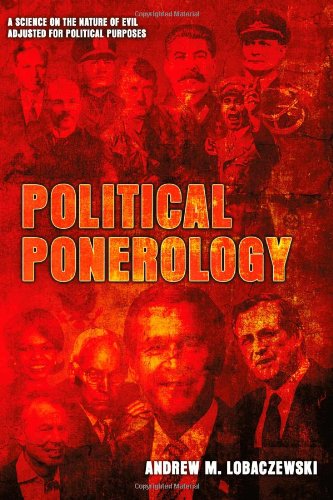
Political Ponerology: The Study of Political Evil

From Ponerology.com

http://www.ponerology.com/evil_1.html#link2

PSYCHOPATHY: THE CAUSE OF EVIL

Inherited and acquired psychological disorders and ignorance of their existence and nature are the primal causes of evil.

The magic number of 6% seems to represent the number of humans who either carry the genes responsible for biological evil or who acquire such disorders in the course of their lifetime. This small percent is responsible for the vast majority of human misery and crime, and for infecting others with their flawed view of the world.

The scope of evil does not respect any boundaries of race, doctrine, or ideology. All races carry the genes, and all schools of thought are susceptible to their influence. These pathological factors that influence behaviour form a complex web. It is only in such a web that the “environmental evil” wherein circumstances can influence a normal person to commit harmful acts can be understood.

Of 5000 psychotic, neurotic and healthy patients, Lobaczewski identified 384 (7.7%) who caused serious harm (physical and/or emotional) to others. Some of these had been penalized for their actions and some had been protected by Communist government of the time.

Contrary to the common moralistic interpretation of evil actions (“evil consists of making evil choices”), and also contrary to legal systems which views psychopaths as sane and thus responsible for their actions, the vast majority (85%) of these 384 individuals showed psychopathological factors influencing their behaviour. It is likely that, without these factors present, the harmful actions would not have taken place. These psychological factors limit the subject’s ability to control their actions. In this sense, a moralistic interpretation to psychopathic behavior is fundamentally flawed. While a moral sense (lacking in psychopaths) can be seen as necessary to be held morally responsible, that is not to say that psychopaths should have free rein to destroy lives.

Psychopathic individuals can have a number of effects on normal people: they can fascinate, traumatize, cause pathological personality development, or inspire vindictive emotions (a result of viewing evil as simply a “choice”). An example of this variety can be seen in the host of groupies, pen pals, supporters, and love-struck fans that flocks towards dangerous serial killers like Richard Ramirez and Ted Bundy. One fan of Ramirez said, “When I look at him, I see a real handsome guy who just messed up his life because he never had anyone to guide him.”

These effects and the confusion they engender can then lead to, and reinforce our collective ignorance of such individuals. We rarely hold responsible the individual who influences another to commit evil, but instead moralistically punish only the agent of an act. The true cause of ‘evil’ actions goes unpunished, much like an Army Private punished for the crimes of his superiors.

In fact, the true source of ‘evil’ may be separated from a specific action by both vast stretches in time (i.e., in literature and tradition) and by large distances (i.e., by mass media).

“The practical value of our natural world view generally ends where psychopathology begins.” (Lobaczewski, 145) PONEROLOGY: A NEW SCIENCE No matter how eloquently and accurately authors (novelists, dramatists, poets, historians) describe the occurrence of evil, a disease cannot be cured through description alone. Our natural language cannot adequately explain the concepts surrounding such phenomena. Only a scientific understanding drawing from psychological, social, and moral concepts can approach the understanding necessary to prevent the emergence of mass madness seen so many times in the history of our planet.

Ponerology describes the genesis, existence, and spread of the macrosocial disease called evil. Its causes are traceable and can be repeatedly observed and analyzed. When humanity manages to incorporate this knowledge into its natural worldview, it will have defensive potential as yet unrealized.”

Blogger arrested for invasion of privacy

A blogger was arrested for invading the privacy of a relative of a political candidate:

http://www.cnn.com/2014/05/17/politics/mississippi-gop-primary-arrest/

“The arrest of a man who allegedly obtained an image of a senator’s bedridden wife has shaken up an already intense Republican primary battle in Mississippi.

Political blogger Clayton Kelly was arrested Thursday, accused of exploiting a vulnerable adult and illegally and improperly obtaining a photo of her without her consent for his own benefit, according to the Madison Police Department.

Donald Clark, an attorney for Sen. Thad Cochran, R-Mississippi, and his wife, Rose, told The Clarion-Ledger newspaper that the woman in question is Rose, saying the Cochrans’ “privacy and dignity have been violated.” Rose Cochran suffers from dementia and has lived at St. Catherine’s Village, the nursing home where Thursday’s incident took place, for 14 years, according to the newspaper.”

The usual suspects will cry foul.  Journalists – even bloggers –  should always be free to say anything they want to about the political class.

On its face, of course, the arrest is a prior restraint, since no one has established the blogger’s guilt in a court of law.

However, this is not the first case of this type. Last year, the Legal Schnauzer blog,  which admittedly published defamatory material, was shut down before a court could adjudicate:

It’s clear that Southern courts are taking an aggressive position on the issue.

Frankly, constitution or not, I can sympathize with the victims. If political bloggers cannot tell the difference between a public issue and a private, they might need a severe shaking-up to find out.

On the other hand, the whole business worries me a lot.

While the first use of the law to pre-emptively discard public speech might be exerted on an obviously unsympathetic figure, it doesn’t follow that every other use will be.

For instance, there was another recent case of an outspoken blogger with powerful enemies being arrested, without a search warrant, for having child-porn on his computer.

Here,  the charges do in fact look trumped up and motivated by resentment of the blogger’s political speech:

These days, with the government privy to every move you make on the Internet, how hard would it be for someone to get a friend in government or a former government employee or contractor to download something onto your computer?

Not very hard, said a counter-terrorism expert I spoke to, although an FBI agent told me the FBI could always determine how any material was downloaded.

Still, if you’re a political blogger, the chances are you don’t want to be relying on the good offices of the FBI to avert a long stay in jail.