The Case For The Resurrection

Did Jesus Rise From The Grave?

“Legal scholar John Warwick Montgomery stated, “In 56 A.D. [the Apostle Paul wrote that over 500 people had seen the risen Jesus and that most of them were still alive. (1 Corinthians 15:6ff.) It passes the bounds of credibility that the early Christians could have manufactured such a tale and then preached it among those who might easily have refuted it simply by producing the body of Jesus.”[26]

Bible scholars Geisler and Turek agree. “If the Resurrection had not occurred, why would the Apostle Paul give such a list of supposed eyewitnesses? He would immediately lose all credibility with his Corinthian readers by lying so blatantly.”[27]

Peter told a crowd in Caesarea why he and the other disciples were so convinced Jesus was alive.

“We apostles are witnesses of all he did throughout Israel and in Jerusalem. They put him to death by crucifying him, but God raised him to life three days later … We were those who ate and drank with him after he rose from the dead.” (Acts 10:39-41)

British Bible scholar Michael Green remarked, “The appearances of Jesus are as well authenticated as anything in antiquity … There can be no rational doubt that they occurred.”[28]……..

…….Chuck Colson, implicated in the Watergate scandal during President Nixon’s administration, pointed out the difficulty of several people maintaining a lie for an extended period of time.

“I know the resurrection is a fact, and Watergate proved it to me. How? Because 12 men testified they had seen Jesus raised from the dead, and then they proclaimed that truth for 40 years, never once denying it. Every one was beaten, tortured, stoned and put in prison. They would not have endured that if it weren’t true. Watergate embroiled 12 of the most powerful men in the world – and they couldn’t keep a lie for three weeks. You’re telling me 12 apostles could keep a lie for 40 years? Absolutely impossible.”[31]

Something happened that changed everything for these men and women. Morison acknowledged, “Whoever comes to this problem has sooner or later to confront a fact that cannot be explained away … This fact is that … a profound conviction came to the little group of people – a change that attests to the fact that Jesus had risen from the grave.”[3

Read more at Y-Jesus.

Crosby/Kirkpatrick: He Hideth My Soul


“A Wonderful Savior is Jesus My Lord,” Fanny Crosby and William J. Kirkpatrick

Read the score at Hymnal.net
A wonderful Savior is Jesus my Lord,
A wonderful Savior to me;
He hideth my soul in the cleft of the rock,
Where rivers of pleasure I see.

Refrain

He hideth my soul in the cleft of the rock
That shadows a dry, thirsty land;
He hideth my life with the depths of His love,
And covers me there with His hand,
And covers me there with His hand.

A wonderful Savior is Jesus my Lord,
He taketh my burden away;
He holdeth me up, and I shall not be moved,
He giveth me strength as my day.

Refrain

With numberless blessings each moment He crowns,
And filled with His fullness divine,
I sing in my rapture, oh, glory to God
For such a Redeemer as mine!

Refrain

When clothed in His brightness, transported I rise
To meet Him in clouds of the sky,
His perfect salvation, His wonderful love
I’ll shout with the millions on high.

Refrain

Poison Ivy: More Dangers Of Elite Schooling

In Excellent Sheep: The Miseducation of the American Elite,” Free Press, 2014, William Deresiewicz writes that elite American schools corrupt the souls of their students …. but he fails to mention that they also endanger their bodies.

Recently, I looked at some crime statistics for Yale University, the premier academic seat of East Coast liberals – the Ivy League that trains the Ivy League, so to speak.

You’d think all that high-powered thinking would have had some impact for good where it most counts –  at home.

Not a chance.

Not only is New Haven, Connecticut, a haven of crime, Yale’s immediate environs are no bower of peace and prosperity.

The Yale Daily News, struggling to portray the campus’s successful spin on the subject as some kind of structural improvement, admits that Yale richly deserves its reputation as a poster-child for violent crime.

“Yale and New Haven’s reputation for being dangerous likely originated in the late 1980s and early 1990s, when crack-cocaine made the city an entirely different place. During that time, when the city was the site of a drug war, there were three times as many shootings in the city as there are today.

And Yale’s campus was not as safe either. There were over 1,000 major crimes — including motor-vehicle theft, larceny and rape — on Yale’s campus each year in the late 1980s and early 1990s. Crime on campus peaked in 1990 with 1,439 major crimes. The image of a dangerous Yale is epitomized by the murder of Prince, who was fatally shot in the chest on Feb. 17, 1991, on the steps of St. Mary’s Church on Hillhouse Avenue.

“When 19-year-old Christian H. Prince died in an attempted robbery — just a block from the university president’s house — whatever remained of the students’ sense of protection around campus died too,” The New York Times reported two days after the murder in a story headlined: “At Yale, Fear and Anger Join Grief Over Slaying.”

The murder shook the campus: “That was a bad time,” Deputy University Secretary Martha Highsmith said. “It was a horrible time.”

After the incident, the University spent millions of dollars installing new lights and blue phones and adding security personnel. But, just seven years later, Jovin was fatally stabbed.……

…In 2007 and 2008 combined, New Haven reported 2,690 violent crimes for every 100,000 residents, according to the Federal Bureau of Investigation’s Uniform Crime Reports. This number is comparable to the crime rates in two of Connecticut’s other major cities, Hartford and Bridgeport — 2,377 and 2,338 respectively. (As defined by the FBI, violent crimes include murder, forcible rape, robbery rape and aggravated assault.)

The average U.S. city of comparable size to New Haven had only 1,246 violent crimes per 100,000 residents — less than half as many.”

The average US city, of course, is no Swiss resort. If New Haven is TWICE as dangerous as the average in a field that includes such  vice- factories as Detroit, DC, Baltimore,  Atlanta, and Memphis, the situation is dire indeed.

Point two. The article relays perceptions of safety at Yale, focusing mainly on undergraduate students who live in carded security in campus dormitories.

But the main target of crime at Yale is the hapless graduate student living off-campus, who has to walk home in the dark.

One  comment on the article punctures the propaganda of the campus rag:

“This is the problem when you have school buildings spread out across a dangerous city and Yale does absolutely nothing to crack the town-gown animosity, give money back to a poor city and its citizens (many of whom are Yale employees), and protect students. Ms. Le’s death is a tragedy, and it is even worse to hear that it may have been committed by a member of the school community. But I will say this: New Haven is a dangerous city and Yale doesn’t care. Wait two weeks, let the news crews drive away, and I can almost guarantee that things will be back to normal for Yale security–putting all of us at risk. I commuted to Yale my last two years after a shooting and a stabbing on my corner. . . I spent thousands of dollars on commutation. I may have missed out on some social experiences, but my safety was–and still is–worth every penny. And for the liberals who claim that New Haven is safe: Go find a grad student living in New Haven Towers and ask them what a walk home at 8 PM is like. Offer to take the walk with that person, and maybe you’ll get a realistic view of the world.”

The comment makes a passing reference to a third point about crime on some campuses. Its source in the animosity between the locals and the “privileged” outsiders – the old town- and- gown conflict. To this hostility can be added racial feelings and class anger, as well as a dollop of xenophobia.

A 2010 analysis by the liberal Daily Beast put Yale in the top 25 most dangerous colleges in the US, a country where colleges abound in the tens of thousands.

And Yale made the top 25 again, in 2012, according to The Business Insider.


J. S. Bach, The Fifth Evangelist

Robin Phillips at Salvo Mag writes about the profound influence of the composer who has been called the Fifth Evangelist:

“In April 2009, British atheist A.N. Wilson shocked the world by announcing that he was returning to the Christian faith. When asked later in an interview what was the worst thing about being faithless, the writer and newspaper columnist replied:

When I thought I was an atheist I would listen to the music of Bach and realize that his perception of life was deeper, wiser, more rounded than my own. . . . The Resurrection, which proclaims that matter and spirit are mysteriously conjoined, is the ultimate key to who we are. It confronts us with an extraordinarily haunting story. J. S. Bach believed the story, and set it to music.

Johann_Sebastian_BachA.N.Wilson is not alone.

In his Introduction to the book Does God Exist? Peter Kreeft noted that he personally knows three ex-atheists who were swayed by the argument, “There is the music of Bach, therefore there must be a God.” Of these, Kreeft informed his readers, two are now philosophy professors and one is a monk.

Even the God-hater Friedrich Nietzsche (1844-1900), upon hearing a performance of the St. Matthew Passion, was compelled to admit that “one who has completely forgotten Christianity truly hears it here as gospel.”

In Japan today, tens of thousands of a people who were once fiercely anti-Christian have been converted to Christianity by listening to the music of J. S. Bach, writes George Weigel:

“A famous scientist of secular persuasion once proposed that, if humanity wanted to put its best foot forward in trying to communicate with extraterrestrial life, we ought to broadcast all of Bach to the far corners of the universe. A bit closer to home, the man whom Swedish Lutheran archbishop Nathan Soederblom once called the “fifth evangelist” is having a remarkable impact on the new evangelization in a surprising place: Johann Sebastian Bach has begun to convert members of the traditionally anti-Christian Japanese elite to Christ.

Classical music fans sensed that something intriguing was afoot when a series of exceptionally high-quality CDs by an ensemble called the “Bach Collegium Japan” began to appear in the stores a few years ago. Under the direction of its founder, Maasaki Suzuki, the Bach Collegium is recording every one of the master’s cantatas. But why on earth would a Japanese choir be doing Bach’s religious works?

Writing in First Things, Uwe Siemon-Netto explores the religious sociology of the intense Japanese demand for Bach. Maasaki Suzuki thinks it’s due to his country’s demonstrable spiritual crisis. Its traditional religions, Shinto and Buddhism, have lost their credibility. Palm readers and pornography are flourishing, and suicides are on the rise. Sixty percent of the country tells pollsters that they feel “afraid” every day.

“What people need in this situation is hope in the Christian sense of the word,” says Maasaki Suzuki, “but hope is an alien idea” in Japan. The Japanese language doesn’t have a word for hope in the biblical sense: there is one word for desire and another for the unattainable, but no equivalent of “hope,” the theological virtue. According to Maestro Suzuki, non-Christians crowd his podium after Bach Collegium performances to talk about any number of taboo subjects in Japanese society, like death. “And then,” says Suzuki, “they inevitably ask me to explain to them what ‘hope’ means to Christians.”

Suzuki, a Christian convert and member of the Reformed Church, evangelizes his Collegium members, teaching them Scripture during rehearsals. He can’t say precisely how many of his musicians or how many in their growing audience have become Christians. But he is convinced that tens of thousands of Japanese have been baptized because of Bach.”

****

This may not be as surprising as it sounds, for the man whom many consider to be the greatest artistic genius who ever lived was well-versed in theology and Bible studies.

Mark Galli at Christianity Today.com (July 28, 2000) writes:

“When he was 48, Johann Sebastian Bach (who died 250 years ago today) acquired a copy of Luther’s three-volume translation of the Bible.

(Lila: This so-called “Bach Bible” was actually a massive six-volume, three-folio 17th-century version with translation and commentary by Luther, as well as by the orthodox Lutheran theologian, Abraham Calov or Calovius).

He(Bach) pored over it as if it were a long-lost treasure. He underlined passages, corrected errors in the text and commentary, inserted missing words, and made notes in the margins.

Near 1 Chronicles 25 (a listing of Davidic musicians) he wrote, “This chapter is the true foundation of all God-pleasing music.” At 2 Chronicles 5:13 (which speaks of temple musicians praising God), he noted, “At a reverent performance of music, God is always at hand with his gracious presence.

As one scholar put it, Bach the musician was indeed “a Christian who lived with the Bible.” Besides being the baroque era’s greatest organist and composer, and one of the most productive geniuses in the history of Western music, Bach was also a theologian who just happened to work with a keyboard.”

But theology only informed a life that embodied the Gospel practically.

Despite a fierce temper that led him into conflict with his superiors and resignation from his job (once, when an unworthy individual was elevated above him),  Bach was a devout man who fulfilled his family and social obligations in difficult circumstances and served his fellow-man with a humility rare, indeed unique, among men of his gigantic abilities and volatile temperament.

Christians.com:

Bach said, “Music’s only purpose should be the glory of God and the recreation of the human spirit”…….

Bach’s own life was in complete accord with his beliefs.

Though he possessed a musical genius found perhaps once in a century, he chose to live an obscure life as a church musician. Only once in his 65 years did he actually take a job where his brilliance might bring him to the world’s notice. For a while, he worked as Kapellmeister of the court of Prince Leopold. But such surroundings were a distraction to him. He soon left to accept a lowly position as cantor at a church in Leipzig, where he would again be cloistered in his unacclaimed but beloved world of church music.”

This unimpeachable testimony of the spiritual power of Bach’s music is made even more impressive when one realizes that Bach’s “evangelism” took place during the dawn of the Enlightenment, when deists like Voltaire were denouncing the church and its dogmas as “infamy” and when Christian belief was struggling not just against the corruptions of the Roman papacy and  newly formed Jesuit Counter-Reformation but against the zealous errors of the Reformation itself – with Pietism, on one hand, with its excessive emphasis on both emotion and austerity (downplaying the use of music in the service) and Rationalism on the  other, with its “higher criticism” of the Bible and its excessive emphasis on the unaided intellect.

Bach, by contrast, grounded his theology on the rock of Lutheran orthodoxy:

1. The Bible as the inspired and inerrant Word of God;

2.  The Redemption of Christ – Salvation from the Death Penalty of the Law – as the central message of the Bible;

3. And the primacy of the Word (and the hearing of the Word) over every moral or intellectual effort (“works”).

Despite the emotional depth of his music (that suggests Pietism) and his fascination with numbers (that suggests a kind of Rationalist leaning), Bach was firmly Orthodox.

Man was not brought to salvation by his good deeds, spiritual struggles, or inner emotions (as the Pietists  believed).

Those were “Works,” not Faith.

Neither were men brought to salvation by reason, understanding, and intellectual argument (as the Rationalists believed).

Instead they came by faith, through hearing the Word of God.

It was Christ’s work, not a man’s,  if he came to faith .

The centrality of the Word to faith made true doctrine the core of Lutheran orthodoxy.

Thus, Romans 10-17:

“Thus faith cometh by hearing, and hearing by the word of God.”

But this “hearing” is not the outward hearing of the ear. It is the inward hearing of the heart.

A Historicist View Of Revelation

Odd though it must seem to confirmed skeptics and atheists,  seminal events in contemporary politics – such as the conflicts in the Middle East –  are closely tied to interpretations of ancient religious texts.

One of the most influential of these is the last book of the New Testament canon, the Revelation (of Jesus Christ to St. John), written by John the Divine, the author of  the Gospel of St. John, around 95-96 AD.

[This popular dating is based on the rather flimsy account of a Church Father. Far  more likely,  from the textual and historical evidence, is a date of 66 AD… or earlier.]

Historicists believe that the events predicted in Revelations have occurred- and will continue to occur – until the (still future) second coming of Jesus Christ.

Praeterists believe all the prophecies have already been fulfilled in the past and do not apply to anything today.

Futurists believe that all the the prophecies apply to the last few years before the Second Coming.

Idealists think Revelation describes spiritual rather than actual historical events.

The Biblical prophets themselves, as well as the early church, appear to have taken a  historicist position.

The preterist and futurist interpretations, on the other hand, had their birth during the Counter-Reformation, the Roman church’s response to the Protestant Reformation.

Historicists argue that futurism and preterism were developed to take pressure off the Papacy and the Roman church, which the Reformers were united in condemning as the Anti-Christ figure of Revelation.

The following passage is excerpted from a  historicist interpretation of  the first six  of the seven seals of the Book of  Revelation, a passage from the Bible that has had astounding influence on international politics in the Middle East:

“Horsemen: The first four symbols are  few connected by using the same symbol. In the total scheme of all the symbols, this style — making the first four in each group of seven to be connected — continues in the trumpets and bowls. In the first of the four trumpets, blows strike, (1) one third of the land and vegetation; (2) one third of the sea and shipping; (3) one third of rivers and fountains; (4) one third of sources of light, sun, moon and stars.

Under the figures of plagues, the first four vials or bowls are likewise blows against land, sea, rivers, and the sun. In the fulfillment of these figures there would naturally be a relation of the first four symbols historically, with the possibility of some overlapping in the fulfillment. Remember then, the design of the book is that the first four symbols in each group are interrelated.

1. White: is a symbol of something good, the bow and crown of armored authority, and expansion of territory in conquest. So the first period of time after Domitian should be characterized historically as an unusually “good” (righteous) period associated with conquest and expansion. When we look in a secular history book the period just following Domitian should say, “something good.”

2. Red: is a symbol of blood, war, fire, not of “good.” Take peace from the earth indicates a total disorder. Kill one another indicates internal war, not killing the enemy, it is a figure of civil war. A great sword indicates a lot of dying in battle. So the second period of time should be characterized historically by breakdown of society, a great deal of armed conflict with many killed in civil disorders and not because of invasion of outsiders. This must follow a period of peace and “good” and expansion.

3. Black: is a symbol of darkness and despair. The scales and high prices and instructions not to waste suggest need for care because of shortages. The third period following hard on the civil disorder should be a period of famine and associated hardships. “Hard times” is the key note.

4. Pale: is a symbol of sickliness. The symbols associate closely with death, the abode of the dead (hades) as epitomizing history in the period. Twenty five percent, or the fourth part of the earth, are to die from (1) sword; (2) famine; (3) disease; (4) wild animals. So the fourth period following the previous (and probably overlapping, as death and famine are part of both) should be a period characterized by depopulation of the earth due to war, famine, disease, and wild animals.

5. Saints under the altar: refers to the dead in Christ awaiting judgment day. These have been killed because of their faith and testimony. They want to know how long before God takes vengeance indicating the day of vengeance on the persecutors. “Rest a little season until,” should indicate a short interval following the last horse’s period. “The time that your brothers should be killed;” when this is fulfilled it will be a period of further persecution for a short but intense period when history is epitomized by that persecution.

So, following the four horsemen (1) peace and good, (2) civil war, (3) famine, (4) depopulation, there should follow a period that is characterized by persecution. In the vision, the persecution has been going on previously, persecution in which Christians have been dying, but this last will be a climax and completion of the persecution. Many Christians will die but after a little season the persecution stops. History is to look like this in the future from John’s view.

6. A great earthquake: equals complete shakeup of those things counted secure: government, religion, social order, ethics, economy; all shaken. The sun and moon are symbols of authority in human governments, the emperor, etc. The stars represent spiritual powers just as astrological charts indicate. The gods of paganism were associated with planets and stars. Heaven departing indicates the removal of spiritual powers or ethical inhibitors. No guidance from above! Mountains and islands are symbols of nations and governments. These being moved out of their places is a symbol of turnover of government, continuing the symbol of a great earthquake, that characterizes this period. The following verses (15-17) make it plain that the whole upheaval is identified with Jesus Christ and it is a day of reckoning for the enemies of the cross of Christ. It is a day that will cause his enemies to hide, disappear, flee away, and he will take vengeance.

So following the period of persecution, world history should be characterized by the world being turned upside down, the disappearance of pagan powers, while Christian ethics take their place. Government will be likewise reorganized and shaken violently at the end of which Christianity will be in a good position, as the next symbol makes clear.

All of chapter seven speaks of conversion. 144,000 of the nation of the Jews and then a great multitude out of every nation and language, beyond number, are brought to worship God and Christ. (Vs. 9) Verses 14 and 15 contain a description of conversion that is symbolic of the changes that most born again believers associate with their own experience. What is characterized in the whole of chapter seven is a great ingathering or gospel harvest that follows the revolutionary period just previous to it.

So the interval is a period of evangelism and expansion of the Christian gospel that should epitomize that historical period. Any one knowing the history of the world from the time of Domitian through the next few centuries will be struck with the incredible coincidence of the outline of the seer of Patmos with what actually happened.

Let the Winds blow: At the commencement of the Interlude of sealing the servants of God an angel is instructed to “Hold back the four winds until the sealing is over. Thus after the ingathering of souls, the Seventh seal will be associated with events that will look like the destructive action of blowing winds associated with the first of the Trumpets. A map of the next 100 yearas after The triumph of the Christian Cburch should look like blowing winds.

Also as noted in the fist chapter of this book The seventh seal IS the Seven Trumpets. Confirming that the trumpets can not be concurrent with the Seals. They are designed to be in sequence. Let us note the following Maps. The first shows the Roman Empire in 395 at the end of the 60 or so years described as the Triumph of Christianity. Notice how the Empire is still in a very neat condition.

Please click to see the map and click the back button to return to this page map

This next map shows the the next 100 year beginning in 410, Beginning fifteen years after the last map.
Please click to see the map and click the back button to return to this page. map

Review

Let us review one more time. The historical periods following the time of Domitian should follow:

1. Something good.
2. Civil disorder, many die.
3. Hard times.
4. Depopulation by twenty five percent.
5. Persecution.
6. Revolution of religious as well as political life.
7. Interval of ingathering or expansion of Christian gospel.
8. Let the Winds Blow

Historical Fulfillment

1. The period immediately following Domitian introduces a century of peace called the Pax Romana or translated the Peace of Rome. The emperors of the period are known in history books as the “Five Good Emperors.” Marcus Aurelius was a philosopher whose doctrines approached the ethics of Christianity. The name of emperor Antoninus Pius indicates his inclinations. This period, from 98 to 180 is also characterized by the additions of large border regions to the empire and expansion to the greatest limits ever. If God wanted to picture the period he could not have chosen a better symbol than a white horse and conquest.

2. History texts call the period from 180 to 280 the period of disorder. Eighty emperors ruled in a space of ninety years and most of them met death by violence. The post of emperor was actually bought and sold at public auction. The empire was ravaged by civil war for most of the period. Every few months a new soldier of fortune would make a claim on the title and march on Rome from distant as well as more local locations, fighting, pillaging, and burning as they approached a war weary city. The depletion of stocks, burning of countryside, disruption of markets, and farms denuded of crops took their toll and the next two figures overlap the end of this period.

3. The devastation of the wars of the previous period brought the empire the worst of famines and shortages. This period overlaps the end of the last.

4. The consequences of the preceding wars and famines created a climate for the depopulation of the earth that historians tell us characterized this period. Due to the depopulation, wild animals increased in formerly civilized areas and death from them was common enough to be placed in the histories. An outbreak of the black plague (bubonic plague) is recorded at this time. The figures of death due to sword, famine, disease, and wild animals is a perfect description of the period, which, with the last, overlaps and extends as a result of the wars to the early 300s when they were cause for what followed. The Christians were blamed!

5. From 300 to 313, “a little season,” the history of the Roman empire is characterized by persecution. It is the last and most severe of the ten great persecutions against the Christian religion which were authorized by the emperors of Rome. Many thousands died, many church buildings and Bibles went to the flames. Every elder, (bishop) was arrested and killed and all other Christian leaders went into hiding or suffered death in the arenas publicly, as sport for the spectators. Diocletian resigned midway and his successor and son-in-law carried on the extremities. He it was who issued the edict of persecution. He would later admit defeat and would issue the edict of toleration which ended the OFFICIAL persecution on a world scale forever. Christians have never faced death on such a scale since. Historians all epitomize this historical period as an epoch of persecution.

6. Following the end of the persecution, Constantine the Great left York in Britain and marched against Galerius and his successors. His conquests and subsequent emperorship are characterized by turning the imperial system of Rome upside down. Rather than merely tolerating Christianity, he issued in 325 the Edict of Milan, which made Christianity the official religion of the Roman Empire. The pagan temples were closed and they were given to Christian churches; the pagan gods were swept away, not only from their pedestals but from peoples’ hearts. The figures of the stars falling and heaven being rolled up could not better describe the disappearance of the old religious and ethical order and the taking of its place by the Christian religion. Imagine being paid to become a Christian when only four or five years ago your family was being torn by lions for the same faith! New government took the place of the old order; the church would play a large part in the affairs of state; and the capitol would be moved from Rome to Constantinople. There could not possibly be a better set of figures to epitomize this great, eventful period than mountains and islands moving, a great earthquake and the day of Jesus Christ’s vengeance, and the shaking and disappearance of secure heavenly powers in favor of Jesus! There is much more to say about the fulfillment of these figures and while this is necessarily an outline it is extraordinary in its completeness and simplicity.”

Charlie Hebdo: The Free Speech of Fools

From Lenin’s Tomb, a clear-eyed look at the bigotry and spite posing as satire in the pages of Charlie Hebdo:

“From what psychological depths did you drag up the nerve to “laugh” at a cartoon representing veiled women baring their buttocks as they bow in prayer towards “Mecca-relle [a pun onmaquerelle, the madam of a brothel – trans.]?  This pathetic stream of crap isn’t even shameful; its stupidity embarrasses you, even before it reveals your state of mind, your vision of the world.”

IMAGE DELETED TO AVOID OFFENSE TO MUSLIMS


Lenin’s Tomb:

“After September 11, Charlie Hebdo was among the first in the so-called leftist press to jump on the bandwagon of the Islamic peril. Don’t deprive yourself of receiving your own share of the shit, at a moment when the number of Islamophobic acts is breaking records: 11.3% higher in the first 9 months of 2013 compared to the same period in 2012, according to l’Observatoire national de l’islamophobie. They worry about a “new phenomenon” of violence, marked by at least 14 attacks on veiled women since the start of the year.”

Lila:

Here are some more Charlie Hebdo images that the mainstream media will not publish. They demonstrate convincingly that only some religions – specifically traditional Islam and traditional Christianity – were targeted by the cartoonists, not others.

They didn’t mock Judaism, for instance.

That omission makes Charlie Hebdo in effect a mouth-piece of Zionist sensibilities.

Notice also that Arabs and blacks were the main objects of the magazine’s animus,  suggesting that its so-called satire was no more than a vehicle through which it  propagated Anglo-Jewish racial supremacism.

Hebdo Cartoon: JESUS CHRIST SODOMIZING GOD THE FATHER AND BEING SODOMIZED BY THE HOLY GHOST


IMAGE DELETED TO AVOID OFFENSE TO CHRISTIANS

Hebdo Cartoon: PROPHET MOHAMMED DISPLAYING HIS BUTTOCKS FOR APPROVAL

 IMAGE DELETED TO AVOID OFFENSE TO MUSLIMS


Hebdo Cartoon: ASKING IF DRAWING MOHAMMED’S BUTTOCKS IS PERMISSIBLE


IMAGE DELETED TO AVOID OFFENSE TO MUSLIMS

Hebdo Cartoon: FILM MAKER CLAIMING THAT PROPHET MOHAMMED HAD SEX WITH PIGS, BECAUSE  HE COULD NOT AFFORD TO PAY FOR NINE YEAR OLD PROSTITUTES

IMAGE DELETED TO AVOID OFFENSE TO MUSLIMS

Lila:

Meanwhile,  when it came to ridiculing the  religion or beliefs of the ruling class, the COWARDS at Charlie Hebdo failed miserably. 

They published no pornographic pictures of Maimonides or Moses, no edgy jokes about the Holocaust, no genitalia of Anne Frank, no raunchy pedophile gags about Rabbis.

[And I, for one,  would not wish them to. I would wish, however, that they had extended the same respect to other people and other faiths.]

Instead, the magazine caved in and fired an employee over the whisper of anti-Semitism. 

Thus, the moniker of “equal opportunity satire” so universally applied to Charlie Hebdo is demonstrable propaganda,  intend to hoodwink the credulous.

Selective satire was the facade behind which the lewd ravings of Zionist hate-mongers flourished without public outrage,  ceaselessly stoking the searing flames of perpetual civilizational war.


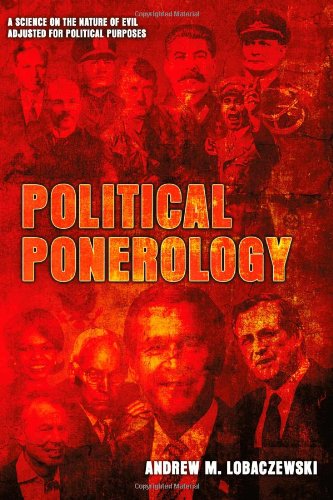
Political Ponerology: The Study of Political Evil

From Ponerology.com

http://www.ponerology.com/evil_1.html#link2

PSYCHOPATHY: THE CAUSE OF EVIL

Inherited and acquired psychological disorders and ignorance of their existence and nature are the primal causes of evil.

The magic number of 6% seems to represent the number of humans who either carry the genes responsible for biological evil or who acquire such disorders in the course of their lifetime. This small percent is responsible for the vast majority of human misery and crime, and for infecting others with their flawed view of the world.

The scope of evil does not respect any boundaries of race, doctrine, or ideology. All races carry the genes, and all schools of thought are susceptible to their influence. These pathological factors that influence behaviour form a complex web. It is only in such a web that the “environmental evil” wherein circumstances can influence a normal person to commit harmful acts can be understood.

Of 5000 psychotic, neurotic and healthy patients, Lobaczewski identified 384 (7.7%) who caused serious harm (physical and/or emotional) to others. Some of these had been penalized for their actions and some had been protected by Communist government of the time.

Contrary to the common moralistic interpretation of evil actions (“evil consists of making evil choices”), and also contrary to legal systems which views psychopaths as sane and thus responsible for their actions, the vast majority (85%) of these 384 individuals showed psychopathological factors influencing their behaviour. It is likely that, without these factors present, the harmful actions would not have taken place. These psychological factors limit the subject’s ability to control their actions. In this sense, a moralistic interpretation to psychopathic behavior is fundamentally flawed. While a moral sense (lacking in psychopaths) can be seen as necessary to be held morally responsible, that is not to say that psychopaths should have free rein to destroy lives.

Psychopathic individuals can have a number of effects on normal people: they can fascinate, traumatize, cause pathological personality development, or inspire vindictive emotions (a result of viewing evil as simply a “choice”). An example of this variety can be seen in the host of groupies, pen pals, supporters, and love-struck fans that flocks towards dangerous serial killers like Richard Ramirez and Ted Bundy. One fan of Ramirez said, “When I look at him, I see a real handsome guy who just messed up his life because he never had anyone to guide him.”

These effects and the confusion they engender can then lead to, and reinforce our collective ignorance of such individuals. We rarely hold responsible the individual who influences another to commit evil, but instead moralistically punish only the agent of an act. The true cause of ‘evil’ actions goes unpunished, much like an Army Private punished for the crimes of his superiors.

In fact, the true source of ‘evil’ may be separated from a specific action by both vast stretches in time (i.e., in literature and tradition) and by large distances (i.e., by mass media).

“The practical value of our natural world view generally ends where psychopathology begins.” (Lobaczewski, 145) PONEROLOGY: A NEW SCIENCE No matter how eloquently and accurately authors (novelists, dramatists, poets, historians) describe the occurrence of evil, a disease cannot be cured through description alone. Our natural language cannot adequately explain the concepts surrounding such phenomena. Only a scientific understanding drawing from psychological, social, and moral concepts can approach the understanding necessary to prevent the emergence of mass madness seen so many times in the history of our planet.

Ponerology describes the genesis, existence, and spread of the macrosocial disease called evil. Its causes are traceable and can be repeatedly observed and analyzed. When humanity manages to incorporate this knowledge into its natural worldview, it will have defensive potential as yet unrealized.”

Proving the existence of Lord Krishna

Indians are taught that Krishna was a myth and did not exist. This is the inevitable byproduct of an educational system and mentality put in place by the British empire. But things are changing. In response to the question of whether Krishna existed amateur historians are coming up with new evidence of the authentic nature of the Hindu scriptures:

“Most certainly, says Dr Manish Pandit, a nuclear medicine physician who teaches in the United Kingdom, proffering astronomical, archaeological, linguistic and oral evidences to make his case.

“I used to think of Krishna is a part of Hindu myth and mythology. Imagine my surprise when I came across Dr Narhari Achar (a professor of physics at the University of Memphis, Tennessee, in the US) and his research in 2004 and 2005. He had done the dating of the Mahabharata war using astronomy. I immediately tried to corroborate all his research using the regular Planetarium software and I came to the same conclusions [as him],” Pandit says.

Which meant, he says, that what is taught in schools about Indian history is not correct?

The Great War between the Pandavas and the Kauravas took place in 3067 BC, the Pune-born Pandit, who did his MBBS from BJ Medical College there, says in his first documentary, Krishna: History or Myth?.

Pandit’s calculations say Krishna was born in 3112 BC, so must have been 54-55 years old at the time of the battle of Kurukshetra.

Pandit is also a distinguished astrologer, having written several books on the subject, and claims to have predicted that Sonia Gandhi would reject prime ministership, the exact time at which Shankaracharya Jayendra Saraswati would be released on bail and also the Kargil war.

Pandit, as the sutradhar of the documentary Krishna: History or Myth?, uses four pillars — archaeology, linguistics, what he calls the living tradition of India and astronomy to arrive at the circumstantial verdict that Krishna was indeed a living being, because Mahabharata and the battle of Kurukshetra indeed happened, and since Krishna was the pivot of the Armageddon, it is all true.

You are a specialist in nuclear medicine. What persuaded you to do a film on the history/myth of Krishna? You think there are too many who doubt? Is this a politico-religious message or a purely religious one?

We are always taught that Krishna is a part of Hindu myth and mythology. And this is exactly what I thought as well. But imagine my surprise when I came across Dr Narhari Achar (of the Department of Physics at the University of Memphis, Tennessee, in the US) and his research somewhere in 2004 and 2005. He had done the dating of the Mahabharata war using astronomy.

I immediately tried to corroborate all his research using the regular Planetarium software and I came to the same conclusions. This meant that what we are taught in schools about Indian history is not correct.

I also started wondering about why this should be so. I think that a mixture of the post-colonial need to conform to western ideas of Indian civilisation and an inability to stand up firmly to bizarre western ideas are to blame. Also, any attempt at a more impartial look at Indian history is given a saffron hue.

I decided that I could take this nonsense no more, and decided to make films to show educated Indians what their true heritage was. The pen is mightier than the sword is an old phrase but I thought of new one: Film is the new pen.

Any ideas I have will receive wide dissemination through this medium.

I wanted to present a true idea of Indian history unfettered by perception, which was truly scientific, not just somebody’s hypothesis coloured by their perceptions and prejudices.

Why not a documentary on Rama, who is more controversial in India today? Proof of his existence would certainly be more than welcome today…

A documentary on Rama is forthcoming in the future. But the immediate reason I deferred that project is the immense cost it would entail. Whereas research on Krishna and Mahabharata was present and ready to go.

Further more, Rama according to Indian thought, existed in the long hoary ancient past of Treta Yuga, where science finds it difficult to go.

There is a controversial point in your documentary where someone Isckon monk alludes to Krishna as being the father of Jesus. How can you say that since there is an age gap of roughly 3000 years between the two spiritual giants?

Is Krishna the spiritual father of Jesus? That is what the person who was training to be a Roman Catholic priest, and who now worships Krishna, asks. The answer comes within the field of comparative religion and theology.

The Biblical scriptures qualify Jesus as the son of God. Most Indians have no problems accepting this as Hindus are a naturally secular people. However, then the question that arises is, if Jesus is the son, then who is the Father or God Himself?

[Lila: The word secular in India means not-communal or not provoking religious animosities.]

Now, Biblical scriptures do not really give the answer except to say that the Father is all-powerful and omnipresent. Now, of course, we know that Jesus does not say that he is omnipresent or omnipotent.

[Lila: Jesus both says that he and his father are “one,” implying omniscience and also says at other times, “No man knoweth except the father,” implying limitation.]

Now, no scripture can live as an island, all by itself, and the Srimad Bhagavatam and other scriptures such as the Bramha Samhita all call Krishna as an all powerful, omnipresent being.

So, if we use these words of Bhagavatam, there can be no other truth, which means that Krishna is the father of all living creation.

But it does not mean that Jesus is not divine. Jesus is indeed divine. What I liked about the monks in my documentary is that they do not denigrate Jesus although they worship Krishna as God. They keep Jesus in their hearts, while worshipping Krishna. What could be more secular or more Christian?”

In which I pat myself on the back for keeping out of it..

Over at Bob Wenzel’s entertaining blog, the libertarians are having it out with each other again – the thick libertarians and the thin.

(http://www.sodahead.com/united-states/which-political-party-is-best-for-america/question-2611731/?page=3&link=ibaf&q=&esrc=s)

First, Sheldon Richman took on Walter Block and Lew Rockwell.

He accused them of not supporting their arguments with evidence.

Bionic Mosquito zapped him.

The verdict from the gallery was a resounding win for the home-team.

Then it was Jeffrey Tucker’s turn to come out swinging against Thomas Aquinas,

who, being dead,  was ably defended by the learned David Gordon.

Next, N. Stephan Kinsella arm-wrestled with a minarchist and called him names like “loser,”

which is par for the course, when it comes to N. Stephan Kinsella.

I woman-fully restrained myself from throwing any sticks or stones, as part of my endless violated not-so-New Year’s resolution to “play nicer.”

[See, Mr. Tucker? I took your humanitarian advice to heart in spirit, even though I criticized it in letter.]

But I admit I missed drawing blood.

And I admit I enjoyed watching others draw blood:

http://johnkreng.wordpress.com/2012/03/05/review-of-bloodsport-1988/

But, honestly, I didn’t get much satisfaction from any of it.

A wee bit of Schadenfreude, maybe.

But, for a brutalist outcaste – a “hater” and a “bigot” –

….not bad at all.

Recommended reading: Jonathan Haidt: “Why Good People are Divided by Religion and Politics”

Rabbi Shternbuch: We Have Begun Messianic Times

NOTE: None of the interpretations below tallies with the evidence of history and archaeology that points to Gog and Magog being historical types that portend future actors:

Gog in history was the king of Lydia in Asia Minor.

“The erroneous belief that Russia is Magog can be traced back to a small group of 18th and 19th century theologians who wrote long before the primary evidence from the ancient Assyrian records was discovered, translated and made available to the public. Instead, they based their assertions on secondary sources, historical works written over 500 years after the time of Ezekiel, and to make matters worse some of these sources had come to be purposefully altered. These altered references include statements attributed to the first century AD Jewish historian Josephus, and first century AD Roman historian Pliny.”

You wonder if these discredited interpretations that surface in popular newspapers have something to do with the intelligence agencies of different countries stirring up the masses to support violent confrontations…

Lydia was the home of the Etruscans who emigrated to Italy and came to dominate Roman culture. The last Roman king, before Rome became a republic, was Etruscan.

So, Gyges of Lydia (Gog of Magog) is best seen as a historical type of a future ruler of the world, in the style of Rome.

Therefore, it’s plausible to argue that Gog = One World Government, or the New World Order, which is the popular name on conspiracy and right-wing sites for the corporate and financial powers behind NATO and the European Union.

Gog is not Russia at all.

Update 2: Here is a more complex interpretation, which considers Ar Rum (Rome) to be the one-world government. That suggests that the current dialectics in play (West versus East, US versus Russia;  Secular vs Orthodox) are working toward a more complex end.

Update 1: An Islamic interpretation of Gog and Magog. It doesn’t identify Russia with Gog and Magog, but identifies it with militant Zionism.

In this version, the subversion of the Ukraine was effected by Soros and Co. (corporate or economic annexation). Russia is instead identified with the defense of Christianity and with “Rum” (Rome) in the Quran.

Russia,  in this version, is seen as the defender of orthodox Christianity, which is seen as the true heir to the church of Rome. The inference is that the Vatican, having succumbed to materialism, atheism, and statism, is now allied with the enemies of the true church.

“Prophet Muhammad (sallalahu ‘alaihi wa sallam) prophesied that Muslims will make an alliance with Rum in Akhir al-Zam?n, and it appears to me that Tatar Muslims now have a historic role to play in the fulfillment of that prophesy.”

I suppose the Muslim allies of Gog must be Saudi Arabia, Qatar, Brunei, and similar states.

ORIGINAL POST

From Haaretz.com, some Apocalyptic thinking:

“Of course, if Gog is Putin, then we all know who the natural candidate for the Antichrist is. But let’s put that aside for now. In any case, there is a nuclear confrontation (“I will start a fire in the land of Magog and along all the seacoasts where people live undisturbed, and everyone will know that I am the Lord) and then a massive seven-month cleanup and a mass burial, somewhere in Jordan, it seems.

If you’re a Christian, the fun is just beginning: An army of “200 million” men will come from the East, according the Book of Revelations, and there’s only one country that can raise such an army. Then, in quick succession but in a sequence that is disputed by scholars, the End Times really get going: Armageddon, Desolation, Tribulation, Rapture, Redemption, the Second Coming – the works.

Jews, by the way, make do with just the war of Gog and Magog, after which messianic days are here and “swords are beaten into ploughshares” etc. Nonetheless, Christians aren’t the only ones who are getting excited about the standoff in Eastern Europe. According to a report catching fire over the weekend in the haredi press in Israel, the Gaon Rabbi Moshe Shternbuch told his disciples this week that the times of the Messiah are upon us. And who is the source for his amazing analysis? None other than one of the top Jewish sages of all time, the Vilna Gaon himself, the Gra, “the genius of Vilnius”, the famously harsh critic of Hasidic Judaism.

According to said Shternbuch, he is privy to a closely guarded secret handed down from the 18th Century Vilna Gaon through generations of revered rabbis: “When you hear that the Russians have captured the city of Crimea, you should know that the times of the Messiah have started, that his steps are being heard. And when you hear that the Russians have reached the city of Constantinople (today’s Istanbul), you should put on your Shabbat clothes and don’t take them off, because it means that the Messiah is about to come any minute.”

I don’t know if Turkish Prime Minister Erdogan knows about Russian designs on Istanbul, but if I were you, I would take your Shabbat clothes to the cleaners, just in case.

Finally, from Moshiach.com: The husband tells the wife, “The Rabbi said that soon we will no longer suffer from the Cossacks, the Messiah is about to come and take us all to Israel.” The wife thinks for a while and says, “Tell the Messiah to leave us alone. Let him take the Cossacks to Israel!”

Examiner.com has the Zionist Christian version of the End Times. Putin is still Gog, trying to expand Magog,  but in this version, the Messiah has some way to go.

More about the differences between Christianity, Reform Judaism, and Orthodox Judaism on the interpretation of this prophecy.

Here’s the relevant chapter – Chapter 38 in the Book of the Prophet Ezekiel.