Stupid Party Leader Tells Stupid Party To Keep Being Stupid

H/T LRC blog:

“Former Texas Rep. and House Majority Leader Dick Armey said Thursday that while Mitt Romney will receive diligent support from tea party activists across the country, he’s not exactly everything they’re looking for.”

Sure. That’s why all those social- conservative activists went to bat yet again for the GOP. They get called everything from “bat-shit crazy” to American Taliban, only to have the party commissar tell them that crony-capitalist, socialistic fascist finance-capital in white-face is really, really different from crony-capitalist, fascistic-socialist finance-capital in black-face.

Dr. Paul, this is what you did by going light on Romney and hitting hard at everyone else.

Of a bad lot, Herman Cain was the best choice for the right….if you had to choose from the two parties. [Correction: I meant, to run along with Ron Paul. I think on his expressed positions, Paul was the best choice, but one the establishment would never have let win. Cain was the best among those it would have accepted and Paul could have hopped on to that ticket.]

Personally, much as I disagree with her methods and objectives, Lila Rose did more for social conservatives on her own than the whole party.

She actually almost got me rethinking my pro-choice stance.

Herman Cain would have trumped the race card. He came from outside politics and outside the financial sector.

He was smart and would have been teachable on economics. He and Paul would have been an unbeatable team, from a marketing perspective.

This year’s elections was the GOP’s to lose.

And, predictably, they’ve just about done that.

Elite Mouthpiece Taunts Ron Paul On Failure Of Fed Campaign

Added July 21, 2012:

How did I see the confrontation? I thought Paul did as well as anyone could in the time given. Except for a few word slips, he was pretty cogent and effective. Bernanke looked discomfited in the middle, when he was questioned about the transfer of authority from Congress to the Fed and when the issue of secrecy was brought up. Other than that, he was impassive and spoke little.  Paul wasn’t “subdued” at all. I don’t watch all his videos, but I’ve seen him a number of times in debate, and that was fairly straightforward Paul. If there was a white flag, I didn’t see it.

If he wasn’t as combative as some seem to think, it’s most likely because it’s his last such confrontation. He’s retiring, I’m told. Too bad.

I thought it was a fairly effective performance and a good wrap up of his major arguments. I think if you’d known nothing about the Fed until then, you would have got the salient points of the anti-Fed argument: he described Bretton Woods,  exchange-rate and interest-rate manipulation; big government financing through debt; transfer of wealth from the poor and middle-class to the wealthy; malinvestment; money supply expansion versus CPI inflation; the housing bubble; and the need for Congressional oversight.

I wouldn’t call it a knock-out, simply because Bernanke was so impassive through out.

That of course helps the media to reframe the confrontation anyway it suits them. Which is what Dana Milbank promptly did.

Paul Vs. Bernanke video

“Ron Paul Vs. Bernanke: final battle ends on surprising note,” David Grant, Christian Science Monitor, July 18, 2012

“Ron Paul Has The Final Say,” Bob Adelman, New American, July 19, 2012

ORIGINAL POST

Skull & Bones affiliated establishment journalist Dana Milbank taunts Ron Paul about the end of the “End the Fed” campaign in a piece entitled, “Ron Paul Fed Up With Trying To End The Fed” (Washington Post, July 18, 2012)

Well, I have plenty of problems with the whole Ron Paul movement these days (for a view from a Paul supporter see  this:), but the piece does more than criticize Paul.

What it does is gloat.

Here are some lines from it, with my parsing.:

“He didn’t even make a dent in it.”

[LR: The Fed is unassailable]

“…Paul raised the white flag.”

[LR: The Fed has won…]

“For the fiery Paul, it was a subdued surrender.”

[LR: So now you know how powerful we really are, old man.]

“….treating him with the cautious affection one might use to address a crazy uncle.”

[LR: You didn’t reach the point where we’d have to assassinate you, so we’ll just let people know that you and your supporters can’t be taken seriously.]

“But Paul faded away with surprising deference.”

[LR: Yes. He’s under our thumb. We call the shots. He knows what’s good for him, so he’s fading away.]

“The one substantial challenge to Bernanke — Paul’s “audit the Fed” bill, which the House is expected to approve next week before it dies in the Senate — was easily dispatched by the Fed chairman,”

[LR: Audit the Fed is croaking.]

“The Paul to Bernanke word ratio this time was 12 to 1.”

[LR: He’s just a rambling  old man. Real men don’t talk, they print.]

“There’s no constitutional reason why Congress couldn’t just take over monetary policy,” he said. “But I’m advising you that it wouldn’t be very good from an economic policy point of view.”

[LR: We’re the constitutionalists, not you. Audit the Fed is only about Congress taking over monetary policy, folks. Imagine! They can’t run a post office. How do you think they’re going to do with deep stuff like economics?]

“”At this point, the committee chairman cut him off. Paul’s time had expired.”

[LR: We’ve put up with you long enough, grandpa. Your time’s up. The game is over.]

The framing of the whole piece is quite masterful. There is not one substantial piece of analysis about the actual policies in question. We are not told what is involved in either “End the Fed” or “Audit the Fed.”

We are instead given information about procedure….rules regarding how bills go through the house, and how speakers get to speak. A contrast is set up between the grave, measured proceedings of the state and the law (the constitution) and the self-indulgent rambling of an aging politician.

The roles are reversed.

Paul becomes the political class. Bernanke becomes the embodiment of the constitution and of law.

From beginning to end we’re told how to think about what’s going on.

This is what we’re supposed to think:

Bernanke is sage, powerful and indulgent.

Paul is a crazy old man, who doesn’t know the elements of civility….or the constitution.

He’s an anti-government politician, but he’s for the government control of the money supply.

He cuts into other people’s time. He rambles on. He talks too much.

Paul is just a “supplicant” before the great Fed chairman. The final word is with the Fed.

So, even though he gets his fifteen minutes, it’s clear Paul doesn’t really understand the constitution or money.

And he’s for the government!

Notice how the piece distorts Paul’s position to make it look as if “Audit the Fed” (Paul’s fall-back position from “End the Fed”) is about putting arcane and complex professional matters into the hands of politicians.

Milbank turns Bernanke into the “private” expert and Paul into the bumbling government man.

That is sure to appeal to Americans of every political stripe. The average reader would immediately distrust anyone who intends to subject policies about the country’s money-supply to ignorant legislators driven by partisan bias.

What that does is clear.

It turns the  whole anti-government argument against anti-government activists.

It also turns  the pro-constitution argument against constitutionalists.

This is propaganda of the highest order.

Rothbard’s Leninist Attack On Gandhi And Voluntaryists

George H. Smith in the June 1983 volume of The Voluntaryist gives one more example of  Rothbard’s penchant for manipulating (in this case, manufacturing) evidence whenever he needed it. It is an article deriding the menace of Gandhism.

Smith correctly calls it “Leninist.” ((This, by the way, is Rothbard’s own term.  By it he meant not the substance of what he wrote but the strategy and tactics he used which he admitted he borrowed from Lenin.

Ah. I knew I wasn’t mistaken.  I know the smell of sulphur as well as anyone. …

Anyway, since I’ve read quite a bit on Gandhi (including the multi-volume biography by Pyarelal, Koestler, Chaudhuri, and dozens of others, as well as Gandhi’s own writing), I feel I am on very strong grounds when I say that Rothbard could not have known much about Gandhi at all, if he thought that Gandhi’s habit  of sleeping with some young women of his circle was unknown.  It was not. It was widely known.

To be clear, there was never any sex in these arrangements and the whole thing was highly public and visible to everyone. The young women were around the ages of 18 or 19 (maybe one was 17? I’ll check)   and vied for the honor of sleeping next to him.

This happened when Gandhi was in his eighties, and it happened after the death of his wife of nearly seventy years (he’d had a child marriage, a common practice in those days).

The young women helped him walk (he called them his crutches), bathed him, and often administered the enemas that were routine in his nature cures. Gandhi wrote about all of this at length, because he saw it as part of a spiritual practice testing his celibacy. He derived this apparently from Tantra and berated himself endlessly when he felt he had been aroused subconsciously or in his dreams (!), instead of just feeling like a “mother” to the women.

I’ve written about this at Counterpunch and Dissident Voice and I believe I was among the first to describe Gandhi’s practices as both arising from repressed psychological needs as a widower and from bona-fide Tantric techniques.

I even corresponded for a while with an academic who had written a dissertation to that effect.  Gandhi was a strongly sexed man, who married in childhood (13), fathered several children, and took a vow of celibacy in his forties. There is no evidence that he ever broke his vow, although he enjoyed warm and slightly very flirtatious relationships with several female admirers.

[Correction n July 18: Sorry, I overlooked more recent research since my 2005 piece that shows Gandhi had “spiritual marriages” with a couple of his close women friends and a very close emotional relationship with a male friend.  These were very close but not physical, so far as I know.  His own words certainly show him to be a highly sexed man and reveal what many will insist is a homoerotic tendency. My own conclusions are different, but I can see some one else thinking he was “creepy” or “freaky”.]

Where Rothbard misrepresents is in claiming that this is unknown. Gandhi himself talked incessantly about his sexual feelings in his letters and even in his startlingly honest autobiography, “My Experiments With Truth,” probably the most revelatory autobiography ever written by a man in his position. Also, there is very little traditionally Hindu about Gandhi in any way. He was a Westernized eclectic, most influenced by Jesus, Thoreau, Tolstoi, and Ruskin]

He was strict (even authoritarian) but affectionate with his own wife, and most of what took place after her death was a kind of acting out of  subconscious drama that he never confronted consciously.

What he did was certainly not harmless to the young women, who must have suffered a good deal of psychological damage.

But it was not intentional, and he was no charlatan.

Even Koestler never thought so.

Anyway, whatever you think about Gandhi or mysticism or Tantra, those who met the man were largely captivated.

Except for a few like Churchill who famously dismissed him as a “seditious Middle Temple lawyer,” most people were impressed by Gandhi’s patent sincerity, demanding personal discipline, and complete unwordliness with regard to money or power.

He loved India and he loved her villages and he wanted to free the masses of people from the most grinding poverty and oppression. No one can doubt that.

What is even more remarkable he never expressed hatred for the British and showed sincere affection and respect even for the officers who arrested and beat him.

When he was shot, his last words were “He Ram” (a salutation to God).

Gandhi’s  stature as a political figure and as a man  is probably a bit higher, I’d guess, than Rothbard’s, which makes R’s shoddy scholarship even stranger.

In sum,  Rothbard has no qualms about

1. Attacking major figures (Gandhi, Ayn Rand, Adam Smith, Milton Friedman and others) in vicious and often personal terms.

2. Misrepresenting both what his targets said and what others have said about them.

3. Refitting the facts/history to suit his own ideological goals and individual temperament.

Why am I spending times analyzing Rothbard’s missteps?

Because for some time I have felt something terribly amiss with the Ron Paul movement.

There is more going on there than meets the eye and it is not just picking the right strategy or Rand’s tactics or alleged opportunism (or not).  My misgivings are not confined to Paul. They extend to the people who promote him, many of whom are anarcho-capitalists (if there is such a thing).

Rothbard is the central figure of this group.

That seems to be not just because of his scholarship (there are many Mises scholars) but because of his relative political success and the success of his acolyte Ron Paul.

Paul, Rothbard and Co. have become the mouthpiece of antiwar, antistate libertarianism.  What they say needs to be examined carefully.  It would be smart to give them more than uncritical support.

With all the establishment propaganda and co-optation out there, one can’t be too suspicious. And Rothbard and Paul have given any thoughtful observer plenty to worry over.

Here are some excerpts from the Smith piece.

“THE ROTHBARDIAN FLIP-FLOP

One of the first times I talked to Murray Rothbard was at the 1975 California Libertarian Party Convention. Looking for a conversational topic, and having just read Arthur Koestler’s anthology The Heel of Achilles, I mentioned to Murray one of  the essays, “Mahatma Gandhi: A Re-valuation.” Calling it “Gandhi revisionism,” I related some of Koestler’s debunking, such as Gandhi’s practice of sleeping with young girls to
test his vow of celibacy.

I vividly recall Murray’s reaction. Stating that Gandhi was a “good guy” who was “sound” on British imperialism, Murray emphasized that one’s personal life is irrelevant to one’s political beliefs and accomplishments. A simple point perhaps, but it sunk in.

Considering this background, it is surprising to see the Koestler piece re-emerge. This time, however, the article (reprinted in a recent Koestler anthology) is used by Rothbard to attack Gandhi with surprising vindict¡veness. Calling Koestler’s piece “a superb revisionist article,” Rothbard employs a Classic Comics version to argue that Gandhi was a “little Hindu charlatan.”

Something changed Rothbard’s view of Gandhi. Was it a scholarly assessment of Gandhi’s ideas and influence? The facts suggest otherwise. Rothbard displays little familiarity with Gandhian literature, primary or secondary. He seems to  think that Koestler uncovered obscure information about Gandhi, but Koestler relied on standard biographies and anthologies (as his footnotes reveal). “The time has come,” Rothbard announces, “to rip the veil of sanctity that has been  carefully wrapped around Gandhi by his numerous disciples, that has been stirred anew by the hagiographical movie, and that greatly inspired the new Voluntaryist movement.”
What “veil of sanctity”? Gandhi’s sexual theories and practices,  his dietary habits, his treatment of his children — these and other “revisionist” aspects of Gandhi’s life were extensively discussed by Gandhi himself, and they appear in many  Gandhi biographies. This may be scintillating revisionist fare for Murray Rothbard, but not for people who have read more than a solitary article. (Rothbard apparently hasn’t even seen the movie.)

Has voluntaryism been fueled by a trumped-up, sanctified Gandhi? Not one iota of evidence is given to support this claim. Not one word of voluntaryist writing is quoted to support Rothbard’s contention that we are, in effect, Gandhi disciples…”

And this:

Nonviolent resistance is not just a fallacy or mistake. True, it is “Hindu baloney,” nonsense,” and a “fad,” but it “cuts deeper than that.” It is a “menace,” “a spectre haunting the libertarian movement” which “has been picking off some of the best and most radical Libertarian Party activists [i.e., RC members], ones
which the Libertarian Party can ill afford to lose if it is to retain its thrust and its principles.” (How such a ridiculous fad appeals to the Party’s best and brightest is not explained.)

Here lies the solution to our puzzle. Here lies the difference between the 1975 Gandhi and the 1983 Gandhi: the latter is a threat to the Party, whereas the former was not. The good of the Party required some quick, if inaccurate, revisionism, so Gandhi got the axe. Rothbard assassinated a dead man for “reasons of Party.” (My own keen analyst informs me that Rothbard searched for someone else to do the dirty work; but apparently unable to locate a good hit man, he did the job himself.”

Rand Wants Spotlight, Ron Approves, Says Rand Staffer

Update 3 July 17:

OK. Apparently Ron Paul’s staff/campaign people are making statements at odds (deliberately? accidentally?) with what Ron Paul’s saying. Not the first time, either. Weird.

Here’s a link confirming that Romney did deny Paul a place to speak at Tampa.

Update 1: I noticed a link at LRC saying that Ron Paul would not be allowed to speak at Tampa, because Romney is terrified of him..but clicking it on it send me to an article at Jeff Berwick’s Dollar Vigilante (Berwick seems to be a Casey friend) talking about an anarcho-capitalist meet with Murphy, Woods, Casey and others. I couldn’t find anything about it at all about Romney preventing Paul from speaking, or anything about Paul on it at all. Maybe it’s a wrong link?

Update 2 (July 15) OK. I just noticed this, where it’s Ron Paul who’s claiming that Romney is too terrified to let him speak.  Maybe, but then why was he so soft on Romney for the last six months?

Sorry. All of this sounds like good marketing to me….including the Berwick stuff…directed at college age kids.

ORIGINAL POST

A report at Business Insider says the Rand endorsement shows he wants star status  in the GOP and a serious shot at the Presidency in 2016:

“For more pragmatic Paulites, however, the surprise endorsement was a shrewd political ploy that puts the younger Paul front and center in the national spotlight, and positions him as a leading figure in the Republican Party, with his eyes set on 2016.

James Milliman, Sen. Paul’s state director, explained the logic to a group of Young Republicans in Louisville, Ky., last week:

“As a practical matter, you have to endorse a candidate before the convention — Romney is going to get the nomination, no doubt about that at all, so it behooves everyone to have Sen. Paul to endorse him before the convention,” Milliman said. “It could enable Sen. Paul to have a prime speaking role at the convention, and his dad to have a prime speaking role at the convention. I think those things factored in.”

The remarks — the Paul team’s most candid comments yet regarding the endorsement — appear to suggest that the younger Paul is more concerned with attaining star status within the GOP than with retaining his father’s army of diehard fans.

Even more interestingly, the same report  quotes Milliman, Rand Paul’s state director, as saying that Ron Paul is OK with the endorsement.

“Rand would not have done this without his dad’s okay,” Milliman told the Louisville Young Republicans. “So if his dad is fine with it, I think everybody else will be fine with it.”

That’s not what Lew Rockwell has been saying.

So who’s right?

Rand Paul: Welshing On No Aid To Israel?

If I were a young libertarian who’d emptied my wallet into Rand Paul’s campaign, I’d  be painting his face on the basement wall and throwing darts at it, especially after the recent revelation at Liberty Fight about Rand Paul’s apparent silence on the $9 billion dollars in aid guarantees to Israel.

That’s after Rand spent the whole of 2011 (just google) swearing he’d cut aid to Israel. It’s not 100 percent clear what happened with the vote, some are making excuses and giving plausible explanations,  but at this stage of the game,  it doesn’t look good.

Also, one thing that seems to have missed comment is that the Senate summary of the bill specifies support for Israel as a “Jewish state,” not just once, either. Delete Israel and substitute, say, “Malaysia as a Muslim state,” and then you’ll get how just preposterous business-as-usual in DC is.

Not only is this vast sum of tax-payer money going to a foreign government (that’s all aid is anyway), it’s going to a form of government that runs counter to something the Constitution stands for – the US is against a state establishment of religion.

Meanwhile, the same people who applaud “Israel as a Jewish state” every day of the week will foam at the mouth and bark like rabid dogs if someone suggests that the US is a Christian state or that India is a Hindu state.

The h*** with Rand.

Mitt Romney’s Foreign Policy Team

Joseph Sarkissian analyzes the foreign policy team to which Rand Paul, heir-apparent to his father’s flock, delivered the libertarian faithful (they-who-do-not-question-but-yet-know-all-the-answers) when, this summer, he endorsed Mr. Wall Street Mitt Romney.

1. Eliot Cohen – Special adviser, author of Romney’s foreign policy white paper.

At least Eliot Cohen doesn’t pull any punches. He has overtly called for the removal of the Iranian regime by all means necessary, sans force. Good to know, but how do we pull that off? Cohen believes soft power would do the trick, but how long before that soft power necessitates hard power once the Iranian regime begins ramping up attacks against U.S. and Israeli assets? No regime like Iran’s will stand by idly as it is picked apart from the outside, and once the retaliatory bombings, assassination attempts, and other counter-intelligence measure are begun by Iran, the U.S. and Israel won’t be able to stand by either.

2. Dov Zakheim – Special adviser

Aside from also being hawkish on Iran and Iraq, Zakheim has a proven track record of sketchy behavior. Aside from the highly controversial disappearance of a massive amount of money while comptroller of the Pentagon, he runs Foreign Policy’s “Shadow Government” blog where he argues for even more aggressive drone strikes and rails against Obama’s foreign policy. Zakheim is a staunch supporter of the American Israeli Public Affairs Committee (AIPAC), a lobbying group that pushes hard for intervention in Iran and was adamant about the push for war in Iraq.

3. John Bolton – Trusted personal policy adviser, potential cabinet appointee

Mitt Romney once said of John Bolton that, “John’s wisdom, clarity and courage are qualities that should typify our foreign policy.” If this is true, be very afraid. Bolton could be the most hawkish of Romney’s advisers. He is a signatory to numerous letters to presidents past and present, including one to Bill Clinton in 1998 from the defunct Neocon think tank, “Project for a New American Century (PNAC)” urging Clinton to get rid of Saddam. In a March letter to President Obama from Romney’s foreign policy team, Bolton signed off on statements saying the president is too soft on Iran, not supportive enough of Israel’s interests, should have left troops in Iraq, and has potentially crippled the U.S. military with budget cuts.

4. Robert Kagan, Special adviser

Who’s ready for some good old-fashioned regime change? If Robert Kagan gets his way, that’s what you can expect. Aside from wanting to oust Iranian leadership and cause massive conflict, Kagan is on the board of directors for the Foreign Policy Initiative, or as I like to call it, PNAC 2.0, where he served as a project director. A quintessential Neocon, Kagan has time and time again steadfastly supported the war in Iraq, saying that the war was a good idea, that Iraq was getting more secure in 2004, and that the Arab Spring can be attributed to U.S. efforts in Iraq. It’s hard to find someone more disillusioned in the policy community.

While some could chalk up all of Romney’s rhetoric to early election cycle hogwash, his advisers haven’t changed their tunes. Given that Mitt is about as informed as a table lamp on foreign policy, I shudder to think of the consequences of his team having carte blanche. Whether they suffer from groupthink – since many of them have worked and continue to work in the same place –or just a lack of ability to see the errors of their predictions, something has to balance them out. Hopefully that something is a loss at the polls in November.”

Anarcho-Capitalism: Dead End Libertarianism

In The Contradiction in Anarchism Robert J. Bidinotto powerfully elaborates the central and most obvious problem with anarcho-capitalism – who will define the rules by which members of an an-cap society would abide and how competing court systems, competing police forces, and competing definitions of every term in the legal system would coordinate without degeneration into inner city gang war-fare….

[Which is of course the case already with the inter-state (international) system.]

“Today, a “legal monopoly” exists to put shady private detectives and private extortionists behind bars. It serves as a final arbiter on the use of force in society. We all agree it does a less-than-exemplary job much of the time; but it’s there. What happens when it isn’t? Or worse: when the shady detective or extortionist has replaced it, in a marketplace where profits depend on satisfying the subjective desires of emotional clients?

Anarchists say this scenario is unrealistically pessimistic: it assumes people are going to want to do the wrong thing. In fact, people “naturally” seek their rational self-interest, they declare, once government is out of the way. They would try to cooperate, work things out.

Well, if they did, why would they need any agency — governmental or private? Why wouldn’t five billion people naturally cooperate on this planet without any legal or institutional framework to resolve disputes?………

…….if the government has been constitutionally limited, the masses are typically thwarted in having their way at the expense of others.  They can’t use force to do anything they want. As private criminals, their acts are limited by the government. And government agents themselves are limited by the Constitution. Our Founders were geniuses at limiting power. It’s  taken lovers of coercion over 200 years to subvert our Founder’s system to its current state; and still, our system is far from being totalitarian.

[Lila: It is totalitarian already and became so in the last thirty years at top speed, but that’s irrelevant to his point]

In the market, by contrast, what’s to stop thugs, and by what standard? Surely no private company would deliberately handcuff itself, with separations and divisions of powers, and checks and balances. Such silly, inefficient “gridlock” and “red tape” would only make it less competitive…….

Anarchists proclaim faith that in the marketplace, all the “protection” companies would rationally work everything out. All companies in the private sector, they assert, have a vested interest in peace. Their reputations and profits, you see, rest on the need for mutual cooperation, not violence.

Oh? What about a reputation for customer satisfaction — and the profits that go with getting results? I guess anarchists have no experience in the private sector with shyster lawyers, protection rackets, software pirates and the like. Aren’t they, too, responding to market demand?

If the “demand” for peace is paramount, please explain the bloody history of the world.

Anarcho-capitalists forget their own Austrian economics. It was Von Mises who described the marketplace as the ultimate democracy, where “sovereign consumers voted with their dollars” to fulfill their desires. Not necessarily good desires, mind you: just “desires.” Whatever they happened to be. The market was itself amoral: it simply satisfied the desires of the greatest number. (That’s why Howard Stern sells better than Isaac Stern.)

[Lila: I believe that mechanisms might arise in a society of a different quality than the one we have now. That is, my disbelief in the viability of anarcho-capitalism is a practical one, resulting from my observation that people themselves lack the moral qualities and self-restraint necessary for society to function without government.  It is not a theoretical disbelief in the possibility of a functioning an-cap society, as it is with this author.]

* * *Anarchists think the “invisible hand” of the marketplace will work in the place of government. But read what Adam Smith had to say about businessmen in that famous “invisible hand” passage. Smith knew that government was a precondition of the market, and of the working of the “invisible hand.” Without government, the “invisible hand” becomes a closed fist, wielded by the most powerful gang(s) to emerge. Why? Because government prevents competing forces from defining — and enforcing — their own private “interests” subjectively and arbitrarily.

Even if 99 percent of “protection agents” behave rationally, all you’d need is one “secessionist” outlaw agency, with it’s own novel interpretation of “rights” and “justice,” tailored to appeal to some “customer base” of bigots, religious fanatics, disgruntled blue collar workers or amoral tycoons with money to burn. …..

Oops — did I say “outlaw?” Under anarchy, there is no final determiner of the law.” There would be no final standard for settling disputes, e. g., a Constitution. That would be a “monopoly legal system,” you see. That’s because anarchists support the unilateral right of any individual or group to secede from a governing framework. (After all — wrote anarchist Lysander Spooner a century ago — I didn’t sign the Constitution, did I?)

So whose laws, rules, definitions and interpretations are going to be final?

……From a practical standpoint, a “protection agency” which could not enforce retribution or restitution against a wrong-doer would be a paper tiger. Who would pay for such toothless “protection”? Who would stand to lose?

But who would stand to gain under this option? Only the thugs, who would unilaterally declare themselves immune from anyone’s arrest, prosecution or punishment. Either as individuals or in gangs, they would use force, unconstrained by the self- limitations adopted by the “good” agencies.

[Lila: That is already the case in criminal-capitalist America. The extent of judicial corruption and subversion of law by lawyers themselves, using the letter of the law to destroy its spirit, makes large parts of corporate America no more than gangland writ large.]

In short, under this option, the good would unilaterally restrain themselves, while the bad would assume the right to use force without self-limitation, and with no fear of retaliation. This option would mean de facto pacifism by the moral, in the face of the immoral.

[Lila: This is precisely what an-cap libertarians iend up advocating, whether they are aware of it or not. ]

…If you have no final arbiter, your de facto pacifism gives society’s thugs a carte blanche — which means society will be run by brute force and thugs — which is immoral.

If you do establish some final arbiter, with the power to enforce its verdicts against all “competitors,” then you have — voila! — a final “legal monopoly” on the proper use of force… which anarchists declare to be immoral.

Anarchists can’t evade this dilemma by making excursions to ancient Iceland or to science-fiction Utopias of the future. The fact that the Icelandic model didn’t last, ought to tell us something about the viability of any science-fiction model of the future.

[Lila: I have no problem with referencing ancient Icelandic or Irish or Indian societies that did not have government. In fact, I think we should be examining every possible variation of social organization we can find. But the idea that we we can eliminate government altogether when multinational corporations already operate like huge governments, as a law unto themselves, is deluded. Will these MNC’s simply restrain themselves or will their managements become more powerful, less accountable, and more likely to operate like bandits, looting from themselves as well as from their clients and rivals?  The answer is staring at us, in the form of such rapacious organizations as Goldman Sachs..]

So, who would really rule the anarcho-capitalist utopia? The same guys who rule it now. They would be elevated by the same popular constituency that now elects them. The only difference would be is that under anarcho-capitalism, there’d be no institutional limits on their behavior……

The answer to unlimited government is not the “unlimited democracy” of the Misesian marketplace. Mises knew better (read his Bureaucracy). But anarchist rationalists, like Rothbard, haven’t yet figured out that “force” is not just like any other good or service on the marketplace.

[Lila: I think Rothbard was smart enough to figure this out. I mean, this is  common sense.  No.  I figure there’s more going on with Rothbard – and the cult of Rothbard – than meets the eye.  Even David Friedman, another an-cap,  finds a certain dishonesty in the way Rothbard treats his material. And he’s not alone. I blogged a few years ago about misrepresentation of a Chinese thinker, Sima Qian, by Rothbard noted by Roderick Long. Then there is Rothbard’s treatment of Rand, and also of Adam Smith….]

Ron Paul Implosion: End The Fed To Technology Revolution…

The Pauls have lost all credibility with me.

Read their latest missive, blogged at EPJ

And reported here at Forbes: “Ron Paul Takes Up Internet Freedom with New Technology Revolution.”

They’ve abandoned the financial battle.

I guess the financial coup of 2008, completed in 2010, is now sealed and cordoned off from prosecution. Last month, as if to confirm that, the White Queen (the City)  took down the Black Knight (Gupta) that had infiltrated the highest ranks of her court, while the White Bishop (Lloyd Doing-God’s Work Blankfein) was witness for the prosecution.

“End the Fed,” which  Rand Paul converted to” Audit the Fed,” is over.

The Pauls have now skipped forward to their new, new project –  the  “Technology Revolution.”

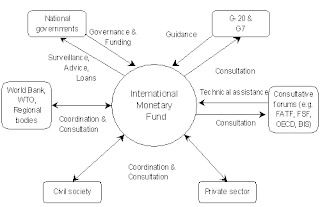
I  never thought that much of “End the Fed,” because, as I’ve blogged previously, the elites can manufacture money from other places besides the Fed, like the BIS and the reconstituted IMF.

But, apparently,  End the Fed doesn’t even work as a popular slogan any more.

So, what do I think about the new campaign?

I think it will be about as effective as their “End the Fed” campaign, which is to say, not effective at all.

See my comment at The Daily Bell in 2010:

Posted by Lila Rajiva on 11/23/10 11:55 AM
Daily Bell: “But by pursuing his strategy, he has made his opponents look like fools and perhaps altered the course of history.”

Lila: Let’s hope. Personally, I agree with Doug Casey on this:
“As a lone voice, his father was a breath of fresh, more principled air, but he didn’t change anything at all that I can see”

(Doug Casey on Presidents, LRC)

But it will be a great platform for the Pauls to sell books, promote ideas and launch political careers for their family members.

I only hope it won’t be done on the backs of idealistic young people. There were many who put change they could hardly spare in a tough economy into the Paul’s war chest.

The new campaign, which dubs itself  “The Internet Versus The Machine” is obviously a rebranding campaign to move young people away from what Forbes calls “the archaic” (they mean arcane) issues of finance.

Instead, the Pauls will focus on the hip world of the net.

Forbes:

“Young people have been a driving force in the Paul campaign, and the focus on internet freedom should only bolster that support.”

I’m going to call foul on that.

Their new “campaign” is in support of the Technology Revolution on the Internet?

Last I looked the tech revolution has been around for a while, getting on quite well without the Pauls.

One part of  the new project is going to be defending big business from attempts by consumers to scrutinize their data collection.

I kid you not. Here is Buzzfeed on the subject.

“The Pauls also take a stand for the growing industry known (and widely criticized) as “big data.”

They deride the notion that “private sector data collection practices must be scrutinized and tightly regulated in the name of ‘protecting consumers,’ at the same time as government’s warrantless surveillance and collection of private citizens’ Internet data has dramatically increased.”

So does this mean that Ron Paul is going to be fighting to prevent European governments or NGOs  like EFF or Asian governments from scrutinizing Google’s data collection practices?

Remember that I just blogged that Google’s CEO Larry Page should be arrested for privacy violations and espionage against foreign governments?

I was being satirical about US surveillance of foreign CEO’s and money-managers.

For instance, in the Galleon -Gupta cases, the government used wire-taps whose authorization was obtained pre-textually in violation of the defendants’ constitutional rights.

I don’t recall that the Pauls said a word about that, although the Galleon insider case has dominated the financial media for a couple of years now, and is directly tied via Rajaratnam’s funding of Tamil charities to  issues like terrorist money-laundering  with which Paul adviser Bruce Fein – once employed by an alleged front group for the Tamil Tigers –  is intimately connected.

A recent Washington Post article described how the military is outsourcing surveillance in Africa to private contractors (with little accountability, significant cost over-runs, and little to show for the expense).

Densely populated China and India are both locked in battles with the West for access to resources and agricultural lands.  Indian and Chinese companies compete with American and European countries on the African continent.  China and India have also complained about American corporate espionage.  American companies in turn complain about IP theft from the Indians and Chinese.  Meanwhile the US government itself is involved in IP theft through its pervasive global surveillance.  Where does data collection for corporations end and espionage for the state begin, anyway? Where does the government end and the private sector begin, when private companies are outsourced arms of the government and the government is the enforcement arm of the companies?

Ron Paul is not oblivious to the complexities of all this. He is far too shrewd.

Rajat Gupta’s conviction shows evidence in my opinion of being a  set up by the government, with some arm-twisting from Goldman Sachs. Likely it was an important blow in the  covert psy war against India, an ostensible US ally, about which I blogged here (“Coconut Imperialism”and here, “Educating the Gentoos In India”)

The obvious response from foreign governments (such as India) would be to treat American CEO’s the same way and wire-tap them.

So, is it just coincidental that the Pauls suddenly abandon their financial campaign (which never involved a word against Goldman Sachs), and suddenly rush to head off any animosity toward Google?

On their silence on G Sachs, here is a comment I made (one among many) below the same Daily Bell article:

Posted by Lila Rajiva on 11/23/10 11:40 AM

@Pisano.

Why would it distract him?
How hard is it to say, unequivocally, “Goldman Sachs and several other banks, are involved in corrupt actions and should be investigated and prosecuted.”

There. Back to “business.”

He certainly had no problem drawing a hard line over relatively trivial things like a monument to Rosa Parks. If he was really afraid of distraction, why would he make a fuss over something like that, and then on something crucial, suddenly go silent?

Why doesn’t he state clearly – “9-11 needs to be investigated. There is credible evidence that there was some kind of conspiracy involving intelligence agencies, US and foreign.”

I like Ron Paul and want to believe the best of him.

But this excuse doesn’t hold water for two seconds.”

This looks like more material to add to the mounting evidence (see  here) that Paul fronts for financial interests.

Perhaps he cannot avoid doing it, as I’ve said.

But there’s no need to be suckered into what could well be a counter-attack against foreign governments who defend themselves against espionage by Google/Facebook/Hotmail/Skype/TOR and the rest of the government-corporate spy sector, by couching the issue as a defense of the private sector.

That explanation also takes care of Paul’s pandering to the left.

The financial world (which controls the media) is left-leaning, in contrast to non-financial businesses.  Paul’s recent moves make quite a bit of sense when understood that way.  He acts to co-opt the brand of libertarianism appropriately called the Marxism of the right by deploying what seem to be ideologically inflexible positions in the service of  larger imperial goals.

So, I have to ask. Will the two Pauls now be collecting money from young people to defend multi-billion dollar multinationals like Google from scrutiny by the governments on which they spy?

I mean, if you phrased that in the appropriately anti-state way, there will be enough libertarian lemmings who’ll rush to defend Google, I’m sure.

This theory might explain why the financial media, usually so vocal in defense of insider-trading, when it’s done by Michael Milken or Ivan Boesky, is suddenly so quiet  about South Asian insider-trading not a tenth as bad.

Does it also explain why large parts of the alternative press  have had nothing but praise for Julian Assange, another front for western financial interests? And why the Pauls have promoted Assange?

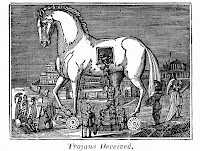
Talk about Trojan horses.

Big corporations cannot be analyzed separately from government.

When the state outsources its spying to corporations, for someone to argue that the state should not limit corporate surveillance because it’s engaged in surveillance itself is confused, at best, and downright misleading, at worst.

Especially when it comes from seasoned politicians like the Pauls.

Parts of the government are scrutinizing the private sector. Often they’re right to.

Other parts of government are much worse than the private sector when it comes to privacy violation.

Those parts of the government are often most incestuously allied with corporations. This is the corporate-state or intel-industrial complex that produces programs like Echelon.

So it’s quite bizarre for the Pauls to claim that Microsoft (or Google or Apple) are pure private-sector entities, when they gain market share directly because of concrete government actions on their behalf and because of endemic and pervasive state-created judicial/legal/financial corruption.

One more thing.  Microsoft wasn’t prescient at all about the net, as the Pauls claim in their new manifesto.

It was way behind. Gates himself admitted it.

There is, finally, another reason why the Pauls may have turned their attention to protecting Big Data,

It looks like Big Data is bankrolling him.

Here’s Reason’s Brian Doherty, making the point:

“With Peter Thiel, founder of the controversial “big data” company Panantir, having made a $2.6 million investment in the (somewhat feckless in the end) superPAC “Endorse Liberty” during campaign season, perhaps the Paul machine sees this as a cause that can energize both grassroots and big money.”

And that’s all  I want to say now about this turn of events until I learn a bit more what is really going on.

But, if you were waiting to see Ron Paul libertarianism implode, it happened this week.

Edward Feser On The Weakness of Rothbard’s Philosophy

[Added, July 4:  In response to a video of Rand on the Middle East, posted at Lew Rockwell.

Yes, Rand was wrong about that.

But that does not diminish the validity of her thinking in other areas, any more than Rothbard’s rightness on foreign policy validates everything else he wrote. Nor is the Middle East the reason the left hates Rand.  It detests her because her appeal to individualism and achievement is perennially powerful and popular.

And it also detests her because she dissected at least a part of the motivation behind much charity/altruism, to which the left insistently appeals.

Now, Rand owes her thought on that subject and other things  to Nietzsche, whom she adapted very originally and powerfully. In turn, Nietzsche, also an original and creative mind, owed his thinking to his studies of Eastern religion, especially Buddhism and Hinduism.

As is the case with Heidegger, Nietzsche, as far as I know, did not properly credit that influence.

(On the other hand, Yeats, also massively influenced by Nietzsche, did….]

In this way, intellectual chicanery/cultural fraud is at the heart of the modernist project.

Imagine if I were to study Christianity surreptitiously, and then go to some state in India where the villagers knew nothing about it and preach about such things as the resurrection of the body, judgement day, the fall, and original sin, passing off these notions as my own original thought, while denigrating the culture from which I took those ideas?

What kind of a fraud would that be?

What kind of damage would that do to the villagers’ understanding of the world at large, and to my own ability to reach valid conclusions about that world?]

Edward Feser on Murray Rothbard as a philosopher:

“I should also make it clear that my low opinion of Rothbard’s philosophical abilities has nothing to do with the particular conclusions he wants to defend. I certainly share his hostility to slavery, socialism, communism, and egalitarian liberalism. I also agree that much of what modern governments do is morally indefensible and that many of the taxes levied by modern governments (maybe even most of them) are unjust. And while I strongly disagree with his claims that government per se is evil and that all taxation is unjust, these are at least philosophically interesting claims. The problem is just that Rothbard seems incapable of giving a philosophically interesting argument for his claims. (Moreover, the claims in question were borrowed by Rothbard from 19th century anarchists like Lysander Spooner, so even where Rothbard is philosophically interesting he isn’t original.)”

Lila: He also borrowed from Rand, indeed, plagiarized her theory of volition, it is said, as well as a dissertation by a student, Barbara Branden. Which might explain why some Rothbardians feel the need to attack Ayn Rand all the time, usually without seeming to have read her very well. It is another way the modern libertarian movement panders to the left – by adopting its superficial reading of Rand, who, while flawed, is a giant next to most of her critics.

Feser goes on to deconstruct Rothbard’s arguments about self-ownership:
“Here, then, is the example. It is Rothbard’s main argument for the thesis of self-ownership, which is, as I have indicated, the very foundation of his moral and political philosophy, without which his moral case against taxation and government totally collapses.
I know of at least three places where he presents it (there may be others): in his book For a New Liberty (first published 1973, revised 1978); in his essay “Justice and Property Rights” (first published 1974, reprinted in his anthology Egalitarianism as a Revolt Against Nature and Other Essays, 2nd edition); and in his main work on moral and political philosophy, The Ethics of Liberty (1982, revised edition published in 1998). In the revised edition of For a New Liberty, the argument begins as follows:
Since each individual must think, learn, value, and choose his or her ends and means in order to survive and flourish, the right to self-ownership gives man the right to perform these vital activities without being hampered and restricted by coercive molestation. Consider, too, the consequences of denying each man the right to own his own person. There are then only two alternatives: either (1) a certain class of people, A, have the right to own another class, B; or (2) everyone has the right to own his own equal quotal share of everyone else. The first alternative implies that while Class A deserves the rights of being human, Class B is in reality subhuman and therefore deserves no such rights. But since they are indeed human beings, the first alternative contradicts itself in denying natural human rights to one set of humans. Moreover, as we shall see, allowing Class A to own Class B means that the former is allowed to exploit, and therefore to live parasitically, at the expense of the latter. But this parasitism itself violates the basic economic requirement for life: production and exchange.” (pp. 28-29)
The rest of the argument attempts to rule out alternative (2) and has its own problems, but I won’t bother with it because the passage quoted is enough for my purposes.
I think this argument is a very bad one; indeed, I think that to anyone with any philosophical training it will be quite obvious that it is bad. And not only is it bad, but given that Rothbard says nothing more in defense of the claims made in this passage (apart from trying to rule out alternative (2)), I think it is clear that the argument fails to be even minimally respectable in the sense described above. I suspect that most readers can immediately see at least some of the problems with it. Here are the ones that occur to me:
1. Even if it were true that “each individual must think, learn, value, and choose his or her ends and means in order to survive and flourish” and that “the right to self-ownership gives man the right to perform these vital activities without being hampered and restricted by coercive molestation,” it just doesn’t follow that anyone has a right to self-ownership. For all Rothbard has shown, we might also be able to think, learn, value, etc. even if we didn’t have any rights at all. (That X could get us Z doesn’t show that Y wouldn’t get it for us too.) Or we might need some rights in order to do these things, but not all the rights entailed by the principle of self-ownership. Or we might really need all the rights entailed by self-ownership, but nevertheless just not have them. After all, the fact that you need something doesn’t entail that you have it, and (as libertarians themselves never tire of pointing out), it certainly doesn’t entail that you have a right to it. For example, wild animals need food to survive, but it doesn’t follow that they have a right to it (indeed, Rothbard himself explicitly denies that animals can have any rights).
Furthermore, why should we grant in the first place that “each individual must think, learn, value, and choose his or her ends and means in order to survive and flourish”? Children survive and flourish very well without choosing most of their means and ends. Some adults are quite happy to let others (parents, a spouse, government officials) choose at least some of their means and ends for them. Many physically or mentally ill people couldn’t possibly survive or flourish unless others chose their means and ends for them. Even a slave or serf could obviously survive and even flourish if his master or lord was of the less brutal sort. And so forth. And if surviving and flourishing are what ground our rights, how could we have a right to suicide or to do anything contrary to our flourishing, as libertarian defenders of the thesis of self-ownership say we do?
Also, why should we grant that respect for each individual’s self-ownership really would ensure every individual’s ability to choose his means and ends, etc.? A leftist might argue that respect for self-ownership would benefit some but leave a great many others destitute and bereft of any interesting range of means or ends to choose from.
Of course, there might be some way a Rothbardian could reply to these objections; I certainly don’t find all of them compelling. But the point is that they are obvious objections to make, and yet Rothbard doesn’t even consider them, much less answer them. Even a brief acknowledgement of some of these objections and a gesture in the direction of a possible reply might have been enough to make the argument minimally respectable, but Rothbard fails to provide even this.
2. The claim that there are “only two alternatives” to denying the thesis of self-ownership is just obviously false. Here are some further alternatives that Rothbard fails to consider:
(a) no one owns anyone, including himself
(b) God owns all of us
(c) one class of people has a right to only partial ownership of another class (e.g. the former class has a right to the labor of the latter class, but may not kill members of the latter class, or refuse to provide for their sustenance, or forbid them from marrying, etc.)
(d) everyone has partial and/or unequal ownership of everyone else (e.g. everyone has an absolute right to bodily integrity, but not to the fruits of his labor, which are commonly owned; or everyone has an absolute right to bodily integrity, and an absolute right only to some percentage of the fruits of his labor, with the rest being commonly owned; or everyone has a presumptive right to bodily integrity, which might be overridden in extreme cases, with a right to a percentage of the fruits of his labor; or the weak and untalented have an absolute right to bodily integrity and to a large percentage of, though not all of, the fruits of their labor while the strong and talented have an absolute right to bodily integrity and to a much smaller percentage of the fruits of their labor; or the strong and talented, unlike the weak and untalented, have only a presumptive right to bodily integrity, which might be overridden if someone desperately needs an organ transplant; and so on and so forth).
Alternative (b) was defended by Locke (for whom talk of self-ownership was really just a kind of shorthand for our stewardship of ourselves before God) and it would also have been endorsed by natural law theorists in the Thomistic tradition. Rothbard explicitly cites both Locke on self-ownership and the Thomistic natural law tradition, so this alternative should have been obvious to him, and yet he fails even to consider it.
Lila: Chesterton has an excellent essay about the uses of the word “own,” but I think anyone with common sense can understand that the meaning of ownership itself varies with the context.
That Rothbard is not reflective about language – a lack of reflection pervasive among certain kinds of libertarians –  is immediately apparent to any reader with the slightest acquaintance with modern literature, let alone semiotics or philosophy.
“Alternative (c) was the standard view taken by defenders of slavery, most of whom would not have endorsed the unqualified ownership of other people implied by Rothbard’s alternative (1). One would think that Rothbard, who fancied himself a historian of ideas, would be aware of this, and yet here again he simply ignores what should have been another obvious possible alternative.
Some version or other of alternative (d) is arguably implicit in the views of many leftists, very few of whom (if any) would really claim that all of us have equal quotal ownership of each other. At the very least, a minimally charitable reading of left-wing arguments about taxation and redistribution would acknowledge that this, rather than Rothbard’s alternative (2), might be what egalitarian leftists are committed to. But Rothbard fails even to consider the possibility. He suggests (later on in the argument, after the passage quoted above) that “communist” ownership by everyone of everyone would entail that no one could take any action whatsoever without the permission of everyone else, but while this might be true under option (2), it would not be true under the less extreme egalitarian possibilities enshrined in (d).
Alternative (a) is one that Rothbard finally did consider – almost a decade after first giving the argument and after once again ignoring this alternative when repeating the argument in “Justice and Property Rights” – in a brief footnote in The Ethics of Liberty. (He attributes it to George Mavrodes, apart from whom, apparently, Rothbard might never have seen the obvious.) Rothbard’s reply to it is to say that “since ownership signifies range of control, this [i.e. no one’s owning anyone, including himself] would mean that no one would be able to do anything, and the human race would quickly vanish.”
But the badness of this argument should also be obvious. While having ownership of something does imply having a range of control over it, having a range of control over it doesn’t imply ownership. I have a certain “range of control” over my neighbor’s flower bed – he couldn’t stop me if I walked over right now and pulled some flowers out of it – but it doesn’t follow that I own it. Animals have a range of control over their environment, but since ownership is a moral category implying the having of certain rights, and animals (by Rothbard’s own admission) have no rights, it follows that they have no ownership of anything. And of course, their lack of ownership of anything hasn’t caused animals as a whole to “vanish,” “quickly” or otherwise, which makes evident the absurdity of Rothbard’s claim that alternative (a) would entail the extinction of the human race.
3. Alternative (1) just obviously doesn’t imply that the members of class B are “subhuman.” Not all defenders of slavery have denied that slaves are fully human; their view is just that some human beings can justly be owned by other ones. Rothbard’s assertion that this “contradicts itself in denying natural human rights to one set of humans” is just blatantly question-begging, since what is at issue is precisely whether there are any natural human rights that might rule out slavery.
4. Rothbard’s claim that the “parasitism” entailed by alternative (1) “violates the basic economic requirement for life: production and exchange” is also just obviously false. Animals do not engage in “production and exchange,” certainly not in the laissez-faire economics sense intended by Rothbard, but they are obviously alive.

In this one brief passage, then, Rothbard commits a host of fallacies and fails even to acknowledge, much less answer, a number of obvious objections that might be raised against his argument. Nor is this some peripheral argument, which might be written off as an uncharacteristic lapse. It served as the foundation of his entire moral and political theory, and was repeated several ti”mes over the course of a decade virtually unaltered. And if things are this bad in the very foundations of his moral and political theory, you can imagine how bad the rest of his philosophical arguments are.”

Comment:

I would also add that  Rothbard’s weaknesses as a thinker are replicated in some of his most fervent acolytes, who substitute sound and fury for depth of reasoning and seem to think incorrect thinking becomes better the more violently it is articulated.

This is not a criticism of  libertarianism as such. A term broad enough to embrace everyone from Tolstoy to Milton Friedman can hardly be criticized as one.  “Libertarianism” cannot be considered a singular movement, however much, for political or marketing reasons, some anarcho-capitalists might try to drag someone like Tolstoy into their fold.

Tolstoy was a libertarian in the way Gandhi was. Profoundly anti-capitalistic. They both believed in voluntary poverty and simplicity and abhorred the complexity of modern life. I doubt either would relish becoming the mascot of the Mises or Bastiat Institutes. To try to ride their reputations for the sake of broadening one’s appeal is intellectually disingenuous.

So I have profound differences with  American-style libertarianism (of the LRC type or of the Reason Magazine type), while supporting LRC’s antiwar and anti-police state positions.

Another point. In things of which  I know something, I can clearly spot the flaws and limitations of Rothbard’s arguments, which makes me think that in areas in which I am uncertain, he must be flawed too.

Anyway, Feser’s points don’t need any great acquaintance with Rothbard’s economic reasoning to follow. They are points that have occurred to me on and off, as I’ve read the great (?) man.

But frankly, my increasing disinterest in Rothbard has grown from more intuitive roots.

First, there is something cocky, smug, and shallow in the writing itself….despite its superficial good humor and sense.

Then, there are the stories of plagiarism – something which intensely prejudices me against a writer. And there are his attacks on writers many would consider his superior, like Ayn Rand and Adam Smith.  I wonder how much of envy lay behind all that.

On the many people whom he knew and taught, he seems to have had a profound influence, which speaks well of him. But I haven’t had the pleasure of knowing him personally, so my judgement must be from what I read of him.

And from reading him, and reading of him,  I get the picture of a shallow, bright, abrasive man, who thought very highly of himself, yet plagiarized often, and covered up the lack of originality by attacking others, attacks that his followers continue, see here,

as well as here.

[Rand was the most famous instance of Rothbard’s plagiarism. But he also borrowed from Spooner, as Feser points out. And a commenter at this blog adds this:

“The first part of his book on the history of American banking drew on a report about the “Suffolk System” published by that bank, but since buried in the archives. After finding a bad microfilm copy at my university library, I paid the Adam Smith Institute to send me a good one. (I also bought one of their neckties.) Rothbard plagiarized heavily from the original Suffolk Banking System and, worse, projected his own anarchist opinions on the facts of history. As a criminologist, I am fully sympathetic to a free market in protection and adjudication, but the fact is that the Suffolk System was not destroyed by the evil machinations of Salmon P. Chase’s Treasury Department.”

So, if Rand has her flaws (and she does), Rothbard has his, analyzed at length in this piece by G. Stolyarov.

Meanwhile, in general power of reasoning, insight into the psychology of the modern mind, and overall influence, frankly, Rothbard cannot hold a candle to Rand, whatever powers he might have as a historian or economist.

There is a reason that the left attacks her, not him.

Support HR 5444: The Private Option Health Care Act

A message from Ron Paul (May 29) urging you to support The Private Option Health Care Act:

Dear Friend of Liberty,

Unlike the statists in Washington, the freedom movement
understands that our health care is too important to be left to
the whims of politicians and bureaucrats. Continue reading