David Stockman: Ukraine Is A Fake Kleptocracy, Not Worth World War

In a historically informed and insightful piece on the background of the Ukraine war, David Stockman puts the failed kleptocracy of Ukraine and its tin-pot clown prince into proper historical perspective:

On April 26, 1954 The decree of the Presidium of the USSR Supreme Soviet transferring the Crimea Oblast from the Russian SFSR to the Ukrainian SSR. Taking into account the integral character of the economy, the territorial proximity and the close economic and cultural ties between the Crimea Province and the Ukrainian SSR….

So, yes, there is every reason for a Kiev government which finally sues for peace to return Crimea to Russia, which owned it all along; and in which Ukrainians accounts for less than 15% of the predominant Russian speaking population. For Washington to claim otherwise and encourage Zelensky to hold out is tantamount to a naked case of hegemonic arrogance.

After all, during the long decades of the Cold War, the West did nothing to liberate the “captive nation” of Ukraine – with or without the Crimean appendage bestowed upon it in 1954. Nor did it draw any red lines in the mid-1990s when a financially desperate Ukraine rented back Sevastopol and the strategic redoubts of Crimea to an equally pauperized Russia.

In short, in the era before we got our Pacific port in 1848 and even during the 170-year interval since then, America’s national security has depended not one whit on the status of Russian-speaking Crimea and the Donbas regions of eastern Ukraine. The fact that the local population of the former in March 2014 chose fealty to the Grand Thief in Moscow over the ruffians and rabble that have seized Kiev amounts to a giant, “So what?”

Still, it was this final aggressive drive of Washington and NATO into the internal affairs of Russia’s historical neighbor and vassal, Ukraine, that largely accounts for the current dangerous confrontation. Likewise, it is virtually the entire source of the false claim that Russia has aggressive, expansionist designs on the former Warsaw Pact states in the Baltics, Poland and beyond.

The latter is a nonsensical fabrication. In fact, it was the neocon meddlers from Washington who crushed Ukraine’s last semblance of democratic governance when they enabled ultra-nationalists and crypto-Nazis to gain government positions after the February 2014 coup, which threw-out Ukraine’s legitimately elected, Russia-leaning president.

In this context, moreover, the history of the 1930s and 1940s must never be forgotten. As indicated above, Stalin decimated upwards of 15% of the Ukrainian population during the Holodomer (starvations) and then moved huge numbers of Russian-speakers into the Donbas to safeguard its chemical, steel and armaments industries from the defiant locals who were sent to Siberia.

Thereafter, when Hitler’s Wehrmacht came charging through Ukraine on its way to the bloody battle of Stalingrad, it had no trouble recruiting hundreds of thousands of vengeance-seeking Ukrainian nationalists to its ranks to do its dirty work: That is, the brutal liquidation of Jews, Poles, Gypsies and other untermenschen.

In fact, during the fall of 1941 began the mass killings of Jews that continued through 1944. An estimated 1.5 million Ukrainian Jews perished, and over 800,000 were displaced to the east; at Baby Yar in Kyiv nearly 34,000 were killed in just the first two days of massacre – and all of these depredations were assisted and often executed by local Ukrainian nationalists.

Then, of course, the tide turned and the Red Army came marching back though the rubble of Ukraine on its way to Berlin. After their victory over the Germans at the Battle of Stalingrad in early 1943, the Soviets launched an equally brutal scorched earth counteroffensive westward, searching high and low for traitors and collaborators among the Ukrainian population who had allegedly aided the Wehrmacht.

The Germans thus began their slow retreat from Ukraine in mid-1943, leaving wholesale destruction in their wake. In November the Soviets reentered Kyiv, where guerrilla activity intensified amid bloody revenge killings which claimed huge numbers of civilian victims. By the spring of 1944 the Red Army had penetrated into Galicia (western Ukraine), and by the end of October Ukraine was a bloody wasteland, once again under Red Army control.

So it may be fairly asked: What Washington lame brains did not understand that triggering “regime change” in Kiev in February 2014 would reopen this entire blood-soaked history of sectarian and political strife?

Moreover, once they had opened Pandora’s Box, why was it so hard to see that an outright partition of Ukraine with autonomy for the Donbas and Crimea, or even accession to the Russian state from which these communities had originated, would have been a perfectly reasonable resolution?

Certainly that would have been far preferable to dragging all of Europe into the lunacy of the current military showdown and further embroiling the Ukrainian factions in a suicidal civil war.

Needless to say, Zelensky gets none of this in the slightest – even though as a native and Russian speaking son of southeastern Ukraine, he actually grew up in a part of modern Ukraine that had been Russian for 370 years!

That’s right. He’s just the perennial short guy feasting on his 15 minutes of fame. But enough is enough already. In a rational world this double-talking creep should have been sent packing this morning by the US Congress, but these war-obsessed nincompoops can’t see the handwriting on the wall.

So once again, here it is. This is where the story ends – even as Washington wages Sanctions War on the entire global economy and thereby the American people as well.

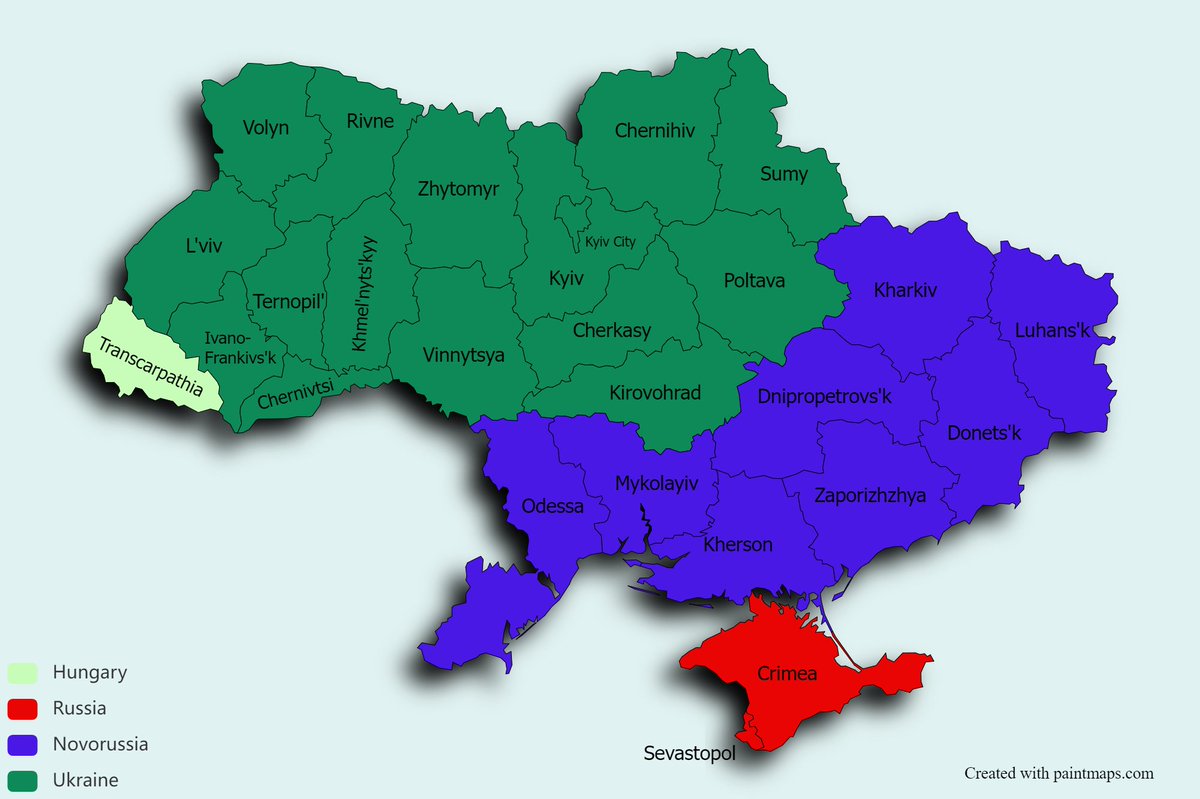
How Ukraine Will Be Partitioned After Kiev Capitulates

In any event, a TV actor who has no script other than that handed to him by his Washington/NATO overseers is one thing. And at the end of the day, it small potatoes compared to the grotesque negligence and misdirection of Sleepy Joe’s own keepers.

That is to say, Secy Blinkey and Snake Sullivan should be bent over the above map in earnest conversation with their Russian counterparts as to the fine points of the partition, and the meaning of “neutrality,” “de-nazification” and “demilitarization” of the green area of the map, which is to become the future “Ukraine,” if there is to be anything left at all.

Needless to say, they are not even talking to the Russians. They are, in fact, so red in tooth and claw with the blood of economic warfare that they would drive the global economy to collapse rather than acknowledge that they – and they alone – brought this horrendous situation to the doorstep of the world.”
 

Flagolatry Then and Now

Third-World Traveler has an excerpt from “Hoax,” by Nicholas Von Hoffman

(Nation Books, 2004).

p33
Flag Waving

Flagolatry , or the excessive or demented reverence for the national symbol, has its innocent roots in the first lines of the National Anthem. Then things began to get out of hand. Respect for the flag commenced to become flagolatry, part of the degraded and antic patriotism which distorts what, in saner hands, are decent and praiseworthy feelings for one’s country. That country was hardly born before people started running Old Glory up the flag pole with a vengeance.

p34
Some flag waving is good, a lot of flag waving is tolerable, incessant flag waving is crazy and dangerous and easily manipulated by the war party to get people bubbling at the mouth in fear and rage.

p36
… when flagalotry takes over the landscape, as it has in the last generation, it says something about people who dwell in that country. Not only does every unpaid-for, overly-mortgaged house in the United States boast its own copy of Old Glory, but so does every SUV, every truck, every truck stop, the side of every barn.

p38
I suppose that the purpose of flag display is inspirational, but taken together with allegiance-pledging and such, its effect is stifling, confining, and intimidating. It was used for the same purpose in the months leading up to America’s entry into World War I. An electric sign was strung across New York City’s 5th Avenue in 1916 flashing the orders for “Absolute and Unqualified Loyalty to Our Country.” In a society of lapel pin flags and standing to attention and red, white, and bluing, the uninterruptedly repeated message is don’t talk, listen up, and get ready to rumble.

Ukraine: In Russia’s Sphere Of Influence, Not America’s

At Forbes, Doug Bandow at Cato has written an excellent piece on the turmoil in Ukraine, over which the imperial bullies in DC (and their covert adjutants are salivating:

“Washington should endorse justice and human dignity, which justifies support for honest elections and warnings against police brutality.  Of course, America’s message would have greater credibility if Washington better respected such values both at home and in its dealings with other nations which don’t always share America’s “interests and values.”

But Ukraine’s “economic health,” “European future,” “turn toward Moscow,” and reengagement “with the European Union” aren’t American values and are barely American interests.  Indeed, they really aren’t proper U.S. concerns.  How would Americans feel if Ukrainian politicians showed up at an “Occupy Wall Street” rally in Washington vowing to stand with protestors in demanding economic redistribution, a North American Union, and a turn away from Europe—all in the name of Ukrainian “interests and values”?

It’s obviously difficult for Washington to imagine any issue that doesn’t warrant U.S. meddling, but Ukraine’s status is one.  Alexander J. Motyl of Rutgers University (Newark) spoke of Washington and Brussels having “vital interests at stake in Ukraine.”  Only in Kiev’s dreams.

More extreme was former UN Ambassador John Bolton, who contended “that tectonic plates are being realigned in Europe” and that Ukraine is “the great prize.”  Robert Zubrin of Pioneer Energy argued that “the events unfolding in Ukraine right now are of global historic importance.”  Indeed, he added, Moscow’s reach for influence in Kiev is part of a “dark program” which “threatens not only the prospects for freedom in Ukraine and Russia, but the peace of the world.”   To suggest that Ukraine is vital to global peace is beyond exaggeration.

A stable, democratic Ukraine would be good for all concerned—and America’s Ukrainian diaspora deserves credit for its long-standing support for its homeland—but Kiev’s orientation isn’t important to Washington.  Ukraine spent centuries subject to Moscow and the U.S. never noticed. Vladimir Putin wants to reestablish Russian influence, but that doesn’t mean he can put the Soviet Humpty Dumpty back together.  Today’s protests in Kiev demonstrate that Ukraine will never be a quiescent tool of Moscow.

On the security side, Russia’s activities in Ukraine do not threaten the U.S.  The reverse, however, is not true.  Bringing NATO up to Russia’s southern border cannot help but be seen as dangerous by Russia—imagine Americans would view the Warsaw Pact expanding to Mexico. Washington’s policy today looks like the fabled “Brezhnev Doctrine,” what is mine is mine, and what is yours is negotiable.  America seeks to dominate not only the Western Hemisphere, Europe, and Central Asia, but all along Russia’s borders.  Washington wants to hold all of the geopolitical chips.

The better strategy would be for the West to treat Russia with respect, acknowledging that it has legitimate interests in Ukraine, while using the prospect of greater economic opportunity to convince Kiev to look westward.  Yanukovich has been rented, not bought.  Complained the Economist:  “Mr. Yanukovich’s favored option seems to be to preserve the status quo and refrain from joining either camp while continuing to milk both.”  Which sounds like a sound strategy from Ukraine’s standpoint.  The EU, which obviously has the most at stake, could up its offer and reconsider its political demands.  How badly does it want to “win”?

Moreover, Europe should look for compromise opportunities with Moscow.  Kiev has proposed creation of “a tripartite commission to handle complex issues.”  Such an approach has promise.  Former congressional staffer Jim Jatras cited recent talks between the EU and Russia over “aspects of the AA with Ukraine that Moscow considers detrimental to its own economy, specifically a massive flow of EU products into Russia via Ukraine.”  All would benefit with greater links between the EU and the Russian-lead CU, which might reduce Moscow’s pressure on Kiev.

Ukraine matters, to Ukraine.  It also matters to Russia.  But less to Europe and much less to the U.S.  If Kiev wants to look east, so be it.  The West is most likely to win influence if it makes itself more attractive, not if it treats the issue like a new Cold War.  Despite Russia’s money Yanukovich’s reelection prospects are weak and Ukraine is likely to eventually join the West.  If not, however, so be it.  The country never was the EU’s or Washington’s to lose.”

Iraq War: Firing On Old Women And Taxis

Update: This comes from Glenn Greenwald. There’s been criticism by the Weekly Standard and others that WikiLeaks released an edited rather than a complete video. Greenwald says Wikileaks released both on the same site and the mistake arises from an erroneous statement in a NY Times piece on the subject.

“The only problem with this?  From the very beginning, WikiLeaks released the full, 38-minute, unedited version of that incident — and did so right on the site they created for release of the edited video.  In fact, the first video is marked “Short version,” and the second video — posted directly under it — is marked “Full version,” and just for those who still didn’t pick up on the meaning, they explained:

WikiLeaks has released both the original 38 minutes video and a shorter version with an initial analysis. Subtitles have been added to both versions from the radio transmissions.

This is Bumiller’s fault for misleadingly suggesting that WikiLeaks failed to release the full video. I know she’s been notified by at least one NYT reader of her misleading sentences but has thus far failed to respond.  Establishment media outlets can’t stand that WikiLeaks is breaking major stories and are trying — consciously or otherwise — to imply that they’re not as reliable as Real Media Outlets (hence, the “WikiLeaks edited the video to 17 minutes” without indicating that they released the full video).  But this is exactly how clear falsehoods are manufactured and then spread.”

Update (Thanks to AD Niven):

The blog post below (April 6, 2010; see also the April 8, 2010 post) says the Wikileaks video was edited to make the event look less defensible.

(Lila: That’s the reason I didn’t post it…….I’ve been through this a number of times with “war footage”)

***********************************

The NY Times, in their story about the incident, spends paragraph after paragraph fretting that we killed a bunch of innocent men standing around doing nothing more than contemplating whether Grotius’ notion of jus ad bellum conflicted with that of Aquinas. Then they hit you with this seemingly important piece of information buried near the end:

“Late Monday, the United States Central Command, which oversees the wars in Iraq and Afghanistan, released the redacted report on the case, which provided some more detail.The report showed pictures of what it said were machine guns and grenades found near the bodies of those killed. It also stated that the Reuters employees “made no effort to visibly display their status as press or media representatives and their familiar behavior with, and close proximity to, the armed insurgents and their furtive attempts to photograph the coalition ground forces made them appear as hostile combatants to the Apaches that engaged them.”

I’d also direct you to Bill Roggio’s post on the subject if my own thoughts didn’t convince you that this was one of the worst smear jobs against our military based on zero evidence in the last decade.

Case closed.

Dahr Jamail in Truthout (hat-tip to Lawrence Vance at LRC blog):

“On Monday, April 5, Wikileaks.org posted video footage from Iraq, taken from a US military Apache helicopter in July 2007 as soldiers aboard it killed 12 people and wounded two children. The dead included two employees of the Reuters news agency: photographer Namir Noor-Eldeen and driver Saeed Chmagh.

The US military confirmed the authenticity of the video.

The footage clearly shows an unprovoked slaughter, and is shocking to watch whilst listening to the casual conversation of the soldiers in the background.

As disturbing as the video is, this type of behavior by US soldiers in Iraq is not uncommon.

Truthout has spoken with several soldiers who shared equally horrific stories of the slaughtering of innocent Iraqis by US occupation forces.

“I remember one woman walking by,” said Jason Washburn, a corporal in the US Marines who served three tours in Iraq. He told the audience at the Winter Soldier hearings that took place March 13-16, 2008, in Silver Spring, Maryland, “She was carrying a huge bag, and she looked like she was heading toward us, so we lit her up with the Mark 19, which is an automatic grenade launcher, and when the dust settled, we realized that the bag was full of groceries. She had been trying to bring us food and we blew her to pieces.”

The hearings provided a platform for veterans from Iraq and Afghanistan to share the reality of their occupation experiences with the media in the US.

Washburn testified on a panel that discussed the rules of engagement (ROE) in Iraq, and how lax they were, to the point of being virtually nonexistent.

“During the course of my three tours, the rules of engagement changed a lot,” Washburn’s testimony continued, “The higher the threat the more viciously we were permitted and expected to respond. Something else we were encouraged to do, almost with a wink and nudge, was to carry ‘drop weapons’, or by my third tour, ‘drop shovels’. We would carry these weapons or shovels with us because if we accidentally shot a civilian, we could just toss the weapon on the body, and make them look like an insurgent.”

Hart Viges, a member of the 82nd Airborne Division of the Army who served one year in Iraq, told of taking orders over the radio.

“One time they said to fire on all taxicabs because the enemy was using them for transportation…. One of the snipers replied back, ‘Excuse me? Did I hear that right? Fire on all taxicabs?’ The lieutenant colonel responded, ‘You heard me, trooper, fire on all taxicabs.’ After that, the town lit up, with all the units firing on cars. This was my first experience with war, and that kind of set the tone for the rest of the deployment….”