The Daily Bell Asks A Question

Update: Antiwar has a good piece about Dr. Lani Kass, Senior Special Assistant to the Chief of Staff to the US Air Force General Norton A. Schwartz, who reached the rank of Major in the Israeli Defense Force (IDF) before rising to her present highly sensitive position at the Pentagon. Dr. Kass is also rumored to be an unofficial adviser to Admiral Mike Mullen, Chair of the Joint Chiefs of Staff, on Middle East Policy.

“There are indications that Dr. Kass is a major player in shaping US security policy.  She has been described as a “key participant” in the development of the national strategy for combating terrorism, as well as the national military strategic plan for the Global War on Terrorism. In September 2007, The Times of London reported that she was a leading participant in “Project CHECKMATE, a “highly confidential strategic planning group tasked with ‘fighting the next war’ as tensions rise with Iran” that was “quietly established” by the US Air Force in June 2007 as a “successor to the group that planned the 1991 Gulf War’s air campaign.”

Also per The Times, CHECKMATE “consists of 20-30 top air force officers and defense and cyberspace experts with ready access to the White House, the CIA and other intelligence agencies.” Its director Brigadier-General Lawrence A. Stutzriem and Kass reported directly to General Michael Moseley, at the time chief of staff of the Air Force. The Times cited Defense sources saying, “detailed contingency planning for a possible attack on Iran has been carried out for more than two years.” Regarding Iran operations, Kass was quoted as saying “We can defeat Iran, but are Americans willing to pay the price?”

ORIGINAL POST

The Daily Bell asks a good question:

“Leaving aside the legal issues involved, one does wonder at America’s insistence that Iran remain nuke-free. Back in the 1950s, America participated in a regime change in Iran and there is considerable evidence that America might have destabilized Iran again in the late 1970s. And despite mistranslations, Iran has never directly threatened Israel with nuclear weapons – even if it had them. Israel on the other hand is said to have up to 400 nuclear missiles or more, though Israel has never confirmed their existence.

States, in fact, usually do not commit suicide. The idea that a nuclear Iran would suddenly start lobbing nukes at Israel strikes us as preposterous. Even if Israel did not strike back, the US has enough firepower to turn all of Iran into molten slag. The regime would not survive the first missile. But none of this seems to matter. The US is the de facto policeman of the new global “Power Elite” order. It is harrying nations around the world into falling in line with the US position that so long as there is any hint of a possibility that Iran is pursuing nuclear weapons, Iran ought to be severely boycotted, its economy squeezed and its businesses barred.

It is a serious situation. Boycotts are not inevitably a prelude to war, but they are often destabilizing and can well be a cynical prelude to action. In this case, we believe that certain US leaders seem to want to ratchet up the pressure on Iran to a point that is positively dangerous. Why would the US put world peace at risk over an atomic program that has not yet been proven to exist?”

Why?

Here is one answer: “The Zionist Power Configuration” (James Petras). (Note: The tone of this is shriller than necessary, but because it is a systematic and superbly documented critique that I can’t really find any where else, and because of Lieberman’s new, extremely dangerous call for war in Iran at a time of maximum global fragility (and with the very suspicious downing of the Polish plane in the background), I am going to post it anyway.

And here is more on the IL:

PY TRADE: How Israel’s Lobby Undermines America’s Economy
by Grant F. Smith
Foreword by Michael Scheuer, former chief, CIA Bin Laden unit

Large Cover Image
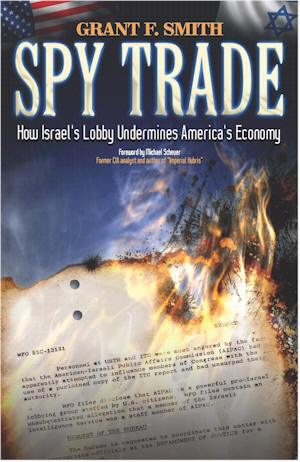
Page Count: 180
Language: English
ISBN: 978-0-9764437-1-1
Price $12.95 (before retailer discounts)


Buy now at:


Praise for Spy Trade:

“This terrific historical expose ought to be required background reading for those FBI agents assigned to investigate foreign espionage and public corruption matters.  For many reasons, such cases are amongst the most challenging to investigate and prosecute, but are made even harder when undue political pressures enter into the picture.  FBI officials responsible for setting investigative priorities and allocating resources would also do well therefore to read Spy Trade so they are aware of the historical linkage between Israel’s ‘Uzi diplomacy’ arms dealing, the Iran-Contra scandal, and the Jonathan Pollard spy incident with AIPAC’s nefarious ‘lobbying’ activities.” Coleen Rowley, former FBI agent and 2002 Time Magazine “Person of the Year.”

“Grant F. Smith’s excellent, deeply disturbing book..is a welcome addition to a growing scholarly literature.” Michael Scheuer, former senior CIA analyst and author of “Imperial Hubris”

“Like political parties, lobbies are groups of citizens with shared interests, an important part of a functioning democracy.  When they have enormous power, however, and especially if their activities remain almost completely hidden, lobbies can be dangerous.

Meticulously detailed in this riveting addition to his earlier exposes, Grant Smith reveals yet another facet of the extent to which the pro-Israel Lobby is beyond dangerous, and has become a serious threat to a broad range of American ideals, objectives and interests abroad, as well as here at home.  This book contains many highly disturbing, documented revelations.  Read it.” Ambassador Edward L. Peck, former Chief of Mission in Iraq and Former Deputy Director, Cabinet Task Force on Terrorism, Reagan White House

“This book presents formidable and dangerous new evidence of spying by Israel and the corrosive long term influence of its lobby on US governance.” Paul Findley, member of Congress from 1961 to 1983 and author of three books on the US-Israeli relationship, including the Washington Post bestseller They Dare to Speak Out: People and Institutions Confront Israel’s Lobby

“Grant F. Smith is without peer as an archival scholar of the history of the Zionist power configuration operating in tandem inside and outside of the US government.  His meticulous research on the long-term operations of AIPAC in shaping US Middle East policy provides the best contemporary framework for understanding our involvement in Middle East wars.  He shows how American foreign policy in the Middle East follows Israel’s agenda and documents the enormous cost to our Treasury and economy as well as the loss of American lives.  This is a book that should be read by all citizens who are concerned about the aggressive manipulation of our media and political institutions to enhance Israel’s power and further its privileged position in the Middle East.” James Petras, Bartle Professor (Emeritus) of Sociology at Binghamton University, New York

About the Book

Israel and its American lobby have committed audacious but generally unknown crimes against the United States.  Government secrecy across the CIA, FBI, Department of Justice and Pentagon long kept files about Israeli espionage, weapons smuggling and covert operations on American soil classified…until now.

Spy Trade begins on the trail of a vast smuggler network funneling stolen and illegally purchased surplus WWII arms to Jewish fighters in Palestine.  When the FBI threatened to crack downa clandestine summit meeting yielded minor convictions for small time operatorsbut not the financial masterminds behind the scheme.  This germ of immunity soon flowered into a full scale assault on American industry, the electoral system, national defense secrets and rule of law itself.

Spy Trade probes Israel lobby smuggling operations diverting uranium from the US to Israel’s Dimona nuclear weapons facility.  The US Department Justice battled mightily to regulate two key enablersthe Jewish Agency and American Zionist Councilas Israeli foreign agents in the 1960s.  But when the effort failed it generated a massive counterstrike.

Israel lobby campaign finance violations unleashed a network of coordinated stealth political action committees that intimidated American politicians and made a “pro-Israel” outlook and voting record requirements for staying in government.  A new legal battle to regulate the American Israel Public Affairs Committee (AIPAC) as a political action committeethis time launched by concerned citizensbegan two decades ago but has not yet been resolved.

Spy Trade also reveals the long term impact of a newly declassified “third scandal” that began in the 1980s.  In the midst of both the Iran-Contra affair and Jonathan Pollard espionage incident AIPAC and the Israeli embassy conducted a spectacular clandestine operation against American industries and workers.  It has so far cost the US economy $71 billion and a hundred thousand jobs each year by shutting down or diverting US exports.  Trade privileges obtained by Israel under the treaty not only permit financing illegal settlement construction with proceeds from diamonds sold in the US.  The US pharmaceutical industry faces an unrelenting onslaught against its capacity to innovate and protect its intellectual property.

Spy Trade is much more than a groundbreaking dissection of the tactics Israel and its American lobby repeatedly use to evade justice.  The book also provides stunningly simple strategies for ending criminal immunity and subversion of law enforcement that may someday restore American governance.

Scoundrel Time…

Scoundrel time in the UK

“Experts have analysed the pensions of a number of former directors of British banks, many of which were only saved from collapse by state bailouts. The biggest beneficiary is former Royal Bank of Scotland director Larry Fish, who has a pension pot of £18m, paying out £1.5m a year. Unlike the former RBS chief executive Sir Fred Goodwin, he has managed to maintain a low profile up to now, as he used to run the bank’s American operations.

Other bankers with pension pots of more than £1m include: Richard Banks, Richard Pym and Chris Rhodes (Alliance & Leicester); Steve Crawshaw and Chris Rodrigues (Bradford & Bingley); Peter Cummings, Colin Matthew and Phil Hodkinson (HBOS); David Baker, Robert Bennett, Keith Currie, David Jones and Andy Kuipers (Northern Rock); and Johnny Cameron and Mark Fisher (RBS).

The analysis also established that the true value of Sir Fred Goodwin’s pension pot could be, in fact, almost double the previously stated figure of £16m. According to pensions expert John Ralfe: “The official numbers that Royal Bank of Scotland has come out with is that his total pension pot from the age of 51 to the expected death is about £16.9m. I think that is a gross understatement. If I wanted to go along to a third-party pension provider and get the sort of pension that Fred Goodwin is on – £700,000 and that goes up in line with inflation, of course, each year – I would have to pay something in the order of £28m.”

The contrast with the pensions given to rank-and-file banking staff could not be greater. Dennis Grainger, who worked at Northern Rock for a decade, is entitled to only £700 a year. “I’m so disgusted with this I’ve turned it down,” said Mr Grainger.

Vince Cable, the Liberal Democrat Treasury spokesman, has attacked the scale of the rewards: “What makes people really, really angry is that these people were exceptionally well paid, got enormous pension pots and other payments, despite the fact that they have failed and they have failed their shareholders, failed their employees and failed the taxpayer, and they are walking away with their millions.”

The large payments are not limited to pensions. Bank bosses have seen their average salaries rise from £800,000 in 2006 to more than £1m in 2008 – 20 per cent more than the average pay packet of chief executives in other sectors. They now earn £255,000 a year more than their FTSE-100 counterparts. Fees paid to non-executive directors of banks have also risen. In the case of the RBS, non-executive directors have seen their fees almost treble in less than a decade, from £25,000 a year in 2000 to £73,000 a year in 2008.

Mr Cable has denounced bankers’ pay and perks as “the kind of things you would associate with absolute monarchies in the days of the Bourbons in France”.

Sir Fred Goodwin

Even after cashing in £2.7m of his pension, he gets £550,000

Sir James Crosby

Will start reaping rewards of £10.4m pension pot in 2011 £572,000

Lawrence Fish

£18m pension fund yields over a million every year £1.5m

Adam Applegarth

In 2022 he will be able to claim his full yearly pension £305,000

Andy Hornby

The former HBOS chief can take his pension at 50 £240,000

Michael Fairey

Opted to take his entire £7m pension pot as a lump sum £280,000″

John Paulson: Market Fraud, Not Market God

John Paulson – more crooked than clever, says The Big Money:

“What emerges from the SEC’s charges against Goldman Sachs (which, it should be noted, the investment bank is strenuously denying) isn’t a story of Paulson seeing a crisis coming when others are still happily buying up housing derivatives. No, it’s a story of reluctant buyers manipulated into buying more collateralized debt obligations when it was already clear that the market was falling apart.”

Michael Hudson On The Basic Problem Of the EU

From an interview of economist Michael Hudson at iTulip:

“EJ: Who wins the political battle shaping up here between the PIIGS and their creditors? Within the structure of the euro?

MH: I guess whoever has the most guns politically. The Greeks are out on the streets. The French are out on the streets. They’re not like Americans. They’re really protesting and the class war is back in business over there. Same thing in Ireland.

EJ: My French friends will tell me they’re barbarians over there. We’re very civilized here in the United States.

MH: That’s our problem, as Freud said in “Civilization and its Discontents.”

EJ: I remember reading that book in college. He explained the conflict between the demands of society for individuals to stifle the animalistic behavioral foundations of human nature. Is there a way to diffuse the conflict? A muddle-through option? The IMF has been in and out of the Greek rescue.

Debtor versus creditor nations split the EU

MH: The IMF cannot be part of the solution. It’s part of the problem. The EU basically is part of the problem because it’s pro-financial. So the whole way in which the European Union is structured, basically in a centralized way to be run by the financial lobbyists, obviously isn’t working. The EU isn’t really like the United States. It doesn’t really have it’s own parliament and systematic taxes. The Germans are saying today that in the old days, a century ago, if a problem like this came up in, say, Latin America, the United States would send in the marines. They’d occupy the custom’s houses and as these governments made most of their money on charging customs on imports and exports the marines would collect it and pay the creditors.

But now what are the creditors going to do today? Are, let’s say, the Germans going to take over in Greece? Who will act as the equivalent of the Internal Revenue Service to collect the money? The Germans would have to promote not a military dictatorship as the colonel powers did in the old days but a popular government that would tax the rich and the Germans aren’t going to do that. The European Union, the creditors, because they support the right wing not the left wing, are preventing these governments from collecting taxes progressively to balance the budget and pay the debts. That’s the problem: it’s a right-wing versus left-wing problem. Unfortunately, there isn’t really a left wing in Europe to make this case very well. The social democrats have more or less abandoned what used to be an economic policy at the outset. They are now concerned more with political and social issues than economic issues. So there isn’t really a party in Europe that is taking the side of progressive economic policies. They’ve left economics and finance, and debt and credit policy, to the right wing to discuss among each other rather than making it a left-wing topic like it used to be a hundred years ago.

EJ: Isn’t that something of a global phenomenon?

MH: Yes.

EJ: I don’t see it as being terribly different here in the US.

MH: Or in Australia. The Labor Parties all over the world. The most right-wing parties that you can see are the labor parties of Australia and New Zealand where they were leading the privatization sell-offs and leading the tax shift favoring the financial sector. And they didn’t even realize it! They’ve somehow “decoupled” financial analysis from the social analysis that characterizes social democratic and labor parties from their outset a hundred years ago.”

My Comment:

Hudson is always interesting to read, as long as you keep in mind his basic Marxist orientation. So he gets the details right, and then he goes on about the old demon “right-wing” in rhetoric that doesn’t make sense to me, and that even his own writing betrays.

“So Old Europe is quite culpable for having promoted a kind of neo-liberalism that was so right-wing as never to have been able to get a foothold at all either in Western Europe or in the United States. In Latvia there is a flat tax on labor of over 50% and less than a 1% tax on property.”

But right-wingers are the ones arguing the hardest to abolish taxes, especially in this country….

So, with the acknowledgment that I’m an alert student of economics who’s been reading/researching the economic crisis for a few years, but whose main training is in history and politics, let me note the puzzling discrepancies I find in the writing of a man whose knowledge and industry experience are said to be impeccable by even people who don’t agree with him:

1. Why does MH blame “right wingers,” when it was Austrians and right-wingers who were vehemently opposed to the bail-out and to TARP that saddled the country with the banks’ debts? Since when are social-democrats right-wingers?

2. Monetarism and monetary intervention are uniformly advocated by all economists, from the so-called left to the so-called right. Indeed, it’s only the extreme right (to the right of the statist Chicago school) that criticizes all monetary intervention.

3.  Why does Hudson argue against deflation? Deflation is the one thing that will ultimately put the economy back on track. All those overpriced houses would fall in price to within reach of the average citizen. Deflation might reduce wages but it will save pensioners and support savers (who have taken the brunt of the damage done by the boom).

4. A default by Greece would have helped the Euro, ultimately.

5. Why does Hudson think that inflating away a country’s debt is good for the working man or for pensioners or for small business? Inflation will whittle away at the currency, at savings, and at real income. None of which is good for ordinary people.

6. Hudson is right that Social Security and Medicare in the US are not entitlements, since people have all contributed to them. One solution to funding them is to dismantle the war machine. Convert all bases to peaceful uses. That requires no extra funding. Why is it that Hudson doesn’t raise that as an option?

7. Hudson claims that Latvian taxes are of a kind no Western nation would levy (50%) on labor. Really? Adding up all income taxes and sales taxes, taxes in the northern European countries are surely that high, and taxes in the US and UK are well on their way there.

8. Despite talking about “social culture” Hudson says nothing about whether the Eastern European countries have the same kind of business and social culture that have made the northern countries creditor countries. What are the rates of savings, of corruption, of business creation? What are the laws regarding property rights? What are the incentives, or lack thereof, for business?

SEC Brings Action Against Goldman Sachs

Update 1(April 17)

Glad to see that Simon Johnson is making the same point I make here, that charges should also be brought against John Paulson, or the system is broken beyond repair.

Market Watch:

“SAN FRANCISCO (MarketWatch) — The Securities and Exchange Commission on Friday charged Goldman Sachs & Co. and one of its vice presidents for defrauding investors by misstating and omitting key facts about a financial product related to subprime mortgages.

The SEC alleged in a lawsuit that Goldman /quotes/comstock/13*!gs/quotes/nls/gs (GS 158.38, -25.89, -14.05%) structured and marketed a collateralized debt obligation that hinged on the performance of subprime residential mortgage-backed securities. However, it failed to disclose the role that a major hedge fund, Paulson & Co., played in the portfolio selection process as well as the fact that the hedge fund had taken a short position against the CDO.”

This hit the FTSE, which fell 100 points, and the DJIA, 120 points and caused a tumble in GS’s share value, down by about (GS 165.40) 18% this morning. Investment banks and brokerages are down 7.6%.

This is likely to start a sell-off in the financial sector as a whole (down 3.1%) and possibly the much waited next leg down of the great correction that began in 2007-08.

Michael Roston points out the obvious. The amount in question in the Abacus deal is $15 million bucks, which is chump change.

Point two. No one’s saying anything about John Paulson, who made $1 billion out of it.

[Or, to take another instance, what about the Greek government, which is also getting bailed out….by tax-payers of another country? No culpability for the governments who get into these kinds of deals?]

You’ll also notice, as I blogged earlier, that George Soros, another speculator, has also called for the IB’s to be broken up (using the same argument, “too big to fail means too big to exist” – something also pushed by David Einhorn and the left-liberals). Now, I can see the sense in the “too big to fail, too big to exist” mantra, especially, if it had been used against the banks before they helped themselves to tax-payer money. But I wonder why it’s being repeated now, after the fact….and not then..

I didn’t hear these same critics of size pipe up at that crucial time.

Why?

Did GoldmanTip Off Galleon?

The Wall Street Journal:

“Wall Street’s most powerful firm is being drawn into the government’s sprawling insider-trading investigation.

Prosecutors are examining whether a Goldman Sachs Group Inc. board member gave inside information about the Wall Street firm to Galleon hedge-fund founder Raj Rajaratnam during the height of the financial crisis, people close to the situation told The Wall Street Journal.”

Rahm And The Killer Hedgie

Yves Smith has a piece at naked capitalism related to the extended Pro Publica (http://www.propublica.org/special/the-timeline-of-magnetars-deals) report by Jake Bernstein, Jesse Eisinger, and Krista Kjellman Schmidt that describes how hedgies manipulated subprime CDOs:

“Magnetar

1) A neutron star with an intense magnetic field, capable of emitting toxic radiation across galaxies
2) A hedge fund, the single market player most responsible for the severity of the 2008 financial crisis, through the toxic instruments it created
Continue reading

The CIA, the Banks, and Drug Running

Opium and the CIA, Peter Dale Scott:

“Protection for Drug Trafficking in America

Thus it is not surprising that the U.S. Government, following the lead of the CIA, has over the years become a protector of drug traffickers against criminal prosecution in this country. For example both the FBI and CIA intervened in 1981 to block the indictment (on stolen car charges) of the drug-trafficking Mexican intelligence czar Miguel Nazar Haro, claiming that Nazar was “an essential repeat essential contact for CIA station in Mexico City,” on matters of “terrorism, intelligence, and counterintelligence.” When Associate Attorney General Lowell Jensen refused to proceed with Nazar’s indictment, the San Diego U.S. Attorney, William Kennedy, publicly exposed his intervention. For this he was promptly fired. Continue reading

More On Einhorn’s Rumor-Mongering About Lehman

Matthew Goldstein and Steven Eder

(Hat-tip to Sean at Deep Capture):

“In forwarding Starr’s email to the SEC, former Lehman General Auditor Beth Rudofker wrote: “I phoned you earlier to review and pass on some recent rumor activity and information that is concerning to us.”

In June, Rudofker sent another email to lawyers at the SEC, pointing out additional “rumors” about Lehman that she said “continue to be destructive.” In her long email to the SEC, she said: “We have been able to prevent 3 stories containing these specific rumors that were set to run.”

Also included in the documents is a back-and-forth email exchange between Einhorn and Callan, in which Callan accused him of being “very disingenuous.” Callan said she would not have talked to Einhorn if she knew he was going to make a speech criticizing the firm’s finances.

“I can only feel that you set me up and you will now cherry pick what you like out of the conversation to your thesis,” she wrote in an May 19, 2008 email.

Einhorn defended himself in a lengthy response, saying that Callan knew Greenlight was “short” the stock when she reached out to talk to him.

“You had no reason to expect that our discussion was confidential in any way,” Einhorn wrote in response. “In fact, you knew that I do not want to be restricted in trading the stock and I did not request any information that you would not provide to any other investor who asked.”

A few days later, Einhorn gave another speech blasting the email exchange.

A spokesman for Einhorn declined to comment on Wednesday evening.

For his part, Starr now says, “obviously I was wrong” about Lehman. But he isn’t backing down on his criticism of Einhorn.

“I still stand by those words,” said Starr, who noted that his fund has $50 million under management. “I think that manipulating the market and running a high publicity business is just not appropriate behavior and disruptive to free and open markets.”

My Comment:

Goldstein is the excellent Reuters reporter whose story on Steven Cohen was reportedly spiked…

(more later)