Let me put this as bluntly as possible. A state cannot be “compassionate.” Policies might have well-intentioned goals, but they are policies – that is, legal and administrative enactments, often backed by force, that must be followed by whoever falls under their jurisdiction, regardless of their state of mind.
On the other hand, compassion is a quality of heart and intention. An involuntary A non-voluntary action consequent to a policy cannot be compassionate. Obedience to a legal requirement cannot be compassionate. Compassion can be understood only by the context and the state of mind of an individual.
Libertarianism is not..should not be…and cannot be… compassionate.
Instead, it is the attitude to government policy and law that best allows human beings to act with the compassion each is capable of. To force “compassion” on people who don’t want to be “compassionate” is simply force, just as surely as if you were forcing anything else on them that they didn’t want. What looks like “compassion” to you might, after all, look like “expropriation” to me.
“Compassionate” policies might indeed achieve some immediate goal that makes some group of people more satisfied than they previously were. But it surely makes another group unhappy in order to do so. Now, the trade off might..or might not…be worth it. But the entity making that utilitarian calculation isn’t an individual, it’s at best a committee of hacks, at worst, a mafia of thugs….or worst of all, some economic model cooked up in a Harvard professor’s study.
By transferring “compassion” to the state, “compassionate conservatism” encourages people to become less compassionate personally. People actually become meaner. Why wouldn’t they? They’re already being taxed at a third to half their money, effectively. Even the good lord only asked for ten percent.
(Note: I don’t necessarily agree with Robert Ringer’s other views on defense. I don’t see a necessity for the US to be on a perma-war footing that involves aggressive wars overseas and an extensive network of bases. As a libertarian, I endorse a strong defense but one that’s decentralized and limited to volunteers, not mercenaries. It would be based on universal ownership of and training in firearms and would refrain from interfering in foreign internal affairs. This would go along with a decentralized government, supported by state and citizen militias. Most of all, I endorse economic freedom and prosperity as our greatest defense. The more attractive the US is as a trade partner, the less foreign states are going to hurt their own economic interests by turning hostile.
Far from strengthening the country, anti-market economic policies and a perpetually intrusive foreign policy are draining money, time, and energy from it.
(Nonetheless, I don’t think we can disarm unilaterally “at one fell swoop,” without opening up a can of worms, now that the government has actually created multiple foreign threats by its belligerence).
“I repeat what I said earlier: If anything, I believe the tea-party rally on tax day was far too docile. It once again demonstrated just how intimidating the far left can be. Not only intimidating, but clever.
How so? The BHO oligarchy has managed to change the Big Question from ”Is Obama a socialist?” to ”Is the tea-party movement dangerously immersed in racism, hate speech, and violence-prone affiliations with paramilitary groups?” Never sell the Saul Alinsky crowd short when it comes to turning every negative around and pointing it in the direction of its accusers.
I honestly believe that Der Fuhrbama believes his verbal skills are so powerful that he can embarrass the tea-party people into submission. He may be a lightweight in most respects, but he’s a lightweight with an abundance of (over)confidence. The tea-party people had better take a page from Rules from Radicals and press down twice as hard on the accelerator, lest they lose their momentum long before November 2.
Docile simply doesn’t cut it. Just ask the compassionate conservatives who are now in the process of going down in flames.”
“The Commission approved the Goldman suit in a vote that spit along party lines – a rare occurrence for approvals of enforcement litigation.
—Before the Commission had released its announcement, the New York Times published on its website a story describing the suit.
–Less than half an hour after the Times story’s publication, Organizing for America, the successor organization to Obama for America and now a project of the Democratic National Committee (“DNC”), sent millions of supporters an e-mail message from President Obama urging support for “Wall Street Reform.”
–Within hours, the Democratic National Committee had purchased AdWords advertising from Google, Inc. The DNC’s Google campaign fundraising advertisement, headed “Fight Wall Street Greed,” appeared whenever a user ran a Google search for the phrase “Goldman Sachs SEC.” It read, “Help Pres. Obama Reform Wall Street and Create Jobs. Families First!” and included a link to www.BarackObama.com, the website of Organizing for America.
–Democrats in Congress and the Administration have heralded the Commission’s suit against Goldman as a welcome boost to their case for the legislation.
–Members of the media have already begun to question the timing of the Commission’s suit and the actions of the Democratic National Committee.
As supported by the Commission’s canons of ethics, and as frequently reiterated by you and other Commissioners, the unqualified independence of financial regulators is crucial to the health of the financial system and the U.S. economy. For this reason, doubts about whether the Commission has scrupulously guarded its independence from the Administration’s partisan political agenda and concerted efforts to manipulate Congressional action are very serious, and should be addressed with full transparency.”
[NoteI: I mentioned Engdahl’s piece about Soros and Rothschild earlier, with the disclaimer that EIR is a Larouche outfit often labeled conspiracist and anti-Semitic, but nonetheless acknowledged to have produced good research. This piece, as I found it on the net, is not extensively sourced, which is why I’ve not previously linked it. However, having recently found old newspaper articles substantiating at least a part of the material, I’m going ahead and posting it.
Note II: Soros has a variety of interesting business associations. He has ties with Jim Rogers, through the Quantum Fund, which Rogers left to form his own group; with Rees-Mogg, the British journalist and Agora associate/writer; and with James Goldsmith, the Anglo-French financier, who was at one time Rees-Mogg’s primary financial backer. But, Goldsmith, a speculator and corporate raider in the 1980s, was vehemently opposed to GATT and the drive to globalize in teh 1990s, which seems to rather complicate the economic hit-man narrative. Rogers’ pronouncements, as much as I’ve followed them, often directly contradict Soros’ public statements.
Thus, in my opinion, while there could well be collusion at work among some (or even all) of these entities, from the record, at least, the situation is much muddier. For instance, if you look at what Goldsmith has to say about globalization in the 1990s, he is anti-agribusiness, anti-nuclear power, and anti-GATT. That diverges sharply from Engdahl’s general premise, which is best exemplified in the shock-doctrine advocated by Soros in Russia, via economist Jeffrey Sachs (the best account of which is by journalist Ann Williamson, who testified on the matter to Congress).
The truth is, many people advocate many kinds of things from ideology. That ideology is often shared by their business associates, since people with shared ideologies usually end up working in the same place. That doesn’t automatically mean they are all working hand-in-glove, or even know each other more than superficially. Even the joint ownership of a fund or corporation, unless it is over a long period of time, does not have to imply that the owners are all in agreement with each other’s financial goals. That said, there are suggestive connections noted in this piece that are relevant both to the debt crisis in Europe and to the ongoing manipulation of the markets, which is why I want to link the piece, despite the problems with it that I’ve noted.
Here’s an excerpt relevant to the situation in Poland:
“Poland: In late 1989, Soros organized a secret meeting between the “reform” communist government of Prime Minister Mieczyslaw Rakowski and the leaders of the then-illegal Solidarnosc trade union organization. According to well-informed Polish sources, at that 1989 meeting, Soros unveiled his “plan” for Poland: The communists must let Solidarnosc take over the government, so as to gain the confidence of the population. Then, said Soros, the state must act to bankrupt its own industrial and agricultural enterprises, using astronomical interest rates, withholding state credits, and burdening firms with unpayable debt. Once this were done, Soros promised that he would encourage his wealthy international business friends to come into Poland, as prospective buyers of the privatized state enterprises. A recent example of this privatization plan is the case of the large steel facility Huta Warsawa. According to steel experts, this modern complex would cost $3-4 billion for a western company to build new. Several months ago, the Polish government agreed to assume the debts of Huta Warsawa, and to sell the debt-free enterprise to a Milan company, Lucchini, for $30 million!.
Soros recruited his friend, Harvard University economist Jeffery Sachs, who had previously advised the Bolivian government in economic policy, leading to the takeover of that nation’s economy by the cocaine trade. To further his plan in Poland, Soros set up one of his numerous foundations, the Stefan Batory Foundation, the official sponsor of Sach’s work in Poland in 1989-90.
Soros boasts, “I established close personal contact with Walesa’s chief adviser, Bronislaw Geremek. I was also received by [President Gen Wojciech] Jaruzelski, the head of State, to obtain his blessing for my foundation.” He worked closely with the eminence gris of Polish shock therapy, Witold Trzeciakowski, a shadow adviser to Finance Minister Leszek Balcerowicz. Soros also cultivated relations with Balcerowicz, the man who would first impose Sach’s shock therapy on Poland. Soros says when Walesa was elected President, that “largely because of western pressure, Walesa retained Balcerowicz as minister.” Balcerowicz imposed a freeze on wages while industry was to be bankrupted by a cutoff of state credits. Industrial output fell by more than 30% over two years.
Soros admits he knew in advance that his shock therapy would cause huge unemployment, closing of factories, and social unrest. For this reason, he insisted that Solidarnosc be brought into the government, to help deal with the unrest. Through the Batory Foundation, Soros coopted key media opinion makers such as Adam Michnik, and through cooperation with the U.S. Embassy in Warsaw, imposed a media censorship favorable to Soros’s shock therapy, and hostile to all critics.
Russia and the Community of Independent States (CIS): Soros headed a delegation to Russia, where he had worked together with Raisa Gorbachova since the late 1980s, to establish the Cultural Initiative Foundation. As with his other “charitable foundations,” this was a tax-free vehicle for Soros and his influential Western friends to enter the top policymaking levels of the country, and for tiny sums of scarce hard currency, buy up important political and intellectual figures. After a false start under Mikhail Gorbachov in 1988-91, Soros shifted to the new Yeltsin circle. It was Soros who introduced Jeffery Sachs and shock therapy into Russia, in late 1991. Soros describes his effort: “I started mobilizing a group of economists to take to the Soviet Union (July 1990). Professor Jeffery Sachs, with whom I had worked in Poland, was ready and eager to participate. He suggested a number of other participants: Romano Prodi from Italy; David Finch, a retired official from the IMF [International Monetary Fund]. I wanted to include Stanley Fischer and Jacob Frenkel, heads of research of the World Bank and IMF, respectively; Larry Summers from Harvard and Michael Bruno of the Central Bank of Israel.”
Since Jan. 2, 1992, shock therapy has introduced chaos and hyperinflation into Russia. Irreplaceable groups from advanced scientific research institutes have fled in pursuit of jobs in the West. Yegor Gaidar and the Yeltsin government imposed draconian cuts in state spending to industry and agriculture, even though the entire economy was state-owned. A goal of a zero deficit budget within three months was announced. Credit to industry was ended, and enterprises piled up astronomical debts, as inflation of the ruble went out of control.
The friends of Soros lost no time in capitalizing on this situation. Marc Rich began buying Russian aluminum at absurdly cheap prices, with his hard currency. Rich then dumped the aluminum onto western industrial markets last year, causing a 30% collapse in the price of the metal, as western industry had no way to compete. There was such an outflow of aluminum last year from Russia, that there were shortages of aluminum for Russian fish canneries. At the same time, Rich reportedly moved in to secure export control over the supply of most West Siberian crude oil to western markets. Rich’s companies have been under investigation for fraud in Russia, according to a report in the Wall Street Journal of May 13, 1993.
Another Soros silent partner who has moved in to exploit the chaos in the former Soviet Union, is Shaul Eisenberg. Eisenberg, reportedly with a letter of introduction from then-European Bank chief Jacques Attali, managed to secure an exclusive concession for textiles and other trade in Uzbekistan. When Uzbek officials confirmed defrauding of the government by Eisenberg, his concessions were summarily abrogated. The incident has reportedly caused a major loss for Israeli Mossad strategic interests throughout the Central Asian republics.
Soros has extensive influence in Hungary. When nationalist opposition parliamentarian Istvan Csurka tried to protest what was being done to ruin the Hungarian economy, under the policies of Soros and friends, Csurka was labeled an “anti-Semite,” and in June 1993, he was forced out of the governing Democratic Forum, as a result of pressure from Soros-linked circles in Hungary and abroad, including Soros’s close friend, U.S. Rep. Tom Lantos.”
Did I mention that 19th-century America was not only the most prosperous nation in history but also the most charitable nation in history? In a land with no income tax and no welfare state, it was voluntary contributions that built the churches, opera houses, museums, and so much more. Continue reading →
“And he said also to the people, When ye see a cloud rise out of the west, straightway ye say, There cometh a shower; and so it is. And when ye see the south wind blow, ye say, There will be heat; and it cometh to pass. Ye hypocrites, ye can discern the face of the sky and of the earth; but how is it that ye do not discern this time?”
My Comment
The notion that you could look at nature and “read” it is part of the so-called “hermetic” tradition of the West and very much a part of eastern religion (Buddhism, Hinduism) as well, from where they might have been derived partially. In the hermetic tradition, the world was conceived of as a complex fractal system in which each part reflected the whole in a succession of patterns that extended from the stars in the sky down to star fish in the ocean. This way of looking at nature holistically in symbolic terms is not necessarily diametrically opposed to the scientific method, a truth that is evident from the fact that leading scientists from the Renaissance to the twentieth century have managed to pursue impeccably empirical research, while holding beliefs that the intellectual class today would call obscurantist.
“When they were first introduced during the early days of the New Deal, farm subsidies were intended to stabilize prices in order to offset the extraordinary low prices brought on by over-production and by the Great Depression; to keep farmers on their farms and in their homes.
Today, it would be fair to say that farm subsidies, like Wall Street bailouts, flow to those who need them the least.
In Thieves in High Places, Jim Hightower provides the classic example — billionaire stockbroker Charles R. Schwab; the proud owner of Casa de Patos, “1,500 acres of picturesque wetlands in Northern California.” Schwab grows rice on the land, not for harvesting purposes but because the rice attracts ducks. Schwab is one of those rich folks who likes to invite friends and clients to go duck hunting. (Careful you don’t invite Dick Cheney, Mr. Schwab.)
So Schwab has no intent to harvest the rice, but that doesn’t prevent this man with an estimated $4.7 billion net worth from collecting $500,000/year in federal farm subsidies because he does not market the rice.
Hightower laments, “Sadly, it’s legal, and it’s a fine upstanding example of what George [W. Bush] and his base like to call ‘entrepreneurship.'”
Update: Antiwar has a good piece about Dr. Lani Kass, Senior Special Assistant to the Chief of Staff to the US Air Force General Norton A. Schwartz, who reached the rank of Major in the Israeli Defense Force (IDF) before rising to her present highly sensitive position at the Pentagon. Dr. Kass is also rumored to be an unofficial adviser to Admiral Mike Mullen, Chair of the Joint Chiefs of Staff, on Middle East Policy.
“There are indications that Dr. Kass is a major player in shaping US security policy. She has been described as a “key participant” in the development of the national strategy for combating terrorism, as well as the national military strategic plan for the Global War on Terrorism. In September 2007, The Times of London reported that she was a leading participant in “Project CHECKMATE, a “highly confidential strategic planning group tasked with ‘fighting the next war’ as tensions rise with Iran” that was “quietly established” by the US Air Force in June 2007 as a “successor to the group that planned the 1991 Gulf War’s air campaign.”
Also per The Times, CHECKMATE “consists of 20-30 top air force officers and defense and cyberspace experts with ready access to the White House, the CIA and other intelligence agencies.” Its director Brigadier-General Lawrence A. Stutzriem and Kass reported directly to General Michael Moseley, at the time chief of staff of the Air Force. The Times cited Defense sources saying, “detailed contingency planning for a possible attack on Iran has been carried out for more than two years.” Regarding Iran operations, Kass was quoted as saying “We can defeat Iran, but are Americans willing to pay the price?”
“Leaving aside the legal issues involved, one does wonder at America’s insistence that Iran remain nuke-free. Back in the 1950s, America participated in a regime change in Iran and there is considerable evidence that America might have destabilized Iran again in the late 1970s. And despite mistranslations, Iran has never directly threatened Israel with nuclear weapons – even if it had them. Israel on the other hand is said to have up to 400 nuclear missiles or more, though Israel has never confirmed their existence.
States, in fact, usually do not commit suicide. The idea that a nuclear Iran would suddenly start lobbing nukes at Israel strikes us as preposterous. Even if Israel did not strike back, the US has enough firepower to turn all of Iran into molten slag. The regime would not survive the first missile. But none of this seems to matter. The US is the de facto policeman of the new global “Power Elite” order. It is harrying nations around the world into falling in line with the US position that so long as there is any hint of a possibility that Iran is pursuing nuclear weapons, Iran ought to be severely boycotted, its economy squeezed and its businesses barred.
It is a serious situation. Boycotts are not inevitably a prelude to war, but they are often destabilizing and can well be a cynical prelude to action. In this case, we believe that certain US leaders seem to want to ratchet up the pressure on Iran to a point that is positively dangerous. Why would the US put world peace at risk over an atomic program that has not yet been proven to exist?”
Why?
Here is one answer: “The Zionist Power Configuration” (James Petras). (Note: The tone of this is shriller than necessary, but because it is a systematic and superbly documented critique that I can’t really find any where else, and because of Lieberman’s new, extremely dangerous call for war in Iran at a time of maximum global fragility (and with the very suspicious downing of the Polish plane in the background), I am going to post it anyway.
And here is more on the IL:
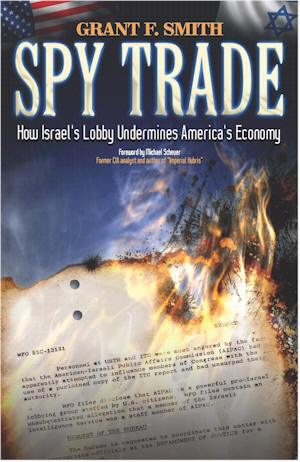
PY TRADE: How Israel’s Lobby Undermines America’s Economy by Grant F. Smith
Foreword by Michael Scheuer, former chief, CIA Bin Laden unit Large Cover Image
Buy now at:
Praise for Spy Trade:
“This terrific historical expose ought to be required background reading for those FBI agents assigned to investigate foreign espionage and public corruption matters. For many reasons, such cases are amongst the most challenging to investigate and prosecute, but are made even harder when undue political pressures enter into the picture. FBI officials responsible for setting investigative priorities and allocating resources would also do well therefore to read Spy Trade so they are aware of the historical linkage between Israel’s ‘Uzi diplomacy’ arms dealing, the Iran-Contra scandal, and the Jonathan Pollard spy incident with AIPAC’s nefarious ‘lobbying’ activities.” Coleen Rowley, former FBI agent and 2002 Time Magazine “Person of the Year.”
“Grant F. Smith’s excellent, deeply disturbing book..is a welcome addition to a growing scholarly literature.” Michael Scheuer, former senior CIA analyst and author of “Imperial Hubris”
“Like political parties, lobbies are groups of citizens with shared interests, an important part of a functioning democracy. When they have enormous power, however, and especially if their activities remain almost completely hidden, lobbies can be dangerous.
Meticulously detailed in this riveting addition to his earlier exposes, Grant Smith reveals yet another facet of the extent to which the pro-Israel Lobby is beyond dangerous, and has become a serious threat to a broad range of American ideals, objectives and interests abroad, as well as here at home. This book contains many highly disturbing, documented revelations. Read it.” Ambassador Edward L. Peck, former Chief of Mission in Iraq and Former Deputy Director, Cabinet Task Force on Terrorism, Reagan White House
“This book presents formidable and dangerous new evidence of spying by Israel and the corrosive long term influence of its lobby on US governance.” Paul Findley, member of Congress from 1961 to 1983 and author of three books on the US-Israeli relationship, including the Washington Post bestseller They Dare to Speak Out: People and Institutions Confront Israel’s Lobby
“Grant F. Smith is without peer as an archival scholar of the history of the Zionist power configuration operating in tandem inside and outside of the US government. His meticulous research on the long-term operations of AIPAC in shaping US Middle East policy provides the best contemporary framework for understanding our involvement in Middle East wars. He shows how American foreign policy in the Middle East follows Israel’s agenda and documents the enormous cost to our Treasury and economy as well as the loss of American lives. This is a book that should be read by all citizens who are concerned about the aggressive manipulation of our media and political institutions to enhance Israel’s power and further its privileged position in the Middle East.”James Petras, Bartle Professor (Emeritus) of Sociology at Binghamton University, New York
About the Book
Israel and its American lobby have committed audacious but generally unknown crimes against the United States. Government secrecy across the CIA, FBI, Department of Justice and Pentagon long kept files about Israeli espionage, weapons smuggling and covert operations on American soil classified…until now.
Spy Trade begins on the trail of a vast smuggler network funneling stolen and illegally purchased surplus WWII arms to Jewish fighters in Palestine. When the FBI threatened to crack down—a clandestine summit meeting yielded minor convictions for small time operators—but not the financial masterminds behind the scheme. This germ of immunity soon flowered into a full scale assault on American industry, the electoral system, national defense secrets and rule of law itself.
Spy Trade probes Israel lobby smuggling operations diverting uranium from the US to Israel’s Dimona nuclear weapons facility. The US Department Justice battled mightily to regulate two key enablers—the Jewish Agency and American Zionist Council—as Israeli foreign agents in the 1960s. But when the effort failed it generated a massive counterstrike.
Israel lobby campaign finance violations unleashed a network of coordinated stealth political action committees that intimidated American politicians and made a “pro-Israel” outlook and voting record requirements for staying in government. A new legal battle to regulate the American Israel Public Affairs Committee (AIPAC) as a political action committee—this time launched by concerned citizens—began two decades ago but has not yet been resolved.
Spy Trade alsoreveals the long term impact of a newly declassified “third scandal” that began in the 1980s. In the midst of both the Iran-Contra affair and Jonathan Pollard espionage incident AIPAC and the Israeli embassy conducted a spectacular clandestine operation against American industries and workers. It has so far cost the US economy $71 billion and a hundred thousand jobs each year by shutting down or diverting US exports. Trade privileges obtained by Israel under the treaty not only permit financing illegal settlement construction with proceeds from diamonds sold in the US. The US pharmaceutical industry faces an unrelenting onslaught against its capacity to innovate and protect its intellectual property.
Spy Trade is much more than a groundbreaking dissection of the tactics Israel and its American lobby repeatedly use to evade justice. The book also provides stunningly simple strategies for ending criminal immunity and subversion of law enforcement that may someday restore American governance.
The Polish genius took the slow, flowing folk-dance and turned it into the swaggering form that perfectly expressed his own fervent nationalism, the heroism of his people, and the mystic nationalism of Chopin’s literary counterpart, the activist and poet, Adam Mickiewicz. Moved by the dismemberment of Poland, the devoutly Catholic Mickiewicz adopted the doctrine of Messianism. The mystic Andrzej Towiaski led him to embrace the belief that Poland was a Christ among nations, like Israel, and that the Kingdom of God would come about in the middle of the nineteenth century, through the Jews, the Poles, and the French.
It’s fitting music for the burial of former Polish president Lech Kaczynski at Wawal Cathedral in Krakow.
A massive bell inside a thousand-year-old cathedral was tolling as the bodies of Poland’s president and first lady arrived for burial. Some 150,000 Poles in Krakow paid their last respects to Polish President Lech Kaczynski (lekh kah-CHIN’-skee) and his wife, Maria. The funeral was long on tradition but short on world leaders. Many of their travel plans were wrecked by the enormous plume of volcanic ash that blanketed Europe.
Financial commentator Joel Bowmanlooks at the Dharavi slum in Mumbai from a different angle:
“In an editorial pre-incarnation, your wayfaring author once found himself roaming the hot, sweaty crucible of economic chaos on the Indian Subcontinent in search of story and adventure. Mumbai squirms and pulses under the weight of three times the population density of New York City. It is both the commercial and entertainment centre of India, generating 5% of the country’s GDP and accounting for 25% of industrial output, 40% of maritime trade, and 70% of the nation’s capital transactions. Mumbai, sometimes still referred to as “Bombay,” is also a land of arresting dichotomy. For one, it is home to the world’s largest movie production industry…but just a short, bumpy ride from the glitz of Bollywood lays Dharavi, the largest slum in all of Asia. The latter area is a heaving mass of one million souls crammed into less than one square mile of unimaginable filth and grinding poverty. Needless to say, our visit to Mumbai’s underbelly was one of the most inspiring days of the whole trip.
The slum actually boasts an annual GDP of $660 million,” we wrote, awestruck after our short visit there, in The Rude Awakening. “The area, nestled between two railroad tracks, is bisected by an open-air sewage drain; commercial district on one side; residential on the other.
“On the commercial side, factories buzz around the clock, recycling the mass of waste spewed forth from around greater Mumbai. By day, ‘rag-pickers’ from the slum troll the city, collecting plastics, metals, bottles and all manner of other reusable matter. These materials are then melted down or repurposed in Dharavi before being sold back to metropolises all over India and, in some cases, across the region. Incredibly, all the machines are made on site. The men and women work 12 hours per day and each shift cooks a welcome meal for the incoming workers.
“Bound by the common oppression of multi-generational poverty, the people of Dharavi live and toil side by side, breaking their backs in the slum’s commercial district. Muslim people carve household Hindu temples, which then sell in the city’s markets, while the religious rift between the two groups rages on in the ‘outside world.’ Christian women watch over Muslim children, youngsters from different castes play together in the yards and Indian boys and girls learn in the slum’s schools alongside their classmates from all over Asia.”