Elena Kagan, Out And Proud Neo-Liberal

Update (May 18): As solicitor general, she intervened on behalf of Monsanto’s right to contaminate non-genetically modified food with GM food, in Monsanto vs. Geertson Seed.

Update: Just to clarify the reference to neo-liberal, Elena Kagan has extensive ties to Goldman Sachs, D.E Shaw, and to Larry Summers on her resume. In other words, her so-called progressive positions are in the service of the kleptocracy.

Update (May 15 PM):

The Boston Phoenix has this, substantiating the main point of the Cockburn piece I’ve posted below it:

“On matters of executive authority — where the judicial branch has been a vital bulwark against post-9/11 “war on terror” civil-liberties violations — Kagan’s record indicates an ideological departure from Justice Stevens, who authored watershed detainee-rights opinions and organized the five-justice majorities that struck down other Bush administration power grabs. Continue reading

State Terrorism: The Ukrainian Genocide, 1933

The Ukrainian genocide at the hands of Stalin was as great as the Holocaust engineered by the Nazis, but is much less well known. The silence of prominent Western journalists is one reason why.  Walter Duranty of The New York Times, a Pulitzer prize-winner, admitted privately that ten million or so peasants had been intentionally starved and/or killed, but in public he dismissed reports of this as exaggeration and anti-Soviet propaganda. It turned out later that Duranty was being sexually blackmailed by the KGB.

Estimates of how many people died in Stalin’s engineered famine of 1933 vary. But they are staggering in their scale — between seven and 11 million people.

But despite the horrific number of people who died, the world is relatively unfamiliar with this grisly chapter in Soviet history which claimed lives on the same scale as the holocaust. One of the main reasons is that the Germans were eventually defeated, and thousands of eyewitnesses told  their stories  about concentration  camps and massacres.  The experience  was also  captured  unforgettably in photographs, film, and written accounts, and many of those responsible for the genocide were captured and put on trial………

British historian Robert Conquest is an expert on the period and his 1986 study of the famine, “Harvest of Sorrow,” brought much information about the tragedy to Western audiences for the first time. Conquest said another contrast between the famine and the holocaust is that while Adolf Hitler had written down much of what he intended to do, Stalin did not go on record about the famine.

“In the first place, [the Germans] were caught, so it ended and they had themselves got into an operation where they said what they were doing. Stalin never said he was trying to starve anyone to death. He just took away their food. He never went on record. It was all done under the auspices of humanist talk, socialist talk — or else denied altogether. The operations were different. And in other ways they were different, too. Hitler did many horrible things but he didn’t torture his friends to tell lies. The operation was a different one.”

Conquest is in no doubt that the famine was primarily aimed at Ukrainians and that Stalin hated not only the country peasants but even senior Communist leaders, like Mykola Skrypnyk, who eventually killed himself…………

“[Stalin] was trying to break the Ukrainians, as you know, with the leading Ukrainian Bolshevik Skrypnyk committing suicide under the pressures that were put on them when they tried to defend just the ordinary alphabet of the Ukrainians. Here [Stalin] was trying to alter it, things like that. I think he also proved he never trusted Ukrainian Communists. The whole Ukrainian Central Committee was totally purged in 1937, even the ones who supported him. He had this terrific distrust of everybody, but particularly of Ukraine.”

Luciuk of the Ukrainian Canadian Civil Liberties Association has a different theory for why news of the famine never reached the West. He blamed a number of Western journalists based in Moscow at the time who knew of the forced starvation but chose not to write about it or deliberately covered it up.

The journalist he says played the most influential role in the cover-up was “The New York Times” correspondent Walter Duranty. A drug addict with a shady reputation, Duranty was also an avid fan of Stalin’s, whom he described as “the world’s greatest living statesman.” He was granted the first American interview with the Soviet leader and received privileged information from the secretive regime.

Duranty confided to a British diplomat at the time that he thought 10 million people had perished in the famine. But when other journalists who had traveled to Ukraine began writing about the horrific famine raging there, Duranty branded their information as anti-Soviet lies. Conquest believes that Duranty was being blackmailed by the Soviet secret police over his sexual activities, which reportedly included bisexuality and necrophilia.

The year before the famine, in 1932, Duranty won the Pulitzer Prize, America’s most coveted journalism award, for a series of articles on the Soviet economy. Luciuk says members of the Ukrainian diaspora, as well as Ukrainian politicians and academics, earlier this month launched a campaign to have Duranty’s award posthumously revoked. He said he hopes the campaign will make more people in the world aware of the famine….”

Ex-KGB Describes Psyops In The US

Update:

Bezmenov divides the stages of ideological subversion into four:

1. Demoralization  (15 -20 yrs) 2. Destabilization 3. Crisis  4. Normalization

My speculation:

1. The 1960s – 1980s is the period of demoralization

2. 1990s – 2001 The fall of the Berlin Wall marks the acceleration of this into active destabilization of the US’s economy and foreign policy (the neo-conservative paper, “A Clean Break,” as well as proposals for “full-spectrum” dominance; Yugoslav and Iraq wars; the total financialization and electronification of the US capital markets, leading to the stock market bubble). This period is initiated by the fall of the Berlin Wall, on November 9, 1989 (11-9-1989) and  George Bush’s statement about a “new world order” on September 11,  9-11-1990.

3. 2001 – 2008  Period that entails vast changes in the political and economic systems, following two crises – one, political, on 9-11 and another exactly 7 years later, economic, around 9-11 too.

We are now still in the period of crisis, which, in my opinion, will throw up further catalyzing “events’ of all kinds, whether occurring spontaneously in the realm of politics/economics/nature, or whether manufactured.

Note:

Bezmenov was talking about Soviet society and propaganda in the 1960s and 1970s. That means his analysis of the general dynamics of propaganda has to be cautiously reconfigured, when it comes to specifics. The US and USSR he was describing (prior to the 1980s) had clearly differentiated economic/political systems. In the 30 years that have passed since then, the ideological convergence he mentions elsewhere, has in many ways occurred or is in the process of occurring. [I describe this in much greater depth in “The Language of Empire.”]

The USA hasn’t been free-market capitalist in any real way for some 20-30 years certainly, even longer. Instead, its experienced ever-accelerating state intervention/mercantilism and crony capitalism. Now that has turned into the final danse macabre of casino capitalism and pure plunder.

Thus the Bezmenovian analyis might plausibly be applied both to the actual situation in the US, as well as to the propaganda the US directs toward its enemies.

Bezmenov didn’t know, or perhaps chose not to voice (since this was the country he defected to), the fact that US propaganda and psyops have been subtler, and thus in the long run much more effective, than Soviet propaganda.

He also doesn’t acknowledge that at many levels “capitalist” and “communist” leaderships have become symbiotic and created a globalized kleptocracy in which the two ideological forms, while retaining different emphases, copulate and spawn a “third way.”  This is the corporatized politically correct social democracy that increasingly seems to be the benign face of corrupt neo-liberalism, which is the power behind the throne of the multilateral institutions – the World Bank, IMF, EU, UN, and others.

ORIGINAL POST

March 07, 2009 — Yuri Bezmenov 1983 Soviet subversion of Western Society

Yuri Bezmenov, a.k.a. Tomas Schuman, soviet KGB defector, explains in detail his scheme for the KGB process of subversion and takeover of target societies at a lecture in Los Angeles, 1983.
Yuri Alexandrovitch Bezmenov is a former KGB propagandist who was assigned to New Dehli, India, defected to the West in 1970, and was interviewed by Edward Griffin in 1985. Bezmenov explains his background, some of his training, and exactly how Soviet propaganda is spread in other countries in order to subvert their teachers, politicians, and other policy makers to a mindset receptive to the Soviet ideology.

He also explains in detail the goal of Soviet propaganda as total subversion of another country and the 4 step formula for achieving this goal. He recalls the details of how he escaped India, defected to the West, and settled in Montreal as an announcer for the CBC.

Note: As I said before about the wikileaks video, the notion that you need to ferret out secret documents, hack computers, or conduct spy v spy ops to understand what’s going on is simply romantic myth. 85% of KGB intelligence ops in the US, according to Schuman, is about ideological subversion or aggressive propaganda, which is intended to demoralize the population so that even when presented with all possible information it’s unable to draw common sense conclusions, protect its own self-interest, or act rationally. Even when confronted with evidence of war atrocities, such as those on the video, people will simply reframe the facts to fit their ideological predisposition.

Murray Rothbard On The Cult Of St. Ayn

Rothbard’s penetrating analysis of the cult of St. Ayn:

“The adoption of the central axiom of Rand’s greatness was made possible by Rand’s undoubted personal charisma, a charisma buttressed by her air of unshakeable arrogance and self-assurance. It was a charisma and an arrogance that was partially emulated by her leading disciples. Since the rank-and-file disciple knew in his heart that he was not all-wise or totally self-assured, it became all too easy to subordinate his own will and intellect to that of Rand. Rand became the living embodiment of Reason and Reality and by some quality of personality Rand was able to bring about the mind-set in her disciples that their highest value was to earn her approval while the gravest sin was to incur her displeasure. The ardent belief in Rand’s supreme originality was of course reinforced by the disciples’ not having read (or been able to read) anyone whom they might have discovered had said the same things long before.

Ejection From Paradise

The Rand cult grew and flourished until the irrevocable split between the Greatest and the Second Greatest, until Satan was ejected from Paradise in the fall of 1968. The Rand-Branden split destroyed NBI, and with it the organized Randian movement. Rand has not displayed the ability or the desire to pick up the pieces and reconstitute an equivalent organization. The Objectivist fell back to The Ayn Rand Letter, and now that too has gone.

With the death of NBI, the Randian cultists were cast adrift, for the first time in a decade, to think for themselves. Generally, their personalities rebounded to their non-robotic, pre-Randian selves. But there were some unfortunate legacies of the cult. In the first place, there is the problem of what the Thomists call invincible ignorance. For many ex-cultists remain imbued with the Randian belief that every individual is armed with the means of spinning out all truths a priori from his own head – hence there is felt to be no need to learn the concrete facts about the real world, either about contemporary history or the laws of the social sciences. Armed with axiomatic first principles, many ex-Randians see no need of learning very much else. Furthermore, lingering Randian hubris imbues many ex-members with the idea that each one is able and qualified to spin out an entire philosophy of life and of the world a priori. Such aberrations as the “Students of Objectivism for Rational Bestiality” are not far from the bizarreries of many neo-Randian philosophies, preaching to a handful of zealous partisans. On the other hand, there is another understandable but unfortunate reaction. After many years of subjection to Randian dictates in the name of “reason,” there is a tendency among some ex-cultists to bend the stick the other way, to reject reason or thinking altogether in the name of hedonistic sensation and caprice.

We conclude our analysis of the Rand cult with the observation that here was an extreme example of contradiction between the exoteric and the esoteric creed. That in the name of individuality, reason, and liberty, the Rand cult in effect preached something totally different. The Rand cult was concerned not with every man’s individuality, but only with Rand’s individuality, not with everyone’s right reason but only with Rand’s reason. The only individuality that flowered to the extent of blotting out all others, was Ayn Rand’s herself; everyone else was to become a cipher subject to Rand’s mind and will.

Nikolai Bukharin’s famous denunciation of the Stalin cult, masked during the Russia of the 1930’s as a critique of the Jesuit order, does not seem very overdrawn as a portrayal of the Randian reality:

It has been correctly said that there isn’t a meanness in the world which would not find for itself and ideological justification. The king of the Jesuits, Loyola, developed a theory of subordination, of “cadaver discipline,” every member of the order was supposed to obey his superior “like a corpse which could be turned in all directions, like a stick which follows every movement, like a ball of wax which could be changed and extended in all directions”… This corpse is characterized by three degrees of perfection: subordination by action, subordination of the will, subordination of the intellect. When the last degree is reached, when the man substitutes naked subordination for intellect, renouncing all his convictions, then you have a hundred percent Jesuit.3

It has been remarked that a curious contradiction existed with the strategic perspective of the Randian movement. For, on the one hand, disciples were not allowed to read or talk to other persons who might be quite close to them as libertarians or Objectivists. Within the broad rationalist or libertarian movement, the Randians took a 100% pure, ultra-sectarian stance. And yet, in the larger political world, the Randian strategy shifted drastically, and Rand and her disciples were willing to endorse and work with politicians who might only be one millimeter more conservative than their opponents. In the larger world, concern with purity or principles seemed to be totally abandoned. Hence, Rand’s whole-hearted endorsement of Goldwater, Nixon, and Ford, and even of Senators Henry Jackson and Daniel P. Moynihan.

Neither Liberty Nor Reason

There seems to be only one way to resolve the contradiction in the Randian strategic outlook of extreme sectarianism within the libertarian movement, coupled with extreme opportunism, and willingness to coalesce with slightly more conservative heads of State, in the outside world. That resolution, confirmed by the remainder of our analysis of the cult, holds that the guiding spirit of the Randian movement was not individual liberty – as it seemed to many young members – but rather personal power for Ayn Rand and her leading disciples. For power within the movement could be secured by totalitarian isolation and control of the minds and lives of every member; but such tactics could scarcely work outside the movement, where power could only hopefully be achieved by cozying up the President and his inner circles of dominion.

Thus, power not liberty or reason, was the central thrust of the Randian movement. despite explicit devotion to reason and individuality, are not exempt from the mystical and totalitarian cultism that pervades other ideological as well as religious movements. Hopefully, libertarians, once bitten by the virus, may now prove immune.” The major lesson of the history of the movement to libertarians is that It Can Happen Here, that libertarians,

Of the several works on Randianism, only one has concentrated on the cult itself: Leslie Hanscom, “Born Eccentric,” Newsweek (March 27, 1961), pp. 104–05. Hanscom brilliantly and wittily captured the spirit of the Rand cult from attending and reporting on one of the Branden lectures. Thus, Hanscom wrote: After three hours of heroically rapt attention to Branden’s droning delivery, the fans were rewarded by the personal apparition of Miss Rand herself – a lady with drilling black eyes and Russian accent who often wears a brooch in the shape of a dollar sign as her private icon….


“Her books,” said one member of the congregation, “are so good that most people should not be allowed to read them. I used to want to lock up nine-tenths of the world in a cage, and after reading her books, I want to lock them all up.” Later on, this same chap – a self-employed “investment counselor” of 22 – got a lash of his idol’s logic full in the face. Submitting a question from the floor – a privilege open to paying students only – the budding Baruch revealed himself as a mere visitor. Miss Rand – a lady whose glare would wilt a cactus – bawled him out from the platform as a “cheap fraud.” Other seekers of wisdom came off better. One worried disciple was told that it was permissible to celebrate Christmas and Easter so long as one rejected the religious significance (the topic of the night’s lecture was the folly of faith). A housewife was assured that she needn’t feel guilty about being a housewife so long as she chose the job for non-emotional

Although mysticism is one of the nastiest words in her political arsenal, there hasn’t been a she-messiah since Aimee McPherson who can so hypnotize a live audience.”

At least as revelatory as Hanscom’s article were the predictable howls of overkill outrage by the cult members. Thus, two weeks later, under the caption “Thugs and Hoodlums?”, Newsweek printed excerpts from Randian letters sent in reaction to the article. One letter stated: “Your vicious, vile, and obscene tirade against Ayn Rand is a new low, even for you. To have sanctioned such a stream of abusive invective…is an act of unprecedented moral depravity. A magazine staffed with irresponsible hoodlums has no place in my home.” Another man wrote that “one who has read the works of Miss Rand and proceeds to write an article of this caliber can only be motivated by villainy. It is the work of a literary thug.” Another warned, “Since you propose to behave like cockroaches, be prepared to be treated as such.” And finally, one Bonnie Benov revealed the inner axiom: “Ayn Rand is…the greatest individual that has ever lived.” Having fun with the cult, Newsweek printed a particularly unprepossessing picture of Rand underneath the Benov letter, and captioned it: “Greatest Ever?”5

My Comment:

I was repelled when I first read “The Fountainhead” when I was about twenty. To tell the truth, I didn’t really read it. I read about 20 pages and then got someone else to tell me about it.

That was natural, I think. I was reading a lot of Catholic philosophy and was surrounded by socialists. In India, that book and the kind of people who read it were people who lived in a different world from mine.

My friends and I tended to laugh at  them, as well as at the crowd we called “JNU Marxists” (upper class and upper middle-class Indian students who affected Marxism and usually attended the Marxist dominated university, Jawaharlal Nehru University in Delhi). These Randian contemporaries of mine, like the JNU Marxists, were usually affluent and enamored of the West, which they saw through the eyes of Western counter-culture.

It was only 15 years later, when I reread Ayn Rand, that I came to appreciate what had first seemed repellent to me.

I thought about this when I was reading Shikha Dalmia’s recent commentary about Rand at Forbes. She writes that a love of Rand is a sign of adolescence and is something you leave behind when you become an adult with adult responsibilities.  Dalmia’s criticism is a common one, but for me it’s unconvincing, because in my case, I came to admire Ayn Rand relatively late in life.

As for Rothbard, as always, he presents many useful insights, but he was perhaps temperamentally unsuited to understand a woman of  Rand’s nature. There’s a whiff of male chauvinism here. Despite all her pretentiousness (and the pretentiousness of her acolytes), despite the flaws in her thinking and in her character, to reduce her to a power-hungry, narcissistic “wicked witch of Capitalism” is just mistaken.

Whatever warping of her personality took place, we have to remember when and where she grew up. She had to struggle mightily simply to maintain her vision of individualism intact, floating in a sea of collectivism and political ideology in the middle of the twentieth century. That, more than pathology, probably accounts for those ideological and personal alignments she made that seem opportunistic to us today….

“I swear, by my life and my love of it, that I will never live for the sake of another man, nor ask another man to live for mine.”

Call this what you will but it’s not narcissism…and it is very very far from selfishness.

As for what is is that sends people screaming to the exits when they hear her name:

“The hardest thing to explain is the glaringly evident which everybody had decided not to see.”
“Compassionate” Conservatism: Statist Propaganda

Let me put this as bluntly as possible. A state cannot be “compassionate.” Policies might have well-intentioned goals, but they are policies – that is, legal and administrative enactments, often backed by force, that must be followed by whoever falls under their jurisdiction, regardless of their state of mind.

On the other hand, compassion is  a quality of heart and intention. An involuntary A non-voluntary action consequent to a policy cannot be compassionate. Obedience to a legal requirement cannot be compassionate. Compassion can be understood only by the context and the state of mind of an individual.

Libertarianism is not..should not be…and cannot be… compassionate.

Instead, it is the attitude to government policy and law that best allows human beings to act with the compassion each is capable of. To force “compassion” on people who don’t want to be “compassionate” is simply force, just as surely as if you were forcing anything else on them that they didn’t want. What looks like “compassion” to you might, after all, look like “expropriation” to me.

“Compassionate” policies might indeed achieve some immediate goal that makes some group of people more satisfied than they previously were. But it surely makes another group unhappy in order to do so. Now, the trade off might..or might not…be worth it. But the entity making that utilitarian calculation isn’t an individual, it’s at best a committee of hacks, at worst, a mafia of thugs….or worst of all, some economic model cooked up in a Harvard professor’s study.

By transferring “compassion” to the state, “compassionate conservatism” encourages people to become less compassionate personally. People actually become meaner. Why wouldn’t they? They’re already being taxed at a third to half their money, effectively. Even the good lord only asked for ten percent.

More on the subject by Robert Ringer, The Tea Party Goes Docile:

(Note: I don’t necessarily agree with Robert Ringer’s other views on defense. I don’t see a necessity for the US to be on a perma-war footing that involves aggressive wars overseas and an extensive network of bases. As a libertarian, I endorse a strong defense but one that’s decentralized and limited to volunteers, not mercenaries. It would be based on universal ownership of and training in firearms and would refrain from interfering in foreign internal affairs. This would go along with a decentralized government, supported by state and citizen militias. Most of all, I endorse economic freedom and prosperity as our greatest defense. The more attractive the US is as a trade partner, the less foreign states are going to hurt their own economic interests by turning hostile.

Far from strengthening the country, anti-market economic policies and a perpetually intrusive foreign policy are draining money, time, and energy from it.

(Nonetheless, I don’t think we can disarm unilaterally “at one fell swoop,” without opening up a can of worms, now that the government has actually created multiple foreign threats by its belligerence).

I repeat what I said earlier: If anything, I believe the tea-party rally on tax day was far too docile. It once again demonstrated just how intimidating the far left can be. Not only intimidating, but clever.

How so? The BHO oligarchy has managed to change the Big Question from ”Is Obama a socialist?” to ”Is the tea-party movement dangerously immersed in racism, hate speech, and violence-prone affiliations with paramilitary groups?” Never sell the Saul Alinsky crowd short when it comes to turning every negative around and pointing it in the direction of its accusers.

I honestly believe that Der Fuhrbama believes his verbal skills are so powerful that he can embarrass the tea-party people into submission. He may be a lightweight in most respects, but he’s a lightweight with an abundance of (over)confidence. The tea-party people had better take a page from Rules from Radicals and press down twice as hard on the accelerator, lest they lose their momentum long before November 2.

Docile simply doesn’t cut it. Just ask the compassionate conservatives who are now in the process of going down in flames.”

Jacob Hornberger: How Much Do Liberals “Love” the Poor?

Jacob Hornberger (Lew Rockwell):

Did I mention that 19th-century America was not only the most prosperous nation in history but also the most charitable nation in history? In a land with no income tax and no welfare state, it was voluntary contributions that built the churches, opera houses, museums, and so much more. Continue reading

The Daily Bell Asks A Question

Update: Antiwar has a good piece about Dr. Lani Kass, Senior Special Assistant to the Chief of Staff to the US Air Force General Norton A. Schwartz, who reached the rank of Major in the Israeli Defense Force (IDF) before rising to her present highly sensitive position at the Pentagon. Dr. Kass is also rumored to be an unofficial adviser to Admiral Mike Mullen, Chair of the Joint Chiefs of Staff, on Middle East Policy.

“There are indications that Dr. Kass is a major player in shaping US security policy.  She has been described as a “key participant” in the development of the national strategy for combating terrorism, as well as the national military strategic plan for the Global War on Terrorism. In September 2007, The Times of London reported that she was a leading participant in “Project CHECKMATE, a “highly confidential strategic planning group tasked with ‘fighting the next war’ as tensions rise with Iran” that was “quietly established” by the US Air Force in June 2007 as a “successor to the group that planned the 1991 Gulf War’s air campaign.”

Also per The Times, CHECKMATE “consists of 20-30 top air force officers and defense and cyberspace experts with ready access to the White House, the CIA and other intelligence agencies.” Its director Brigadier-General Lawrence A. Stutzriem and Kass reported directly to General Michael Moseley, at the time chief of staff of the Air Force. The Times cited Defense sources saying, “detailed contingency planning for a possible attack on Iran has been carried out for more than two years.” Regarding Iran operations, Kass was quoted as saying “We can defeat Iran, but are Americans willing to pay the price?”

ORIGINAL POST

The Daily Bell asks a good question:

“Leaving aside the legal issues involved, one does wonder at America’s insistence that Iran remain nuke-free. Back in the 1950s, America participated in a regime change in Iran and there is considerable evidence that America might have destabilized Iran again in the late 1970s. And despite mistranslations, Iran has never directly threatened Israel with nuclear weapons – even if it had them. Israel on the other hand is said to have up to 400 nuclear missiles or more, though Israel has never confirmed their existence.

States, in fact, usually do not commit suicide. The idea that a nuclear Iran would suddenly start lobbing nukes at Israel strikes us as preposterous. Even if Israel did not strike back, the US has enough firepower to turn all of Iran into molten slag. The regime would not survive the first missile. But none of this seems to matter. The US is the de facto policeman of the new global “Power Elite” order. It is harrying nations around the world into falling in line with the US position that so long as there is any hint of a possibility that Iran is pursuing nuclear weapons, Iran ought to be severely boycotted, its economy squeezed and its businesses barred.

It is a serious situation. Boycotts are not inevitably a prelude to war, but they are often destabilizing and can well be a cynical prelude to action. In this case, we believe that certain US leaders seem to want to ratchet up the pressure on Iran to a point that is positively dangerous. Why would the US put world peace at risk over an atomic program that has not yet been proven to exist?”

Why?

Here is one answer: “The Zionist Power Configuration” (James Petras). (Note: The tone of this is shriller than necessary, but because it is a systematic and superbly documented critique that I can’t really find any where else, and because of Lieberman’s new, extremely dangerous call for war in Iran at a time of maximum global fragility (and with the very suspicious downing of the Polish plane in the background), I am going to post it anyway.

And here is more on the IL:

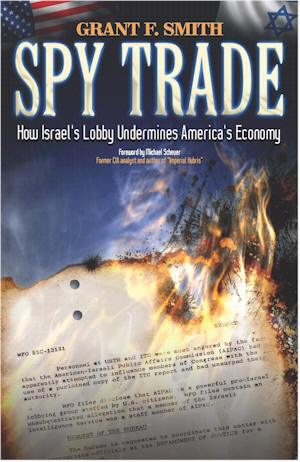
PY TRADE: How Israel’s Lobby Undermines America’s Economy
by Grant F. Smith
Foreword by Michael Scheuer, former chief, CIA Bin Laden unit

Large Cover Image

Page Count: 180
Language: English
ISBN: 978-0-9764437-1-1
Price $12.95 (before retailer discounts)


Buy now at:


Praise for Spy Trade:

“This terrific historical expose ought to be required background reading for those FBI agents assigned to investigate foreign espionage and public corruption matters.  For many reasons, such cases are amongst the most challenging to investigate and prosecute, but are made even harder when undue political pressures enter into the picture.  FBI officials responsible for setting investigative priorities and allocating resources would also do well therefore to read Spy Trade so they are aware of the historical linkage between Israel’s ‘Uzi diplomacy’ arms dealing, the Iran-Contra scandal, and the Jonathan Pollard spy incident with AIPAC’s nefarious ‘lobbying’ activities.” Coleen Rowley, former FBI agent and 2002 Time Magazine “Person of the Year.”

“Grant F. Smith’s excellent, deeply disturbing book..is a welcome addition to a growing scholarly literature.” Michael Scheuer, former senior CIA analyst and author of “Imperial Hubris”

“Like political parties, lobbies are groups of citizens with shared interests, an important part of a functioning democracy.  When they have enormous power, however, and especially if their activities remain almost completely hidden, lobbies can be dangerous.

Meticulously detailed in this riveting addition to his earlier exposes, Grant Smith reveals yet another facet of the extent to which the pro-Israel Lobby is beyond dangerous, and has become a serious threat to a broad range of American ideals, objectives and interests abroad, as well as here at home.  This book contains many highly disturbing, documented revelations.  Read it.” Ambassador Edward L. Peck, former Chief of Mission in Iraq and Former Deputy Director, Cabinet Task Force on Terrorism, Reagan White House

“This book presents formidable and dangerous new evidence of spying by Israel and the corrosive long term influence of its lobby on US governance.” Paul Findley, member of Congress from 1961 to 1983 and author of three books on the US-Israeli relationship, including the Washington Post bestseller They Dare to Speak Out: People and Institutions Confront Israel’s Lobby

“Grant F. Smith is without peer as an archival scholar of the history of the Zionist power configuration operating in tandem inside and outside of the US government.  His meticulous research on the long-term operations of AIPAC in shaping US Middle East policy provides the best contemporary framework for understanding our involvement in Middle East wars.  He shows how American foreign policy in the Middle East follows Israel’s agenda and documents the enormous cost to our Treasury and economy as well as the loss of American lives.  This is a book that should be read by all citizens who are concerned about the aggressive manipulation of our media and political institutions to enhance Israel’s power and further its privileged position in the Middle East.” James Petras, Bartle Professor (Emeritus) of Sociology at Binghamton University, New York

About the Book

Israel and its American lobby have committed audacious but generally unknown crimes against the United States.  Government secrecy across the CIA, FBI, Department of Justice and Pentagon long kept files about Israeli espionage, weapons smuggling and covert operations on American soil classified…until now.

Spy Trade begins on the trail of a vast smuggler network funneling stolen and illegally purchased surplus WWII arms to Jewish fighters in Palestine.  When the FBI threatened to crack downa clandestine summit meeting yielded minor convictions for small time operatorsbut not the financial masterminds behind the scheme.  This germ of immunity soon flowered into a full scale assault on American industry, the electoral system, national defense secrets and rule of law itself.

Spy Trade probes Israel lobby smuggling operations diverting uranium from the US to Israel’s Dimona nuclear weapons facility.  The US Department Justice battled mightily to regulate two key enablersthe Jewish Agency and American Zionist Councilas Israeli foreign agents in the 1960s.  But when the effort failed it generated a massive counterstrike.

Israel lobby campaign finance violations unleashed a network of coordinated stealth political action committees that intimidated American politicians and made a “pro-Israel” outlook and voting record requirements for staying in government.  A new legal battle to regulate the American Israel Public Affairs Committee (AIPAC) as a political action committeethis time launched by concerned citizensbegan two decades ago but has not yet been resolved.

Spy Trade also reveals the long term impact of a newly declassified “third scandal” that began in the 1980s.  In the midst of both the Iran-Contra affair and Jonathan Pollard espionage incident AIPAC and the Israeli embassy conducted a spectacular clandestine operation against American industries and workers.  It has so far cost the US economy $71 billion and a hundred thousand jobs each year by shutting down or diverting US exports.  Trade privileges obtained by Israel under the treaty not only permit financing illegal settlement construction with proceeds from diamonds sold in the US.  The US pharmaceutical industry faces an unrelenting onslaught against its capacity to innovate and protect its intellectual property.

Spy Trade is much more than a groundbreaking dissection of the tactics Israel and its American lobby repeatedly use to evade justice.  The book also provides stunningly simple strategies for ending criminal immunity and subversion of law enforcement that may someday restore American governance.

Libertarians Rising: Helio Beltrao, Mises Brasil, and the Swedish Mises Institute

From Lew Rockwell exciting news from Brazil…and also from Sweden:

“The young Brazilian financial and ideological entrepreneur, Helio Beltrão, has done something great for the Austro-libertarian movement and the cause of liberty, for his country and the whole world: establish the Instituto Ludwig von Mises Brasil, and make it flourish. The website is already significant, and this month, MisesBrasil sponsored the first Austrian Economics conference in the country’s history. Continue reading

Sir James Goldsmith: GATT, Nukes, Agribusiness Devouring Society

Sir James Michael Goldsmith, Anglo-French financier and corporate raider of the 1980s, is most infamous for taking over Goodyear Tires and restructuring it, thereby putting its many employees out of work.

In this deeply prophetic interview with Charlie Rose in 1994 he discusses his book about globalization, The Trap, and displays a more humane side of his complex intelligence.

In the earlier part of the interview (not shown here), Goldsmith gets into a heated debate with Clinton economic honcho Laura Tyson over the benefits of NAFTA and GATT in which Tyson comes off as both naive and uninformed.

In another part, Goldsmith calls Indian physicist and environmental activist Vandana Shiva “remarkable” and asks why it is that global “free” trade, supposedly so beneficial to developing countries, was protested widely and vigorously by huge numbers of people in India.

Take away points from the interview:

*This (globalization) is the establishment against the rest of society

*I am for big business until it devours society

*Big business loves total access to unlimited give-away labor

*In every developing nation you have a handful of people who control everything, the oligarchs

*This (globalization) is the poor in rich countries subsidizing the rich in the poor countries
(Lila: I’d add that the poor in poor countries are also subsidizing the rich in rich countries)

*Free trade within homogeneous regions is to be preferred to global trade
(Lila: This coincides with something I’ve advocated for a while, on the principle of subsidiarity)

*The European parliament is a force for pseudo-democratic institutions

*It’s already fixed by the two main parties, the Christian Democrats and the Socialists

*The people have a right to vote on the single most important economic decision of their life times

*Here in the USA we’ve had no debate on it (GATT) while we’ve had a huge debate about NAFTA which was a pimple

*GATT is going through because business wants it
*It’s a fix here (the US), as it is in Europe

*We’ve allowed instruments that are supposed to serve us to become our masters

*GATT is an example of how an economic doctrine is going to destabilize our society

*Nuclear is another example. Here in Europe, we’ve not been allowed to discuss this disastrous form of energy, disastrous in terms both of economics and in terms of security

*Corporate agriculture is a third example of how we are destroying our societies

*The ruling machinery of government power in Europe is imposing this (GATT) without a debate