PsyWar: COINTELPRO Infiltration Of Dissidents

From the War at Home Archive:

“False Media Stories: COINTELPRO documents expose frequent collusion between news media personnel and the FBI to publish false and distorted material at the Bureau’s behest. The FBI routinely leaked derogatory information to its collaborators in the news media. It also created newspaper and magazine articles and television “documentaries” which the media knowingly or unknowingly carried as their own. Copies were sent anonymously or under bogus letterhead to activists’ financial backers, employers, business associates, families, neighbors, church officials, school administrators, landlords, and whomever else might cause them trouble.

One FBI media fabrication claimed that Jean Seberg, a white film star active in anti-racist causes, was pregnant by a prominent Black leader. The Bureau leaked the story anonymously to columnist Joyce Haber and also had it passed to her by a “friendly” source in the Los Angeles Times editorial staff. The item appeared without attribution in Haber’s nationally syndicated column of May 19, 1970. Seberg’s husband has sued the FBI as responsible for her resulting stillbirth, nervous breakdown, and suicide.

Bogus Leaflets, Pamphlets, and Other Publications: COINTELPRO documents show that the FBI routinely put out phony leaflets, posters, pamphlets, newspapers, and other publications in the name of movement groups. The purpose was to discredit the groups and turn them against one another.

FBI cartoon leaflets were used to divide and disrupt the main national anti-war coalition of the late 1960s. Similar fliers were circulated in 1968 and 1969 in the name of the Black Panthers and the United Slaves (US), a rival Black nationalist group based in Southern California. The phony Panther/US leaflets, together with other covert operations, were credited with subverting a fragile truce between the two groups and igniting an explosion of internecine violence that left four Panthers dead, many more wounded, and a once-flourishing regional Black movement decimated.

Another major COINTELPRO operation involved a children’s coloring book which the Black Panther Party had rejected as anti-white and gratuitously violent. The FBI revised the coloring book to make it even more offensive. Its field offices then distributed thousands of copies anonymously or under phony organizational letterheads. Many backers of the Party’s program of free breakfasts for children withdrew their support after the FBI conned them into believing that the bogus coloring book was being used in the program.

Forged Correspondence: Former employees have confirmed that the FBI has the capacity to produce state-of-the-art forgery. This capacity was used under COINTELPRO to create snitch jackets and bogus communications that exacerbated differences among activists and disrupted their work.

One such forgery intimidated civil rights worker Muhammed Kenyatta (Donald Jackson), causing him to abandon promising projects in Jackson, Mississippi. Kenyatta had foundation grants to form Black economic cooperatives and open a “Black and Proud School” for dropouts. He was also a student organizer at nearby Tougaloo College. In the winter of 1969, after an extended campaign of FBI and police harassment, Kenyatta received a letter, purportedly from the Tougaloo College Defense Committee, which “directed” that he cease his political activities immediately. If he did not “heed our diplomatic and well-thought-out warning,” the committee would consider taking measures “which would have a more direct effect and which would not be as cordial as this note.” Kenyatta and his wife left. Only years later did they learn it was not Tougaloo students, but FBI covert operators who had driven them out.

Later in 1969, FBI agents fabricated a letter to the mainly white organizers of a proposed Washington, D.C. anti-war rally demanding that they pay the local Black community a $20,000 “security bond.” This attempted extortion was composed in the name of the local Black United Front (BUF) and signed with the forged signature of its leader. FBI informers inside the BUF then tried to get the group to back such a demand, and Bureau contacts in the media made sure the story received wide publicity.

The Senate Intelligence Committee uncovered a series of FBI letters sent to top Panther leaders throughout 1970 in the name of Connie Mathews, an intermediary between the Black Panther Party’s national office and Panther leader Eldridge Cleaver, in exile in Algeria. These exquisite forgeries were prepared on pilfered stationery in Panther vernacular expertly simulated by the FBI’s Washington, D.C. laboratory. Each was forwarded to an FBI Legal Attache at a U.S. Embassy in a foreign country that Mathews was due to travel through and then posted at just the right time “in such a manner that it cannot be traced to the Bureau.” The FBI enhanced the eerie authenticity of these fabrications by lacing them with esoteric personal tidbits culled from electronic surveillance of Panther homes and offices. Combined with other forgeries, anonymous letters and phone calls, and the covert intervention of FBI and police infiltrators, the Mathews correspondence succeeded in inflaming intra-party mistrust and rivalry until it erupted into the bitter public split that shattered the organization in the winter of 1971.

Anonymous Letters and Telephone Calls: During the 1960s, activists received a steady flow of anonymous letters and phone calls which turn out to have been from the FBI. Some were unsigned, while others bore bogus names or purported to come from unidentified activists in phony or actual organizations.

Many of these bogus communications promoted racial divisions and fears, often by exploiting and exacerbating tensions between Jewish and Black activists. One such FBI-concocted letter went to SDS members who had joined Black students protesting New York University’s discharge of a Black teacher in 1969. The supposed author, an unnamed “SDS member,” urged whites to break ranks and abandon the Black students because of alleged anti-Semitic slurs by the fired teacher and his supporters.

Other anonymous letters and phone calls falsely accused movement leaders of collaboration with the authorities, corruption, or sexual affairs with other activists’ mates. The letter on the next page was used to provoke “a lasting distrust” between a Black civil rights leader and his wife. Its FBI authors hoped that his “concern over what to do about it” would “detract from his time spent in the plots and plans of his organization.” As in the Seberg incident, inter-racial sex was a persistent theme. The husband of one white woman active in civil rights and anti-war work filed for divorce soon after receiving the FBI-authored letter reproduced on page 50.

Still other anonymous FBI communications were designed to intimidate dissidents, disrupt coalitions, and provoke violence. Calls to Stokely Carmichael’s mother warning of a fictitious Black Panther murder plot drove him to leave the country in September 1968. Similar anonymous FBI telephone threats to SNCC leader James Forman were instrumental in thwarting efforts to bring the two groups together.

The Chicago FBI made effective use of anonymous letters to sabotage the Panthers efforts to build alliances with previously apolitical Black street gangs. The most extensive of these operations involved the Black P. Stone Nation, or “Blackstone Rangers,” a powerful confederation of several thousand local Black youth. Early in 1969, as FBI and police infiltrators in the Rangers spread rumors of an impending Panther attack, the Bureau sent Ranger chief Jeff Fort an incendiary note signed “a black brother you don’t know.” Fort’s supposed friend warned that “The brothers that run the Panthers blame you for blocking their thing and there’s supposed to be a hit out for you.” Another FBI-concocted anonymous “black man” then informed Chicago Panther leader Fred Hampton of a Ranger plot “to get you out of the way.” These fabrications squelched promising talks between the two groups and enabled Chicago Panther security chief William O’Neal, an FBI-paid provocateur, to instigate a series of armed confrontations from which the Panthers barely managed to escape without serious casualties.

Pressure Through Employers, Landlords, and Others: FBI records reveal repeated maneuvers to generate pressure on dissidents from their parents, children, spouses, landlords, employers, college administrators, church superiors, welfare agencies, credit bureaus, and the like. Anonymous letters and telephone calls were often used to this end. Confidential official communications were effective in bringing to bear the Bureau’s immense power and authority.

Agents’ reports indicate that such FBI intervention denied Martin Luther King, Jr., and other 1960s activists any number of foundation grants and public speaking engagements. It also deprived alternative newspapers of their printers, suppliers, and distributors and cost them crucial advertising revenues when major record companies were persuaded to take their business elsewhere. Similar government manipulation may underlie steps recently taken by some insurance companies to cancel policies held by churches giving sanctuary to refugees from El Salvador and Guatemala.

Tampering With Mail and Telephone Service: The FBI and CIA routinely used mail covers (the recording of names and addresses) and electronic surveillance in order to spy on 1960s movements. The CIA alone admitted to photographing the outside of 2.7 million pieces of first-class mail during the 1960s and to opening almost 215,000. Government agencies also tampered with mail, altering, delaying, or “disappearing” it. Activists were quick to blame one another, and infiltrators easily exploited the situation to exacerbate their tensions.

Dissidents’ telephone communications often were similarly obstructed. The SDS Regional Office in Washington, D.C., for instance, mysteriously lost its phone service the week preceding virtually every national anti-war demonstration in the late 1960s.

Disinformation to Prevent or Disrupt Movement Meetings and Activities: A favorite COINTELPRO tactic uncovered by Senate investigators was to advertise a non-existent political event, or to misinform people of the time and place of an actual one. They reported a variety of disruptive FBI “dirty tricks” designed to cast blame on the organizers of movement events.”

Comment

Some of my experiences of internet harassment over the past five years sound a lot like this stuff. But in my case, I’m pretty sure that the people involved were private individuals, who maybe used some of their government connections or authority. At some point, one ex-CIA official [ a guy who had a history of out-of-control behavior and had had run-ins with the law] was actually writing nasty stuff on this blog, and may have been behind a few other things.

But the rest was private. Which suggests that between corporations (correction: criminal corporations) and  government (correction: unconstitutional governments), there’s not much to choose.

Anyway, this kind of history of government infiltration of activist groups  should make people very wary about their communications. The email in your inbox can be forged and your own name could be tacked onto things you never wrote.  With all the powers at their disposal, if the government decided to frame someone, they would be able to get or create all kinds of incriminating stuff.

That’s why I don’t buy the Gupta verdict at all. With five years of investigation by two different outfits, with thousands of wire-taps, they only got him talking to Raj once? And even then, there was nothing illegal in that conversation….

Von Mises On Minarchism

Ludwig Von Mises, Human Action, 280-281:

“The concepts of freedom and bondage make sense only when referring to the way in which government operates. It would be highly inexpedient and misleading to say that a man is not free because, if he wants to stay alive, his power to choose between a drink of water and one of potassium cyanide is restricted by nature. It would be no less inconvenient to call a man unfree
because the law imposes sanctions upon his desire to kill another man
and because the police and the penal courts enforce them. As far as the government—the social apparatus of compulsion and oppression—confines the exercise of its violence and the threat of such violence to the suppression and prevention of antisocial action, there prevails what reasonably and meaningfully can be called liberty. What is restrained is merely conduct that is bound to disintegrate social cooperation and civilization, thus throwing all people back to conditions that existed at the time homo sapiens emerged from the purely animal existence of its nonhuman ancestors……

In the market economy, the laissez-faire type of social organization, there is a sphere within which the individual is free to choose between various modes of acting without being restrained by the threat of being punished. If, however, the government does more than protect people against violent or fraudulent aggression on the part of antisocial individuals, it reduces the sphere of the individual’s freedom to act beyond the degree to which it is restricted by praxeological law. Thus we may define freedom as that state of affairs in which the individual’s discretion to choose is not constrained by governmental violence beyond the margin within which the praxeological law restricts it anyway.”

First US State Recognizes Jury Nullification

When New Hampshire Governor John Lynch signed HB 146 into law on June 18, the Granite State became the first in the nation to enact a measure explicitly recognizing and protecting the indispensable right of jury nullification.

New Hampshire’s jury nullification law reads, in relevant part: “In all criminal proceedings the court shall permit the defense to inform the jury of its right to judge the facts and the application of the law in relation to the facts in controversy.”

There is nothing novel about the principle and practice of jury nullification, which dictates that citizen juries have the right and authority to rule both on the facts of a case, and the validity of a given law. This is widely recognized in judicial precedents in both American history and in Anglo-Saxon common law dating back to the Magna Carta (or earlier). At the time of the American founding it was well and widely understood that the power of citizen juries — both grand and petit — was plenary, and that their chief function was to force the government to prove its case against a defendant — and the validity of the law in question.

In contemporary America, however, trial by jury has been all but abolished in practice. Reviewing recent Supreme Court rulings, legal commentator Adam Liptak of the New York Times observes that in its just-completed term, the High Court “has turned its attention away from criminal trials, which are vanishingly rare, and toward the real world of criminal justice, in which plea bargains are the norm and harsh sentences commonplace.” (Emphasis added.)

The fact that the right to a trial by a jury of one’s peers, which is supposedly sacrosanct, has become all but extinct illustrates the extent to which the U.S. “justice” system has become Sovietized.

After the Bolsheviks seized power in 1917, the jury system — which had been established under Czar Alexander II in 1864 — was abolished and replaced with “People’s Courts” composed of a judge and a panel of two to six Party-appointed “assessors” who heard all of the evidence and decided all questions of both fact and law. The assessors “became known as `nodders’ for simply nodding in agreement with the judge,” wrote federal Judge John C. Coughenour in an article published by the Seattle University Law Review. “People’s assessors virtually always agreed with judges; acquittals were virtually nonexistent…. [U]nlike our adversarial system, the Soviet inquisitorial criminal justice system neither prioritized nor emphasized the rights of individual defendants, but instead paid homage to the interests of the state.”

One very telling measure of the Regime’s fear of citizen juries — especially those informed of their right to nullify unjust laws — is found in the efforts expended by prosecutors to prevent cases from going to trial.

In his 1998 book (co-written with Lawrence M. Stratton) The Tyranny of Good Intentions, Dr. Paul Craig Roberts points out that “the vast majority of felony cases are settled with a plea bargain….” Many, perhaps most, “felonies” today involve no offenses against persons or property, no criminal intent, and are usually a product of an opportunistic prosecutor’s malicious creativity in confecting a criminal offense.

It is common for prosecutors to multiply charges as a way of terrorizing an innocent defendant into accepting a plea. Very rarely do we see a defendant with the means to defend himself in such circumstances. For the average citizen who finds himself targeted by an ambitious prosecutor, a plea bargain usually seems like the only relatively palatable alternative to the expense of a trial and the possibility of a long time in prison. At the bargaining table, “I’m all in” for the prosecutor means that, should he lose, he would sacrifice a little prestige, with the taxpayers absorbing all of the expenses; the defendant stands to lose everything and faces the prospect of utter ruin.

This is why so many innocent people are willing to deal. For the State, the most attractive feature of such arrangements is the fact that it keeps such cases away from juries. And we’re left with a “justice” apparatus that functions, in the words of legal scholar John Langbein, like “the ancient system of judicial torture,” which relied on self-incrimination through duress, rather than conviction on the basis of sound evidence.”

Ron Paul Implosion: End The Fed To Technology Revolution…

The Pauls have lost all credibility with me.

Read their latest missive, blogged at EPJ

And reported here at Forbes: “Ron Paul Takes Up Internet Freedom with New Technology Revolution.”

They’ve abandoned the financial battle.

I guess the financial coup of 2008, completed in 2010, is now sealed and cordoned off from prosecution. Last month, as if to confirm that, the White Queen (the City)  took down the Black Knight (Gupta) that had infiltrated the highest ranks of her court, while the White Bishop (Lloyd Doing-God’s Work Blankfein) was witness for the prosecution.

“End the Fed,” which  Rand Paul converted to” Audit the Fed,” is over.

The Pauls have now skipped forward to their new, new project –  the  “Technology Revolution.”

I  never thought that much of “End the Fed,” because, as I’ve blogged previously, the elites can manufacture money from other places besides the Fed, like the BIS and the reconstituted IMF.

But, apparently,  End the Fed doesn’t even work as a popular slogan any more.

So, what do I think about the new campaign?

I think it will be about as effective as their “End the Fed” campaign, which is to say, not effective at all.

See my comment at The Daily Bell in 2010:

Posted by Lila Rajiva on 11/23/10 11:55 AM
Daily Bell: “But by pursuing his strategy, he has made his opponents look like fools and perhaps altered the course of history.”

Lila: Let’s hope. Personally, I agree with Doug Casey on this:
“As a lone voice, his father was a breath of fresh, more principled air, but he didn’t change anything at all that I can see”

(Doug Casey on Presidents, LRC)

But it will be a great platform for the Pauls to sell books, promote ideas and launch political careers for their family members.

I only hope it won’t be done on the backs of idealistic young people. There were many who put change they could hardly spare in a tough economy into the Paul’s war chest.

The new campaign, which dubs itself  “The Internet Versus The Machine” is obviously a rebranding campaign to move young people away from what Forbes calls “the archaic” (they mean arcane) issues of finance.

Instead, the Pauls will focus on the hip world of the net.

Forbes:

“Young people have been a driving force in the Paul campaign, and the focus on internet freedom should only bolster that support.”

I’m going to call foul on that.

Their new “campaign” is in support of the Technology Revolution on the Internet?

Last I looked the tech revolution has been around for a while, getting on quite well without the Pauls.

One part of  the new project is going to be defending big business from attempts by consumers to scrutinize their data collection.

I kid you not. Here is Buzzfeed on the subject.

“The Pauls also take a stand for the growing industry known (and widely criticized) as “big data.”

They deride the notion that “private sector data collection practices must be scrutinized and tightly regulated in the name of ‘protecting consumers,’ at the same time as government’s warrantless surveillance and collection of private citizens’ Internet data has dramatically increased.”

So does this mean that Ron Paul is going to be fighting to prevent European governments or NGOs  like EFF or Asian governments from scrutinizing Google’s data collection practices?

Remember that I just blogged that Google’s CEO Larry Page should be arrested for privacy violations and espionage against foreign governments?

I was being satirical about US surveillance of foreign CEO’s and money-managers.

For instance, in the Galleon -Gupta cases, the government used wire-taps whose authorization was obtained pre-textually in violation of the defendants’ constitutional rights.

I don’t recall that the Pauls said a word about that, although the Galleon insider case has dominated the financial media for a couple of years now, and is directly tied via Rajaratnam’s funding of Tamil charities to  issues like terrorist money-laundering  with which Paul adviser Bruce Fein – once employed by an alleged front group for the Tamil Tigers –  is intimately connected.

A recent Washington Post article described how the military is outsourcing surveillance in Africa to private contractors (with little accountability, significant cost over-runs, and little to show for the expense).

Densely populated China and India are both locked in battles with the West for access to resources and agricultural lands.  Indian and Chinese companies compete with American and European countries on the African continent.  China and India have also complained about American corporate espionage.  American companies in turn complain about IP theft from the Indians and Chinese.  Meanwhile the US government itself is involved in IP theft through its pervasive global surveillance.  Where does data collection for corporations end and espionage for the state begin, anyway? Where does the government end and the private sector begin, when private companies are outsourced arms of the government and the government is the enforcement arm of the companies?

Ron Paul is not oblivious to the complexities of all this. He is far too shrewd.

Rajat Gupta’s conviction shows evidence in my opinion of being a  set up by the government, with some arm-twisting from Goldman Sachs. Likely it was an important blow in the  covert psy war against India, an ostensible US ally, about which I blogged here (“Coconut Imperialism”and here, “Educating the Gentoos In India”)

The obvious response from foreign governments (such as India) would be to treat American CEO’s the same way and wire-tap them.

So, is it just coincidental that the Pauls suddenly abandon their financial campaign (which never involved a word against Goldman Sachs), and suddenly rush to head off any animosity toward Google?

On their silence on G Sachs, here is a comment I made (one among many) below the same Daily Bell article:

Posted by Lila Rajiva on 11/23/10 11:40 AM

@Pisano.

Why would it distract him?
How hard is it to say, unequivocally, “Goldman Sachs and several other banks, are involved in corrupt actions and should be investigated and prosecuted.”

There. Back to “business.”

He certainly had no problem drawing a hard line over relatively trivial things like a monument to Rosa Parks. If he was really afraid of distraction, why would he make a fuss over something like that, and then on something crucial, suddenly go silent?

Why doesn’t he state clearly – “9-11 needs to be investigated. There is credible evidence that there was some kind of conspiracy involving intelligence agencies, US and foreign.”

I like Ron Paul and want to believe the best of him.

But this excuse doesn’t hold water for two seconds.”

This looks like more material to add to the mounting evidence (see  here) that Paul fronts for financial interests.

Perhaps he cannot avoid doing it, as I’ve said.

But there’s no need to be suckered into what could well be a counter-attack against foreign governments who defend themselves against espionage by Google/Facebook/Hotmail/Skype/TOR and the rest of the government-corporate spy sector, by couching the issue as a defense of the private sector.

That explanation also takes care of Paul’s pandering to the left.

The financial world (which controls the media) is left-leaning, in contrast to non-financial businesses.  Paul’s recent moves make quite a bit of sense when understood that way.  He acts to co-opt the brand of libertarianism appropriately called the Marxism of the right by deploying what seem to be ideologically inflexible positions in the service of  larger imperial goals.

So, I have to ask. Will the two Pauls now be collecting money from young people to defend multi-billion dollar multinationals like Google from scrutiny by the governments on which they spy?

I mean, if you phrased that in the appropriately anti-state way, there will be enough libertarian lemmings who’ll rush to defend Google, I’m sure.

This theory might explain why the financial media, usually so vocal in defense of insider-trading, when it’s done by Michael Milken or Ivan Boesky, is suddenly so quiet  about South Asian insider-trading not a tenth as bad.

Does it also explain why large parts of the alternative press  have had nothing but praise for Julian Assange, another front for western financial interests? And why the Pauls have promoted Assange?

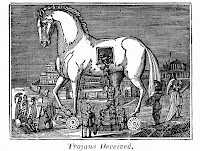
Talk about Trojan horses.

Big corporations cannot be analyzed separately from government.

When the state outsources its spying to corporations, for someone to argue that the state should not limit corporate surveillance because it’s engaged in surveillance itself is confused, at best, and downright misleading, at worst.

Especially when it comes from seasoned politicians like the Pauls.

Parts of the government are scrutinizing the private sector. Often they’re right to.

Other parts of government are much worse than the private sector when it comes to privacy violation.

Those parts of the government are often most incestuously allied with corporations. This is the corporate-state or intel-industrial complex that produces programs like Echelon.

So it’s quite bizarre for the Pauls to claim that Microsoft (or Google or Apple) are pure private-sector entities, when they gain market share directly because of concrete government actions on their behalf and because of endemic and pervasive state-created judicial/legal/financial corruption.

One more thing.  Microsoft wasn’t prescient at all about the net, as the Pauls claim in their new manifesto.

It was way behind. Gates himself admitted it.

There is, finally, another reason why the Pauls may have turned their attention to protecting Big Data,

It looks like Big Data is bankrolling him.

Here’s Reason’s Brian Doherty, making the point:

“With Peter Thiel, founder of the controversial “big data” company Panantir, having made a $2.6 million investment in the (somewhat feckless in the end) superPAC “Endorse Liberty” during campaign season, perhaps the Paul machine sees this as a cause that can energize both grassroots and big money.”

And that’s all  I want to say now about this turn of events until I learn a bit more what is really going on.

But, if you were waiting to see Ron Paul libertarianism implode, it happened this week.

A Tribute To Ayn Rand And The Spirit Of America

A Tribute to Ayn Rand

I posted this in 2008 and I’m reposting it from PopModal today because it seems to be corrupted on my blog and the youtube version has vanished

Projwal Shreshta  compiled the quotations from “Atlas Shrugged” and the music, which is Divano, by Era.

From “Atlas Shrugged”:

“I started my life with a single absolute: that the world was mine to shape in the image of my highest values and never to be given up to a lesser standard, no matter how long or hard the struggle.”

“What is morality, she asked.
Judgment to distinguish right and wrong, vision to see the truth, and courage to act upon it, dedication to that which is good, integrity to stand by the good at any price. ”

“The view that man was ever to be drawn by some vision of the unattainable shining ahead, doomed ever to aspire, but not to achieve, my life and my values could not bring me to that.”

“I never found beauty in longing for the impossible and never found the possible to be beyond my reach.”

“I take no pride in hopeless longing; I wouldn’t hold a stillborn aspiration. I’d want to have it, to make it, to live it.”

“I do not think that tragedy is our natural fate and I do not live in chronic dread of disaster. It is no happiness, but suffering that I consider unnatural. It is not success, but calamity that I regard as the abnormal exception in Human Life.”

“Every form of happiness is one, every desire is driven by the same motor.- by our love for a single value, for the highest potentiality of  our own existence — and every achievement is an expression of it.

“Every man builds his world in his own image; he has the power to choose, but no power to escape the necessity of choice. If he abdicates his power, he abdicates the status of man, and the grinding chaos of the irrational is what he achieves as his sphere of existence—by his own choice.”

“Morality is judgment to distinguish right and wrong, vision to see the truth, courage to act upon it, dedication to that which is good, and integrity to stand by it at any price.”

“Joy is the goal of existence, and joy is not to be stumbled upon, but to be achieved, and the act of treason is to let its vision drown in the swamp of the moment’s torture.”

“Devotion to the truth is the hallmark of morality; there is no greater, nobler, more heroic form of devotion than the act of a man who assumes the responsibility of thinking.”

“I am. Therefore I’ll think.”

“The choice–the dedication to one’s highest potential–is made by accepting the fact that the noblest act you have ever performed is the act of your mind in the process of grasping that two and two make four.”

“There was no meaning in motors or factories; that their only meaning is in man’s enjoyment of his life, which they served – and that my swelling admiration at the sight of achievement was for the man from which it came.”

“For the power and the radiant vision within him which had seen the earth as a place of enjoyment and had known that the work of achieving one’s happiness was the purpose the sanction and the meaning of life.”

More quotations listed conveniently here:
http://en.wikiquote.org/wiki/Ayn_Rand

Yeats: The Rag And Bone Shop Of The Heart

Image by K.R. Hamm via So Fake It’s Real

The Circus Animals’ Desertion

I sought a theme and sought for it in vain,
I sought it daily for six weeks or so.
Maybe at last, being but a broken man,
I must be satisfied with my heart, although
Winter and summer till old age began
My circus animals were all on show,
Those stilted boys, that burnished chariot,
Lion and woman and the Lord knows what.

What can I but enumerate old themes,
First that sea-rider Oisin led by the nose
Through three enchanted islands, allegorical dreams,
Vain gaiety, vain battle, vain repose,
Themes of the embittered heart, or so it seems,
That might adorn old songs or courtly shows;
But what cared I that set him on to ride,
I, starved for the bosom of his faery bride.

And then a counter-truth filled out its play,
‘The Countess Cathleen’ was the name I gave it;
She, pity-crazed, had given her soul away,
But masterful Heaven had intervened to save it.

I thought my dear must her own soul destroy
So did fanaticism and hate enslave it,
And this brought forth a dream and soon enough
This dream itself had all my thought and love.

And when the Fool and Blind Man stole the bread
Cuchulain fought the ungovernable sea;
Heart-mysteries there, and yet when all is said
It was the dream itself enchanted me:
Character isolated by a deed
To engross the present and dominate memory.
Players and painted stage took all my love,
And not
those things that they were emblems of.

Those masterful images because complete
Grew in pure mind, but out of what began?
A mound of refuse or the sweepings of a street,
Old kettles, old bottles, and a broken can,
Old iron, old bones, old rags, that raving slut
Who keeps the till. Now that my ladder’s gone,
I must lie down where all the ladders start
In the foul rag and bone shop of the heart.

Comment

William Butler Yeats wrote “The Circus Animals’ Desertion” toward the end of his life, in a moment of insight into the limits of aesthetic pursuits. The poem speaks equally to the limits of ideology.

The Mind-Body Politic: The Technique Of Inner Listening

The fifth chakra = Vishuddha

Wikipedia

“The throat wheel is an important centre in the Highest Yoga traditions of Vajrayana. It is circular, red, with 16 upward pointing petals or channels. It is of particular importance for the practice of Dream Yoga. Correctly meditating upon it before going to sleep should produce lucid dreams, within which one can continue to practice yoga.[1]

“Western occultists make various differing kabbalistic associations with Vishuddha. Some associate it with the hidden sephirah Da’at, where ‘wisdom’ and ‘understanding’ are balanced in the supernal realm by the aspect of ‘knowledge’, a tangible idea, which is then expressed, leading to the act of the creation, others associate it with the sephirah Chesed and Geburah, mercy and strength, which are sephirah intimately associated with morality, and the concept that both expansion, as expressed by Chesed, and limitation, as expressed by Geburah, are necessary for the creation of individual beings. In terms of ethics, this is expressed by the yamas and niyamas ( do’s and do nots ) of yoga.”

Yoga Sutras of Patanjali 3.39-3.49

“By samyama over the relation between space and the power of hearing, the higher, divine power of hearing comes.


(shrotra akashayoh sambandha samyamat divyam shrotram)
[Note: In some renditions this is sutra 3.40 or 3.41]

  • shrotra = ear, the power of hearing
  • akasha = space, ether
  • sambandha = over the relation
  • samyama = dharana (concentration), dhyana (meditation), and samadhi taken together (3.4)
  • divyam = higher, divine
  • shrotram = ear

Divine or psychic hearing: By samyama over the relation between space (one of the five elements) and the power of hearing, the higher, divine power of hearing comes.

Space, hearing, and the chakras: Space is one of the five elements (earth, water, fire, air, space) and hearing is one of the five karmendriyas. Both of these operate from the fifth chakra, which is at the throat. It is through samyama of one that mastery over the other is attained. The same principle applies to the other elements, karmendriyas, and jnanendriyas. (See the Chakras section of Kundalini Awakening).”

Edward Feser On The Weakness of Rothbard’s Philosophy

[Added, July 4:  In response to a video of Rand on the Middle East, posted at Lew Rockwell.

Yes, Rand was wrong about that.

But that does not diminish the validity of her thinking in other areas, any more than Rothbard’s rightness on foreign policy validates everything else he wrote. Nor is the Middle East the reason the left hates Rand.  It detests her because her appeal to individualism and achievement is perennially powerful and popular.

And it also detests her because she dissected at least a part of the motivation behind much charity/altruism, to which the left insistently appeals.

Now, Rand owes her thought on that subject and other things  to Nietzsche, whom she adapted very originally and powerfully. In turn, Nietzsche, also an original and creative mind, owed his thinking to his studies of Eastern religion, especially Buddhism and Hinduism.

As is the case with Heidegger, Nietzsche, as far as I know, did not properly credit that influence.

(On the other hand, Yeats, also massively influenced by Nietzsche, did….]

In this way, intellectual chicanery/cultural fraud is at the heart of the modernist project.

Imagine if I were to study Christianity surreptitiously, and then go to some state in India where the villagers knew nothing about it and preach about such things as the resurrection of the body, judgement day, the fall, and original sin, passing off these notions as my own original thought, while denigrating the culture from which I took those ideas?

What kind of a fraud would that be?

What kind of damage would that do to the villagers’ understanding of the world at large, and to my own ability to reach valid conclusions about that world?]

Edward Feser on Murray Rothbard as a philosopher:

“I should also make it clear that my low opinion of Rothbard’s philosophical abilities has nothing to do with the particular conclusions he wants to defend. I certainly share his hostility to slavery, socialism, communism, and egalitarian liberalism. I also agree that much of what modern governments do is morally indefensible and that many of the taxes levied by modern governments (maybe even most of them) are unjust. And while I strongly disagree with his claims that government per se is evil and that all taxation is unjust, these are at least philosophically interesting claims. The problem is just that Rothbard seems incapable of giving a philosophically interesting argument for his claims. (Moreover, the claims in question were borrowed by Rothbard from 19th century anarchists like Lysander Spooner, so even where Rothbard is philosophically interesting he isn’t original.)”

Lila: He also borrowed from Rand, indeed, plagiarized her theory of volition, it is said, as well as a dissertation by a student, Barbara Branden. Which might explain why some Rothbardians feel the need to attack Ayn Rand all the time, usually without seeming to have read her very well. It is another way the modern libertarian movement panders to the left – by adopting its superficial reading of Rand, who, while flawed, is a giant next to most of her critics.

Feser goes on to deconstruct Rothbard’s arguments about self-ownership:
“Here, then, is the example. It is Rothbard’s main argument for the thesis of self-ownership, which is, as I have indicated, the very foundation of his moral and political philosophy, without which his moral case against taxation and government totally collapses.
I know of at least three places where he presents it (there may be others): in his book For a New Liberty (first published 1973, revised 1978); in his essay “Justice and Property Rights” (first published 1974, reprinted in his anthology Egalitarianism as a Revolt Against Nature and Other Essays, 2nd edition); and in his main work on moral and political philosophy, The Ethics of Liberty (1982, revised edition published in 1998). In the revised edition of For a New Liberty, the argument begins as follows:
Since each individual must think, learn, value, and choose his or her ends and means in order to survive and flourish, the right to self-ownership gives man the right to perform these vital activities without being hampered and restricted by coercive molestation. Consider, too, the consequences of denying each man the right to own his own person. There are then only two alternatives: either (1) a certain class of people, A, have the right to own another class, B; or (2) everyone has the right to own his own equal quotal share of everyone else. The first alternative implies that while Class A deserves the rights of being human, Class B is in reality subhuman and therefore deserves no such rights. But since they are indeed human beings, the first alternative contradicts itself in denying natural human rights to one set of humans. Moreover, as we shall see, allowing Class A to own Class B means that the former is allowed to exploit, and therefore to live parasitically, at the expense of the latter. But this parasitism itself violates the basic economic requirement for life: production and exchange.” (pp. 28-29)
The rest of the argument attempts to rule out alternative (2) and has its own problems, but I won’t bother with it because the passage quoted is enough for my purposes.
I think this argument is a very bad one; indeed, I think that to anyone with any philosophical training it will be quite obvious that it is bad. And not only is it bad, but given that Rothbard says nothing more in defense of the claims made in this passage (apart from trying to rule out alternative (2)), I think it is clear that the argument fails to be even minimally respectable in the sense described above. I suspect that most readers can immediately see at least some of the problems with it. Here are the ones that occur to me:
1. Even if it were true that “each individual must think, learn, value, and choose his or her ends and means in order to survive and flourish” and that “the right to self-ownership gives man the right to perform these vital activities without being hampered and restricted by coercive molestation,” it just doesn’t follow that anyone has a right to self-ownership. For all Rothbard has shown, we might also be able to think, learn, value, etc. even if we didn’t have any rights at all. (That X could get us Z doesn’t show that Y wouldn’t get it for us too.) Or we might need some rights in order to do these things, but not all the rights entailed by the principle of self-ownership. Or we might really need all the rights entailed by self-ownership, but nevertheless just not have them. After all, the fact that you need something doesn’t entail that you have it, and (as libertarians themselves never tire of pointing out), it certainly doesn’t entail that you have a right to it. For example, wild animals need food to survive, but it doesn’t follow that they have a right to it (indeed, Rothbard himself explicitly denies that animals can have any rights).
Furthermore, why should we grant in the first place that “each individual must think, learn, value, and choose his or her ends and means in order to survive and flourish”? Children survive and flourish very well without choosing most of their means and ends. Some adults are quite happy to let others (parents, a spouse, government officials) choose at least some of their means and ends for them. Many physically or mentally ill people couldn’t possibly survive or flourish unless others chose their means and ends for them. Even a slave or serf could obviously survive and even flourish if his master or lord was of the less brutal sort. And so forth. And if surviving and flourishing are what ground our rights, how could we have a right to suicide or to do anything contrary to our flourishing, as libertarian defenders of the thesis of self-ownership say we do?
Also, why should we grant that respect for each individual’s self-ownership really would ensure every individual’s ability to choose his means and ends, etc.? A leftist might argue that respect for self-ownership would benefit some but leave a great many others destitute and bereft of any interesting range of means or ends to choose from.
Of course, there might be some way a Rothbardian could reply to these objections; I certainly don’t find all of them compelling. But the point is that they are obvious objections to make, and yet Rothbard doesn’t even consider them, much less answer them. Even a brief acknowledgement of some of these objections and a gesture in the direction of a possible reply might have been enough to make the argument minimally respectable, but Rothbard fails to provide even this.
2. The claim that there are “only two alternatives” to denying the thesis of self-ownership is just obviously false. Here are some further alternatives that Rothbard fails to consider:
(a) no one owns anyone, including himself
(b) God owns all of us
(c) one class of people has a right to only partial ownership of another class (e.g. the former class has a right to the labor of the latter class, but may not kill members of the latter class, or refuse to provide for their sustenance, or forbid them from marrying, etc.)
(d) everyone has partial and/or unequal ownership of everyone else (e.g. everyone has an absolute right to bodily integrity, but not to the fruits of his labor, which are commonly owned; or everyone has an absolute right to bodily integrity, and an absolute right only to some percentage of the fruits of his labor, with the rest being commonly owned; or everyone has a presumptive right to bodily integrity, which might be overridden in extreme cases, with a right to a percentage of the fruits of his labor; or the weak and untalented have an absolute right to bodily integrity and to a large percentage of, though not all of, the fruits of their labor while the strong and talented have an absolute right to bodily integrity and to a much smaller percentage of the fruits of their labor; or the strong and talented, unlike the weak and untalented, have only a presumptive right to bodily integrity, which might be overridden if someone desperately needs an organ transplant; and so on and so forth).
Alternative (b) was defended by Locke (for whom talk of self-ownership was really just a kind of shorthand for our stewardship of ourselves before God) and it would also have been endorsed by natural law theorists in the Thomistic tradition. Rothbard explicitly cites both Locke on self-ownership and the Thomistic natural law tradition, so this alternative should have been obvious to him, and yet he fails even to consider it.
Lila: Chesterton has an excellent essay about the uses of the word “own,” but I think anyone with common sense can understand that the meaning of ownership itself varies with the context.
That Rothbard is not reflective about language – a lack of reflection pervasive among certain kinds of libertarians –  is immediately apparent to any reader with the slightest acquaintance with modern literature, let alone semiotics or philosophy.
“Alternative (c) was the standard view taken by defenders of slavery, most of whom would not have endorsed the unqualified ownership of other people implied by Rothbard’s alternative (1). One would think that Rothbard, who fancied himself a historian of ideas, would be aware of this, and yet here again he simply ignores what should have been another obvious possible alternative.
Some version or other of alternative (d) is arguably implicit in the views of many leftists, very few of whom (if any) would really claim that all of us have equal quotal ownership of each other. At the very least, a minimally charitable reading of left-wing arguments about taxation and redistribution would acknowledge that this, rather than Rothbard’s alternative (2), might be what egalitarian leftists are committed to. But Rothbard fails even to consider the possibility. He suggests (later on in the argument, after the passage quoted above) that “communist” ownership by everyone of everyone would entail that no one could take any action whatsoever without the permission of everyone else, but while this might be true under option (2), it would not be true under the less extreme egalitarian possibilities enshrined in (d).
Alternative (a) is one that Rothbard finally did consider – almost a decade after first giving the argument and after once again ignoring this alternative when repeating the argument in “Justice and Property Rights” – in a brief footnote in The Ethics of Liberty. (He attributes it to George Mavrodes, apart from whom, apparently, Rothbard might never have seen the obvious.) Rothbard’s reply to it is to say that “since ownership signifies range of control, this [i.e. no one’s owning anyone, including himself] would mean that no one would be able to do anything, and the human race would quickly vanish.”
But the badness of this argument should also be obvious. While having ownership of something does imply having a range of control over it, having a range of control over it doesn’t imply ownership. I have a certain “range of control” over my neighbor’s flower bed – he couldn’t stop me if I walked over right now and pulled some flowers out of it – but it doesn’t follow that I own it. Animals have a range of control over their environment, but since ownership is a moral category implying the having of certain rights, and animals (by Rothbard’s own admission) have no rights, it follows that they have no ownership of anything. And of course, their lack of ownership of anything hasn’t caused animals as a whole to “vanish,” “quickly” or otherwise, which makes evident the absurdity of Rothbard’s claim that alternative (a) would entail the extinction of the human race.
3. Alternative (1) just obviously doesn’t imply that the members of class B are “subhuman.” Not all defenders of slavery have denied that slaves are fully human; their view is just that some human beings can justly be owned by other ones. Rothbard’s assertion that this “contradicts itself in denying natural human rights to one set of humans” is just blatantly question-begging, since what is at issue is precisely whether there are any natural human rights that might rule out slavery.
4. Rothbard’s claim that the “parasitism” entailed by alternative (1) “violates the basic economic requirement for life: production and exchange” is also just obviously false. Animals do not engage in “production and exchange,” certainly not in the laissez-faire economics sense intended by Rothbard, but they are obviously alive.

In this one brief passage, then, Rothbard commits a host of fallacies and fails even to acknowledge, much less answer, a number of obvious objections that might be raised against his argument. Nor is this some peripheral argument, which might be written off as an uncharacteristic lapse. It served as the foundation of his entire moral and political theory, and was repeated several ti”mes over the course of a decade virtually unaltered. And if things are this bad in the very foundations of his moral and political theory, you can imagine how bad the rest of his philosophical arguments are.”

Comment:

I would also add that  Rothbard’s weaknesses as a thinker are replicated in some of his most fervent acolytes, who substitute sound and fury for depth of reasoning and seem to think incorrect thinking becomes better the more violently it is articulated.

This is not a criticism of  libertarianism as such. A term broad enough to embrace everyone from Tolstoy to Milton Friedman can hardly be criticized as one.  “Libertarianism” cannot be considered a singular movement, however much, for political or marketing reasons, some anarcho-capitalists might try to drag someone like Tolstoy into their fold.

Tolstoy was a libertarian in the way Gandhi was. Profoundly anti-capitalistic. They both believed in voluntary poverty and simplicity and abhorred the complexity of modern life. I doubt either would relish becoming the mascot of the Mises or Bastiat Institutes. To try to ride their reputations for the sake of broadening one’s appeal is intellectually disingenuous.

So I have profound differences with  American-style libertarianism (of the LRC type or of the Reason Magazine type), while supporting LRC’s antiwar and anti-police state positions.

Another point. In things of which  I know something, I can clearly spot the flaws and limitations of Rothbard’s arguments, which makes me think that in areas in which I am uncertain, he must be flawed too.

Anyway, Feser’s points don’t need any great acquaintance with Rothbard’s economic reasoning to follow. They are points that have occurred to me on and off, as I’ve read the great (?) man.

But frankly, my increasing disinterest in Rothbard has grown from more intuitive roots.

First, there is something cocky, smug, and shallow in the writing itself….despite its superficial good humor and sense.

Then, there are the stories of plagiarism – something which intensely prejudices me against a writer. And there are his attacks on writers many would consider his superior, like Ayn Rand and Adam Smith.  I wonder how much of envy lay behind all that.

On the many people whom he knew and taught, he seems to have had a profound influence, which speaks well of him. But I haven’t had the pleasure of knowing him personally, so my judgement must be from what I read of him.

And from reading him, and reading of him,  I get the picture of a shallow, bright, abrasive man, who thought very highly of himself, yet plagiarized often, and covered up the lack of originality by attacking others, attacks that his followers continue, see here,

as well as here.

[Rand was the most famous instance of Rothbard’s plagiarism. But he also borrowed from Spooner, as Feser points out. And a commenter at this blog adds this:

“The first part of his book on the history of American banking drew on a report about the “Suffolk System” published by that bank, but since buried in the archives. After finding a bad microfilm copy at my university library, I paid the Adam Smith Institute to send me a good one. (I also bought one of their neckties.) Rothbard plagiarized heavily from the original Suffolk Banking System and, worse, projected his own anarchist opinions on the facts of history. As a criminologist, I am fully sympathetic to a free market in protection and adjudication, but the fact is that the Suffolk System was not destroyed by the evil machinations of Salmon P. Chase’s Treasury Department.”

So, if Rand has her flaws (and she does), Rothbard has his, analyzed at length in this piece by G. Stolyarov.

Meanwhile, in general power of reasoning, insight into the psychology of the modern mind, and overall influence, frankly, Rothbard cannot hold a candle to Rand, whatever powers he might have as a historian or economist.

There is a reason that the left attacks her, not him.

Yes, We Have A Banana Republic…

Linh Dinh at Counterpunch describes the good part of the US descent into a banana-republic:

“It’s all going according to plan, this transformation of the US into a police state and Third-World nation, but what’s meant by “Third World,” exactly? A Third World country is one that is poor, with inadequate infrastructure, an obscene wealth gap and a corrupt government. America is by far the most-indebted nation on earth, with a record-setting trade deficit, so we are, in effect, much poorer than Greece, Zimbabwe, Somalia or any other basket case, but it hasn’t become manifest because we have guns, missiles and drones pointing in all directions. Using our gargantuan military to hold the world hostage, we receive more foreign aids, in the form of debts, than all the other nations combined. Riding a nuclear-armed mobility scooter, America is a gross welfare queen barging down the world’s sidewalk, but this is how an empire is supposed to work, many will smirk, and they are right, of course, until this extortion racket falls apart, and soon enough. Preparing for the inevitable, our ruling class is becoming more belligerent abroad, in a last ditch effort to prolong its advantages, and nastier at home, to slap down domestic rage at a sinking standard of living. Splurging beyond our means for decades, we will revert to the universal means, and not because we care about justice or equality, but because we don’t have a choice.

Just as there are pockets of First World opulence and luxury in even the most dismal Third World countries, rich nations also have stretches of Third World squalidness and destitution, but Third World isn’t all bad. Not by far. To survive on little requires enterprise, resourcefulness and cooperation, virtues that will emerge and even blossom as we slide downward. Ubiquitous in most Third World countries, peddlers will make a comeback here, and the black market will thrive. As globalism recedes, the local will rise. Instead of being slaves to huge corporations, we will become tiny businessmen, as long as we’re not hunted down, then fined or locked up…..

Back to the positive aspect. Each home can become a store or a restaurant. Each car is a gypsy cab. In totalitarian Vietnam, the government actually gives its people much more leeway to conduct petty business than is allowed in America. A private home can display a table with, say, five cans of soda, two brands of cigarettes and some candies, and that’s a store, though nobody is manning it most of the time. To get service, you might have to shout. It’s not their only source of income, but this pee wee initiative does bring in a buck or two a day, so it’s better than nothing. ….. There is no welfare, food stamps or Social Security in a Third World country, no safety net outside of your extended family……

One can say that the United States is becoming a police state because it is turning into a Third World country. Already, choppers snake through skyscraper canyons and tanks roll down main streets. The police state protects and advances the interests of the ruling class, which in our case is the military banking complex, and since an informal market nibbles at the profits of banks and corporations, you can expect their henchmen, cops and regulators, to stomp hard on us smallest fries. (Underpaid in a collapsed economy, cops will also use these opportunities to shake us down, so that’s a kind of tax we’ll have to pay.) In any case, it appears that as we become poorer and thinner, not to mention more enterprising or devious, and more colorful too, since everyday will be casual Friday, we will have to fend off our bullying state, if not the gangs that rise up in its place.”